



Google’s new camera app brings Photo Sphere and Lens Blur to Android devices

While Google has continued to toss new features into the camera app shipped on its Nexus devices, many Android phones replace it something else. But just as we revealed a few weeks ago, now it’s available in the Play Store, ready to run on any phone or tablet using Android 4.4 KitKat. Beyond bits like Photo Sphere that we’ve seen before, Google is filling in the blanks on its new “Lens Blur” option. Meant to emphasize the subject while blurring the background for an impressive depth of field effect, it uses algorithms to simulate the large camera lens and aperture your phone / tablet doesn’t actually have. Google’s Research Blog has details on how its done, including a Lytro-like ability to change which object is in focus after you take the shot.

Tired of tilt-shift effects after years of Instagramming, no matter how much math is at work? There’s more to the new camera app than that, it has all the other features we’d heard about too, like a “100% viewfinder” that makes sure you can see everything that will be in the picture on your screen before the shot is taken with no “dropped pixels” and a larger capture button. Panorama shots are better now too, with higher resolution, and Google’s 360-degree Photo Spheres can be captured at up to 50 megapixels.
Filed under: Cellphones, Tablets, Software, Mobile, Google
Source: Android (G+), Google Research Blog, Google Play

HTC allows devs to tap into the power of the One’s Duo Camera

The HTC One (M8) brought with it a load of new camera features, including its unique Duo Camera setup on its back side. Now, the handset maker is opening up the code that powers the pair in a SDK preview for third-party devs. This means that apps can be designed specifically for the M8′s cameras with DualLens and DimensionPlus APIs baked right in. In other words, developers will get their hands on that bokeh-style refocusing and multi-angled shot selection in addition to depth maps from the pair of cameras. Of course, only time will tell how eager app makers are to latch on to HTC’s smartphone snapshooting tricks, but at least now they’ll have the necessary tools to do so.
Filed under: Cellphones, Software, Mobile
Source: HTC
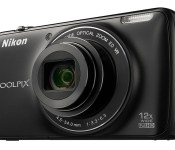
Nikon returns to Android game with the Coolpix S810c

Nikon have today announced the Coolpix S810c which brings the popular technology Nikon build into their cameras with the Android Operating System.
With a 16-Megapixel camera, the Nikon Coolpix S810c combines the flexibility of Android and its variety of Apps with a 12x optical zoom NIKKOR lens and an ISO range of up to 3200, all underpinned by Lens-Shift Vibration Reduction (VR) technology.
The Nikon Coolpix S810c runs Android 4.2.2 and can run apps including Facebook, Twitter, and Instagram, allowing your pictures to be uploaded directly to your favourite photo sharing site instantly.
The Nikon COOLPIX S810c will be available in early May 2014 in Black or White for around $349.95.
[Nikon]
The post Nikon returns to Android game with the Coolpix S810c appeared first on AndroidGuys.
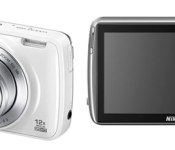
Nikon’s Coolpix S810c is a second attempt at an Android compact camera

Liked the idea of Android apps with a proper camera attached? Still itching for a Nikon camera over a Samsung one? Then perhaps the new S810c will win you over where its predecessor didn’t. To start, the rear touchscreen is bigger (3.7 inches this time) while the body of the camera is thinner than the S800c that came before it. There’s also a longer 12X zoom with a 16-megapixel sensor, while on the non-imaging side, it gets GPS and a headphone jack if you’re looking to check audio quality on video or simply play things back and use the point-and-shoot more like a media player than a camera. Compared to the model that appeared two years ago, this one’s running Android 4.2.2. Not the latest, sure, but way beyond the Android Gingerbread OS we wrestled with on the older camera. Nikon has also tacked on its own commenting system to, meaning you can type your thoughts and attach ‘em as soon as the photo’s taken. If your missives simply can’t wait for uploading to Facebook and Twitter, you’ll have to wait until early May, when the camera arrives for $350.
Source: Nikon

Ultra HD’s the word at NAB 2014

Whether you call it 4K or Ultra HD, next-gen television sets are on their way to your living room. Some experts expect sales in the US alone to approach one million this year, with early adopters opening their wallets at an even greater rate overseas. But while many of us still get by with 1080p, content producers are adopting Ultra HD as the norm on set, with manufacturers focusing almost exclusively on next-gen hardware here at the National Association of Broadcasters’ annual trade show in Las Vegas.
Ultra HD cameras take every shape and size, from Sony’s just-announced Alpha A7s mirrorless camera to Blackmagic’s giant URSA, with its fold-out 10-inch screen. Even drones are snapping 4K footage, including JVC’s new gimbal-mounted Super 35mm cam. Some models, such as Red’s $14,500 Dragon cam, can capture even higher-res video — in this case, that means 6K footage from a camera you can hold in your hand.
Tools for shooting video from above were another focus here in Vegas. One of our favorite drones of the show, DJI’s Phantom 2 Vision+, only captures at 1080p, but it does so with such grace (thanks to its integrated three-axis gimbal) that the $1,300 copter should not be overlooked. NAB’s not just about cameras, though. Thunderbolt 2 made its debut here in 2013, and this year, Intel returned to demo Thunderbolt Networking, enabling 10 Gbps connections (and super-fast 4K video transfers) between Macs and PCs.

Microsoft even made an appearance to show off Skype TX, the company’s hardware/software solution for seamlessly linking up remote television guests with hosts in the studio, while HP dropped by with its DreamColor displays, capable of showing a billion colors. Finally, FCC Chairman Tom Wheeler rounded out the week with an address to broadcasters, a good part of which was spent motivating attendees to maintain their competitive edge when it comes to internet distributors, such as Netflix.
Ultimately, there was plenty to take away from these few days in the desert — filmmakers and distributors have more options at their disposal than ever before, and while Ultra HD may have yet to take off in the American living room, producers are well on their way to creating future-proofed content, guaranteeing that when you opt to update your own hardware, there will be plenty of movies, TV shows, ads and live broadcasts to enjoy at four times the resolution of 1080p.

Filed under: Cameras, Displays, Home Entertainment, HD

DxO Labs crowns the Sony Xperia Z2 the best in mobile photography, for Now
 DxO Mark, created by DxO Labs, is a favourite among photography enthusiasts for seeing which mobile devices have the best camera performance on the market. According the latest findings, DxO Mark crowns the Sony Xperia Z2 the best in mobile photography, even beating out Nokia’s latest effort, the PureView-toting Nokia 808. The tests take into account all facets of the camera’s properties including aperture, exposure time, lenses and even focal length; a comprehensive test indeed.
The Xperia Z2, announced at MWC 2014 earlier this year, is Sony‘s answer to the Samsung Galaxy S5 and HTC One M8 (which are disappointingly missing from the DxO Mark results) and improves on its stalwart predecessor, the Xperia Z1, with a Qualcomm Snapdragon 801 processor, 3GB RAM and a up-sized 5.2-inch Triluminos display. The Xperia Z2 will be the third device (after the Xperia Z1 and Xperia Z1 Compact) to boast Sony’s 20.7MP camera, but also adds the ability to take 4K resolution videos.
What do you think of the Sony Xperia Z2′s abilities as a mobile camera device? Have these results swayed your decision-making? Let us know what you think.
//<![CDATA[
ord = window.ord || Math.floor(Math.random()*1E16);
document.write('’);
//]]>
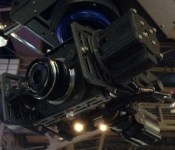
JVC’s first 4K movie cameras include one for flying drones

[Image credit: DV Info]
Filed under: Cameras
Via: No Film School, DV Info
Source: JVC

Flying high above Vegas with the DJI Phantom 2 Vision+ drone
There’s been a lot of killer gear here at NAB, from Sony’s Alpha A7s to the Blackmagic URSA. But of all the gadgets that debuted in Vegas this week, I’m most obsessed with DJI’s Phantom 2 Vision+ drone. This year’s version represents a significant boost over 2013′s model, due to one brilliant feature: a three-axis gimbal. The flying craft sports an integrated 1080p camera that can shoot solid stills and video alike, but the gimbal adds serious stabilization, keeping footage impossibly still, whether you’re flying at 30MPH, caught in a gust of wind or simply hovering above the ground. The built-in GPS and compass keep the device on track at all times, letting you focus not on staying aloft, but on getting the shot.
Camera-equipped drones are a dime a dozen these days, but assuming you have the $1,300 to burn, DJI’s Vision+ is the one you want. The autonomous features at play here enable very stable footage, while the intuitive control and Android and iOS apps make it easy to fly and get the shot, without any experience at all. The drone can shoot and fly for 25 minutes on a single charge, and while climbing can use a bit more power, you can move left and right all you want without accelerating drain. The camera, designed in-house by DJI, captures to a microSD card. You get a live preview from the app, though, making framing a shot, changing modes and snapping still photos a breeze. Take the Vision+ for a spin in our video below, complete with some fantastic aerial footage of the Vegas skyline.
Filed under: Cameras

Red’s 6K-capable Scarlet Dragon camera goes on sale for a mere $14,500

Don’t despair that you’ll have to buy both Red’s Scarlet camera and its Dragon upgrade just to get 6K video capture at a semi-reasonable price. The company has announced that the ready-made Scarlet Dragon body will go on sale tomorrow for a relatively affordable $14,500. It should ship once Red catches up on Dragon upgrade orders, or around June. You may not be recording many projects at full resolution, however. Red did squeeze in 6K (after concerns that it wouldn’t make the cut), but you’ll only get it at 12FPS when shooting full frame — you’ll have to drop to ‘just’ 5K to get speed worthy of movies and TV. Company chief Jarred Land hints that the Scarlet Dragon should be faster in widescreen mode, though, so you might not have to shell out for the higher-end Epic Dragon to produce a sharp-looking masterpiece.
Filed under: Cameras
Source: Red
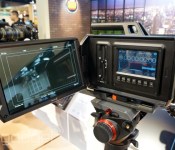
Blackmagic’s 4K URSA camera features massive 10-inch 1080p display, ships in June for $6,000

Consumers may not be familiar with Blackmagic Design, but the firm’s cameras are all the rage with filmmakers at NAB, drawing enormous crowds within seconds of the show floor opening up to attendees. This year’s flagship is the URSA, a relatively massive 4K camera with an enormous 10-inch 1080p flip-out display. There are also two five-inch monitors on each side, displaying everything from camera settings to a duplicate preview. Another highlight is the Super 35 image sensor (the same used in Blackmagic’s existing 4K cam), which is upgradeable should you wish to swap in a refreshed version down the line. You also get plenty of SDI inputs and outputs, XLR mic jacks and either a Canon EF or PL lens mount.
We spent a few minutes shooting with the EF version with a Canon 85mm f/1.2 lens. The preview looked fantastic — with such a large, high-res display, it’s easy to confirm focus without enlarging, though you’ll want to take extra care when capturing in 4K. There’s definitely no shortage of readouts, with the secondary LCDs providing all the necessary info. The EF version will retail for $6,000, while the PL flavor is set to ship for $6,500 (though you can swap lens mounts later on if you upgrade the sensor module). Both models are expected in stores this June or July. Check ‘em out in our hands-on video.
Sarah Silbert contributed to this report.
Filed under: Cameras
 AIVAnet