


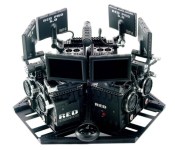
‘Virtual Reality Camera System’ uses 6 Red Dragons to make 360-degree video magic

Oculus/Facebook, Samsung, Sony, Google. We’re about to be flooded with virtual reality hardware, but what about content? While John Carmack works on the gaming side, the folks at NextVR (formerly Next3D) have been developing camera rigs to record live video in full surround that will let VR units put you anywhere in the world you want to go, and here’s the latest one. Red Camera’s Jarred Land spilled the beans, posting pics of this “Virtual Reality Camera System” which links six of his company’s 6K Dragon cameras together in a rather monstrous-looking array. There should be demo footage on display at the IBC conference, but based on what we’ve seen from NextVR already, the potential is high. There aren’t any cameras pointing up (or down) but previous systems from NextVR have used fisheye lenses to expand their range, and we expect something similar would be in store for this. NextVR is providing video to go along with Samsung’s Gear VR headset when it launches and it’s working with Oculus too. Judging by this setup more video experiences — whether live streamed or recorded — will be coming to the VR space soon.
Filed under: Cameras, Home Entertainment, HD
Source: Reduser.net, NextVR
.CPlase_panel display:none;
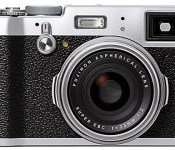
Fujifilm’s new retro cameras pack smarter viewfinders and more controls

Those hints of significant upgrades to Fujifilm’s retro-styled X100 and X-T1 cameras? Yeah, they’re real. The company has just unveiled the X100T and X-T1 Graphite Silver Edition, both refinements of familiar formulas. The X100T gets the biggest update of the bunch. It still has a 16.3-megapixel X-Trans II CMOS sensor and that signature, super-bright 23mm f/2 lens, but should give you much more control over your output. The centerpiece is an improved hybrid viewfinder that lets you focus as if you’re using an old-school rangefinder, hopefully giving you a well-composed photo on the first try. New focus peaking, split-image and filter simulation modes should also give you a better sense of how a shot will turn out before you press the shutter.
And don’t worry if you’re still fond of tactile controls — Fujifilm has given those an upgrade, too. Both the exposure compensation dial and lens aperture ring offer finer-grained control with a firmer grip, and you’ll find both a new command dial (in place of the lever) and a four-way controller. Seven programmable function buttons should fill in any gaps if there’s a toggle you absolutely need on a moment’s notice. Even the body itself has received a subtle refresh with magnesium on both the top and bottom. If all these nip-and-tuck refreshes are what you’re looking for, you can pick up the X100T for $1,300 when it ships in mid-November.
The X-T1 Graphite Silver Edition won’t be quite as dramatic a revamp when it arrives in late November, but it may be worth checking out if you’ve been holding off on the existing model. While its namesake color scheme is the most obvious change, the new camera also has a more natural-looking electronic viewfinder that lets you disable preview effects. It has a faster electronic shutter (1/32,000th of a second), too, and will avoid invoking the noisier mechanical shutter if you’re trying to stay quiet. The X-T1 GSE will cost $1,500 if you’re looking for the body alone, while a kit with a multi-purpose 18-135mm f/3.5-5.6 lens will set you back $1,900.

Filed under: Cameras
Source: Fujifilm (1), (2)
.CPlase_panel display:none;
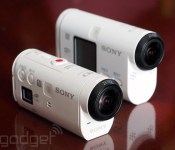
Sony’s Action Cam Mini packs just as much power in two-thirds the size

While some users might not love everything about Sony’s current adventure camera lineup, you can hardly fault the Action Cams for being too large. Still, when size and weight really matter, such as when you’re mounting a camera on a helmet or a drone, it certainly wouldn’t hurt to shave off an inch or two. That’s exactly what Sony’s done with its Action Cam Mini, which replaces the AS100V we first met at CES with a camera that’s two-thirds the size. Fortunately, you won’t have to compromise on image quality, and all of the former model’s accessories work with the Mini, too.
The battery’s been scaled down, so longevity is reduced slightly, but the camera’s now splash-proof, so you don’t need a waterproof case when shooting mountain bike treks or trips down the slopes. Popping on the included case adds even more protection, making the Mini dust, sand and waterproof to five meters. As for specs, there’s an 11.9-megapixel Exmor R BSI CMOS sensor, a 170-degree ultra-wide-angle lens, a stereo mic, 120 fps high-speed recording at 720p and support for Sony’s super-sharp 50 Mbps XAVC S codec when you’re shooting at 1080p.

The Mini will run you $250, or $350 Mini when bundled with the new live-view remote, which gives you complete control over up to five cameras, including image-quality adjustments, flip, timecode and shooting mode. The remote is waterproof to five meters and also sports an integrated GPS — data is pushed to the camera — as well as video playback (without sound). Both products launch October 19th, and while you can’t pick up the new remote a la carte, you can still order its predecessor for $150.
.CPlase_panel display:none;
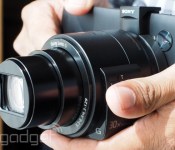
Sony updates ‘lens camera’ lineup with QX30, interchangeable-lens QX1

At last year’s IFA in Berlin, Sony announced its first two “lens cameras,” a pair of point-and-shoot cams that clip onto your smartphone. You use your phone’s display to control the camera, and while you can technically fire off shots using the integrated zoom toggle and shutter release, there’s no built-in LCD. Given the limitations, they’re not for everyone, but there’s apparently been enough interest for Sony to keep the QX line going, with a 30x zoom version and a unique interchangeable-lens model that accepts any E-mount optic now making their debut here in Berlin.
The first model, the QX30, sports a 30x, 24-720mm f/3.5-6.3 optical zoom lens. There’s a 20.4-megapixel, 1/2.3-inch Exmor R CMOS sensor, a 12,800 top ISO and 1080/60p video support. You can store shots both on the camera’s microSD card and on your smartphone as well — images and videos can be transferred instantly via WiFi, and you can push pics to the web straight from your phone. The replaceable battery can keep you going for 200 shots or 45 minutes of HD video, and you can charge up the camera via micro-USB. The QX30 ships next month for $350.

Sony’s QX1 is by far the most interesting model of the bunch. There’s an interchangeable lens mount and a large 20.1-megapixel APS-C sensor, essentially giving your smartphone DSLR-like image quality. You’ll have access to many of the same features as Sony’s mirrorless camera lineup, including a 16,000 top ISO, 1080/30p video, advanced shooting modes and support for RAW captures. There’s also a pop-up flash and a much beefier battery (the same pack that Sony ships with its mirrorless cams), letting you capture up to 440 stills or 150 minutes of video on a single charge. The QX1 is expected in stores in November for $400.
Filed under: Cellphones, Cameras, Sony
.CPlase_panel display:none;
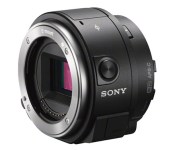
Sony’s new snap-on camera will take E-mount lenses, cost $399

Remember Sony’s newly leaked smartphone-mountable camera? The one that’ll let mobile photographers snap their existing E-mount lenses onto it so they can really mix up their shots? Sony’s reportedly gearing up to unveil the thing — also known as the QX1 — at its press conference at IFA on Wednesday, but it’s already made another appearance on the company’s online store. That means it’s time to dig into some of the juicier details, like what it packs inside the barrel (a 20.1-megapixel APS-C sensor and when you can nab one (it should start shipping on October 9). The QX1′s product page mentions that the curious camera will cost $399, but the thing to remember is that the price tag only covers the camera itself — there’s still no sign of the bundle that’s expected to include a 16-50mm lens. As always, you may want to take some of these tidbits with a grain of salt. After all, it’s not too likely that technical particulars will change too much, but the page clearly hasn’t been completely fleshed and we wouldn’t be surprised if there was a little leeway with that ship date.
[Thanks, tipster!]
Source: Sony Store
.CPlase_panel display:none;
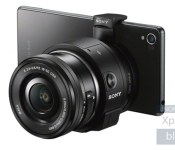
Sony’s next smartphone-mounted camera will let you change lenses

If you’re looking to be the king of Instagram, Sony’s about to give you the ultimate smartphone weapon, judging by a leak from Xperia Blog. The site posted several purported images of the Sony ILCE-QX1, a lens camera system that’d work with interchangeable E-Mount style lenses. Sony’s niche-oriented lens camera lineup is currently fixed-lens only with the QX10 and QX100 models. The QX100, for instance, is based on Sony’s fantastic RX100 camera and priced for serious smartphone photographers at $500. Assuming the rumor pans out, the QX1 would have an even larger APS-C (26.7mm) sensor and take compatible E-Mount lenses. There are no other specs, but as before, we’d expect that your smartphone will control the QX1 and capture images from it, with a mount that adapts to a wide variety of handsets. It’ll also likely have a built-in memory card. There’s no pricing yet, but as a rule, interchangeable-lens cameras are usually more expensive than fixed-lens models. Then again, Sony tends to break that rule.

Source: Xperia Blog
.CPlase_panel display:none;

Sony’s RX10 camera now shoots higher-quality video at a lower price

Sony’s Cyber-shot RX10 is a pretty capable camera, but it still has weaknesses: it doesn’t shoot super high-quality XAVC-S video, and that steep $1,300 price is bound to steer some people toward DSLRs and mirrorless cams. Well, consider both of those problems licked. Sony has just put out new firmware (installable through Macs and Windows PCs) that lets it record in XAVC-S and preserve more detail in your movies. At the same time, the RX10′s price has dropped to $1,000; that’s still a lot of money to shell out for a camera with a non-replaceable lens, but it’s definitely more accessible. If you’ve been holding out for a few more reasons to try this superzoom, you may want to take another look.
Source: Sony (Mac), (Windows)
.CPlase_panel display:none;

So what is it like to drive with Nissan’s Smart rearview mirror?

Despite all the changes going on in automobiles lately, one thing that’s remained pretty consistent in every car I’ve driven has been the rearview mirror. We can check that one off now though, now that I’ve taken a test drive in a Nissan Rogue equipped with the new Smart rearview mirror. Due to roll out on the company’s cars in North America next year, it’s a simple augmentation that combines a traditional mirror with a video screen. Flipping the dimmer switch usually meant for night driving drops you into video camera mode, with a feed streamed directly from a 1.3MP camera mounted in the trunk that drops out the usual blockages from the car’s interior for a clear view of what’s behind you. Back up cameras are already common — and highly necessary if you have my (lack of) parallel parking skills — but is it time to change out something that’s worked pretty well for the last century or so?

Based on my experience the answer is yes. Of course, I wasn’t driving a race car like the Zeod RC which doesn’t have a normal window for the driver to see behind in, but a common situation like transporting people or cargo can interfere with a normal mirror easily. According to Nissan’s Steven Diehlman, the normal FOV of a rearview mirror is about 17 degrees, while its camera not only frees the view of the normal C-pillar obstructions, but also expands that to cover 48 degrees. The difference was immediately apparent just backing out of my driveway — instead of having to turn my head to fill in the gaps between the mirrors, I could just see a fair amount of the street without shifting my viewpoint (there’s still a normal backup camera in place that feeds the display in the console, complete with the Around View birds-eye vision).
It does take some getting used to though — since the camera is right at the back of the car, everything is suddenly close up instead of 5-6~ feet in the distance. When you’re stopped in traffic it means suddenly getting very familiar with the car behind you, and depending on the height and zoom (which are adjustable) you might be able to see all of it in the 4:1 aspect ratio mirror.

Still, it easily became a part of the drive and not a distraction, and since switching back and forth between operation as a regular mirror is so easy, it could let others drive without even worrying about it (the focusing delay seen in the clip is from my camera, not the mirror). In Japan, the add-on costs around $600, but we don’t have a US price yet. Rolled into the price of a new car, it seems like a worthy feature, although I’m not sure if it would change my preference of which car to buy just to get it.
Filed under: Transportation
.CPlase_panel display:none;

Olympus’ newest mirrorless camera is built for selfies

Even Olympus can’t resist the allure of selfies, it seems. The company has just unveiled the PEN E-PL7, a retro-tinged mirrorless camera whose centerpiece is a 3-inch flip-out LCD that makes those trendy self-portraits a little easier. When you swing out the display, it kicks into a “Selfie Mode” which lets you tap the screen to capture a slightly time-delayed (and hopefully, better-prepared) shot. There’s a selfie interval option to snap successive photos in different poses, and powered zoom lenses will automatically kick into a wide-angle view to make sure your pretty face is in the frame.
It’s not just about stroking your ego. The E-PL7 still has a 16-megapixel sensor like the E-PL6, but it carries both the E-M10′s three-axis image stabilization and a fast 81-point autofocusing system that can shoot a moving subject at up to 3.5 frames per second (8FPS in regular bursts). And you’ll be glad to hear that WiFi has finally reached the mid-tier PEN line — you can both share pics through your phone or control the camera from a short distance away.
If you’re tempted, the E-PL7 won’t cost too much when it ships in late September. Spending $600 will get you the body alone, and $700 bundles a 14-42mm f/3.5-5.6 standard zoom lens. The accessories don’t arrive until October, although there are two that will be worth waiting for if you’re going diving: a $700 underwater shell will keep your camera safe, while a matching $500 flash will illuminate darker waters.
Filed under: Cameras
Source: Olympus
.CPlase_panel display:none;
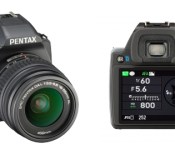
Pentax’s latest DSLR has glowing LEDs to tell you what mode it’s in

If you’re intimidated by most DSLRs with all their knobs and buttons, you might want to take a look at Ricoh Imaging’s Pentax K-S1, a new mid-range camera that’s just one of many shooters the company’s releasing this year. It packs in plenty of performance — a 20-megapixel sensor and sky-high sensitivity of ISO 51200 — along with an interface that’s more reminiscent of a smartphone than a camera. According to Ricoh, the K-S1 “eliminates many of the complexities of a DSLR” with a friendlier “flat field” user interface that should be easy to navigate due to the luminous 3-inch 921,000-dot LCD, back-lit selection dial and four-way navigation. There are also various built-in LEDs that light up when certain features are in use. For example, the mode dial will glow green when it’s toggled to take still shots and it’ll glow red if it’s in video mode, as you can see in the video after the break.
If you’ve got Face Detection turned on, the number of lit-up LEDs on the grip gives a quick visual cue as to how many faces it’s detected and you could also use the grip LEDs as a countdown timer.
Aside from the simpler interface, the KS-1 also boasts a variety of features that would be of interest to camera enthusiasts: in-body shake reduction, an AA filter simulator, a 100-percent field of view glass pentaprism viewfinder and 5.4 frames per second shooting with a shutter speed of 1/6000. Optionally, the KS-1 also supports Pentax’s FLUcard, which lets you tack on extras like Wi-Fi transfer, wireless live and the ability to use your camera remotely with your smartphone, tablet or computer.

To make it even more obvious that the KS-1 is meant as a “fun” mid-range camera, it’ll come in a whole host of different colors. The standards are black, blue and white, but you can also choose one from either the Fabric Collection or the Night Sky Collection — the former calls on its fashion inspiration with cotton beige, tweed gray, linen brown and denim blue, while the latter flaunts hues such as Sunset Orange, Dusk Gold, Moon Silver, Midnight Black and Dawn Purple.
If all of that sounds intriguing to you, the KS-1 along with a 18-55mm kit lens will retail for $799.95, while the body-only version is just a touch cheaper at $749.95. Both will be available in September.
Filed under: Cameras
Source: Pentax K-S1, Ricoh
.CPlase_panel display:none;
 AIVAnet