


Leica’s medium-format S shoots 4K video, 37.5-megapixel stills
 Leica’s ready to jump on the professional video bandwagon, releasing its 4K-capable S here at Photokina in Cologne, Germany. The 37.5-megapixel camera sports a medium-format sensor that’s just a hair larger than full-frame, giving you a crop factor of 0.8x. It can snap 3.5 frames per second in a continuous-shooting mode, 1080/30p video and 4K clips at 24 fps. You can capture 42MB RAW files or 37.5, 9.3 or 2.3-megapixel JPGs, but if you’re spending €20,230 ($25,400 in the US) on a camera (body only), you better be shooting RAW.
The bundled battery lets you snap up to 1,000 stills, so while many pros will be tethered to an external pack or an outlet, you can also use the cam away from another power source if you’d like. There’s clean HDMI output, of course, for pushing 4K video to an external recorder, which you’ll need to purchase separately. You’ll also need to add on a lens, such as the €6,450 ($7,995 in the US) 100mm f/2 Summicron-S we were shooting with in the hands-on photos above. While most of us don’t have nearly $35,000 to spend on a camera and one lens, there’s no doubt that the latest S will make its way onto at least a few magazine cover/billboard/motion picture shoots in the months and years to come.
Photos by Edgar Alvarez.
Filed under: Cameras
.CPlase_panel display:none;
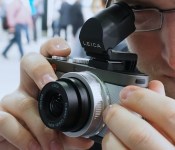
Meet the Leica X-E, an almost-affordable APS-C compact
 Leica just released an update to its X2 point-and-shoot camera here at Photokina. The X-E has a look and feel that’s very similar to its predecessor, with comparable specs as well. There’s a 16.5-megapixel APS-C sensor that, like the X model also announced today, can capture images with a level of quality that rivals that of many DSLRs. What you can’t do, unfortunately, is swap in a different lens — there’s a 24mm f/2.8 optic permanently attached, which is what you’d expect given the light weight and compact size, but if you need to get closer to your subject, you’ll need to walk forward rather than zoom in.
As with all APS-C sensors, the X-E’s has a crop factor of 1.5x, making that 24mm lens equivalent to a 35mm optic on a full-frame camera. There’s a 230k-dot (low-res) 2.7-inch LCD, a 5 fps continuous shooting mode and a top sensitivity of ISO 12,500. The X-E does not, however, shoot video, which is quite disappointing given the price. At €1,490 in Europe or $1,795 in the US, you might be better off spending an extra grand for Sony’s full-frame RX1, but if a Leica’s what you’re after, this is a decent choice. The X-E is available now through select retailers.
Photos by Edgar Alvarez.
Filed under: Cameras
.CPlase_panel display:none;

Hands-on with Leica’s super-rare $19,400 M Edition 60

As of this writing, 15,000 Euro is the equivalent of $19,400 — a very reasonable exchange rate indeed, and a fair price to pay for a mid-range car or a year of college. Only a select few can justify handing over that sum for a digital camera, however, regardless of the exclusivity that comes in tow. Leica’s counting on at least a few die-hard fans to fork over the cash, though, for the M Edition 60, a very special model created to celebrate the M system’s 60th anniversary. Only 600 have been made, and each is numbered between 001 and 600. Most peculiar is what this camera doesn’t include — a display, menu system, electronic viewfinder or any indicators at all, besides a tiny red light that flashes when the SD card is in use.
Instead, the only way to review your shoot is to pop the SD card into a computer. There’s no USB port to speak of, or an HDMI output. Not even a monochrome LCD readout. A large ISO dial (from 200-6400) occupies the area where you’d normally find a display. You set the aperture directly on the bundled Summilux-M 35 mm f/1.4 ASPH lens, and the shutter speed using a dedicated dial beside the shutter release. The M Edition 60, which is based on the 24-megapixel Leica M-P and includes a stainless steel build, shoots RAW image files (but not JPEGs). You can only adjust focus manually, using the rangefinder system. Expect to find it in very select stores beginning next month.
Photos by Edgar Alvarez.
Filed under: Cameras
Source: Leica
.CPlase_panel display:none;

Canon’s bringing back the square selfie cam with PowerShot N2

Early last year, a Canon rep pulled out a point-and-shoot with a very peculiar design. Instead of the rectangular form factor we’d grown used to, this camera was square. The PowerShot N was designed to be held any which way, making it a good fit for both righties and lefties, but without any pronounced grip, it didn’t feel quite as natural to hold. We were a bit relieved, then, when Canon debuted the N100 with a more familiar look and feel, but at Photokina, the company’s returning to the original shape and size with the PowerShot N2. The N2 replaces the original N — the N100 will remain on the market — bringing a slew of new features for social sharers and video bloggers alike.
There’s a new 16.1-megapixel sensor, a faster DIGIC 6 processor, a 28-224mm f/3.0-5.9 8x optical zoom lens (with improved IS) and a 461k-dot, 2.8-inch touchscreen that now flips 180 degrees for self-portraits (and videos). You still get WiFi (after all, this camera’s all about creating sharable content), but the N2 now includes NFC, making it easier to get up and running with a new device. The camera can capture 1080/30p video and thanks to a few added touchscreen controls, you can tweak exposure compensation, turn on the flash and adjust the smoothness of your skin (to decrease sharpness with certain facial features), all from the selfie mode. Canon’s expecting to ship the PowerShot N2 to customers this December; the camera is priced at $300.
.CPlase_panel display:none;
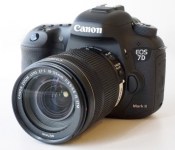
The 7D Mark II is Canon’s best DSLR without a full-frame sensor

The wait is over. Canon’s long-anticipated EOS 7D Mark II is here, shipping in November for $1,799, without a lens. With a price tag that high, you’d think it’d be safe to assume that the company’s consumer flagship sports a full-frame sensor. It does not. It does, however, represent an enormous step up from the original model — the Mark II includes just about every feature a pro photographer (and video shooter) could hope for, excluding a 35mm sensor, of course, and integrated WiFi. Instead, there’s a 20.2-megapixel APS-C CMOS sensor, which, despite a similar spec, is an improvement over what you’ll get with the 70D. You can also take advantage of a new 51,200 top ISO and a 10 fps continuous shooting mode (at full resolution, of course), powered by the dual DIGIC 6 processors.
You can capture up to 4 frames per second in silent mode, which, although not completely silent, is certainly the best option for shooting performances and other events where a clanging shutter wouldn’t be appropriate. The 7D Mark II now includes 65 autofocus points, compared to just 19 on the original model. There’s a dedicated AF lever for jumping between modes, and when you’re shooting video, Canon reps liken the focusing performance to what you’d experience with a camcorder. You can also adjust the speed at which the camera will focus and track subjects while you’re capturing video, with five levels to choose from. You can capture MP4 or MOV clips at up to 1080/60p to a CF or SD card, or output uncompressed footage (with audio) through the HDMI port. Speaking of ports, there are plenty to choose from, including USB 3.0, a mic input and headphone output, a PC socket for strobes and a wired remote connector.
The camera has a magnesium alloy construction, so even though you’ll want to avoid it, the body should survive a tumble or two (though there may be a different outcome for the lens). The new 7D is even four times more dust and weather resistant than the original model — reps say you shouldn’t have any problem shooting in moderate rain, assuming you’re using a weather-resistant L lens. There’s a new, slightly higher capacity battery on board (the LP-E6N), though the camera will work with older packs too. You will need to buy a new BG-E16 grip, however. Finally, the shutter, previously rated for 150,000 shots, can now handle more than 200,000 without repair. The 7D Mark II is expected in stores this November for $1,799 body only, or $2,149 when bundled with an 18-135mm f/3.5-5.6 IS STM lens.
.CPlase_panel display:none;

Canon targets Sony’s popular RX100 with PowerShot G7 X point-and-shoot

When you’re looking to buy a camera, the physical size of the sensor — not the megapixel rating — is what you want to keep an eye out for. The larger the better, of course, and while we may never see pocketable full-frame cameras with powerful zoom lenses, some manufacturers are getting close. Sony was the first such camera maker to debut a camera with a 1-inch sensor, the RX100, and now Canon’s trying to reclaim some of that high-end point-and-shoot market share with a model of its own. The PowerShot G7 X is Canon’s first 1-inch sensor camera, and while it costs a pretty penny ($700), you do get what you pay for.
In this case, that means a 20.2-megapixel CMOS sensor paired with a very respectable 24-100mm f/1.8-2.8, 4.2x optical zoom lens, besting Sony’s own 2.9x optic. And while there’s no pop-up electronic viewfinder (that’s still unique to Sony’s latest RX), you do get a very sharp 3-inch touchscreen that flips up 180 degrees for self-portraits. Canon’s latest processor, the DIGIC 6, is on board, as is WiFi with NFC support. You also get 1080/60p video shooting, a 6.5 fps continuous shooting mode and a top sensitivity of ISO 12,800. The camera has more control options than your run-of-the-mill compact — there’s a dedicated mode dial and an exposure-compensation dial behind, and even though there’s a touchscreen on board, Canon opted to include a variety of dedicated buttons on the back. You can pick up your own G7 X next month for $700.
.CPlase_panel display:none;
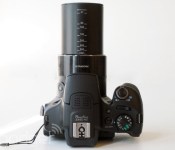
Canon’s most powerful superzoom sports advanced video features, 65x lens

If you need a 21-1365mm focal range in a single permanently affixed lens, man does Canon have the camera for you. The PowerShot SX60 HS, which replaces the SX50, sports a 65x optical zoom with an f/3.4-6.5 maximum aperture range and features to help you track distant subjects when you’re zoomed all the way in. The camera’s Advanced Zoom Framing Assist lets you select how much of a person you want to keep in the frame, and the camera will automatically zoom in and out to maintain that composition. The SX60 has an upgraded 16.1-megapixel 1/2.3-inch CMOS sensor, a DIGIC 6 processor, a 922k-dot viewfinder that flips out, up and forward, along with built-in WiFi and NFC.
The SX60 also packs some sophisticated video capture features, letting you shoot 1080/60p clips with full control over the exposure. There’s an external mic port with manual audio level controls and “silent” focus and zoom adjustments, so you can continue to make tweaks without interrupting recording. For stills, you can shoot up to 6.4 frames per second at full resolution (with fixed focus), and the camera’s zoom memory will bring you back to your previous zoom position after you swap a battery or SD card. Canon’s new flagship superzoom ships next month for $550.
.CPlase_panel display:none;

Olympus’ E-M1 camera gets a silver hue and a slew of pro features

Olympus’ OM-D E-M1 may still be hot stuff as far as high-end mirrorless cameras go, but it’s easy to point out flaws: it’s missing a few big pro features like tethering, and that businesslike black exterior isn’t very charming. Well, consider both problems licked. The company has just unveiled both a retro (and fairly stylish) silver edition of the E-M1 and, more importantly, a big 2.0 firmware update that could help you make a living from your photos. To begin with, tethering has arrived; like with other camera systems, you can both send photos to your PC as you shoot and control the camera from the computer’s screen. It’s now easy to use the E-M1 for studio shoots or live events, where you often need to put your photos on a computer as quickly as possible. The refresh also lets you correct lens distortion in-camera, and preview long exposure shots like you can with the E-M10. Olympus’ smartphone app is more useful, too, offering support for self-timed photos, timelapses and speed-sensitive panning shots.
The silver-clad cam will ship this month for the same $1,400 (body-only) as its all-black counterpart, and you can grab the 2.0 update on September 24th at 10PM if you’re already an owner. Whether or not you’re new, you may want to go lens shopping — Olympus is also releasing a high-end 40-150mm telephoto that touts both a bright, constant f/2.8 aperture and heavy-duty weather resistance. It’ll cost you a steep $1,500 when it ships in November, but it could be the only glass you need for that next big photo safari.
Filed under: Cameras
Source: Olympus
.CPlase_panel display:none;

HTC’s next device could be an action camera

It’s been a testy couple of weeks for HTC. It’s had new phones, plus rumors of a canceled wearable, a new tablet and a fragile deal with Amazon. What’s a company to do? If reports are true, the answer is “release a camera.” More specifically, a rugged GoPro-like device. Bloomberg’s sources suggest the forthcoming action cam would be tube-shaped (so more like Contour’s design), have a 16-megapixel sensor and an ultra-wide lens (though no specifics). The camera also reportedly has both Bluetooth and WiFi. WiFi isn’t uncommon in helmet cameras, letting you control it with apps and accessories, but Bluetooth suggests a closer relationship with a phone. More likely meaning it could be a standalone device, and one that’s tightly integrated with an HTC handset — much like Sony’s QX line of lens cameras. As luck would have it, HTC’s hosting an event in October, so whatever it is, we shouldn’t have to wait too long.
Filed under: Cellphones, Cameras, Mobile, HTC
Source: Bloomberg
.CPlase_panel display:none;
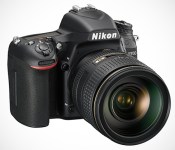
Nikon’s full frame D750 packs a tilting LCD and WiFi for pros on the go

Rumors of the full frame Nikon D750 have been floating around for a little over a month now, and where there’s smoke there’s usually a fire. To wit: Nikon just officially pulled back the curtain on its latest SLR, and it packs quite a bit of oomph into a body that’s only $2299. The D750’s foundation is awfully solid with its 24-megapixel FX format CMOS sensor, an Expeed 4 image processor (the same one seen in bodies like the much pricier D810), a more light-sensitive 51-point autofocus system, and an ISO range that stretches from 100 to 12,800. Oh, and did I mention it packs better battery life and some carbon fiber trim to keep the weight down? What might really put the D750 over the top for some of you, though, are some of the firsts that it boasts.
It’s the company’s first FX format camera to have a tilting LCD screen (we’re looking at 3.2-inches diagonal) and the first to have built-in WiFi — all of that has been crammed into a body that’s thinner than usual thanks to some savvy internal component shuffling. Nikon’s given the thing enough horsepower to make it worthy of slipping into a pro’s bag, but it also pegs the D750 as a worthy upgrade for photogs with a more modest amount of experience under their belts and a selection of DX lenses they don’t want to give up. As a concession to some of those greener camera buffs, Nikon has also included a slew of scene modes and effects too, just in case they’re more concerned with grabbing fun shots than stunningly composed ones. Interest piqued? You’ll be able to pick up the body by itself or with a 24-120mm f/4 VR kit lens by the middle of October… though if you’re feeling the latter, you’ll still need to wait for Nikon to disclose its price tag.
.CPlase_panel display:none;
 AIVAnet