


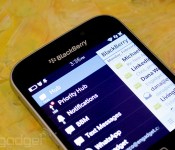
BlackBerry wants to bring some of its best features to every device

BlackBerry has only been willing to give out tiny pieces of its smartphone experience so far, like BBM and its enterprise servers, but it’s going to be much more liberal in the near future. It’s launching BlackBerry Experience Suite, a collection of apps and services that bring some of its biggest features to Android, iOS and Windows gear in hopes of making them mainstays of the working world. Some of them are more behind-the-scenes features that keep your corporate info both secure and separate from your personal affairs. However, others are very conspicuously borrowed from BlackBerry 10 smartphones. The company is promising the BlackBerry Hub (which unifies BB10’s messaging), universal search and even its own input method — yes, you may get a BlackBerry keyboard on your phone without resorting to a Typo case. The suite won’t be available until later in the year, but it may be just the ticket if you (or your office) wants to try BlackBerry features while keeping the hardware and apps you already use.
Filed under: Cellphones, Mobile, Blackberry
Source: BlackBerry (1), (2)
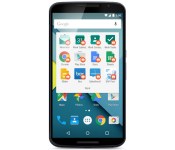
Android for Work is ready to make your phone office-friendly

Remember Android for Work, Google’s big effort to make your smartphone safe for business? It’s finally ready for prime time. The officially launched initiative lets you keep work-related accounts and app info separate from personal affairs while maintaining security — you don’t have to worry that higher-ups will peek at (or worse, delete) your vacation photos. You’ll only get full flexibility if you’re using Android 5.0 Lollipop, which lets you create work profiles, but an app will grant you access to corporate-approved tools if you’re running Android 4.0 or later.
The launch is getting help from a mix of app and hardware providers, including Box, Citrix, VMware, HTC, LG and Sony. Even BlackBerry is helping out with Android for Work support in its latest management tools. Developers of paid apps can even get in the mix, by opting-in to make their apps available for bulk purchase. However, Samsung isn’t pitching in to the same degree that was promised last year. While Samsung is still a partner, Google tells Recode that it didn’t end up using the Korean tech firm’s Knox technology to lock things down. Whatever’s under the hood, you now have a better chance of using your personal phone for office duties without enduring the hassles and security risks of the past.
Filed under: Cellphones, Internet, Mobile, Samsung, Google, Blackberry
Source: Android Official Blog, BlackBerry
BlackBerry 10.3.1 update includes the Amazon Appstore

BlackBerry has just starting rolling out version 10.3.1 of its OS to a range of devices, including the BlackBerry Passport, Z30, Z3, Z10, Q10, and Q5. What is particularly interesting about this update is that it also includes the Amazon AppStore, granting Blackberry users access to a wide range of Android apps.
This update has been a long time in the making, Blackberry initially announced Amazon store integration back in June of 2014. Although not quite as extensive as the Google Play Store, Amazon’s AppStore contains a good portion of the most popular Android games and applications, which will really help bulk up the range of apps available to BlackBerry customers.
Following a huge decline in its market share, Blackberry has gradually been opening up to competing platforms, including porting its messenger service to other operating systems and promising support for Google’s Android Wear. While clearly a positive move for consumers, this will likely come at the cost of support for its own store, as developers no longer need to cater exclusively to Blackberry’s smaller platform.
BlackBerry 10.3.1 is rolling out to devices in Africa, Asia Pacific, Europe and the Middle East starting today, subject to carrier approval, while a North American release is scheduled for the future.

BlackBerry’s latest update brings Amazon Appstore to its phones

All BlackBerry 10 phones will soon get features previously available on the BB Classic only, thanks to the platform’s latest update. One of the most notable changes is the addition of Amazon’s Appstore, giving users access to a bevy of Android apps. The update also equips the phones with BlackBerry Blend, which consolidates emails, text messages, BBM, contacts and calendar, and keeps them all synced across devices and even across operating systems (it works on Mac, Windows, Android and iOS). There’s BlackBerry Assistant, as well: a virtual secretary like SIri and Cortana that responds silently if you type a question, speaks when you ask out loud and adds context to its answers if you’re using a Bluetooth headset and it thinks you don’t have access to the screen. These features, along with a bunch of other ones, are coming to all available BB 10 devices in Africa, Asia Pacific, Europe and the Middle East starting today, but it’s slated to make its way to North America in the future.
Filed under: Cellphones, Mobile, Amazon, Blackberry
Source: BlackBerry
BlackBerry update opens up Amazon App Store access for Android apps on all BlackBerry 10 devices
BlackBerry has revealed a pretty major software update for all of its BlackBerry 10 running devices. The build number carries version number 10.3.1 and brings in the BlackBerry Assistant, think Siri and Google Now. It also adds in a new feature called Blend that allows users to communicate via email, text, and other services while also […]
The post BlackBerry update opens up Amazon App Store access for Android apps on all BlackBerry 10 devices appeared first on AndroidSPIN.
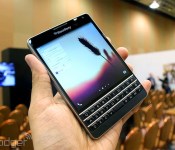
BlackBerry Passport and Classic come to AT&T on February 20th

BlackBerry fans on AT&T, your long wait for a new phone is almost over — the carrier has announced that both the Passport and Classic will reach its stores on February 20th. As promised, AT&T’s ever-so-slightly customized (but still oddly shaped) Passport will cost you $200 on contract, $22 per month on Next 24 or $650 up front. If you’d like something a tad less squarish, the Classic will cost you $50 on contract, $14 per month on Next 24 or $420 outright. These BlackBerrys certainly aren’t the cheapest devices in AT&T’s roster, but they’re also the network’s only modern phones with hardware keyboards. If you still aren’t a fan of typing on glass, they’re your best bets.
Filed under: Cellphones, Mobile, AT&T, Blackberry
Source: AT&T

Daily Roundup: Google’s robotic dog, one-way trips to Mars and more!

In today’s Daily Roundup, we marvel over the impressive stabilization abilities of the latest robot from Google-owned Boston Dynamics, get all the details on why people want to go on a one-way trip to Mars and review BlackBerry’s latest phone, straight out of 2011. All that and more past the break.
Google’s got a robot dog that stalks indoors, haunts dreams

Google-owned Boston Dynamics showed off its latest quadruped, “Spot.” This 160-pound robot is able to conquer a variety of challenging situations thanks to an array of sensors on its head that helps keep it balanced.
Here’s why people are volunteering for a one-way trip to Mars

A new documentary about the Mars One mission was just released by The Guardian. It interviews three Mars One finalists and asks why they’d want to leave our relatively safe and comforting home for a new life on a planet far, far away.
BlackBerry Classic review: A love letter to fans and few others

The BlackBerry Classic looks like a phone straight out of 2011, but it has a few modern touches to make it interesting. Is it enough to turn things around for the struggling company? Read our review and find out.
New video spec clears the way for 8K laptop screens

We’re finally starting to get comfortable with 4K displays, but the Video Electronics Standards Association (VESA) just unveiled Embedded DisplayPort 1.4a, a new format that lets all-in-ones and laptops use 8K screens. That’s a resolution of 7,680 x 4,320 pixels.
Neil Armstrong kept the original moon landing camera in his closet

After returning from the moon, Neil Armstrong stored numerous items from the Apollo 11 moon landing in a closet at home, including the 16mm Data Acquisition Camera used to record the iconic moment he reached the lunar surface. Some of these items will be on display at the Smithsonian National Air & Space Museum starting on June 8th.
Apple cracks down on accessory makers to discourage leaks

Sources for 9to5Mac claim that Apple is making key accessory manufacturers sign agreements that prevent them from making items for upcoming devices based on factory leaks. If the firms give in to the temptation and ship leak-based products, Apple warns of “penalties.”
Samsung swears its smart TVs aren’t eavesdropping on you

Samsung’s smart TV privacy policy recently left a number of people worried that the manufacturer was eavesdropping on private conversations. The company posted a response clarifying how its voice-recognition features work.
Oh snap: Motorola chief suggests Samsung, like Nokia and Blackberry, will fade away in the future
In case you haven’t heard, Motorola has had a great quarter. While it hasn’t yet translated to profit for its now-parent company Lenovo, it’s innovation and growth is almost back to Motorola’s heyday, and people are starting to take notice. But with the rise of multiple manufacturers, including Motorola, there has to be someone who […]
The post Oh snap: Motorola chief suggests Samsung, like Nokia and Blackberry, will fade away in the future appeared first on AndroidSPIN.

Survey finds 50% of phones activated last quarter came from Apple, 26% from Samsung

Apple trumped all other smartphone manufacturers last quarter based on consumers activating a device. The usual Android foes were all far behind Apple with Samsung leading the way. Consumer Intelligence Research Partners (CIRP) conducted a survey with five hundred subjects in the United States and aimed to find which phone brands were most popular among activations. The devices, both old and new, were activated between October and December of last year.
Samsung trailed Apple by 24% and that was the closest any company came to catching the clan in Cupertino. After that, the numbers dropped off significantly. The third place company was LG with 11% and Motorola finished fourth at 4%. Rounding out the bottom was HTC (2%), Nokia (2%), Amazon (1%), and “other” with 4%. BlackBerry, who may or may not be facing an acquisition in the near future, had no activations from the survey.
Josh Lowitz, the co-founder of CIRP, explained that the loyalty of Apple customers is far greater than that of Samsung and LG’s. He said:
“iPhones drew from loyal Apple customers, with 86% of buyers upgrading from an older iPhone. Samsung and LG saw far lower loyalty rates, with 25% of Samsung owners and 18% of LG owners who activated a phone in the quarter switching to an iPhone.”
Source: Consumer Intelligence Research Partners (PDF)
Via: Phone Arena
Come comment on this article: Survey finds 50% of phones activated last quarter came from Apple, 26% from Samsung
Samsung + Blackberry: pros and cons

The persistent rumors about the possibility of Samsung buying BlackBerry have become a permanent fixture in the tech press over the last couple of years. Long before BlackBerry officially went up for sale in 2013, there was speculation about possible suitors. It’s only natural that talk turned to the largest, cash-rich, smartphone manufacturer on the scene in Samsung. But companies like Microsoft, Dell, and IBM were also mentioned.
As it turned out no-one was interested. There was to be no tech giant in white armor to ride to the rescue. In September 2013, BlackBerry announced losses around $1 billion and plans to cut its workforce by 40 percent. At this low point, shareholder Fairfax, with 10 percent of the company, announced plans to acquire the rest for $4.7 billion. The deal later fell through when Fairfax couldn’t raise the cash.
Is Samsung interested?
Back in the summer of 2012 Samsung denied it was interested in acquiring BlackBerry (still RIM at the time) or licensing its new BlackBerry 10 platform. What has changed since then?
If you believe Samsung’s mobile CEO, J.K. Shin, the company still isn’t interested. He was quoted by the Wall Street Journal on Monday.
“We want to work with BlackBerry and develop this partnership, not acquire the company.”
It’s worth mentioning that BlackBerry’s share price soars on the back of rumors like this, so even if Samsung was interested it wouldn’t want that to be public knowledge. Though you do have to wonder about the timing. Samsung could have swooped just over a year ago and acquired the company far more cheaply than the $7 to $8 billion price that’s being touted now.
To complicate things, Canada’s Financial Post reported this week that, despite the public rebuttals of both Samsung and BlackBerry, the Korean company is still very much interested in acquiring BB.

Samsung’s Knox secure environment is no match for BlackBerry’s products
What’s in it for Samsung?
There are two credible reasons that Samsung might want to acquire or partner more closely with BlackBerry.
- Patents – BlackBerry has 44,000 patents covering things like wireless communications and encryption technologies, which could obviously be useful for Samsung.
- Enterprise – The foundations of the BlackBerry brand are built on enterprise customers. It’s a market we know that Samsung is interested in.
If the patent portfolio was enough motivation on its own, then you get the feeling Samsung would have looked to do the deal when the patent war was still at its height. It feels as though the litigation is slowing down, but there’s still little doubt that BlackBerry’s patents would be valuable to Samsung.
Samsung’s attempts to break into the enterprise with Knox have not been wildly successful. The perception of Android and Samsung devices in terms of security is not especially good. Samsung’s biggest competitor, Apple, has been making real inroads into the enterprise market and threatening to steal away BlackBerry’s share. Samsung could definitely use some of BlackBerry’s know-how and reputation in the enterprise, and it has a vested interest in halting Apple’s progress.
What about BlackBerry?
The prospect is much more straightforward for BlackBerry. Shareholders might be glad to take above market price right now if they don’t have faith in a comeback. Even if BlackBerry can turn things around, it would seem like a smart idea to align itself with the biggest smartphone player around. If software and services is truly the future of BlackBerry then a close partnership with Samsung could really help it back into the game.
In fact this is already happening. A partnership was announced in November. It brings BlackBerry’s BES12 enterprise mobility management software and Samsung’s Knox for Android together. There’s no way BlackBerry is going to be able to build back a significant share of the market with hardware, so it has to get its software onto more devices.
BlackBerry CEO, John Chen, said of the deal “We’re not about phones this time – we’re about software.”

CEO John Chen managed to stabilize BlackBerry, but is he considering an exit?
Why buy the cow?
One other reason we’ve seen offered that Samsung might want BlackBerry is the software. It would be fair to say that software development is seen as a weak spot for Samsung and a strength for BlackBerry. If Samsung wanted help developing a new operating system or building on Tizen it could do worse than look to BlackBerry. There’s also the potential of QNX for embedded systems as the Internet of Things gathers pace.
Ultimately, the idea that Samsung would sink a large sum of cash into acquiring BlackBerry right now seems fanciful. Samsung can get all the potential benefits by working on some kind of partnership deal instead. With all the talk about declining profits for Samsung, the last thing it needs is to acquire a company that’s still losing money.
For BlackBerry’s part an acquisition also seems unlikely. It looks as though the company may be over the worst. The restructuring could bear fruit given time. Shareholders may be prepared to give Chen a fair crack of the whip. The company has enough going for it that we wouldn’t bet against a healthy software-driven revenue within a couple of years.
Mutually beneficial
What we can agree on is that a partnership would be mutually beneficial, and that’s no doubt why it’s already happening. Samsung gets security software and a touch of BlackBerry’s enterprise reputation. BlackBerry gets its software onto loads of Android devices and provides support for the largest smartphone manufacturer in the world. It’s an obvious win-win.
Could the partnership go further? BlackBerry services underpinning Samsung’s hardware. A merging of software that would see BlackBerry apps pre-installed on Samsung devices? A joint smartphone project for a Samsung-built BlackBerry phone? Maybe, maybe not. Let’s give it some time. The two rivals are still getting used to working together.

BBM remains one of BlackBerry’s best assets
Turning things around
In the middle of 2008 RIM was worth $77 billion based on the share price. It continued to claim a dominant market share into 2010. A lethargic reaction to its changing fortunes was what delivered the killer blow, but the decline has been slow and it hasn’t proven fatal. The hardware heights are gone, but BlackBerry could recover in a new form.
Samsung is fresh onto the downward slide from its peak. Talk of the company being in trouble still feels overblown right now, but Samsung has a tough year ahead. There are plenty of reasons that a similarly sharp decline is unlikely for the South Korean conglomerate, not least diversification, but there’s a lesson for everyone in what happened to BlackBerry.
It would be interesting if a partnership between the two, once fierce rivals, is what turns both their fortunes around.
 AIVAnet