


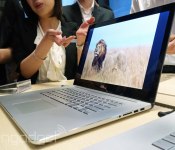
Hands-on with ASUS’ Zenbook NX500: The MacBook Pro meets its match

Before you yell at me for putting the word “MacBook” in the headline, hear me out: the new ASUS Zenbook NX500 really is one of the closest things I’ve seen yet to a Retina display MBP competitor. For all of you who ever wanted something as thin and powerful as the MacBook Pro, something just as high-res, the NX500 is it. Only, you know, it runs Windows! If you’re just catching up (the news broke overnight, while our American readers were asleep), the NX500 is a 15.6-inch Ultrabook with a 3,840 x 2,160 IPS display, and a Core i7 processor, 2GB NVIDIA GTX 850 GPU and up to 16GB of RAM under the hood. Wowza. Oh, and all of this fits inside a package that’s just 19mm thick and weighs 4.85 pounds. That’s technically thin and light enough to be considered an Ultrabook, though ASUS would prefer you not call it that — whatever this is, “Ultrabook” is probably too wimpy a name.
It’s not just specs that remind me of the MacBook Pro, though. This, too, is made of unibody aluminum, similar in color and texture to the ol’ MBP. That said, you’d never, ever mistake the two: The NX500 has the Bang & Olufsen speakers built into the keyboard deck, with the fine grille flowing out from underneath the keys in an circular pattern. I think it’s tasteful and quite lovely, personally, but to each his own; if you prefer more discrete speakers, I totally get that. Speaking of the keyboard, the 15.6-inch form factor allows for a spacious layout, though the buttons are on the shallow side, as is often the case with Ultrabooks (keep in mind that ASUS just barely got the machine down to the Ultrabook spec of 19mm, so I’m not sure it could have afforded to go with thicker keys).

As for the display — the star of the show, really — it covers 100 percent of the NTSC spectrum, along with 108 percent of Adobe RGB. Between the rich colors, sharp resolution and wide viewing angles, ASUS has cooked up one hell of a display. I’ll reserve judgment for a full review, of course, but let’s be real: it’s pretty obviously a nice screen. I don’t expect my opinion to change much, not even after more careful examination.
Mat Smith contributed to this report.
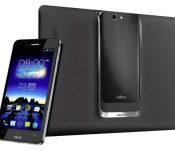
The ASUS PadFone S will be the PadFone X for the rest of the World
 I’ve always had a soft spot for the ASUS PadFone line; it uniquely marries the capabilities of a smartphone with the possibility of being able to use tablet functions too, without any of the cost. When ASUS announced that the PadFone was coming to America, it seemed like only a matter of time before the rest of the world would also see the transformable device. And sure enough, at this year’s Computex, it’s been announced that the ASUS PadFone S will likely be launched globally sometime in Q3.
Essentially the same as the AT&T-bound ASUS PadFone X which is due for launch in a few days, the PadFone S will be a 5-inch smartphone paired with an 8.9-inch tablet dock. Hardware-wise, it will have a Snapdragon 800 processor clocked at 2.3GHz, 2GB RAM, 2GB front and 13MP rear cameras on the phone, and the phone and tablet will have 2,300 mAh and 4,990 mAh batteries respectively. The PadFone S will also benefit from the ability to be wirelessly charged through Qi-wireless technology. Definitely not a bad device at all, however, pricing has not yet been announced yet.
Are you interested in the PadFone devices? Would you consider the ASUS PadFone S? Let us know what you think.
Source: engadget
//<![CDATA[
ord = window.ord || Math.floor(Math.random()*1E16);
document.write('’);
//]]>
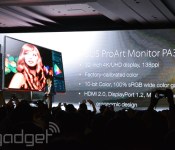
Here’s a semi-professional 32-inch 4K monitor from ASUS

Following ASUS’ $799 28-inch 4K monitor from earlier this year, the Taiwanese tech giant has today unveiled yet another high-res display, but this time it’s aimed at semi-professionals instead of mainstream users. The new ProArt Monitor PA328Q is a 32-inch, 16:9 3840 x 2160 monitor, and it boasts factory calibration with 10-bit color, 100-percent sRGB color gamut plus 350cd/m² brightness. On the back, you’ll find three HDMI ports (one of which with built-in MHL 3.0), one DisplayPort 1.2, one Mini DisplayPort 1.2 and four USB 3.0 ports. ASUS added that this pretty monitor lets you adjust its tilt, swivel, pivot and height.
As with many product announcements today at Computex, ASUS doesn’t yet have a solid date or price for the PA328Q, but our understanding is that it’s aiming for around half the price of the high-end $3,799 PQ series when it lands in Q4. If you need something fairly reliable for your graphics projects but are stuck with a smaller budget, then this monitor is probably worth your consideration — if you can wait for it, that is.

ASUS’s Zenbook NX500 is a thin and light laptop with a 4K screen

Lest you think all the laptops announced at Computex this week are Yoga knockoffs, ASUS has at least one traditional notebook for you. The company has just announced the Zenbook NX500, a 15.6-inch Ultrabook that manages to pack a 3,840 x 2,160 screen, Core i7 processor, discrete NVIDIA GTX 850 graphics and up to 16GB of RAM into a relatively thin and light frame (it measures just 19mm thick and weighs 2.2kg, or 4.85 pounds).
As you can probably tell, with specs like that, it’s more of a Retina display MacBook Pro competitor than a typical Ultrabook — the sort of thing you’d recommend to creative pros who need to get work done on the go. To that end, the screen isn’t just high-res, but also uses ASUS’ “VisualMaster” display technology, with the color gamut covering 100 percent of the NTSC spectrum and 108 percent of Adobe RGB. No word yet on price or availability (ASUS rarely mentions such details at its press conferences), but we’ll let you know if we learn more.

The ASUS MEMO Pad 8 is ‘the world’s lightest eight-inch LTE tablet’

ASUS boss Jonney Shih is barreling through his announcements at Computex 2014. Between routers, 4K monitors and flagship laptops, he also revealing the company’s newest tablets, and the MEMO Pad 8 is the first salvo. With a 64-bit 2.3GHz Intel processor, Gorilla Glass 3 and a full HD display, Shih says it’s the lightest LTE tablet in the world — it’s only 299 grams.
It was swiftly followed by the slightly smaller, and logically named, MEMO Pad 7. It’ll also pack Intel’s 64-bit Atom processor, although the screen is merely HD(that’s 720p), not 1080p like the ‘Pad 8. If you haven’t quite bought an Android tablet yet (and you’re still in the market for one), the MEMO Pad 8 will arrive later this year in pink, white and royal blue color options, while the MEMO Pad 7 will be dressed in turquoise, red, white and yellow. Summer shades, people. Summer shades.

ASUS’ new Fonepads offer 3G, extra processing power

It wouldn’t be an ASUS event without a new device that functions as both a handset and a slate. And, as expected, the Taiwanese company delivered on that front here at Computex; CEO Jonney Shih announced the Fonepad 8, along with a 7-inch version, the Fonepad 7. A follow-up to ASUS’ Fonepad 7, the new devices sports similar specs, with improved performance and a slimmer design. Oh, and they boast a 64-bit processor that supposedly crushes other phones when it comes to real-world benchmarks.
On stage, Mr. Shih mostly emphasized the 64-bit processor’s performance; the Fonepad 8 runs a 1.8GHz Intel Atom Z3560 chip that apparently trounces the competition when it comes to power and efficiency. That speed should make navigating the device’s Zen interface a seamless experience, though we’ll reserve final judgment until we’ve tried it out for ourselves. The FonePad 8 also features 3G connectivity for its dual SIM slots.
Back to the more superficial stuff: the new Fonepads sport a very narrow bezel for easy one-handed use, and it will be available in black, red, gold and red. Other specs include dual front speakers (the standout feature on the previous Fonepad), a 1,280 x 800 IPS display (for both the 7- and 8-inch versions). We’ll be gathering more specs — and hands-on impressions — as soon as possible, so stay tuned.
Filed under: Cellphones, Tablets, ASUS
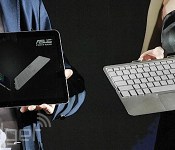
ASUS’ Transformer Book T300 Chi is a super-thin hybrid PC with a 2,560 x 1,440 display

We’ve heard companies make lots of claims, but this latest one from ASUS is mighty specific: The company says its new Transformer Book T300 Chi is the “world’s thinnest 12.5-inch detachable tablet.” Well then! Sounds like a not-so-subtle reference to the Surface Pro 3, if you ask us. In any case, to ASUS’ credit, this does look like quite the savory device, with or without the marketing hype. What we have here is a 12.5-inch tablet with an included keyboard dock, with top-of-the-line specs that include a 2,560 x 1,440 display, built-in LTE and “next-generation” Intel Core processors (like, so “next-gen” Intel isn’t even talking about them yet). As for that thin shape, it measures 14.3mm (0.56 inch) with the dock and 7.3mm (0.29 inch) thick for just the tablet. As usual, ASUS isn’t talking price or availability just yet, but we’ll update this post if we hear more.

ASUS Transformer Book V is a Windows hybrid laptop with a detachable Android phone

Wow, just wow. ASUS has just announced the Transformer Book V, a Windows 2-in-1 laptop with a detachable Android phone. No, this isn’t the Windows Phone-powered PadFone that we’ve been waiting for, but the package is still pretty mind-blowing. Let’s break it down. First of all, the 12.5-inch tablet/laptop hybrid part has its own Windows 8.1 brain running on Intel Core architecture. Then you have the 5-inch, ZenFone 5-like Android 4.4 phone, which is the first to run on Intel’s 64-bit quad-core Atom (Moorefield) chip with LTE radio. When docked, the phone’s Android interface is displayed within Windows 8, and you can also switch to the full Android tablet interface. In other words, you get five modes in total (hence the name): a Windows tablet, a Windows laptop, an Android phone, an Android tablet and an Android laptop.
The 0.8kg tablet part comes with a 12.5-inch HD IPS display, 4GB of RAM and a 28Wh battery that claims to offer up to 10 hours of web browsing time. In terms of storage space, the tablet packs up to 1TB for the Windows part and up to 128GB dedicated to Android as external space. As for the phone itself, we’re looking at 140g, 11mm-thick package featuring a 2,500mAh battery plus 2GB of RAM, up to 64GB of storage and 8MP/2MP cameras.
Judging by the fact that the product was kept underneath a glass case at Computex, it might be a while before we can actually buy it. We’ll keep poking ASUS until we hear more, so stay tuned.
Filed under: Cellphones, Laptops, Tablets, Mobile, ASUS
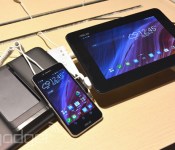
ASUS’ PadFone X goes global: still a 5-inch to 8.9-inch transformer

The ASUS PadFone X due June 6th can be considered as a slightly rugged version of the regular PadFone Infinity flagship line, but it’s only limited to AT&T customers. Luckily, for those outside the US, there will soon be a global variant dubbed the PadFone S. These two models are pretty much identical: you get the same 5-inch phone to 8.9-inch tablet transformation, and the guts include the 2.3GHz quad-core Snapdragon 800, 2GB of RAM, full HD displays, microSD slot, 13MP plus 2MP cameras on the phone (1MP front camera on the tablet) and 2,300mAh plus 4,990mAh batteries. The only differences are the 3G and 4G bands for obvious reasons, plus the wireless charging here follows the more popular Qi specifications, as opposed to PMA’s. There’s no info on pricing yet here at Computex; all we know is that it’ll arrive in select markets as early as late Q3 this year.

Also announced alongside the PadFone S are an LTE-enabled ZenFone 5 (A500KL, with a 1.2GHz quad-core Snapdragon 400) and a ZenFone 4 with a slightly newer Intel chip. Both are due some time between late Q3 and early Q4 in select markets. We’ll have more info closer to the time.
Filed under: Cellphones, Tablets, Mobile, ASUS

Gadget Rewind 2007: ASUS Eee PC 4G

The ASUS Eee PC was launched in 2007 and while it had all the characteristics of a “netbook,” it arrived before the term had wormed its way into popular vocabulary. This species of compact computer — essentially miniaturized, internet-focused laptops — took the market by storm in the late 2000′s, but failed to have much staying power and ultimately faded from view. At the time, these stripped-down portables from Taiwan-based ASUS, filled a growing niche for people on the go. They offered just the essentials, while still managing to provide a surprisingly good bang-for-buck ratio. The Eee PC was aimed at users who rarely stepped beyond the bounds of basic web surfing and email, so it was easy for ASUS to trim the fat and offer a small, lightweight device. In fact, that undemanding demographic was the inspiration for its titular triple E’s: “Easy to learn, Easy to work and Easy to play.”
Beyond simplicity, the Eee PC’s portability and price were the keys to making it desirable. The 7-inch, 800 x 480 screen and two-pound weight made it far easier to cram in a bag or oversized pocket than its hefty, full-sized notebook counterparts. However, the cramped keyboard was definitely not built with large-pawed users in mind. Three models arrived in the first wave of Eee PCs, covering a variety of price points. The Eee PC 4G (701) landed squarely in the middle of the group, all of which ranged in price from $300 to $500 — sadly the rumored $200 model never surfaced. And before you get confused, the 4G stood for its 4GB SSD rather than mobile connectivity (2GB and 8GB versions were also in the lineup). To help offset the relatively skimpy drive sizes, ASUS bundled in 10GB of free cloud-based Eee Storage for the first year and a half.
As tablets, lightweight Ultrabooks and high-functioning smartphones arrived on the market, the Eee PC and other netbooks eventually faded from view, but ASUS still had weight and portability on the menu. Between its keyboard-packing Transformer Pad tablet series and the super-slim Zenbook line, the company managed to tackle two divergent formats, yet still provide quality specs in light, portable packages. Today, for those who still want that laptop experience, but don’t need all the expensive extras, the growing selection of Chromebooks definitely fits the bill and even manages to deliver on that $200 promise.
Did you own an ASUS Eee PC 4G? Add it to your Engadget profile as a device you had (or still have) and join the discussion to reminisce or share photos of your device with other like-minded gadget fans.
 AIVAnet