


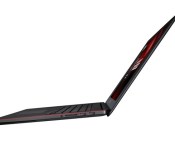
ASUS’ GX500 gaming laptop has a 4K screen and is just 19mm thick

Remember the ASUS NX500, that super-thin, MacBook Pro-inspired laptop we saw yesterday? (Now you do.) Well, then: This right here is its macho, gaming-obsessed cousin, the GX500, which just made its debut here at Computex. Like the NX500, it’s a 15.6-inch notebook coming in at just 19mm (0.75 inch) thick and 2.2kg (4.85 pounds). Spec-wise, too, it packs a Core i7 processor and a 3,840 x 2,160 display that covers 100 percent of the NTSC color gamut. The difference? It purrs along with heavier-duty NVIDIA GeForce GTX 860M graphics. Oh, and the chassis is black with industrial red accents, making it less of a MacBook clone. No word yet on how much it will cost or when it will be available, but it seems to us this should make for a compelling Razer Blade competitor. Hopefully we can review one soon enough and decide for ourselves.

ASUS has two Steam Machines and one is incredibly compact

Computex has a heavy PC gaming flavor to it in places. Between the likes of NVIDIA and ASUS’ ROG brand, it acts as a gentle primer to PC-based gaming hardware ahead of E3 – which is next week, if you forgot. Alongside a frankly ridiculous 4K gaming laptop, ROG’s announced two new Steam Machines with varying footprints and specifications. The GR8 takes up just 2.5 liters of space, and ASUS ROG is talking up the size:power ratio as the best it’s ever made, with a Core i7 processor and NVIDIA GeForce GTX 750Ti inside. Meanwhile, 4K output and Miracast support could well make this a plausible, portable ‘console’ PC – you’ll just need a screen.

Slightly more powerful (and bigger), the G20 gaming desktop still packs high-end 4th generation Core i7 processors, but upgrades the GFX to the GeForce GTX 780. Interestingly for a gaming rig, there’s no visible exhaust events, with a hidden airflow tunnel apparently offering heat management and (really?) near-silent operation. ASUS has it pegged at 25dB at idle. Even without the ports, If you still like your gaming PCs at least a little garish, there’s still built-in lighting, that will cycle through millions of color shades. Millions!
Both units will launch as Steam Machines, bundled with Steam controllers, although in traditional Computex style, ASUS hasn’t got prices to share just yet — expect them to appear alongside Valve’s next announcement about Steam Machines.

Engadget Daily: Apple announces OS X Yosemite, iOS 8 and more!

Today, we watched Apple unveil OS X Yosemite, iOS8 and its own smart home platform, went hands-on with ASUS’ new Zenbook NX500, learned about Samsung’s Tizen-based smartphone and more! Read on for Engadget’s news highlights from the last 24 hours.

Apple reveals iOS 8 at WWDC, available for free this fall
Today at its 25th annual developers conference, Apple unveiled iOS 8, the newest version of its mobile operating system. Design-wise, it looks a lot like iOS 7, but there’s a bunch of brand new features under the hood, including a health app, widgets, and yes, third-party keyboard support!

OS X Yosemite: Apple’s latest desktop operating system is free this fall
Apple’s next desktop operating system is called Yosemite, and will arrive as a free upgrade this fall. Besides getting a few slight UI adjustments, the OS gained a pumped-up version of Spotlight and Safari, as well as a new AirDrop feature that let’s you seamlessly transfer work between all of your Apple devices.

ASUS Transformer Book V is a Windows hybrid laptop with a detachable Android phone
Today, ASUS released the Windows-powered Transformer Book V and it’s, well, an interesting combination of a 2-in-1 laptop and dockable Android smartphone. Between both devices, the Book V packs five different combinations of software and hardware. Crazy, right?

What you need to know about the ‘right to be forgotten’ on Google
Thanks to a recent case between Google and Europe’s biggest court, European users have the “right to be forgotten.” Read on as our own Matt Brian breaks down the ruling and what it means for you.
You also might like:
Up close with ASUS’ quirky Windows laptop / Android phone hybrid

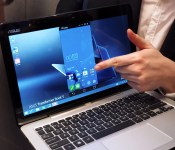
Computex hasn’t even officially started, and we’re already blown away by ASUS’ rather eccentric Transformer Book V from this morning. The name doesn’t tell the whole story; it’s actually a Windows 8.1 hybrid laptop that lets you dock a Android phone on its back — a bit like the PadFone concept except the tablet has its own brain. That’s right, you can use both the 12.5-inch tablet and the 5-inch LTE phone simultaneously with their own brains. When docked, you’re shown the phone’s live Android phone interface within Windows (as pictured above), but you can also toggle the full Android tablet interface. It’s easily the most versatile product we’ve seen of late, but is it practical?
First of all, we should note that the Transformer Book V is apparently still about six months away from market, which may explain why ASUS only had one prototype available for hands-on. The design wasn’t even final; it’s supposed to look very much like the ZenFone 5. Understandably, the early software didn’t perform that well at the time: I couldn’t swipe between Android home screens in the windowed mobile interface, for instance. That said, I could launch Android apps just fine in the window, and it didn’t take long for the Android mobile interface to pop up in Windows after docking. It’s like Motorola’s Webtop implementation but much more powerful. On a similarly positive note, switching between the Android tablet interface and Windows was just a matter of pressing one button on the keyboard.
Since the docked phone is recognized as an external device in Windows here, you’ll still have to handle file transfer the usual way via Windows Explorer, rather than through a more seamless experience with some sort of drag and drop action over the Android interface (at least not for now, anyway). On the bright side, you can transfer files and charge the docked phone without a cable nor having the phone lie around the laptop. Another plus is with tethering enabled, you also have yourself an LTE-enabled Windows or Android laptop.
For a tablet of such size, 800g is a pretty nice weight, and this means you’re still under 1kg in total when you dock the 140g phone. There was no mention on the weight of the keyboard dock, but I found the full package to be of acceptable weight — my guess is somewhere just around 1.6kg. This is based on the fact that the slightly larger 13.3-inch Transformer Book T300 has an 800g keyboard dock with a built-in battery, so the Transformer Book V’s battery-less dock should be slightly lighter.
Due to the prototype nature of the device we played with, we’ll save our hardware comments for a mass production unit. The only complaint we have so far is that the tablet’s 1,366 x 768 display is an eyesore for those who are used to much sharper screens; though if — and it’s a big “if” — this product does take off, there’s a good chance that the displays will be upgraded.
Regardless, we think ASUS is at least headed in the right direction: the tablet dock is no longer dependant on the phone; and in fact, it’s a full-fledged Windows PC on its own but with the versatility of having Android run in Windows or run natively. But as with many products, this concept’s success will ultimately depend on the pricing. We also hope this Windows/Android hardware combo doesn’t mean ASUS has given up on the idea of a Windows Phone-powered PadFone.
Hands-on photos by Zach Honig.
Filed under: Cellphones, Laptops, Tablets, Mobile, ASUS

ASUS’ new Fonepads are solid tablets, but still awkward for making calls

ASUS’ new Fonepad 7 and 8 are sleek, well-built Android tablets equipped with 3G connectivity and dual SIM slots, along with a speaker and mic. Whether making calls on a gigantic slate is something you’re into is another question, but if you’re at all interested in a tablet that can pull double duty as your handset, ASUS’ products are the best ones you could ask for. And they work quite well as tablets, too.
Announced at Computex in Taiwan earlier today, the Fonepad 7 and 8 are updates to last year’s Fonepad 7 — both sport 64-bit Intel processors for improved power efficiency and speed. It’s impossible to draw conclusions about a tablet’s performance based on a few minutes of use, but basic Android 4.4 (KitKat) navigation on both Fonepads felt a smooth as you’d expect. On the 1,280 x 800 IPS display, colors are extremely crisp and vivid as well.
The larger Fonepad 8 is definitely the more premium of the two, with a dimpled texture on the back as opposed to the Fonepad 7′s simple rubberized finish. The bezels are extremely narrow, which makes gripping the tabs with one hand relatively easy. At a show full of run-of-the-mill Android tablets, these two definitely stand out.

While both devices are quite thin and light, there’s no getting around it: holding a 7- or 8-inch slab up to your face to make calls will never feel natural. If you mostly communicate via text — or if you’re content to use the speakerphone — this won’t be a huge problem, but the Fonepads’ size is definitely not ideal for lengthy calls.
Fortunately, both tablets have much more going for them than just the phone functionality; they’re attractive, with premium specs to boot, and dual front speakers make them ideal for streaming music and watching movies. ASUS is the master of multifunctional devices — seriously, check out this phone-laptop hybrid also unveiled at the show — and the Fonepads are high-quality, if unexciting, Android tablets.
Filed under: Cellphones, Tablets, ASUS
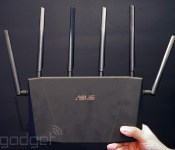
There’s no such thing as too many antennas for ASUS’ high-end router

Six antennas, apparently delivering up to 3,200Mbit per second. That’s some impressive credentials, especially from the typically sleepy world of wireless routers. ASUS reckons its new six-pronged WiFi brick is not at all sleepy either: the RT-AC3200 will come with an adaptive Quality of Service feature that allows users to manage their bandwidth and traffic, working on tri-band 802.11ac. Meanwhile, AiRadar will apparently intelligently strengthen and tweak your wireless coverage. ASUS is promising that this will give improved signal stability, range and optimal speeds. If it sounds like something that could need technical support and a lengthy troubleshooting phone call, rest assured, ASUS is promising a 30-second setup time that’s friendly to router rookies. There’s no pricing alongside the technical specifications, but we reckon it could well be the kind of router you’d likely need to make the most of Google Fiber and similar high-speed internet connections.
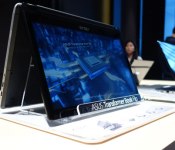
ASUS’ Transformer Book Flip has a 360-degree rotatable screen, realistic pricing

Lenovo’s Yoga series has a lot of fans — and we just mean within the PC-making fraternity. ASUS might have initially bested the Yoga with its dual-screened convertible laptop, but two screens meant weaker battery life and well, it was expensive too. The Transformer Book Flip, then, also offers four different use cases: completely flat like a tablet, a house of cards style prop-up structure, a media-viewing mode with the keyboard down, and good-ole laptop mode. The notable thing here is that the Transformer Book Flip will arrive with similar pricing to ASUS’ middleweight to entry-level Vivobook series. (We managed to get UK pricing: the Flip starts at £449 for the 13.3-inch Core i3 model, with the top-of-the-range 15.6-inch Core i7 is priced at £699. Once we get some US prices, we’ll update this article.)
Screen resolutions go up to 1,900 x 1,080, and while there’ll apparently be cheaper 720p models in both 15.6- and 13-inch sizes. we’d advise sticking to the higher resolution models if you can afford to. The build quality feels a lot like the middleweight laptops that ASUS has shown in years past, although there’s a classy brushed aluminum effect to the top of the laptop. Both sizes will launch in Europe and Asia at the end of June, although we’re sure ASUS will want to capitalize on back-to-school/college sales in the US as well.
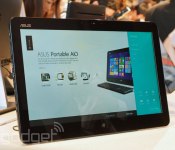
ASUS’ 20-inch ‘portable’ all-in-one PC has gesture controls and a carrying handle

Portable can mean different things to different people, and ASUS is also severely stretching the definition of the word with its new 20-inch all-in-one PC. The built-in battery will apparently go the distance, as long as said distance takes five hours, while a fold-out handle ledge offers a way to carry it without getting finger smudges on the screen. The unit weighs in at 3.2kg, and when we gingerly picked it up to carry, we were left wishing for a handle that was a little more substantial.
The AIO is pitched at families, with built-in gesture controls and navigation for web-browsing and more, as well as an adjustable hinge attempting to offer plenty of different ways to swipe around Windows 8 (yep, it’s touchscreen.) While it has no pretensions of being a games machine, there’s still 4GB of RAM, a Core i5 processor and NVIDIA’s GeForce 820M GFX powering it all, complementing the 1,600 x 900 IPS screen. As ASUS’ big Computex presentation kicks off, we haven’t been given a price yet, but if Jonney Shih decides to fill us in, we’ll share the knowledge.

ASUS launches 3 new 64-bit tablets: ASUS Fonepad 8, MeMO Pad 7 and MeMO Pad 8 [Computex 2014]
 Computex 2014 is now in town and the biggest Asian technology manufacturers are out in force to show off their latest and greatest. Included in ASUS‘ usual grand showcase are 3 new tablets, the ASUS Fonepad 8, MeMO Pad 7 and MeMO Pad 8, all of which house 64-bit processors. Starting with the ASUS Fonepad 8 (pictured above), the device intuitively has an 8-inch 1280×800 IPS LCD display with side bezels that measure just 5mm. The quadcore Intel Atom Z3560 processor inside of it chugs along at 1.8GHz and is also 3G capable, and also features dual speakers situated on the top and bottom bezels of the device.
 Next is a newer version of the ASUS MeMO Pad 7 (above), which also intuitively has a 7-inch display and a more regular 720p resolution. There is a 5MP camera to be found on the back of the device and it is powered by a quadcore Intel Atom Z3745. Unsurprisingly, the MeMO Pad design does seem to take a lot of design cues from the ASUS-manufactured Nexus 7.
 And lastly is the ASUS MeMO Pad 8, which ASUS is calling “the world’s lightest 8-inch LTE tablet”. Also sporting dual speakers, this time on the rear of the device, the MeMO Pad 8 is a substantial jump from the 7-inch variant; with an 8-inch 1080p display and a 64-bit quadcore Intel Atom Z3580 clocked at 2.3GHz, the MeMO Pad 8 is a formidable tablet. Throw in some physical traits like a metal coated chassis and measuring only 7.3mm thick, and you have a very attractive device. Unfortunately, ASUS hasn’t yet explicitly mentioned availability or pricing for any of these devices, but that’s likely to come through soon.
Who would be interested in getting one of these three tablets? Is the fact they are 64-bit powered mean anything to you? Let us know what you think in the comments.
Source: ASUS via Phone Arena
//<![CDATA[
ord = window.ord || Math.floor(Math.random()*1E16);
document.write('’);
//]]>
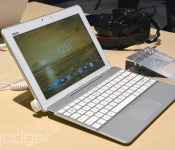
ASUS Transformer Pad refreshed with front speakers, lighter keyboard

It’s been a while since we last heard about ASUS’ Transformer Pad series, so today’s announcement of two new 10.1-inch models was a nice surprise. Starting from the higher end we have the TF303CL, which not only features Intel’s 64-bit, 1.86GHz quad-core Atom chip (Z3745), but it also supports LTE for Europe and Asia-Pacific. Otherwise, the plastic tablet packs the usual set of goodies for a decent Android tablet: a 1,920 x 1,200 IPS display, 2GB of RAM, 16 or 32GB of storage with microSD expansion, 5MP/1.2MP cameras (a downgrade from the old 8MP main imager) and a 25Wh battery. The TF303CL is also enhanced with stereo front-facing speakers, as opposed to the old single-channel speaker (but with two drivers) on the back.
A less obvious change is the removed battery in the new keyboard dock, which is for both reducing its weight — from 546g to 505g, so just 1.1kg when docked — and also for keeping the price competitive; though there’s no pricing info at the launch event. As with most ASUS tablets, this one seems to have a solid build quality, and we dig its textured shell that deters fingerprints. ASUS’ Zen UI is also a nice touch on Android 4.4 — elegant and not too heavy. Expect this device to arrive in Q3 with blue and gold color options.

ASUS also announced the WiFi-only TF103C as the entry-level refresh of the Transformer Pad line. Apart from the processor and the microSD expansion, pretty much everything else have taken the cost-down route: 1,280 x 800 IPS display, 1GB of RAM, 8 or 16GB storage options, 2MP/0.3MP cameras and a 19Wh battery. This will arrive in the coming weeks with white and black options, followed by a 3G version (TF103CG) due July. Again, no prices for now, but they will no doubt be very attractive.
 AIVAnet