


Apple’s 4-inch iPhone is reportedly a 6 in a 5S case
 It’s right around that time of year when iPhone rumors start heating up and 2016 is no exception. Earlier this week, there were rumors floating around that Apple could be working on a 4-inch iPhone 6c, theoretically for those who missed the smaller iPhone screens of old. Mark Gurman of 9to5Mac, however, is debunking that tall tale. Instead, Gurman says that the rumored phone is actually just an upgrade of the existing iPhone 5s that was released way back in 2013 and is in no way an indication of what the iPhone 7 would look like (The 5se would still have its headphone jack, for example). Its launch name? Gurman, who usually has reliable sources, says it could very well be the “iPhone 5se.”
Apparently that “se” refers to “special edition” and points to a phone that looks and feels very similar to the 5s, but has all new internals and software that would make it parallel to that of the 6 and 6s. For example, the 5s’ chamfered edges would be replaced by the curved glass on the iPhone 6 line, while the cameras would be upgraded to 8-megapixel for the rear and 1.2-megapixel for the front. It’ll also apparently have support for larger panoramas, autofocus for video recording, A8 and M8 chips from the iPhone 6, and, of course, an NFC chip so you can use Apple Pay. And it’ll supposedly be available in space grey and rose gold as well. Interestingly, Gurman also says that Live Photos will be supported on the 5se, but it won’t have 3D Touch — that’s a tech that’s only on the latest iPhone 6s.
According to Gurman, one of the reasons Apple is doing this is to prompt upgrades from those who are still holding on to the 5s as well as a way to offer an alternate design to those who don’t like the larger and thinner iPhone 6 hardware. Apple would also reportedly be discontinuing the 5s as a result, and the 5se could be available as early as late March or early April. Of course, we suggest taking these early reports with a grain of salt, but that timeline does fit with the rumor of an Apple event in March.
Source: 9to5Mac
Twitter for Mac Gets Major Update With Revamped Design, New Features
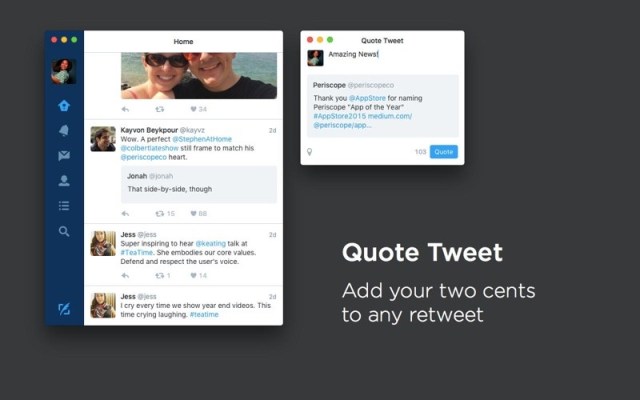
Twitter for Mac today received its most significant upgrade since 2013, introducing a range of new features to bring the Mac app in line with the iOS and web experiences. Twitter for Mac 4.0 includes an updated design with improvements to icons, buttons, and interactions, and it brings a new dark theme to change the background from white to black.
Along with a new look, Twitter for Mac is gaining several new features like inline video playback, GIF support, Group Direct Messages, a mute option, and the ability to quote tweets. All of these features have previously been available within the Twitter iOS app and on the web. Today’s update also includes a new Today Center Widget for viewing Twitter highlights in the Apple Notification Center on the Mac.
Don’t call it a comeback!
Twitter for Mac is getting the update you’ve been asking for. Now it looks and feels more like the Twitter you carry with you everyday. We’ve built in some of the most-requested features so your Twitter for Mac experience combines what you love about Twitter with the elegance you expect on a Mac. Here’s what we’ve added:
– Inline video playback – You’ll see videos play directly in your feed.
– GIFs support – See animations without leaving your timeline.
– Group Direct Messages – Create and receive private notes with up to 50 people.
– Mute – Silence specific accounts so you no longer see them in your feed.
– Today Center Widget – Get your Twitter Highlights right on your desktop.
– Dark Theme – Now you can see the world in black or white.
– Updated design – Get the latest improvements to icons, buttons, and interactions.
– Quote Tweet – Add your two cents to any Retweet.
The Mac Twitter app received a minor update in August of 2015, but beyond that, the app has gone untouched since 2014. The last major version update ahead of today’s refresh was introduced in December of 2013.

Twitter for Mac can be downloaded from the Mac App Store for free. [Direct Link]
Discuss this article in our forums
AT&T to Stop Offering Two-Year Phone Contracts Starting January 8
Starting on January 8, 2016, AT&T plans to introduce a “pricing simplification effort” that will see the end of device subsidies and two-year contracts. According to an internal training document shared by Engadget, new and existing AT&T customers will only be able to purchase a smartphone at full price or with an AT&T Next payment plan going forward.

As outlined in the document, the new rules apply to all of the phones that AT&T sells, including smartphones and more basic devices, which will be paid for using new installment plans. More information on how AT&T will handle corporate accounts and non-smartphone devices like tablets and wearables will become available after an official announcement from AT&T, but it appears certain corporate users will be able to continue making two-year contract purchases.
The shift away from two-year contracts and iPhone subsidies began with T-Mobile in 2013, when the company introduced its Un-carrier payment plans uncoupling device costs from plan costs. Verizon followed suit in August of 2015, debuting new smartphone rate plans and eliminating its subsidized two-year contract option for new users.
Existing Verizon customers can still renew their two-year contracts, but AT&T’s no-contract implementation is more extreme and will not offer existing customers the option to keep their contracts once they expire.

AT&T has already been working on shifting away from two-year contracts by pushing its Next plans. In June of 2015, AT&T forced Apple and other third-party retailers to remove the option to purchase AT&T phones with a two-year contract, leaving customers with AT&T Next or a full-priced smartphone as their only third-party purchase options.
Discuss this article in our forums
Microsoft Considering Smaller Xbox One as Potential Apple TV Rival
Microsoft may be gearing up to launch a new Xbox One gaming console in 2016, with a download-only device that would be noticeably smaller than the current Xbox One and enter the market as a potential rival to the new Apple TV. According to a report from Petri IT Knowledgebase (via Business Insider), the console would also see a price cut to match the current market of streaming-centric devices.
 Keeping with the Xbox brand, the slimmer Xbox One would be able to download games from the Windows Store, but the power restraints of a smaller box would likely prevent access to the full Xbox games store. This casual-leaning app marketplace is another category in which the Xbox would compete directly with the new Apple TV, which introduced a similar App Store for the first time on Apple’s living room device when it launched in October. The report gave no mention as to whether the Siri-like Kinect would be integrated as well.
Microsoft is said to be looking at a late 2016 launch for the new Xbox One, which would be sold in concert with current models akin to the slimmed down Xbox 360 S that launched five years after the original 360. The company has introduced design refreshes and low-tier prices on its gaming consoles in the past: as low as $199 for the 256MB Xbox 360 Arcade and 4GB Xbox 360 E. Although the Xbox One has seen multiple price cuts, it’s yet to have a major hardware overhaul.
Discuss this article in our forums
Apple’s Kevin Lynch Explains Method Behind Apple Watch’s Precise Timekeeping
 One of the Apple Watch features Apple often highlights is the device’s precise timekeeping, which Apple says is within 50 milliseconds of the global time standard. Apple’s VP of Technology, Kevin Lynch, today spoke with Mashable and The Telegraph to share some details on how Apple achieves that level of accuracy.
Lynch told Mashable that the Apple Watch is so accurate that the hands of two Apple Watches placed next to one another will move in perfect unison. This is achieved primarily through 15 Network Time Protocol (NTP) servers that Apple has around the world, kept inside of buildings with GPS antennas that connect to GPS satellites broadcasting time data from the U.S. Naval Observatory in Washington, D.C. The Observatory houses an ultra accurate atomic clock, which uses electronic transition frequency to measure time.
Apple’s time servers communicate the time to iPhones across the world, and the iPhone in turn syncs with the Apple Watch via Bluetooth to provide the exact time. Communicating a GPS signal from a server to an iPhone to an Apple Watch over Bluetooth has its own delays, which Apple corrects for via software. Apple’s NTP servers make sure iPhones and Apple Watches keep time at “Stratum One” accuracy, within milliseconds of “Stratum Zero” devices.
Speaking to The Telegraph, Lynch also described the hardware inside of the Apple Watch that makes sure the time remains accurate. Each Apple Watch has a temperature-controlled crystal oscillator inside to combat time drift that clocks and watches see. The oscillator also makes sure the Apple Watch remains warm enough to keep accurate time in very cold climates. Thanks to this hardware, the Apple Watch is even more accurate than the iPhone.
“The second hand on every Apple Watch is perfectly in sync, and each device is accurate to 50 milliseconds of Co-ordinated Universal Time (UTC), the world’s time standard, which is below human perception, so when you look at it you can’t tell the difference,” he explains.
With New Year’s Eve approaching, Lynch says Apple Watch owners will have the most accurate watches in the room. “If you’re in a room on New Year’s Eve wearing one, you will be the best reference for when the New Year actually begins,” he said.
Discuss this article in our forums
Apple Hosting In-Store Art and Photography Workshops Beginning Next Month
Apple has announced plans for in-store art workshops to give customers “at all skill levels” some hands-on time with image capturing and art-centric apps (via CNET). The classes aim to not only instruct attendees on photography techniques like long exposures and light trails, but will equip them with various iPhone and iPad accessories in attempting to introduce new and creative ways to take photos and create artwork on an Apple device.
 A painting part of Apple’s “Start Something New” campaign
“We’ll help you try out various accessories and techniques — like long exposure for light trails, using Time-lapse to show progression, or getting up close with nature using a macro lens,” Apple said in a statement. “Then, we’ll explore artistic ways to adjust and edit your photos, so you can create a work of art, find your style, or just improve your skills.”
In addition to an iPhone-focused photography session, Apple Stores will offer an iPad workshop centered around drawing and painting on the tablet. The company didn’t give any detail as to whether the workshops will require specific iPhone and iPad models, but there’s a good chance that the improved 12-megapixel camera on the iPhone 6s and Apple Pencil support on the iPad Pro will be a big focus.
The workshops are the newest addition to Apple’s “Start Something New” campaign, which it has introduced coinciding with the New Year holiday over the past few years. The campaign features a collection of artwork — including paintings, photos, drawings, and even short films — that were all created using Apple products and accessories. Apple has yet to set a start date for the in-store workshops, but promised that each Apple Store around the world would be joining in on offering the creative sessions.
Tag: Apple Store
Buyer’s Guide: iPhone (Buy Now), iPad Air (Don’t Buy)
Discuss this article in our forums
Apple fined $347 million for Italian tax… irregularities

Apple’s Italian subsidiary has reportedly been slapped with a €318 million ($347 million) bill for failing to pay tax in the country. According to the BBC and La Repubblica, authorities found disparities between the amount of money it brought in and the amount it handed over between 2008 and 2013. In that five-year period, it’s believed that the firm paid just €30 million ($33 million), significantly less than the €880 million ($961 million) it’s believed to have owed.
Apple is one of the wealthiest companies in the world, not just by revenue, but also by the amount of cash that’s sitting in its bank account. Its ability to make money so successfully has been questioned by several countries, who feel that something nefarious is going on. Apple, and Tim Cook, have both maintained that it pays every penny of tax that it owes, but that situation isn’t entirely accurate.
For instance, the company signed a sweetheart deal with Ireland in order to base its European subsidiary in the country. The arrangement enabled the firm to get one of the lowest rates of corporation tax on the continent in exchange for creating jobs locally. The European Union decided that the pact was illegal, and Ireland has been forced to eliminate the “double Irish” loophole that enabled firms to hide cash from authorities. Apple’s current deal, for instance, will expire at some point before 2018.
The firm has also come under attack on home soil for the same reasons, with lawmakers asking why it won’t bring back some of its vast reserves to the US. Tim Cook says that it’s not good practice — and in violation of good business thinking — since repatriating that money incurs a 35 percent levy. The CEO, along with others, has previously lobbied the US to either reduce that rate or to introduce a tax holiday as a one-off.
It’s likely that the skirmishes about Apple’s cash pile will remain relatively minor, since the SEC has previously found no wrongdoing on the company’s part. Despite this, former senator Carl Levin once described Apple’s use of the “double Irish” loophole as “the holy grail of tax avoidance.”
[Image Credit: Robert Alexander/Getty]
Source: La Repubblica, BBC News
Report: Samsung and LG to supply AMOLED panels for new iPhones
AMOLED, OLED, EL, SAMOLED, YOUM, POLED: whatever abbreviation one chooses to give organic display technology, they all describe the same basic results: deep inky blacks, vibrant colors, and near infinite contrast. Samsung has made a name for its Galaxy S and Galaxy Note series in part, because of the Super AMOLED panels the devices make use of. Even LG has gotten into the game with its G Flex series, and smartwatches. Now however, it seems that both companies are going to be working hard to put out panels for…Apple.
According to a new report published today by Korean site etNews, the contracts have been finalized and are simply awaiting signatures to officiate. The possibly pending production won’t come cheap however, and will apparently require Samsung and LG to invest a total of $12.8 billion over the next 2 or 3 years, some of which Apple itself may help finance.
LG’s lines

The source goes on to state that LG Display, which already has experience in supplying displays for Apple, “has had relatively smooth contract discussions” and is simply awaiting a signature to solidify the deal. Furthermore, LG may now begin to “reduce…investments for facilities by changing current LCD lines to flexible OLED lines.”
LG Display may begin by first supplying 30,000 panels per month on a Generation 6 board. Upon reaching a stable production yeild, the Korean OEM will then increase supply of anywhere between 45,000 to 60,000 sheets per month. Given the relatively small numbers being discussed – for reference iPhones sell tens of millions – , it is stated that:
Because flexible OLEDs that are produced from Gen 4.5 (E3) Line in Paju do not have any experience in 6th Generation, LG Display is planning to start small and gradually expand its size. From 1 sheet of Gen. 6 glass substrate, 288 5-inch cellphone panels can be produced. If LG Display increases production capability up to 60,000 sheets in the future, it will be able to mass-produce 200 million 5-inch OLED panels per year.
Samsung’s story

On the other side of the competitive aisle, Samsung is quoted at receiving 30% more allocation than LG Display because of its current production facilities that already allow for high yields. Specifically, Samsung is quoted with a figure of around 90,000 sheets each month, for a 2 or 3 year period.
EtNews goes on to state that,
Negotiation between Samsung and Apple is not going too smoothly. It is heard that both businesses’ stances are considerably tense on unit cost of products, technical cooperation, advance investments, and others. Because unit cost that Apple is requesting is excessively low while level of technical cooperation is high, there can be a chance where somehow Samsung’s major know-hows can flow into Apple.
Cost is cited as a major factor here, noting that:
Samsung Display was able to collect considerable amount of operating profit as it was supplying Smartphone OLEDs to China. Smartphone OLED is a major profitable product that has higher profit rate than LCD. However as Apple is requesting one-digit percent margin, negotiation is not progressing too smoothly.
Other problems listed include Apple’s well-publicized “hands on” approach to product development, something that Samsung is allegedly concerned with as it may ultimately allow competitors to reap the benefits in terms of production know-how.

The piece then ends with a quote from an unspecified person within the industry:
Although Samsung Display and LG Display are planning to start supply their OLEDs to Apple starting from 2018, they can start supplying OLEDs as early as 2017…Although Apple is requesting large amount of supplies from the start, they are carefully going over size of investments for facilities because panel manufacturers can be financially burdened since there will be more supplies than demands in the future.
The situation room
While the idea of Apple adopting AMOLED display panels has been floating around the rumor mills for seemingly ages now, this is arguably one of the most solid assertions that such a transitioning phase has begun. Just weeks ag
AMOLED is also a potentially big source of money for both Samsung and LG, two companies that have fallen on harder times given the intense, keen competition from smartphone and tablet manufacturers in China and India. Both companies have seen their market share erode over the past two years, and both have taken more dramatic steps to try and find a profitable picture beyond end-user product sales.

LG recently reorganized itself to allow its display division greater speed and agility. Samsung’s CEO even went all out and basically warned of a path to ruin less the company makes major changes now. In addition to this, on another tangent, a rumor has broken out suggesting neither company will make the jump to 4K displays in their 2016 flagships and Samsung in particular, allegedly opting to release a Galaxy S7 that has very little visual differences going on compares with this year’s model.
Meanwhile, AMOLED was recently reported with having its most profitable quarter yet, and Samsung taking a lion’s share of the profits, with 95.8% of the market. HTC has used an AMOLED panel in its One A9, OnePlus uses them for the X one, Apple uses them in the Apple Watch units, LG uses them in its LG G Watch R and Urbane series as well as the – possibly discontinued – G Flex series. Even Samsung has made it a proper priority to place these panels in plenty of its non pinnacle of premium products.
Pwned by OLED?
Despite the claims of OLED panels offering superior battery life thanks to individual pixel backlighting and thus blacks require none whatsoever, the results are oddly polarizing. While some absolutely love AMOLED and refuse to buy anything that’s not making use of it, others have a decidedly different perspective, calling it oversaturated, cartoonish, or undesirable.

HTC One A9 (unlocked, international) has a Color profile setting with four different options.
While Samsung has featured “Screen Mode” settings for years now, even HTC and Google have gotten in on the action. Perhaps dye to the requirements of finding the correct menu selection setting however, most users still seem to be unaware the “hyper” realistic color schemes can be reduced.
In a recent poll on Google Plus, Android Authority community users were asked which they preferred, AMOLED or LCD. As of the time of publishing, 1,341 users had participated and the results were split with 86% favoring the former, and just 14% liking the latter.

It is almost a given that Apple users will take to AMOLED should this news pan out, especially considering that many already cite the use of laminated glass as giving the devices fantastic color reproduction as is due to the lack of air between the glass and display.
And about Android?
Bringing this piece back to Android, two potential points are worth mentioning:
- By the time Apple finally does manage to implement AMOLED displays into its iPhones – many state it wouldn’t happen until at least 2017 – Android OEMs may very well be widely using the panels. Currently Samsung, LG, OnePlus, Huawei, HTC, and Motorola have released products in the past year that make use of them, and potentially more in the year to come.
- In the event OEMs aren’t using AMOLED by the time Apple does, it is highly possible they may switch over due to the general public’s inevitable “wake up call” to the technology.
An increase in AMOLED use may in turn have other effects on Google’s mobile OS. For example it would be conceivable that Google could formally introduce Night Mode to capitalize on the technology’s use of black colors to save power. Likewise, it might follow that “Active Notification” options become more standard for Android.

Moto X: Active Display and Active Notifications | Image Credit: Android Police
Increased competition in the AMOLED market might also ultimately spur Samsung and LG to create new types of screens and further advance the progression of bendable, foldable, and wearable displays.
LCD prices would possibly fall if demand shifts to AMOLED, which might increase the quality of panels seen on lower-end smartphones, devices that typically avoid things such as IPS LCD due to the extra costs involved. It is worth mentioning that Quantum Dot, Pixel Eyes, and IGZO are all competitors to AMOLED, and that – as ASUS often does – it’s also possible to include color profile adjustment settings on LCD displays as well.
On the other hand, should Apple start buying large quantities of AMOLED panels in bulk, it might drive up the price for the technology considerably, a cost that might be passed onto the customer. It might also mean that OEMs go for inferior AMOLED panels to save money.
It is actually worth posing the question: why did Motorola drop AMOLED from the Moto X Style (Pure Edition) when both the original Moto X and the Moto X (2014) made use of it. Could it be due to pricing/cost related issues? Notice the Moto X Force (Droid Turbo 2) makes use of an AMOLED panel, yet costs considerably more.
Wrap Up

The idea of Apple transitioning to AMOLED panels is nothing new, but the news of a possible contracted agreement to begin the process is a very big development. It is highly unlikely Apple itself would make a press release of the venture given the tendencies it has to keep non-internal component related business dealings as low key as possible. Consider that the company, to this day, still does not mention Gorilla Glass, nor does it make a point to mention the companies who supply the components for its products. The list includes Samsung, LG, Sony, Sharp, and many more, yet all the mainstream public hears about is Apple’s A9 Soc or Apple’s camera.
We are eager to hear your take on this matter. Does Apple’s potentially making use of AMOLED have a collective benefit in the business, or will it make things worse? Is Apple eager to make use of the power saving features, or does it just want to “copy” Android OEMs? Would an AMOLED iPhone potentially spell trouble for LCD Android devices in terms of the mainstream consumer’s decision making process?
Please leave your comments below and let us know!
(function ()
document.getElementsByTagName(‘body’)[0]).appendChild(opst);
());
Apple to Pay 318 Million Euros in Italy to Settle Corporate Tax Probe
 Apple has agreed to pay 318 million euros in Italy to settle an investigation that determined the iPhone and iPad maker failed to pay nearly triple that amount in corporate taxes in the country over a five year period, according to Italian newspaper La Repubblica.
Italian regulators in Milan concluded a tax probe of Apple in March, accusing the company of booking profits generated in Italy through an Irish subsidiary in an effort to lower its taxable income base and save 879 million euros between 2008 and 2013.
Apple has yet to comment on the deal, but previously said it has paid all necessary taxes in countries that it operates. “These new allegations against our employees are completely without merit and we’re confident this process will reach the same conclusion,” the company said in March.
Apple Italia is part of the company’s European operation headquartered in Ireland, where Apple pays a significantly lower corporate tax rate compared to other EU countries. Ireland has a corporate tax rate of 12.5% for normal business activities, compared to a standard rate of 27.5% in Italy, per The Guardian.
Apple faces a similar Irish tax probe by the European Commission, which formally accused the company of receiving illegal state aid from Ireland in September 2014. A decision in the lengthy investigation has likely been delayed until early 2016, as the Brussels-based executive cabinet has requested supplementary questionnaires.
Apple’s tax policies in Europe have come under intense scrutiny over the past three years, as the company is said to utilize multiple subsidiary companies located in the Irish city of Cork to move money around without significant tax penalties. Apple continues to deny any wrongdoing, and CEO Tim Cook recently described the accusations as “total political crap” on 60 Minutes.
Discuss this article in our forums
Matias Duarte: we need to stop basing design on archaic concepts

Everyone keeps talking about how far technology has gotten the past decade or so, but that is not exactly what the bigger brains in the industry believe. After some talks with a couple Foxconn engineers, I realized technology has gone through more of an evolution, as opposed to a revolution. The truth is it’s all the same, but faster, more powerful and in different form factors.
The same applies to design, which is a huge part of the experience these high-tech gadgets provide. And we are not alone in this belief; even Google VP of design Matias Duarte agrees that current smartphones are advanced copycats of Apple’s UI from 8 years ago, while tablets and computers continue to follow the desktop graphic user interface (GUI) that was introduced decades ago.

PC interfaces still look like a refined version of the first popular computers. The same goes with smartphone designs – the base is a set of rows and columns of icons. What is the next step? Android Wear comes to mind, a wearable operating system that was forced to change its mechanics due to the limited space Google had to work with.

But is Android Wear the source of the next big jump in technology design? Nobody knows, and Duarte is clear about that.
“I don’t know that Android Wear has the right solution or even is on a vector to the right solution, nobody knows. We’re just trying things to see which are successful. That’s what design is. You form a thesis, you try to do it without any ego or hubris.” -Matias Duarte

Android Wear-related articles:
Matias then goes on to mention he will do everything in his power to get us off the archaic habit of working with a desktop/laptop and a smartphone. Instead he wants us to operate “a much richer, continuous mesh of devices and interfaces”.
Coming up with a new concept isn’t easy, that’s for sure. New and upcoming designers have a lot of work to do. And they should get moving, because a change has be long overdue. I say it, tech leaders say it and even Matias Duarte says it. Do you agree?
 AIVAnet