


Rare Recordings from The Beatles to Launch Exclusively on iTunes Next Week [Mac Blog]
 A digital compilation of 59 rare and unheard recordings from The Beatles is set to be released exclusively on the iTunes Store this coming Tuesday, December 17, reports NME (via BBC).
Titled The Beatles’ Bootleg Recordings 1963, the collection of music is reportedly being released in order stop the expiration of the copyright protection surrounding the records, as the tracks themselves consist of BBC sessions, alternative versions of popular hits, and studio outtakes.
EU law protects songs for 70 years after they are recorded, but only if they get an official release. Otherwise, copyright lasts 50 years.
In the case of The Beatles, that means their 1963 debut album Please Please Me is protected until 2033, but the unreleased session tapes for that album are not.
If the Beatles chose not to release the recordings before the end of the year, it would mean other record labels could theoretically put them out and profit from them.
The Beatles’ music originally debuted on iTunes in November 2010 after years of speculation and prolonged negotiation between record label EMI and Apple. The group’s music went on to sell 2 million songs and 450,000 albums in its first week on the iTunes Store, and eventually reached overall sales of 5 million songs and 1 million albums within in two months. Exclusive ringtones by The Beatles also were made available on iTunes in February 2012.
     |

Mac Pro Launch Nears as Apple Business Staff Begin Offering Price Quotes
 With potential customers of the new Mac Pro eagerly awaiting any sign of a more concrete launch date than the “December” timeframe announced by Apple at its October media event, increased activity from Apple’s business team members suggests that a launch may indeed be very near.
While Apple has publicly remained silent on pricing for various Mac Pro configurations beyond the $2999/$3999 stock models in shown in its U.S. online store, members of the company’s business sales team have on occasion been offering pricing quotes on build-to-order configurations upon request.
One Canadian forum member at FCP.co posted late last month that he had been quoted $9700 for a maxed-out Mac Pro with 1 TB flash storage, 64 GB of RAM, dual AMD FirePro D700 graphics, and a 12-core processor. Given Apple’s current currency conversions, U.S. pricing should fall in the range of $9400-$9500, although that quote almost certainly incorporates a small discount made available to certain business customers. A somewhat lower-specced model with 500 GB of flash storage and an 8-core processor was quoted at $7700 Canadian.
But while Apple business team members have had some access to the full price list for the new Mac Pro for at least several weeks, team members appear to have become more proactive over the past several days, contacting business customers who had previously expressed interest in the new Mac Pro to offer them price quotes ahead of the official launch.
One MacRumors forum member yesterday posted a price quote he received from an Apple business sales representative for a build-to-order Mac Pro configuration, a higher-end stock model upgraded with additional RAM and flash storage. Pricing for that configuration came to $4464 in the quote, but retail pricing would be slightly higher.

A second MacRumors reader reported today that he was contacted by a member of Apple’s business sales team requesting desired configuration options for the purposes of generating a price quote. The Apple representative indicated that a price quote could be available by Monday, December 16, but it is unknown if that corresponds to any public release of additional information for that date.
Aside from the recent activity from Apple’s business sales team regarding the new Mac Pro, the rapidly approaching holidays also led to speculation that a Mac Pro launch could come sooner rather than later. Next week is the last full week before Christmas, and with many Apple employees having time off around the holidays, the company would likely prefer to avoid conflicts with the holidays as much as possible.
An alternative theory suggests, however, that Apple may still be working to secure the component volumes it needs to produce a launch batch of the machines. As a result, the company could have little alternative but to launch the new Mac Pro in small volumes at the very end of the month in order to technically meet its stated launch timeframe while being able to push the bulk of its initial deliveries into early 2014.
| |

Retina iPad Mini Shipping Estimates Improve to 1 to 3 Days in Multiple Countries Ahead of the Holidays
As the holidays approach, Apple’s Retina iPad mini supplies have begun to improve, alleviating the supply constraints the product has faced since its quiet November 12 launch.
In the Online Apple Store, Retina iPad mini shipping estimates for all models and capacities, including cellular models, have decreased to 1 to 3 days in the United States, Canada, Mexico, and Asia Pacific. The Retina iPad mini continues to ship within 3 to 5 days in European countries.

The new shipping estimates are a significant improvement from shipping estimates in November, which ranged from 5 to 10 days for multiple weeks before improving to 3 to 5 days in December.
Issues with display yields were reportedly behind Apple’s supply shortages, and as a result of the constrained supplies, Apple launched the Retina iPad mini in the middle of the night, offering the tablet solely via its online store and through Personal Pickup. It wasn’t until 10 days after launch that Apple began allowing walk-in sales of the Retina mini. Cellular models have been the most constrained, with multiple carriers experiencing back orders on cellular Retina iPad minis in November.
Just a few weeks ago, a report suggested Apple had solved its production problems, allowing it to build up some supplies for the holiday shopping season. Along with shorter shipping estimates, in-store supplies of the Retina iPad mini appear to have improved slightly as well, with several colors and capacities available for immediate pickup in quite a few Apple Stores around the country.
According to an unofficial web tracker, supplies of the 16 and 32 GB Wi-Fi models are widely available, while the larger 64 and 128 GB Retina iPad minis and all cellular minis remain in shorter supply.
Apple’s holiday shipping guidelines now suggest that U.S. customers order the non-engraved Retina iPad mini by December 16 for a December 24 delivery with standard shipping.
(Thanks, Leonard!)
| |

Sprint Working on Potential T-Mobile US Purchase
 Sprint is preparing a possible bid for T-Mobile US, reports The Wall Street Journal. If permitted by antitrust regulators, a potential merger between the two companies would result in just three major carriers in the United States.
Sprint is studying regulatory concerns and could launch a bid in the first half of next year, the people said. A deal could be worth more than $20 billion, depending on the size of any stake in T-Mobile that Sprint tries to buy.
Sprint hasn’t yet decided whether to move ahead with a bid. Going forward despite regulators’ concerns would be highly risky. Any pursuit of a bid by Sprint could be aimed at testing antitrust officials’ reaction to a deal, and a bad reaction could put an end to the effort.
Currently, T-Mobile US, which operates under the T-Mobile, MetroPCS and GoSmart brands, is the fourth largest carrier in the United States with 45 million customers. Sprint is the third largest carrier with 54 million customers. Combined, the two companies would be come close to reaching the subscriber numbers of the larger carriers in the U.S., Verizon and AT&T, at 119 million and 108 million customers each, respectively.
Both Sprint and T-Mobile have struggled to keep up with competitors like Verizon and AT&T, which have installed much larger LTE networks. A merger between the two companies would likely see significant service improvements for customers, due to a larger network infrastructure.
It is unclear whether such a merger would be permitted, as AT&T previously tried to purchase T-Mobile US in 2011. The Federal Communications Commission and the Department of Justice both made moves to block the transaction, putting an end to the acquisition. AT&T had planned to pay $39 billion in cash and stock for the company.
According to the report, Deutsche Telekom AG, which owns approximately 67 percent of T-Mobile US, is looking to exit the U.S. market.
| |

China Mobile Stores Going All Out for iPhone and iPad Promotion
Following the start of pre-orders for the iPhone 5s and iPhone 5c on China Mobile earlier this week, new photos from PRC and ME show just how much the world’s largest carrier is emphasizing its launch of Apple’s products.

The carrier’s relatively small store at the Link City shopping mall in Shenzhen is covered in Apple promotional signage, including wall-mounted banners and a large scrolling digital ribbon sign advertising discounted pricing on the new iPhones, extra free-standing signage, and even a flatscreen television replaying video of Apple’s iPhone 5s/5c introduction from September.
Not only were there Apple advertisements all over the place, but even Phil Schiller was present, his A7 chip announcement playing on a flatscreen TV. A majority of the ad and display space in the store had been dedicated to Apple. If this is any indication, China Mobile is planning to aggressively promote their new Apple partnership in the hopes of blunting any advances from China Unicom and Telecom.
One of the store’s two display tables is entirely devoted to Apple products, with iPhone 5s, iPhone 5c, iPad, and iPad mini units on display for customers to try out, extra iPhone 5c samples showing the various color options, and a China Mobile salesperson staffing the table at a large iMac.
The China Mobile iPhone launch comes just as market research firm Counterpoint Research revealed a significant jump in Apple’s smartphone market share in China in October, with Apple leaping from sixth place to third with over 10% of the market on the strength of the iPhone 5s and 5c launches. With China Mobile opening iPhone availability up to millions of potential new customers beyond launch partners China Unicom and China Telecom, Apple is clearly looking to make a significant move in the world’s largest market.
| |

Older Versions of Safari Store Login Info in Plain Text [Mac Blog]
Older versions of Safari for Mac store unencrypted user login credentials in a plain text file, according to security firm Kaspersky (via ZDNet). Safari saves the information in order to restore a previous browsing session, reopening all sites, even those that require authentication using the browser’s “Reopen All Windows from Last Session” functionality.
 Plist file screenshot showing login credentials from Kaspersky
It turns out that Safari for Mac OS, like many other contemporary browsers, can restore the previous browsing session. In other words, all the sites that were open in the previous session – even those that required authorization – can be restored in a few simple steps when the browser is launched. Convenient? Of course. Safe? No, unfortunately.
Safari 6.0.5 for OS X 10.8.5 and 10.7.5 does not encrypt previous sessions, storing them instead in a standard LastSession.plist file that includes website usernames and passwords. Though the file is located in a hidden folder, it is still easily accessible and can be opened on any system.
Apple fixed this issue in Safari 6.1, which was released alongside OS X 10.9 Mavericks. Mac users running Mavericks or those who have installed the Safari 6.1 update for OS X 10.8 Mountain Lion or OS X 10.7 Lion will not be affected. This problem is limited to users running Safari 6.0.5 and can be remedied by upgrading to the latest software.
| |

Apple Seeds iOS 7.1 Beta 2 to Developers
Apple today released the second beta of iOS 7.1 to registered developers for testing purposes, following the release of the first iOS 7.1 beta back in mid-November. The update can be downloaded via Apple’s developer center and carries a build number of 11D5115d.

Release notes from the first iOS 7.1 beta indicated that the update fixes network connection issues in addition to other bugs. The beta also included a new Yahoo logo, extra burst mode uploading options for the camera, and an option for a “dark keyboard” in the Accessibility section.
Apple has also seeded a new version of the Apple TV beta software, along with Xcode 5.1 Developer Preview 2.
| |
BearExtender Turbo Adds 802.11ac Wi-Fi to Older Macs [Mac Blog]
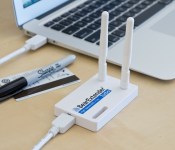
BearExtender today announced the launch of BearExtender Turbo, a new USB-based solution for adding faster 802.11ac Wi-Fi connectivity to older Macs. Regularly priced at $80 but available through Amazon for $70, BearExtender Turbo can boost Wi-Fi speeds by up to 2-3x for Macs supporting USB 3.0 but not 802.11ac natively.

Using AJA System Test on Mac OS X 10.9 Mavericks, a 2GB file was transferred between a Mid-2012 802.11n MacBook Air and a 2013 Apple Time Capsule at a rate of 10.66 Megabytes per second (MB/s not megabits). The same test with BearExtender Turbo connected to the MacBook Air’s USB 3.0 port had a rate of 23.84 MB/s, more than twice the Macbook Air’s internal Wi-Fi card.
While speed bottlenecks for most users will continue to be their actual ISP connections when connecting to the Internet, 802.11ac is particularly useful for transferring large amounts of data between machines within a network.
BearExtender Turbo supports maximum throughput of 867 Mbps and includes dual-band connectivity at 2.4 GHz and 5 GHz for maximum speed and compatibility. The device’s two antennas can also be removed for portability.
| |

Apple’s ‘iWatch’ Said to Arrive in October 2014 with Wireless Charging
According to Chinese site C Technology [Google Translate, via GForGames], Apple is planning to release its long-rumored iWatch alongside the next iPhone in October 2014, with the company having tested two iWatch prototypes. However, the report also states that Apple has not decided on the final screen size of the device, with the prototype units being powered by a 100 mAh battery. The iWatch is also said to include wireless charging capabilities which will allow the device to charge from up to a meter away.
The report questions the reported inclusion of a 100 mAh battery, noting that it seems far too small to allow for significant battery life. Samsung’s Galaxy Gear watch contains a 315 mAh battery and has received criticism over poor battery life.
 Sixth-generation iPod nano with watch face
Battery life has previously been reported as being an issue for Apple, with iWatch prototypes lasting only 1-2 days on a charge and the company hoping to find ways to extend that to 4-5 days. C Technology notes that wireless charging would be one way to reduce the burden of frequent charges, but it is unclear exactly how it would be implemented by Apple. A 100 mAh battery in the iWatch would roughly match the 105 mAh battery seen in the sixth-generation iPod nano that was designed in part to be able to be used as a watch.
In contrast, a report last month from Digitimes stated that the iWatch would be released in Q2 2014, with component makers having started pilot production for the device. The report also stated that low part yields have pushed back mass production of the device from an internal target date of Q1 2014 to Q2 2014, with Apple suppliers Quanta, Inventec, and Foxconn said to be competing for iWatch production orders.
iWatch reports have surfaced throughout the past few months, with Apple rumored to be releasing both 1.7 and 1.3-inch display sizes of the watch for men and women. NPD DisplaySearch analyst Paul Gagnon also noted that Apple appears to have put its major television product plans on hold for the time being in order to focus on wearables such as the iWatch.
C Technology‘s rumor track record is mixed, with the site being a frequent source of accurate iPhone 5s and 5c photo leaks leading up to the launch of those devices but also sharing several inaccurate pictures claimed to be of iPads in gold and/or with Touch ID prior to the introduction of the new tablets.
| |
Pebble Smart Watch Adds ‘Do Not Disturb’ Option, Enhanced Notification Control [iOS Blog]
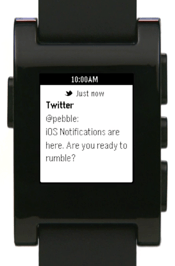 Pebble today released an update for its smart watch that enables various features, including a “Do Not Disturb” function that blocks notifications for a specified period of time, and the ability to create multiple alarms.
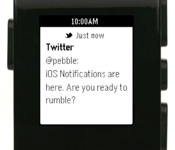
Also included is improved control over notifications which allow the user to specify which types of messages are displayed, and enhanced iOS connectivity performance along with various bug fixes.
What’s New
Do Not Disturb. Block notifications for a set period of time (from Pebble: Settings » Notifications » Do Not Disturb).Alarms app update. Create multiple Alarms, toggle Alarms on/off, and edit existing Alarms.
New “Snooze Alarm.” Customizable via the Pebble Alarms app.Improved Notification Control. Specify what notifications are displayed (Notifications On, Phone Calls Only, or Notifications Off). Notification settings are now accessible more quickly through a dedicated menu (Settings » Notifications).
Improved iOS performance. Notifications are now sent more quickly from your iOS device to Pebble. After exiting Airplane Mode, Pebble will now search for connectable iOS devices immediately, instead of waiting one minute.
The device was also updated earlier this month with full support for iOS 7 notifications along with the addition of a developer SDK and APIs for Javascript, the accelerometer, data logging and persistent storage.
Originally, the Pebble raised more than $10 million on Kickstarter, potentially proving the viability of the smart watch as a product. Apple is also said to be working on its own iWatch and recently invested hundreds of millions of dollars in a new Arizona factory to make sapphire glass, perhaps for such a product.
The Pebble smart watch is available for $150 from getpebble.com and at Best Buy and AT&T retail stores. 
| |

