



A closer look at Apple’s new Mac Pro workstation (hands-on)

We know, we know: everyone who’s seen it says it looks like a trashcan. But surely there’s something else to say about Apple’s new Mac Pro workstation, right? The thing is, until now, any tech blogger who’s spent any time with it has had to take photos through a glass case (read: they didn’t really spend any time with it). Finally, though, the Mac Pro is on sale, and we’ve just come home with a review unit, meaning we’ve finally had the chance to lay our hands on it. In person, it somehow feels smaller and shorter than I imagined, at 9.9 inches tall. Either way, it should take up minimal space if you’re working on location — and yes, given that it’s only 11 pounds, you could certainly schlep it around as needed.
Aesthetically, the anondized aluminum is more reflective than any of Apple’s other products, which also means it’s more fingerprint-prone. (Not necessarily an issue if you plan on having it tucked away, though you’ll definitely notice it if you engage in some of that aforementioned schlepping.) It also looks less black than it does on Apple’s site — more like the “Space Gray” that it actually is. As it happens, that case is easy to unlock and slip off, on the rare occasion that you want to replace the RAM, storage or one of the GPUs. Hopefully, of course, you won’t need to do this often. And besides, the machine won’t actually turn on unless you have the case locked in, so keeping the lid off indefinitely simply isn’t an option. Even with the lid on, though, the four USB 3.0 ports, six Thunderbolt 2 sockets, HDMI port and dual Ethernet jacks are easy to access, thanks to a cut-out in the aluminum enclosure.
And what of performance? Well, we’d hardly doing the machine justice if we did a deep dive now, but rest assured we’ll be putting the Pro through its paces over the coming days, with a full review to follow soon. Suffice to say, we’ve already seen it play back 16 simultaneous 4K streams in the new version of Final Cut Pro, with zero waiting time as effects were applied to the original footage. Stay tuned for much more on that front and for now, enjoy some (honest-to-goodness) hands-on photos above.
Zach Honig contributed to this report.

Cut The Rope 2 Swings Onto the iPhone and iPad [iOS Blog]
ZeptoLab has released Cut The Rope 2, the latest installment in the company’s wildly popular franchise. Cut The Rope: Time Travel was released earlier this year, while Cut The Rope: Experiments came out in mid-2011. The original Cut The Rope won a 2011 Apple Design Award.
The new game follows the familiar theme set by the prior games, Om, the candy-loving creature, sees spiders trying to steal his candy, though there is a new cast of characters and gameplay elements. The game is $0.99, though there are in-app purchases, mostly focused on special power-ups and cosmetic changes. The game itself is fully unlocked with purchase.
Like most level-based puzzle games and its predecessor, Cut the Rope 2 starts off slow to give the player a chance to learn its most basic functions and controls as ropes are sliced in perfect time to toss the candy into Om Nom’s infectious grin. Things like air cushions and balloons help keep the candy from falling off of a cliff and turning Om Non’s adorable grin into an “awww” producing frown but a bunch new characters add a ton of creative new elements to an already creative game.
What appears to be hedgehogs crossed with aardvarks can spit out their tongues across a chasm creating a bridge to stop or roll the candy towards its final destination. Baby elephant looking creatures turn their long noses into springs to bounce Om Nom or the candy closer together and in the path of stars that can add to the game’s longevity. These whimsical characters add a fun new dimension to what could have been an otherwise dull experience if the developers had just created new levels under the game’s already brilliant design. They expand on a simple concept and give the puzzle creators more possibilities and challenges to throw in front of their players, which gives the players ample opportunities to replay it as they try to capture those elusive stars.
Cut The Rope 2 is available for $0.99 for the iPhone and iPad. [App Store]
     |

First Mac Pro Review Units Out in the Wild
With the new Mac Pro beginning online orders today, review units have begun to arrive at select publications. The Verge is one of the first to show off their unit, posting a short piece with some photos and first impressions.

It’s astonishingly reflective — I can see the screen clearly, and anyone who walks by is immediately recognizable — and it picks up fingerprints really easily. But it’s beautiful, understated, and looks great on a desk next to the 4K Sharp monitor we’ve paired it with. It’s particularly good-looking with its case off, exposing the Mac Pro’s machinery, but the case is required to dissipate heat. You can’t even use the Mac Pro with it off.
All the device’s ports are on the back, bordered by a light that turns on and pulses when you spin the computer toward you. When you first turn it on, the fan kicks in, smelling a little like a new car at first. But we’ve been using it for a few minutes and it’s quiet and cool, with little indication that it’s even on in the first place. It’s so unassuming and unadorned that you almost overlook it — that’s a huge improvement from the big, boxy previous models.
The site promises benchmarks and further testing soon.
Orders for the new Mac Pro now have an estimated shipping time of February, after initially showing estimates of “by December 30″.
Update: An unboxing video has been posted as well.
| |
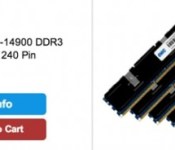
OWC Announces RAM Upgrades for New Mac Pro, Up to 64 GB for $895 [Mac Blog]
Following today’s launch of the new Mac Pro, Other World Computing has announced new RAM upgrade kits for the machines. The ECC 1866 Mhz quad-channel kits are available in both 32 GB and 64 GB at prices up to 31 percent lower than factory upgrade options.

– OWC 32GB Kit (8GB x 4 matched 1866MHz): $449.00
– OWC 64GB Kit (16GB x 4 matched 1866MHz): $895.00
The same upgrades directly from Apple are priced at an additional $500 for 32 GB and $1300 for 64 GB of RAM in the lower-end quad-core Mac Pro and $400/$1200 in the higher-end 6-core Mac Pro.
Crucial has memory upgrade options available as well, with a 32 GB kit priced at $439.
OWC is also offering a trade-in rebate for the original factory memory, giving customers up to $100 towards the purchase of a memory kit. Apple’s Mac Pro, which went on sale at midnight, is currently shipping in February at the earliest.
| |

First Mac Pro Unboxing Video Revealed [Mac Blog]
With the first review units of the Mac Pro in the wild, FCP.co has posted an actual unboxing video of the device.
The Mac Pro, which is assembled and packaged in Austin, Texas, comes in a sleek black box with a plastic handle at the top. Inside, there is minimalist, environmentally friendly molded foam with the aluminum Mac Pro wrapped in plastic for protection.
Several reviewers have commented on the surprising density of the Mac Pro, saying it is heavier than they expected.
| |
Apple Maps App with Interactive Data Layers Detailed in New Patent
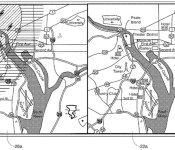
Apple has filed for a United States patent (via AppleInsider) detailing an interactive mapping program that allows users to view different layers of information based on factors such as location, points of interest, and the context of a current situation. While the concept of various layers of information for digital maps is not new, Apple seeks to enhance layering by drawing upon several types of information based on the user’s needs through various “modes”.
The patent introduces itself by describing the problem with existing maps applications and the need for a user to rely on multiple ones in order to gain a complete set of information relevant to a current situation. For instance, the patent gives an example of a user who views a weather map and sees that a storm is coming, and then has to switch to another app to locate a shopping mall or nearby building to take refuge while the storm passes.

The application described in the patent however, would essentially contain all of the various types of information for quick and unified access. With the application in patent, the user in the first example would be able to reveal the weather layer to note that a storm was coming, and then hide that layer and reveal another one giving the locations of nearby buildings to reach safety.
In another aspect, user input can be directed at specific features displayed on the map, such as clicking a mouse button while a cursor is positioned over a dot representing a city, or touching a highway indicator on a map displayed on a touch screen device. In response to such input, the map displays information that pertains to the feature of interest. For instance, clicking on a city dot might result in the display of information pertaining to the city, such as demographics, hotels, flight schedules, etc. Touching a highway indicator, such as a route number shield, may cause the map to display the locations of fueling stations, hotels and restaurants along the route.
Users would also be able to select different modes in order to emphasize map layers that could be useful to a particular interest, such as a commuting mode that would reveal the locations of nearby trains or bus stops and their specific transit times. Other modes could include a shopping mode that would reveal information while in a mall about special deals and sales, similar in nature to how shopping app Shopkick and Macy’s teamed up for the first retail-based iBeacons last month that allowed customers to find location-specific deals, discounts and recommendations while looking at items in the store.
This would also be relevant to search results, as searching the word “food” in tourist mode would give results for locations such as restaurants and cafes, while searching the same term in the outdoor recreation mode would give the locations of camping supply stores.

Another application would be the ability to create routes by touching two points on a map with distance calculations, which would also give the best possible route to select based on context. For instance, if a person is deciding what route to take across a certain area, the mapping application would show the best possible route in terms of traffic density, possible restaurants, weather, and so forth.
Finally, the application would also include geospatial capabilities that can be integrated to provide information based on a specific location. For instance, if a user had a tourism mode toggled and walked through a location of historical significance, then information about facts related to the area could pop up to compliment an experience.
While it is unknown as to whether Apple will actually integrate the technology detailed in the patent into its existing Maps application, the company clearly continues to look to improve its mapping services, as evidenced by a number of recent acquisitions.
For instance, Apple’s purchases of companies such as Embark, HopStop, and Locationary would allow it to pursue some of the mapping capabilities discussed in the patent, and could also be bolstered by the technology provided by PrimeSense, another recent acquisition. With Apple Maps now the clear-cut favorite among iOS users, it would only make sense that Apple look to improve the app beyond any other effort from its competitors.
| |

Apple Updates Logic Pro Audio Apps Alongside Mac Pro Launch [Mac Blog]
Alongside today’s launch of the redesigned Mac Pro and updates to Final Cut Pro X and its associated professional video apps, Apple has also released updated versions of its professional audio apps. Updates include:
Logic Pro X 10.0.5 [Direct Link]
– Adds 3 new Drummers and 11 new Drum Kit Designer patches
– Significant enhancements to Channel EQ and Linear Phase EQ plug-ins including redesigned interfaces that are also accessible within the Smart Controls area
– Solo now works as expected on channel strips using an External I/O plug-in
– Volume and pan automation is now included in XML interchange with Final Cut Pro X
– Loops that belong to the same family can be selected and changed using a new control in the region header
– The waveform size in an audio region now adapts to the value of the region Gain parameter
– The Link mode button is now available for the Piano Roll editor
– Includes stability improvements

– Compatible with Logic Remote v1.0.3
– Save & load times are significantly faster
– Workspace can be hidden to allow a larger area to view Channel Strips
– Various stability improvements
Apple’s Logic Remote 1.0.3 for iPad has also been updated for compatibility with MainStage 3.0.2. [Direct Link]
| |
Apple Looks to Improve Displays with Research on Quantum Dot Technology [iOS Blog]
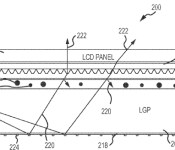
Apple has filed for a United States patent detailing a quantum dot-enhanced liquid crystal display with a dichroic filter that can provide a greater accuracy of colors over traditional displays, reports AppleInsider. Similar technology is currently being used by Amazon in the Kindle Fire HDX 7, which significantly outperforms that of the Retina iPad mini with regard to color gamut and accuracy.

The patent describes quantum dots as being similar in shape to traditional nanocrystals found in regular displays, but can also change sizes in order to emit light of different colors more effectively. For instance, bigger quantum dots can emit a longer wavelength light color such as red, while small quantum dots can emit shorter wavelength light should as blue light or violet light. This results in the quantum dots being able to cover a wider and more varied color spectrum compared to current LEDs, which can only emit light in a fixed spectrum.
As one example, Quantum dots (QDs) are semiconductors in the form of nanocrystals that provide an alternative display. The electronic characteristics of the QDs are generally governed by the size and shape of the nanocrystals. Quantum dots of the same material, but with different sizes, can emit light of different colors when excited. More specifically, the emission wavelength of the QDs varies with a size and shape of the quantum dots. As one example, larger dots may emit longer wavelength light, such as red light while smaller QDs may emit shorter wavelength light, such as blue light or violet light.
Apple goes on to note that one of the issues with quantum dots is the toxic nature of their contents, going on to suggest that cadmium-free quantum dots or heavy metal-free quantum dots could be used in order to alleviate the problem. The patent also suggests that there “remains a need” for designing the quantum-dot enhanced display to achieve more breakthroughs before it becomes ready for general use, including reduced toxicity, improved performance, and lower cost in fabrication.
Meanwhile, the dichroic filter that would be deployed on the quantum dot display would help reduce the density and toxic content of the quantum dots, and would also improve color and luminance levels, resulting in a more vibrant and accurate display. The filter itself would help in transmitting red light and a green light while reflecting most of a blue light, so that white light can be produced and ultimately benefit color accuracy as a whole.
It is not known exactly if or when Apple plans to integrate quantum dot enhanced displays in its products, but the company would have incentive to do so given criticisms of the Retina iPad mini display compared to Google’s and Amazon’s 7-inch tablets. Beyond mobile devices, quantum dot displays may also make their way to notebook computers, televisions and other consumer electronics over time.
| |

Shipping Estimates for Mac Pro Online Orders Slip to February 2014
Just hours after Apple began taking orders for the new Mac Pro with shipping estimates of “by December 30″ for stock configurations, availability has already slipped significantly with new orders currently being quoted shipping in February.

The rapid move to push shipping off by over a month indicates that Apple has indeed been struggling to have any Mac Pro units at all ready to ship in order to meet its previously announced launch timeframe. Reports had indicated that Intel’s chips are in short supply and may have been one of the major bottlenecks for Mac Pro production, but with an all-new design, high-end technology throughout, and Apple shifting assembly to the United States, there are any number of areas where Apple may be experiencing production constraints.
| |

Apple’s new Mac Pro now on sale, will ship by December 30th

After months of waiting, Apple’s new Mac Pro is now available to order through its online store. Coming just a day after the company announced the availability of the trashcan-shaped desktop, the quad-core and six-core models start at $3,000 and $4,000 respectively. Should you order today, Apple says it’ll ship your new Mac Pro by December 30th. That base model will get you a 3.7GHz quad-core Xeon CPU, 12GB DRAM, two AMD FirePro D300 GPUs, and a 256GB SSD. However, if you max out every setting, you’re looking at around $10,000 — and that’s without a mouse or a keyboard.
Source: Apple Mac Pro

