


Just Mobile unveils its fine-point capacitive stylus, expands dock and battery lineup

Just Mobile was back at CES to sprinkle some magic dust on its new accessories, and this time it involves a mixture of batteries, Lightning docks, cables and styli. We’re most excited by the company’s AluPen Digital, a fine-point capacitive stylus that works on any modern mobile device, without the need of Bluetooth or any additional sensor. We also got an exclusive look at the upcoming AluBolt Pro Lightning dock for the iPad, along with the Launch Pro and Launch Ice iPhone docks, the AluCable Flat and the aluminum refresh of the Gum++ battery. Read on to check them out.
AluPen Digital

As mentioned earlier, the AluPen Digital shifts away from the conventional blunt stylus to deliver something closer to a real pen. The only thing needed here is an AAAA battery (yes, such a thing exists!) that keeps the narrow tip going for about six to eight weeks. When you’re done with doodling, you can also retract the tip by twisting the small cap. The best part of all is the price: just $49.95. Expect this to be made available in Q1 this year.
AluBolt Pro

Just Mobile launched the AluBolt Lightning dock for the iPhone in late November, and given the funky design, it’s no surprise to see a larger version made for the iPad — and we were apparently the first people outside the company to see it. The only downside is that both stands are set at a fixed angle due to their Lightning plugs, but if you don’t mind the missing Lightning plug, then you may consider the similar-looking Encore that lets you adjust your tablet’s angle. The AluBolt Pro will arrive in early April for $59.95 — the same price as the Encore, which is already available.
Gum++ aluminum edition and AluCable Flat

The original Gum++ launched last year with a Rimowa-inspired design, but apparently there’s a demand for a smooth aluminum version, hence this refresh. All five colors are pictured above: black, space gray, silver, red and gold. The specs are the same as before: 6,000mAh capacity and a generous 2.5A output. You can grab one at the end of this month for $79.95.
If you’re looking for a Lightning cable as well, Just Mobile’s also offering the self-explanatory AluCable Flat, available in black with silver caps, black with blue caps or white with gold caps. You can grab one by the end of March, with the long version for $24,95 and the short version (pictured above) for $19.95.
Launch Pro

This minimalistic iPhone dock has a couple of not-so-obvious features. For one, there’s a retractable support stand behind the phone (but the Lightning plug alone also does the job), and there’s also a hole underneath the iPhone’s speaker, which amplifies the sound through a front-facing slot at the bottom of the dock. This will be available toward the end of March for $34.95 — it’s cheaper than the AluBolt Pro because it uses your own Lightning cable.
Launch Ice

Last but not least, we have the Launch Ice, which is clearly designed with the iPhone 5c in mind. It’s named as such because when plugged in, it’s as if you’re looking at a popsicle. Aww. The wooden plug isn’t just for show, though, as it actually houses your Lightning cable’s plug. This is also launching around end of March, and it’ll cost $29.95.
Filed under: Peripherals, Mobile

SimCity Getting Offline Mode Nearly a Year After Launch [Mac Blog]
EA is adding an offline mode to SimCity, nearly a year after saying it would require “a significant amount of engineering work” to do so. It should launch in the “near future”, according to EA.
SimCity launched on the Mac last August and immediately ran into a number of problems including installation issues and more, but they were resolved fairly quickly — particular in comparison to the extremely poor launch of SimCity on the PC.

SimCity‘s PC launch was more than a little rocky, largely because the game can only be played online. EA requires that the game be connected to its servers at all times. At launch, SimCity‘s servers were overwhelmed with traffic and the gameplay experience was extremely poor. Today, EA seems to have ironed out most of the bugs and users are playing the game as intended.
However, with offline mode “in the late phases” of development according to a post on EA’s SimCity blog, it remains to be seen if it is too little, too late, for the game’s fans.
Yes, Offline is coming as a free download with Update 10 to all SimCity players. When we launch it, all of your previously downloaded content will be available to you anytime, anywhere, without the need for an internet connection. We are in the late phases of wrapping up its development and while we want to get it into your hands as soon as possible, our priority is to make sure that it’s as polished as possible before we release it. So, until then… testing, testing and more testing. As one of the final steps, we’re putting Offline into the hands of some of our most hardcore players, the DevTesters. This group of volunteers is going to put Offline through its paces before we release it.
In Update 10, you can still play solo in Regions on your own, or in Multiplayer with people from around the world. What’s new is the Single Player Mode, which allows you to play the game Offline by yourself. And because your saved games in this mode are stored locally, you can save and load to your heart’s content. Our team will be delivering a follow-up blog that will outline the full details in the near future so stay tuned.
SimCity is available through EA’s Origin store at $40 for the standard game, or $60 for a Deluxe Edition that includes additional content. Purchases cover both PC and Mac platforms.
     |

Apple Interested in Liquidmetal Alloys for Home Buttons, Touch Sensors, and Tamper-Resistant Screws
Back in 2010, Apple signed an exclusive agreement with Caltech spinoff Liquidmetal Technologies, providing Apple with the rights to use Liquidmetal’s advanced metal alloys for consumer electronics purposes. Liquidmetal’s amorphous metal alloys or bulk metallic glasses posses a number of characteristic properties such as high strength and corrosion resistance while remaining relatively light and able to be cast into a variety of forms.
Apple quietly tested Liquidmetal’s alloys in the SIM card eject tool for the iPhone 3G, but the materials have otherwise not been confirmed to have appeared in any other Apple products, as one of alloys’ inventors noted in 2012 that their use as major design materials was still several years in the future.
Evidence of Apple’s continued interest with Liquidmetal alloys has surfaced a number of times over the past several years, including in a granted patent from July covering a process for mass producing thin sheets of the Liquidmetal alloys and a series of technical patent applications published in November describing methods of working with the alloys to create products.
A number of patent applications addressing additional innovations with Liquidmetal alloys have been published since that time, including a batch of 17 applications published just this past Thursday. Many of these applications are not yet listed as being assigned to Apple, but the inventors listed on the patents are Apple employees who have routinely been associated with the company’s work on Liquidmetal alloys in the past.
One of these patent applications proposes using Liquidmetal alloys in pressure sensors such as those found in buttons and switches on mobile devices, offering greater durability under repeated use. Figures accompanying the patent application closely resemble the iconic home button found on Apple’s iOS devices.
Because switches on consumer electronic devices are operated frequently, the materials used to fabricate the switch must be capable of repeated deformation and return to their original configuration. The ability of a material to deform reversibly under stress is known as the material’s elasticity. Above a certain stress, known as the elastic limit of a material or the yield strength, the metal material may deform irreversibly, becoming inelastic, exhibiting plasticity and adversely affecting the function and utility of the switch. […]
A proposed solution according to embodiments herein for pressure sensors is to use bulk-solidifying amorphous alloys as the deformable material, and to measure the pressure based on the physical changes of the bulk-solidifying amorphous alloy as it is deformed.
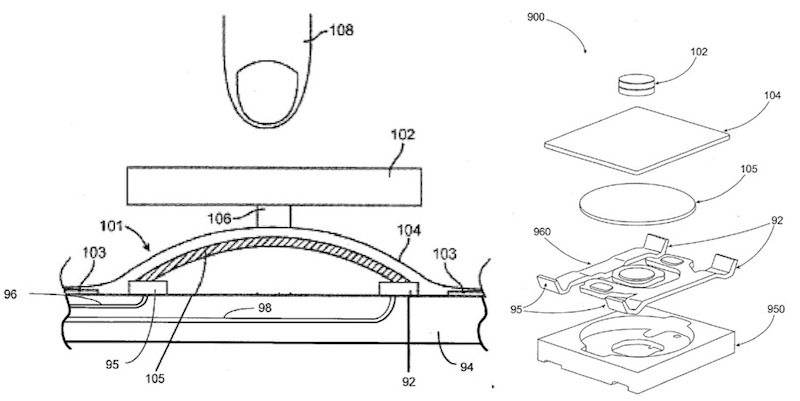 Button or switch using Liquidmetal alloy as deformable material
Another application published in mid-December describes how Liquidmetal alloys could be used as material for tamper-resistant screws to help secure devices against unauthorized access.
A proposed solution according to embodiments herein for tamper resistance is a fastener having a head portion and a tamper resistant bulk-solidifying amorphous alloy interlock portion, wherein the fastener and the substrate into which the fastener is fitted into are permanently fastened via an interlock formed from the interlock portion during the fastening process.
 Tamper-resistant screw made of Liquidmetal alloys
A third patent application addresses the use of Liquidmetal alloys as a substrate for touch sensors found in displays such as in Apple’s iOS devices. Apple describes how discrete areas of crystallinity can be created on the amorphous metal substrate, allowing for greater control and higher density of touch sensing arrays, thus giving greater positional precision for touch sensing.
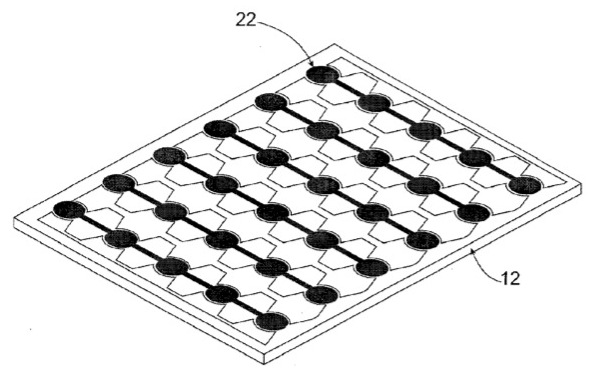 Touch sensor grid using Liquidmetal alloy as substrate
Most of the remaining patents are more technical in nature, addressing methods for working with Liquidmetal alloys or assessing their characteristics. One such patent application does, however, address methods for applying or transforming coatings to an amorphous material, allowing for increased durability and strength by protecting the underlying metal.
All of these patent applications were filed in June or July of 2012, suggesting that Apple may have made significant progress on these disclosed inventions since that time. It is unclear, however, whether any of the techniques or proposed components have made their way into shipping products or if they remain in the research or prototyping phase.
(Thanks, David!)
| |

Griffin and ShopKeep POS Announce ‘ShopKeep Mobile’ POS Case for iPod Touch [iOS Blog]
Following the release of an iPad point-of-sale (POS) stand last year, accessory manufacturer Griffin and ShopKeep POS have once again partnered up to announce the ShopKeep Mobile, a specialized POS case designed for the iPod touch. Using Griffin’s Olli technology and the ShopKeep POS app, the case features an encrypted credit card reader and laser barcode scanner to accept payments.

ShopKeep Mobile also comes with support for QuickBooks and the ability to create customer and item databases, along with the inclusion of an offline mode and printer support. The accessory can also email receipts to customers, with options to toggle discounts and sales tax also included.

Griffin also announced a partnership with Square at CES 2014 to release the Merchant Case + Square Reader for the iPhone 5s and iPhone 5, which is a specialized case that integrates itself with Square’s mobile card payment system for added convenience.
The ShopKeep Mobile accessory is in production beta and is expected to be available soon.
| |

Mac Pro Sales Resume in Europe After Previous Ban
 Apple’s redesigned Mac Pro is on sale in Europe after the previous model sustained near a year-long ban in the region, reports MacGeneration [Google Translate] (via 9to5Mac).
Sales of the Mac Pro in Europe were originally halted last March after regulatory requirements went into effect, as Apple issued a notice to its distributors in the region. Currently, Apple’s stores in Europe list a ship date of February for new orders of the computer, with MacGeneration adding that some recently placed orders are being marked for delivery as early as January 14.
Apple originally unveiled the redesigned Mac Pro at its October 2013 media event, and began online orders for the computer last month. Similar to its availability in Europe, Mac Pro models also still show a shipping estimate of February on the U.S. Apple Online Store, while Mac Pro units appear to be out-of-stock at all Apple Retail Stores.
| |

Increased Theft of Apple Devices ‘Driving Force’ Behind Rise of Larcenies in New York City
According to new data from the New York Police Department (via The Wall Street Journal), the rising theft of devices such as the iPhone and iPad remained one of the driving forces behind the high amount of grand larcenies last year in New York City. In detail, the data showed that Apple products were involved in 8,465 thefts and made up for 18% of all grand larcenies in the city, which rose 13% overall in 2013 from the year prior.

Apple products are so popular among criminals that the NYPD specifically tracks thefts of that brand, officials said. In 2013, Apple products made up more than 18% of all grand larcenies—that is more than 8,000 devices, according to police. In 2002, there were 25 grand larcenies of Apple products, police said.
A spokeswoman for the company said Apple has “led the industry in helping customers protect their lost or stolen devices” since it launched its “Find My iPhone” app in 2009, which allows users to track a stolen phone and erase personal data remotely.
In 2012, former New York City mayor Michael Bloomberg released data showing that the theft of iPhones and iPads contributed to growth of the overall crime index for the city, as the police department recorded 3,890 more Apple product thefts than for the same period in 2011.
iPhone and iPad thefts continue to be a major issue for law enforcement, despite efforts to implement various theft deterrent programs. However, Apple’s Activation Lock feature, which prevents stolen phones from being reactivated without an iCloud password, has received praise from various groups since its inclusion in iOS 7.
San Francisco district attorney George Gascón and New York Attorney General Eric Schneiderman, who have spearheaded anti-theft efforts, called Activation Lock the “world’s first attempt to implement a technological solution to the global smartphone theft epidemic,” while the police department distributed flyers near Apple Retail Stores encouraging users to download iOS 7.
The New York City Council also announced in November that it was considering a pawn shop bill that would require second hand dealers and pawn brokers to maintain easily accessible electronic records of purchased items, however the status of the bill is currently unknown. Notably, a national phone database established last year was found to be largely ineffective against smartphone thefts in the U.S., with law enforcement authorities even pressing smartphone manufacturers to build a kill switch into phones. 
| |

Mac Pro back on sale in Europe following previous ban

EU bureaucrats famously revoked their ban on ugly fruit, but they never showed such leniency to Apple. The older Mac Pro breached rules requiring extra shielding on fans and electrical ports and as a result it hasn’t been seen on European store shelves since last March. Fortunately, however, the new 2013 Mac Pro passes muster, and some customers in France are seeing shipping estimates as early as mid-January — although most folks who order their canister of computing today should expect to receive it sometime in February.
Via: MacGeneration, 9to5mac
Source: Apple Store

Apple Debuts New Poetry-Themed ‘Your Verse’ iPad TV Ad
Apple debuted a new television ad for the iPad during the NFL playoffs this weekend. The 90-second spot features a Robin Williams speech from the film Dead Poet’s Society overlaying the iPad being used in a variety of industries including filmmaking, hiking, SCUBA diving, music and more.
Apple has also introduced a new website called “Your Verse” to share the stories of the iPad users behind the ad.
We don’t read and write poetry because it’s cute. We read and write poetry because we are members of the human race. And the human race is filled with passion. And medicine, law, business, engineering — these are noble pursuits and necessary to sustain life. But poetry, beauty, romance, love — these are what we stay alive for.
To quote from Whitman,
“O me, O life of the questions of these recurring.
Of the endless trains of the faithless. Of cities filled with the foolish. What good amid these, O me, O life?
Answer: that you are here. That life exists and identity. That the powerful play goes on, and you may contribute a verse.”“That the powerful play goes on, and you may contribute a verse.”
What will your verse be?
Apple is using the spot, along with it’s previously existing ‘Life on iPad’ website, to show the wide variety of ways the iPad can be used in work and life.
| |

Refurbished Late 2013 15-Inch Retina MacBook Pro Now Available in Apple’s Online Store [Mac Blog]
Apple has added a number of models of the current 15-inch Retina MacBook Pro to its online store for refurbished products, marking the their first appearance in the store since their October launch. All six of the currently available configurations are listed as shipping in 1-5 business days and are available at a roughly 15% discount compared to brand-new machines. Available models include:
– 2.0 GHz quad-core Intel i7 with 8 GB RAM, 256 GB flash storage, and Intel Iris Pro Graphics: $1699 ($300 savings)

– 2.0 GHz quad-core Intel i7 with 8 GB RAM, 512 GB flash storage, and Intel Iris Pro Graphics: $1949 ($350 savings)
– 2.3 GHz quad-core Intel i7 with 16 GB RAM, 256 GB flash storage, and Intel Iris Pro Graphics: $1949 ($350 savings)
– 2.3 GHz quad-core Intel i7 with 16 GB RAM, 512 GB flash storage, and Intel Iris Pro and NVIDIA GeForce GT 750M graphics: $2199 ($400 savings)
– 2.6 GHz quad-core Intel i7 with 16 GB RAM, 512 GB flash storage, and Intel Iris Pro and NVIDIA GeForce GT 750M graphics: $2379 ($420 savings)
– 2.0 GHz quad-core Intel i7 with 16 GB RAM, 1 TB flash storage, and Intel Iris Pro Graphics: $2549 ($450 savings)
Models of the latest 13-inch MacBook Pro have yet to appear in Apple’s refurbished store.
(Thanks, Andrew!)
| |

New iOS Swiping Keyboard Capable of 120WPM Speeds
App developer Yose Widjaja has created a new Swype-style keyboard designed to allow users to type with two hands using swipe gestures, and he’s demoing the keyboard in his Hipjot note taking app.
Poised as a cross between both gesture-based Android keyboard Swype and the standard iOS keyboard, the Hipjot keyboard can be typed on like a regular keyboard, but it also supports two handed sliding between letters. That means users can type the letters of a word, such as “deviant” with two hands simultaneously in a single double loop gesture.
Because the keyboard allows users to both type normally and swipe through letters with one or two hands, it can result in some impressive typing speeds. Widjala is able to reach peak speeds of 120 words per minute, which is higher than the predicted Swype typing speed of 50 words per minute.
While Swype, which is limited to Android, also allows for gesture-based typing, it does not let users type with two hands simultaneously nor does it allow users to switch between swipes and standard key entry.
Because the Hipjot keyboard incorporates dual entry methods, users have more control over the typing experience. It’s also designed to be highly forgiving of inaccurate touches and it includes both selectable corrections based on input and a customizable dictionary.
With two finger inputs, you can be a lot more explicit in your touches, so it allows you to type without choosing what you want to type, most of the time, while retaining a comfortable swipe where you want to. One finger swipes are inferior in that words like “paraphernalia” forces your finger to go left/right so much.
Currently, Widjala’s Hipjot note-taking app is designed to serve as a way to show off his innovative keyboard. The app itself, while functional, has a steep learning curve and a custom user interface that is difficult to decipher.
While Widjala is willing to work with other developers and would like to see his keyboard gain traction in iOS, custom keyboard implementation on the platform must be done on a per-app basis because Apple does not allow third-party keyboards to replace the default keyboard. While many iOS users would like to have the option to install keyboards like Swype, or Hipjot‘s own dual-swipe invention, Apple has yet to budge on the matter.
Some developers, such as those behind predictive keyboard Fleksy, have skirted Apple’s rules by releasing an SDK for other developers to use, but custom keyboards like the one found in Hipjot are unlikely to catch on until Apple relaxes its rules.
The dual-swipe typing experience is currently limited to Widjala’s Hipjot note-taking app, which can be downloaded from the App Store for $1.99. [Direct Link]
| |

