


Big Retailers Begin Rolling Out iBeacon Trials
As Apple rolls out its iBeacon technology across its Retail Stores and investigates using it to enable mobile payments, a number of large retailers are testing the technology in their establishments.
Today, Shopkick announced it would be starting an iBeacon trial at 100 American Eagle stores in the U.S. This follows announcement earlier this month that InMarket would introduce iBeacons to more than 200 Safeway and Giant Eagle grocery stores in a number of markets across the country.
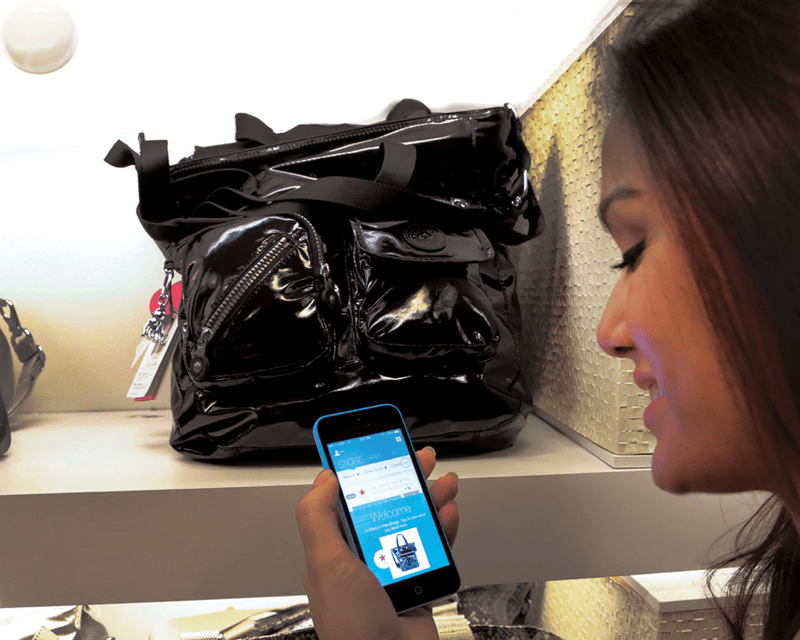
As shoppers enter an American Eagle Outfitters store, shopBeacon will welcome and show them location-specific rewards, deals, discounts and product recommendations – without them even having to remember to open the app. It can also tie at-home browsing behavior to in-store benefits; if the customer “likes” a specific product online, if they so choose, shopBeacon can remind them where in the American Eagle Outfitters store that product is sold. Even better, in the future, it can also deliver department-specific offers throughout the store – so must-have skinnies show up at the most useful time: in the jeans department.
Companies introducing iBeacons seem to understand the appeal of the devices, but it remains to be seen how consumers will respond and if they will download apps for individual stores — a necessity for the iBeacons to have any effect. Shopkick previously performed a retail trial of iBeacons in two Macy’s locations.
If the larger American Eagle trial is successful, Shopkick could introduce the technology to its other retail partners including Best Buy, Crate & Barrel, JCPenney, Old Navy, Sports Authority, Target and more.
     |
Apple Seeds OS X Mavericks 10.9.2 Build 13C39 to Developers [Mac Blog]
Apple today seeded build 13C39 of OS X 10.9.2 to developers, marking the second developer beta iteration of 10.9.2. The release comes almost a month after the first OS X 10.9.2 beta, build 13C32, was seeded to developers.
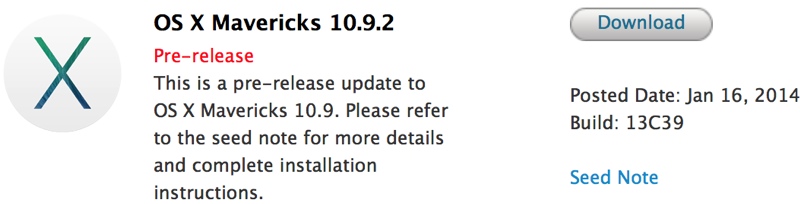
The update is available to registered developers through the Software Update mechanism in the Mac App Store as well as through the Mac Dev Center.
The first seed of OS X 10.9.2 introduced FaceTime Audio to the Mac and asked developers to focus testing on Mail, Messages, VPN, Graphics Drivers, and VoiceOver. The second build allows Mac users to block people on iMessage and FaceTime as can be done in iOS 7.
Apple has also seeded Safari 7.0.2 for Mavericks and Safari 6.1.2 for Lion/Mountain Lion, asking developers to focus on General Website Compatibility, Accessibility, AutoFill features, Printing and Emailing from Reader, Dragging Tabs Between Monitors, and Extension Compatibility.
| |

Sonnet Shipping First New Thunderbolt 2 PCIe Expansion Chassis
Sonnet today announced the first Thunderbolt 2 expansion chassis, allowing owners of late 2013-era MacBook Pro and Mac Pro models to add two or three PCIe cards to their machines.
There are three new options, desktop and rack mount three-slot chassis, plus a two-slot desktop version.
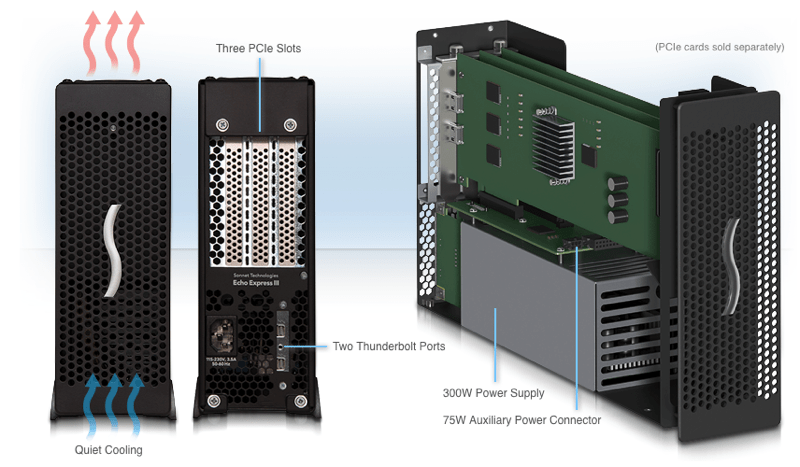
The Echo Express III-D, Echo Express III-R, and Echo Express SE II incorporate ultra-fast Thunderbolt 2 technology, which delivers twice the throughput of 10 Gb/sec Thunderbolt and provides sufficient bandwidth to support many of the highest-performance and most-demanding PCIe cards. The new expansion chassis support every kind of Thunderbolt-compatible PCIe card available — enabling the use of professional video capture, audio interface, 16Gb and 8Gb Fibre Channel, 10 Gigabit Ethernet, SAS and SATA HBA, and RAID controller cards with Thunderbolt-enabled iMac®, Mac® mini, Mac Pro®, MacBook Air®, and MacBook Pro® computers. Plus, the Sonnet systems’ dual Thunderbolt 2 ports support full-bandwidth connectivity with Thunderbolt 2-equipped host computers, full backward compatibility with 10 Gb/sec Thunderbolt-equipped computers and devices, and daisy-chaining of other Thunderbolt 2 and Thunderbolt devices.
Customers who purchased Thunderbolt 1 equipped expansion chassis can get free upgrades to the Thunderbolt 2 version. All the Thunderbolt 2 chassis are fully backwards-compatible with older Thunderbolt equipped Macs.
The desktop three-slot version is available for $979, the rack mount three-slot is $1,199, and the two-slot desktop is $499.
| |

T-Mobile to Expand ‘Un-Carrier 4.0’ Initiative, Offer Switch Incentives to U.S. Cellular, Regional Customers
T-Mobile will expand its recently introduced “Un-Carrier 4.0″ initiative, which saw the company offering to pay up to $350 in early termination fees for Sprint, Verizon, and AT&T customers who switched to T-Mobile. As part of the expansion, first detailed by Re/code, T-Mobile will pay the same contract termination fees for customers currently with U.S. Cellular and a dozen other small regional carriers.
T-Mobile also has plans to entice additional customers by accepting a larger number of handsets for trade-in, including damaged phones, albeit for a lower trade-in credit.

“This is not just a promotion,” T-Mobile marketing chief Mike Sievert told Re/code on Thursday. “What we are trying to do is bring an end to unfair one-way onerous contracts in this country.”
First unveiled last week, T-Mobile’s early termination deal pays up to $350 per line in fees for individuals and families with up to five lines who switch from their current carriers and trade in their phones to T-Mobile.
Under the terms of the program, customers have to leave their current carriers, trade in existing phones (T-Mobile offers up to $300 per trade-in), sign up for a new T-Mobile plan and port a phone number. After the above qualifications are met, customers can send the final bill from their previous carrier (with termination fees listed) to T-Mobile for reimbursement via prepaid MasterCard.
According to T-Mobile, upwards of 80,000 “break-up” letters have been shared on social media sites in the last week by customers leaving their carriers for T-Mobile and signups have increased as a result of the program.
| |
Apple to Begin iPhone 5c In-Store Screen Replacements Next Week
Apple will begin offering in-store screen replacements or repairs for iPhone 5c displays next week, starting on Monday, January 20, according to 9to5Mac.
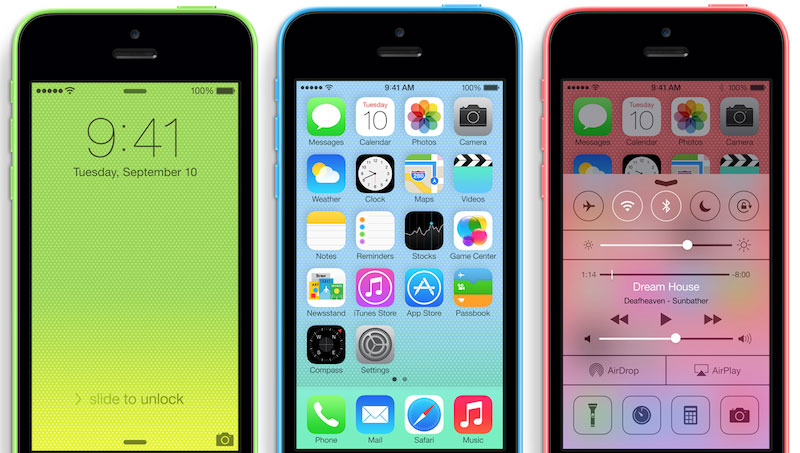
Apple has begun conducting iPhone 5c screen replacements in a small number of stores in the United States over the past couple of months, but the January 20th rollout will represent a full-scale launch in all of Apple’s retail regions aside from Hong Kong and Canada.
Broken displays that aren’t covered under AppleCare+ will likely cost $149 per device to replace or repair, while displays that are covered under AppleCare+ are likely to cost $79 per device, similar to the pricing structure Apple employs for broken iPhone 5 displays.
In-store replacements/repairs for iPhone 5s displays are still in Apple’s plans and are “coming soon”, though are not expected to roll out next week alongside iPhone 5c replacements/repairs. The moves are part of Apple’s larger shift to lower repair costs.
| |

Tim Cook Asked About Larger iPhone at China Mobile Launch
After nearly six years of negotiations, the iPhone is finally available on China Mobile, which is the largest mobile carrier in the world with around 763 million subscribers. Apple CEO Tim Cook was on hand with China Mobile Chairman Xi Guohua at the carrier’s headquarters store in Beijing at launch, according to Bloomberg.
 Tim Cook with China Mobile’s Xi Guohua and a customer. Image via Eunice Yoon
Cook handed out autographed iPhones to the first few customers before he once again praised Apple’s new cooperation with China Mobile.
“Today is just the beginning of China Mobile and Apple coming together to deliver the best experience in the world,” Cook said as a few dozen people came in to look at the iPhones on display. China Mobile said Jan. 15 it signed a multiyear agreement with Apple containing “broad potential” for future cooperation.
Cook was soon asked whether the next iPhone would launch with a bigger screen, and responded that Apple does not like talking about future projects, but that they are working on “great things” and want to keep them secret because “you will be so much happier when you see it.”
Having fun in Beijing at the iPhone launch with China Mobile! pic.twitter.com/AqoqLbbeO7
— Tim Cook (@tim_cook) January 17, 2014
China Mobile is focused on attracting premium customers for the iPhone, Canalys analyst Nicole Peng told Bloomberg, because the carrier is concerned the high subsidy on the iPhone would impact their profitability. Fellow Chinese carrier China Telecom reported a 10 percent drop in net income in the first year of offering the iPhone, largely because of the higher subsidy.
On January 15, China Mobile said that 1 million iPhones had been pre-ordered in advance of launch. Estimates of Apple’s potential iPhone sales have varied from 10-30 million units, with some claiming demand is lower due to satisfaction with China’s other two carriers China Telecom and China Unicom as well as waning interest in iPhone because of increased smartphone choices in the country.
| |
Google Now for Desktop Available in Chrome Canary Builds [Mac Blog]
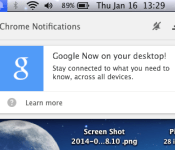
Google Now is a personal assistant service that is considered to be Google’s counterpart to Siri. Available on iOS and Android devices, the service is now making its way onto the desktop via Chrome Canary, the experimental build of Google’s Chrome web browser.

As reported by the Google Operating System blog, the latest build of Chrome Canary allows users to receive Google Now cards directly in the browser’s notification system. Canary users on the Mac can enable the personal assistant by turning on the correct flag in the browser. Users should go to “chrome://flags/#enable-google-now” and then switch the settings from “Default” to “Enabled.” A final click on the “Relaunch Now” button will turn on the feature.
Users who are signed into Chrome will receive a Google Now notification and a list of available cards. According to a Google support page, Google Now on the desktop will support weather, sports scores, commuter traffic and event reminders. Some of these desktop cards will sync with Google Now if it is enabled on a mobile phone. These mobile-synced cards will display relevant information using location data pulled from the mobile device.
Google Now for the desktop is still in the experimental stage, but it will likely land in the consumer version of Chrome for the Mac. 
| |

Task-Oriented Email App ‘Mail Pilot’ Now Available for Mac [Mac Blog]
Originally a 2012 Kickstarter project, Mindsense’s long awaited Mail Pilot email client is now available from the Mac App Store following a beta testing period that began in June. Mail Pilot focuses on the idea that email is action-based, providing users with a number of ways to deal with email messages.
Taking a cue from most standard email apps, Mail Pilot organizes emails into a two column design. A complete list of inbox messages is displayed on the left side of the screen while full email messages are displayed in the right column when an email is selected.
All incoming messages are marked as incomplete and can be dealt with using the following actions from the bottom menu bar: Complete, Remind, Set Aside, and List. While Complete marks an email as read and instantly archives it, the other included functions give users new ways to deal with their messages.

Remind allows emails to be dealt with on a specific date, which the developers suggest is useful for emails about bills and meetings. Set Aside files emails until later, a useful function for emails that require more time than a simple read through, and the List button aggregates related emails together, useful for wishlists, read it later lists, and collecting information on a specific event. Delete and folder options are also available.
At the top of the app, various inboxes can be accessed from a tabbed menu. There’s a standard inbox, along with an inbox that displays messages received in the last day, and two inboxes for emails filed as Set Aside or Remind.
Emails added to lists are accessed from the separate and collapsible “Sources” menu bar, which also houses a list of archived, sent, and deleted messages. Composing an email is also done in a separate popup window that includes a text box with simple formatting options.
Mail Pilot is the email client reimagined from the ground up. We ignored all notions of common email clients, and we focused on how an email client could fit modern email workflows and uses. Realizing that all email messages are action-based, we developed Mail Pilot and its feature-set to empower users to use email in an intuitive and productive way.
Many companies have aimed to reinvent email in recent years with apps like Dropbox’s Mailbox, but there remain few highly rated email apps for the Mac. While Mailbox does include much of the same action-oriented email functionality found in Mail Pilot, it is limited to iOS. Mail Pilot, while newly released on the Mac App Store, has been available for the iPhone and the iPad since April of 2013 and is able to offer a multi-device experience.
According to the developers, Mail Pilot works with Google, iCloud, Yahoo, Outlook.com, AOL, and standard IMAP/Exchange with IMAP email accounts, but App Store reviews indicate that iOS users have had issues getting some email accounts to work properly.
Mail Pilot for Mac can be downloaded from the Mac App Store for the introductory price of $9.99. [Direct Link]
| |

Apple Widens Lead Over Samsung in U.S. Smartphone Race in 2013
Research firm NPD today announced the results of its latest Connected Home Report, showing that Apple increased its share of the U.S. smartphone installed user base by seven percentage points, from 35 percent in the fourth quarter of 2012 to 42 percent in the same quarter of 2013. Second-place Samsung increased its share of the market by a smaller margin from 22 percent to 26 percent, while other major manufacturers saw their shares drop.

NPD’s data, which is based on a survey of roughly 5,000 consumers, is in close alignment with recent data from comScore that showed Apple with 41.2 percent of the market and Samsung at 26.0 percent in the September-November period.
Both firms track installed user base rather than sales, offering a more realistic picture of real-world usage but which is slower to react to shifting market trends given typical handset lifespans. Apple has shown steady increases under these studies over the past several years, even as Android has experienced significant growth. One recent study of trends by Asymco’s Horace Dediu has predicted that Apple’s share of installed user base in the U.S. will peak at 68 percent in 2017 when the smartphone market hits a saturation point at 90 percent of the country’s population.
While Apple’s performance remains strong in the U.S. and several other countries, Android has had more success attracting customers in many other markets around the world. Data from Kantar Worldpanel for the August-October period pegged Apple’s share of the market in many European countries and China in the 15-20 percent range, with iOS barely registering in some countries such as Spain.
| |

UK Court Allows Activists to Sue Google Over Safari Tracking [Mac Blog]
A UK Court will allow a group of privacy experts to sue Google over the company’s circumvention of privacy settings in Apple’s Safari browser, reports Gigaom. Following this ruling, the activists can pursue a tort claim that alleges Google misused their private information. The Honourable Mr Justice Tugendhat writes in his decision:
“I am satisfied that there is a serious issue to be tried in each of the Claimants’ claims for misuse of private information… The Claimants’ application to rely on ground (9) in relation to the DPA [Data Protection Act] claim is allowed… the Claimants have clearly established that this jurisdiction is the appropriate one in which to try each of the above claims.”
This case stems from Google’s former practice of installing cookies in Safari even when the web browser blocked that practice. Google circumvented the browser’s default privacy settings by tricking Safari into thinking a web page was a trusted page. Google did this through code embedded in its ads that made Safari think the user was submitting a form. When a user fills out a form, Safari makes an exception in its privacy policy and allows a cookie to be installed on a user’s device, and Google exploited this exception to install cookies without the permission of the user.
 Graphic from The Wall Street Journal
Google halted this practice in 2012 after it was reported by The Wall Street Journal, but consumers and regulators pursued the case through several investigations and lawsuits. The company was fined $22.5 million by the U.S. Federal Trade Commission for this privacy violation and paid a $17 million settlement in a case filed on behalf of Thirty-seven states and the District of Columbia.
| |

