


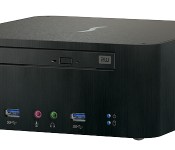
Sonnet Echo 15 Docking Stations Delayed for Thunderbolt 2 Upgrade [Mac Blog]
In an email to customers, hardware upgrade company Sonnet has announced yet another shipment delay for its Echo 15 and Echo 15 Pro+ Thunderbolt docking stations. Unveiled in April 2013, the hardware is still in the pre-order stage. The latest delay is the result of a company decision to upgrade the device to support Thunderbolt 2.0. 
Following our last Echo 15 and Echo 15 Pro+ Thunderbolt Dock status update, we received very positive feedback and valuable input that confirms these products were designed with the right feature sets. However, there has been an increasingly louder chorus of requests for them to be based on Thunderbolt 2 technology. We carefully considered this input, and, combined with recent clarification of requirements for Windows Thunderbolt compatibility, we have decided to upgrade these products to use Thunderbolt 2 chipsets.
The Thunderbolt dock features a DVD or Blu-ray reader/burner, a 2.5″ or 3.5″ SATA drive bay (6 Gb/s) as well as a variety of ports for USB 3.0, SATA, eSATA, FireWire 800, audio input and output, and Gigabit Ethernet connections.
The Sonnet Echo 15 dock can be pre-ordered for $400 with a DVD drive and $450 with a Blu-ray drive. Different capacity hard drives are available as an optional add-on. The Echo 15 Pro+ starts at $550 while upgrading to a Blu-ray burner and adding space for a second solid-state drive.
(Thanks, Dan!)
     |
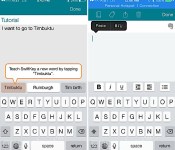
SwiftKey’s new iOS note-taking app syncs with Evernote

Will Apple ever open up its mobile platform to allow the use of third-party keyboards? Y’know, customizable boards that have features like clever word prediction algorithms and finger-swiping gestures? Despite CEO Tim Cook’s suggestion last May that we might see iOS open up more in the future, we’ve seen no strong indication that alternative keyboards are even on the drawing board at present time. Fortunately, some developers are finding small workarounds to this dilemma: even though they aren’t allowed to change the keyboard on the platform level, it’s possible to do so within third-party applications. Fleksy is a prime example of a company that’s thinking outside the box, opening up a developer kit allowing third parties to incorporate the Fleksy keyboard into their own app.
SwiftKey is also making the jump to iOS, but it’s taking a different approach: the keyboard maker just announced SwiftKey Note, a note-taking app that’s integrated with your Evernote account. This is great news for current Evernote users, and it may even be enough of an incentive for newbies to try it out. Using the new Note app, you’ll be able to create notes that sync up with the account on your desktop or other mobile app. But what’s more important is that you’ll have the help of SwiftKey’s trusty and faithful word prediction engine combined with the look of the default iOS 7 keyboard. We’ve got a gallery, video and additional impressions after the break.
However, this version of SwiftKey is much more minimal than what you can currently get on Android — essentially, you’re looking at an iOS 7 keyboard with an extra bar on top for word predictions and a few formatting options (if you swipe to the left on that bar, you’ll find a set of buttons for bold, underline, italics, indent and bullet points). We found that we could type faster on this keyboard than the standard iOS version, so it’s off to a decent start, but long-time fans of the Android version may be frustrated by the limited number of features. No swipe gestures, customizable themes, adjustable sizes or anything of the sort, at least not yet; this is the first version, after all, so we’re hopeful that SwiftKey will continue pouring more features into the project.
Still, for all that it’s missing, some of the key ingredients of a good note-taking keyboard are there. Not only do you get to enjoy the same word prediction engine found on the Android platform, the keyboard also gets smarter as you type; the more you do it, the more it’ll be able to figure out your patterns. (Again, this has been done on Android for a long time, but it’s refreshing to see on a platform like iOS.) To take it a step further, it also looks at your Evernote archive to get an idea of your personal writing style, and even keeps track of stats like how many keystrokes you’ve saved and how efficient SwiftKey makes you. Five languages are also currently supported: English, French, Spanish, German and Italian. The app is free and available on the App Store starting today on iPhones and iPads. It’ll work on devices running iOS 6 or higher, but the formatting options are only available for iOS 7. And who knows — perhaps the app will be enough to grab Sir Jony Ive’s attention.
Filed under: Cellphones, Wireless, Mobile, Apple

Facebook Unveils News Creation and Curation App ‘Paper’ [iOS Blog]
Facebook today announced Paper, a news creation and curation tool that ties into a user’s Facebook account. The app is the first product to come out of Facebook Creative Labs, a division within Facebook made of small teams who are dedicated to startup-style projects.

Paper is split into a news reader that pulls its content from both a user’s Facebook News Feed and from well-known online publications, featuring a magazine-style layout with sections that range from technology news to animals. Facebook will also reportedly assign a team of editors to curate the best and most popular online content for users, and a composition tool that allows users to create their own status updates rich with media will be available as well.
Speaking to Re/code, Michael Matas, product design lead for Paper, explained why the company moved beyond a visual newsreader like Flipboard [Direct Link] and created both a news reading and creating tool.
“As you start changing the way you’re displaying this content, we hope that it will change the way people think about posting content,” Michael Matas, Paper’s product design lead, said in an interview. “Because the two are obviously really connected.”
But just as important, as Matas explains it, “It’s no fun to make a bunch of great stuff if no one ever sees it.”
Paper by Facebook will be available from the iOS App Store in the US starting February 3rd, with international availability to be determined. A visual walkthrough of the app is available on Facebook’s website.
| |
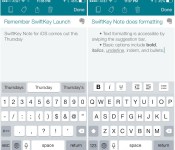
‘SwiftKey Note’ Brings Contextual Word Suggestions and Autocorrect to iOS with Evernote Integration
Last week, an image was posted on Twitter by noted leaker @evleaks appearing to show a “SwiftKey Note” app for iOS from the company behind the popular alternative Android keyboard that ranked as the top-selling paid app on Google Play last year.
SwiftKey Note is indeed real and it launches today as a note-taking app that optionally integrates with Evernote’s popular suite of apps. The app offers several features to allow for faster and easier note-taking, including automatic word suggestions based on context and personalized auto-correction. SwiftKey’s suggestion and autocorrect features learn over time based on context from previous text entries, and can tap directly into a user’s Evernote archive to assist with predictions.
SwiftKey’s Chief Marketing Officer Joe Braidwood told MacRumors that his firm was approached by Evernote early last year about the possibility of developing a SwiftKey app to integrate with Evernote, and the two companies have worked closely together and with Apple to bring that vision to reality.
The new SwiftKey Note app supports seamless backup and two-way syncing, both with other instances of SwiftKey Note and with Evernote, allowing for easy note entry and editing in the app while notes propagate to other instances of Evernote. While SwiftKey Note does support some text formatting through easy swipe access to a toolbar, it does not support syncing of more sophisticated Evernote features such as advanced text formatting and embedded images.
With Apple so far refusing to allow developers to create systemwide alternative keyboards for iOS, SwiftKey is limited to bringing its keyboard functionality to its own apps and releasing tools to allow other developers to offer it in their own apps on a case-by-case basis. As such, SwiftKey Note also serves as an example and marketing tool as the company looks to partner with select third-party developers going forward before opening up broader access through an open SDK.

Apple’s prohibition of alternative systemwide keyboards has also contributed to SwiftKey’s decision to not include support for the gesture-based typing found in its Android keyboard. For the time being, SwiftKey Note includes only the standard iOS keyboard to ensure familiarity for users, augmented with word suggestions appearing by default in a narrow bar above the keyboard, although the “tap to dismiss” interface familiar to iOS autocorrect users is also an option. Gesture input may, however, also be added in the future depending on user feedback.
One final key feature of SwiftKey Note is multilingual support, with the app able to offer contextual word suggestions in up to three languages simultaneously. Initial language support includes English (US and UK), German, Spanish (Spain and US), French (France and Canada), and Italian.
Unlike the SwiftKey Keyboard app for Android, SwiftKey Note for iOS arrives as a free app for iPhone, iPad, and iPod touch, giving the company the opportunity to test the waters of iOS with a useful but still lightweight app accessible to all users. The app requires a minimum of iOS 6, although text formatting is currently only supported on iOS 7. [Direct Link]
| |

Samsung escapes penalty after its lawyers leaked secret Apple documents

Late last year, Samsung found itself in trouble over claims it had secretly spied on Apple and Nokia documents to gain a better position in patent deals. It denied any wrongdoing, saying it hadn’t done so wilfully, and now US judge Paul S. Grewal has finally drawn the same conclusion. PCWorld reports that the US District Court for the Northern District of California ruled Wednesday that the Korean company could not have used confidential information for its patent licensing talks with Nokia, a deal that was extended in November, because it already knew all of the terms ahead of the leak.
The court considered sanctions against Samsung after the company’s legal negotiator, Dr. Seungho Ahn, had reportedly told Nokia that its terms with Apple “were known to him,” even though they were marked “highly confidential — attorneys’ eyes only.” Up to 50 Samsung employees were said to have been given non-redacted copies of Apple documents by its external counsel Quinn Emanuel, which included patent deals with Nokia, but also Ericsson, Sharp and Philips. While Samsung has escaped further action, the court will force its legal representatives to cover both Apple and Nokia’s legal fees, effectively making the “junior associate working late one night” pay for underusing that big black marker.
Filed under: Cellphones, Mobile, Apple, Samsung, Nokia
Source: PCWorld

Apple Details Pressure-Sensitive Touchscreen in New Patent Application
An Apple patent detailing pressure-sensitive touchscreens was published today by the United States Patent and Trademark Office, reports AppleInsider. Entitled “Gesture and touch input detection through force sensing,” the application describes a system in which a traditional touchscreen is complimented by multiple force-sensors in order to better log unique gestures and more complex input.

The patent application introduces itself by describing the problems with current touchscreens found in devices, noting that some gestures such as those involving a swipe or pinch from a screen’s edge are not recognized properly, or result in unintended action. Apple suggests that by deploying three or more force sensors in a touchscreen, a device can determine specific central pressure points and take appropriate action.
The touch screen is configured to detect a touch signal corresponding to a user finger approaching or contacting the touch screen. The at least three pressure sensors are configured to detect a pressure signal corresponding to an object proving pressure on a surface. In response to the pressure signal the processor determines a centroid location relative to the surface and the touch signal is processed by the processor by analyzing the centroid location.

Apple also states that central points determined by force sensors can determine if one or more touches are accidental, which is slightly similar to the current palm rejection technology found on the iPad Air and iPad mini. The illustration above shows a user resting the right thumb on one side of an iPad’s screen while continuing to use the tablet with the left thumb. Currently, this input combination cannot be performed on iOS devices, and would potentially allow for new interactions if enabled.
Furthermore, the patent notes that the force sensors can be positioned outside of an active touch region, which could allow for users to interact with user interface elements such as menu options that extend well beyond the immediate area of a touchscreen. This would allow a device the option to render more elements onscreen while retaining key touch elements needed offscreen, offering a secondary mode of input.
Currently, it is unknown whether Apple plans to create such a touchscreen for its products or not, but the company has shown an interest in pressure sensitive technology before. An Apple patent detailing the integration of a pressure sensitive button in a touchscreen was published last November, and a patent that described pressure-sensitive device casings was awarded to Apple in March 2013.
The patent application, which was originally filed on January 30, 2012 and published today, also lists Nima Parivar and Wayne C. Westerman as its inventors.
| |

Judge Declines to Sanction Samsung for Role in Apple-Nokia Patent License Leaks [iOS Blog]
 Last October, Apple filed a motion seeking sanctions against Samsung and its outside lawyers, accusing both of unlawfully obtaining sensitive data about Apple’s 2011 patent license agreement with Nokia. Samsung responded to the allegations by filing three motions intended to slow the investigation. However, those motions were denied by Judge Lucy Koh, who also proceeded to call Samsung’s lack of information about the alleged violation “inexcusable.”
Now, FOSS Patents reports that Judge Paul S. Grewal yesterday ruled against imposing sanctions on Samsung, instead choosing to solely penalize its law firm, Quinn Emanuel. By Judge Grewal’s order, Quinn Emanuel will be required to reimburse Apple, Nokia, and their legal counsel for all costs and fees incurred during the litigation.
Judge Grewal also explained why some further-reaching and more dramatic sanctions proposed by Apple and Nokia were not appropriate:
The vast majority of these are ludicrously overbroad, such as the suggestion that both Samsung and Quinn Emanuel should be banned from any situation in which they might make use of licensing information for the next two years. Although the evidence has shown Quinn Emanuel failed to notify the relevant parties at the relevant times, and that [Samsung in-house lawyer Daniel] Shim made use of the information, there has been insufficient evidence that this failure to notify or misuse ultimately implicated any issue in this or any other litigation or negotiation.
The decision by Judge Grewal can be appealed to Judge Koh and then on to the Federal Circuit if necessary, where Apple or Nokia could attempt to win additional sanctions. Samsung cannot appeal any part of the decision further as it was not sanctioned.
The ruling comes as a second patent infringement lawsuit between Apple and Samsung is set to begin on March 31, 2014. Notably, Samsung will only have four patents claims to bring to the upcoming trial, as Judge Koh invalidated two of its patent claims last week. Both companies will also partake in a trial centered around Apple’s new call for a U.S. ban on Samsung products set for January 30.
</iframe 
| |

Apple Looking to Take Arizona Sapphire Plant Live in February for ‘Critical’ Component
Apple is aggressively pursuing the launch of its new sapphire plant in Mesa, Arizona for a “critical new sub-component”, according to documents obtained by 9to5Mac. The company is aiming to open the plant by February.
 Furnaces for sapphire glass production.
The documents reveal that James J. Patton, Apple’s Deputy Director of Global Trade Compliance, requested expedited approval from the Foreign-Trade Zone Board to approve two requests that would allow Apple to meet its “aggressive go-live timeline” for February 2014. Recently, both Apple and manufacturing partner, GT Advanced, have been recruiting potential employees.
In addition, the documents show that the sapphire plant would be used for a “critical new sub-component” that would be used in Apple’s consumer electronics. Apple currently uses sapphire glass to protect the iPhones’ camera lenses and the iPhone 5s’ Touch ID home button, though Apple’s language in the documents indicates something more could be in the works.
Project Cascade will conduct high-tech manufacturing of intermediate goods/components for consumer electronics. All finished components will be exported. This high-tech manufacturing process will create a critical new sub-component of Apple Products to be used in the manufacture of the consumer electronics that will be imported and then sold globally. By pulling this process into the U.S., Apple will be using cutting edge, new technology to enhance and improve the consumer products, making them best in class per product type.
While it’s not clear what a “new” sub-component could be, Apple could be looking to create full-screen displays made out of sapphire. It could also potentially be used to protect the rumored flexible OLED display on Apple’s iWatch.
9to5mac also points to some other materials that will be utilized in the plant, such as diamond cutting wire, which is currently used in iPhone and iPad assembly for creating bezels.
Just a couple days ago, Taiwan’s Apple Daily reported the company’s assembly partner Foxconn had begun an initial 100 unit run of an iPhone with a sapphire display glass. Last week, an Apple patent application was discovered for an Apple device with a sapphire display glass.
Sapphire has been seen as a potential successor to high-strength glass for display covers, although Corning claims Gorilla Glass 3 is stronger than sapphire glass at a lower cost. Apple has reportedly experimented with sapphire glass displays before, but found them infeasible. It is possible, however, that advances in material and production technology have allowed the company to revisit the possibility.
| |

Nintendo Confirms No Games Coming to iOS, But Service App in the Works
During a strategy briefing that took place in Osaka, Japan, Nintendo president Satoru Iwata today confirmed (via The Wall Street Journal) that Nintendo has plans to “actively” use service apps for smart devices, but does not have plans to introduce key Nintendo software, like its portfolio of games, on third party platforms.
According to Iwata, Nintendo is aiming to use service apps to both build a bridge with its customers and deliver information on Nintendo products. Service apps are not intended to make money for the company, but instead will be used to “make connections with customers.”

Iwata did acknowledge that Nintendo’s apps would need to be more than a simple advertisement in order to engage customers, but he did not elaborate on what tactics the company would use to entice customers to use a Nintendo app. Neither a potential release date or nor any additional information on the content of the service app was divulged.
Iwata did, however, say that the game console will continue to be at the center of Nintendo’s strategy and there are no plans for the company to abandon its hardware business.
News of Nintendo’s foray into mobile first surfaced in mid-January after company president Satoru Iwata indicated Nintendo would consider a new business structure involving smart devices in light of increasing competition from both iOS and Android and competing consoles.
On Monday, Japanese business newspaper Nikkei suggested Nintendo would release an iOS and Android app featuring game information and playable mini games, but Nintendo quickly refuted the claim and insisted it had no plans to make Nintendo software available on mobile devices.
Earlier today, Nintendo missed its earnings forecast and announced an operating loss of 1.58 billion yen ($15.3 million) for the December quarter. The company expects another loss of 33.4 billion for the final quarter of the year with a total operating loss of 35 billion yen ($355 million) for 2013.
During today’s event, Nintendo also announced plans to bolster its profits by introducing an on-demand gaming service, allowing Wii U players to access Nintendo DS games, and releasing a non-wearable health monitoring device in 2015.
| |

Google Selling Motorola Mobility to Lenovo for $2-3 Billion
Google is selling its Motorola Mobility division to Lenovo for $2-3 billion, according to a report from China Daily. Google acquired the company and its then 17,000-strong patent portfolio, along with 7,500 filed patents, in August of 2011 for roughly $12.5 billion.
At the time, Google said Motorola was a “natural fit” for the two companies and that it would “supercharge the entire Android ecosystem”. It’s likely that Google will retain rights to the Motorola patent portfolio, though the deal assigns the rights to more than 10,000 of the patents to Lenovo.

Lenovo Group Ltd is likely to buy Google Inc’s Motorola Mobility business, giving the Chinese company a bigger say in the global tablet and smartphone market.
The acquisition, worth at least $2 billion, will include more than 10,000 mobile communications patents currently held by the United States company, according to a person familiar with the matter.
The deal is expected to be announced on Thursday morning in Beijing.
Google’s Motorola Mobility subsidiary has been a money loser for the company in recent quarters, costing the firm $248 million in the most recent quarter. Earlier this month, Google purchased the Tony Fadell-founded Nest for $3.2 billion in cash.
| |

