


Apple Confirms Suppliers Do Not Use Conflict Mineral Tantalum
Apple today published its 2014 Supplier Responsibility Report, releasing the results of its supplier audit program for 2013 and confirming that its partners do not use tantalum, a primary metal used in electronic components mined from war-torn regions in Africa.

In January 2014, we confirmed that all active, identified tantalum smelters in Apple’s supply chain were validated as conflict-free by third-party auditors, and we will continue to require all suppliers to use only verified tantalum sources. We know supply chains fluctuate, and we’ll maintain ongoing monitoring of our suppliers’ smelters.
Apple’s senior vice president of operations Jeff Williams, also spoke to The Wall Street Journal on the matter:
In the company’s 2014 Supplier Responsibility report published on Wednesday, Apple identified that its suppliers use 20 global smelters or refiners whose tantalum has been verified by third-party auditors as what the industry calls “conflict-free.” Jeff Williams, Apple’s senior vice president of operations, said the company has had success in pressuring tantalum smelters to agree to a third-party audit because Apple and other consumer electronics firms are the biggest users of the metal.
The gathering of tantalum, along with other minerals such as gold and tungsten, has become a controversial subject in the tech industry due to their sourcing at mines blamed for funding conflict in the Democratic Republic of the Congo (DRC). Apple added in its report that it will continue to support conflict-free supply lines and economic development in the region instead of abandoning the questionable minerals.
Apple’s report also noted a number of other achievements for 2013, including driving suppliers to achieve a 95% compliance rate with the company’s standard maximum 60-hour workweek, requiring suppliers to reimburse $3.9 million in excess foreign contract worker fees, and tracking the weekly work hours for over 1 million supply chain workers.
In its Supplier Responsibility Report for 2012 published last year, Apple revealed that it had dropped one of its suppliers in China after finding evidence of 74 underage workers at one facility.
     |

Apple’s New Vision for Apple TV ‘Less Ambitious’ Than Before
 Apple’s plans for its revamped Apple TV have been scaled back compared to what the company had previously planed, reports The Wall Street Journal. According to the publication, the company was originally approaching media companies directly to obtain content rights for an ambitious a-la-carte-Internet-enabled TV box.
In the current discussions, which involve at least two big media companies, Apple envisages working with cable companies, rather than competing against them, the people said. For programming, it would rely on cable providers to acquire programming rights from media companies, rather than acquire them on its own, the people said. Apple might consider seeking some rights directly in the future, one of the people said.
Apple has been trying to negotiate with companies like CBS and Disney to offer their content directly to Apple’s customers over the Internet, cutting out cable and satellite providers like Comcast, Time Warner and DirecTV. However, the media companies have constantly pulled out of negotiations, fearing that any potential deal with Apple could damage their revenue streams.
The company’s ambitious plans went further, as Apple hoped to erase the distinction between live and on-demand TV, allowing users to watch any show at any time via iCloud as well as being able to skip commercials. In addition, Apple explored the possibility of paying media companies more for ad-free TV.
Instead, Apple is asking content providers for the last five episodes of any given show rather than an entire season. The structure is similarly used by Hulu and is considered a standard amongst TV show streaming services.
Earlier today it was reported Apple was in negotiations with Time Warner Cable, who is now reported to have been purchased by Comcast. Apple is expected to unveil the new Apple TV in April in preparation for a holiday launch.
| |

Apple Seeds Sixth Beta of OS X Mavericks 10.9.2 to Developers [Mac Blog]
 Apple today seeded build 13C59 of OS X 10.9.2 to developers, marking the sixth beta iteration of 10.9.2.
The release comes roughly a week after the fifth OS X 10.9.2 beta, build 13C53, and nearly two months after the first OS X 10.9.2 beta.
The update is available to registered developers through the Software Update mechanism in the Mac App Store as well as through the Mac Dev Center.
Apple continues to ask developers to focus on mail, messages, graphics drivers, VoiceOver, VPN, and SMB2. Earlier betas of OS X 10.9.2 began allowing Mac users to block people on iMessage and FaceTime, as can be done in iOS 7, and also introduced FaceTime Audio.
| |

Rovio Teases New Angry Birds ‘Adventure’ Game With New Bird Characters [iOS Blog]
Rovio today tweeted a teaser image of an upcoming Angry Birds game, which it calls “a big adventure with new birds.” Many of the games in Rovio’s ultra popular Angry Birds series have utilized the same group of birds introduced in the original game, each of which has its own special ability.

While the company has added some new birds and modified existing birds for select games like Angry Birds Star Wars, today’s tweet hints at some all new birds for the next Angry Birds game.
Aside from revealing new birds, Rovio’s teaser is short on information. It is not clear when the company plans to release its newest game, except for a vague “coming soon” announcement.
Big adventure with new birds coming soon! #NewAngryBirds pic.twitter.com/DWdZ7fBrXq
— Angry Birds (@AngryBirds) February 12, 2014
Rovio’s Angry Birds series has been wildly successful, garnering tens of millions of downloads and spawning an entire line of merchandise. The company has thus far released eight variations of the original Angry Birds game that debuted in 2009.
| |
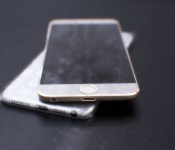
Supposed iPhone 6 parts surface on Twitter, hint at a larger screen on the way

Lately it’s seemed like Apple can’t build anything without a few prototype shells and cases leaking into public view, and now we’re seeing pictures of what could be the next iPhone. Posted by a Twitter user earlier today and addressed to several Apple-focused websites, the empty iPhone 6 shells look very close to current models, but appear to have space for a larger edge to edge-style display, which has been rumored before. Sonny Dickson, who has previously obtained iPhone and iPad parts prior to the launch of new devices, has also apparently received the same pictures and tells MacRumors they came from a source in China. Are these pics the real thing, and if they are, do they represent what we’ll likely see from Apple later this year? Without any details to back them up we can’t be sure, but you can check out a few more pictures for yourself after the break.
iphone 6 #apple pic.twitter.com/T7URVS8O6f
– mornray886 (@mornray886) February 12, 2014
iphone 6 #apple pic.twitter.com/GW6jKLG9FP
– mornray886 (@mornray886) February 12, 2014
Filed under: Cellphones, Mobile, Apple
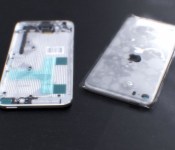
Alleged iPhone 6 Prototype Depicted in New Images
A set of images depicting what is said to be the shell of the next-generation were shared with MacRumors by an anonymous Twitter user earlier today. Australian writer Sonny Dickson, who shared several of the same images, claims that they were initially shared by someone in China.

It is entirely unclear whether the device in the images is a legitimate iPhone 6 part or a fake. Early prototypes of the iPhone 5s and the iPhone 5c exhibited a blank rear shell while the iPhone 6 shell in the picture clearly shows FCC text that is generally added to the phone at a later date.

The device depicted in the images has a width of 2.6 inches, while the existing 4-inch iPhone 5s has a width of 2.31 inches.
Even if these images are fake, they give a good idea of what a larger screened iPhone 6 could look like.
| |
iPad Air Battery Life Bests Other Tablets [iOS Blog]
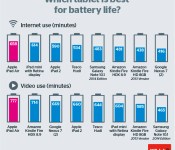
Apple’s iPad Air outperforms competing tablets by a significant margin when it comes to battery life, according to a new test conducted by Which? Test Lab, a consumer test organization in the United Kingdom.
In a battery usage test that covered both Internet and video use, the iPad Air bested both the iPad 2 and the Retina iPad Mini, as well as tablets from competing companies like Amazon, Google, and Samsung.

With the Internet (web browsing) test, the iPad Air saw 658 minutes of battery life, or nearly 11 hours. The Retina iPad mini came in second place with 614 minutes of battery life, while the Samsung Galaxy Note 10.1 and the Amazon Kindle Fire HDX 8.9 lasted just 483 minutes and 481 minutes (eight hours), respectively. Apple’s iPad 2 also performed well, lasting 590 minutes.
In the video test, the iPad Air lasted quite a bit longer than its competitors at 777 minutes (almost 13 hours). The Kindle Fire HDX 8.9 and the Nexus 7 from Google came in second and third, at 714 minutes and 669 minutes, respectively. The Retina iPad mini and the iPad 2 fared decently at 660 and 604 minutes, respectively, while the Samsung Galaxy Note 10.1 came in dead last with 465 minutes of battery life (7.75 hours).
For the tests, Which? set all of the tablets at a brightness of 200 nits (what it calls a reasonable daytime brightness level) and checked battery life while web browsing over wi-fi (with 3G enabled) and during video playback. The tests may not be entirely reflective of real world usage given variations in browsing and video watching habits, but the experiment does give a clear overall view of the battery life of the iPad Air compared to its competitors.
| |
Analyst Predicts ‘iAnywhere’ OS X and iOS Combo Platform Despite Apple’s Public Dismissal
Apple is working on a platform that combines OS X and iOS to boost iPhone and iPad sales, according to J.P. Morgan analyst Mark Moskowitz (via CNET). He believes that a combo operating system, which he has termed “iAnywhere,” would work in tandem with an iOS device docked to a secondary display, running as a full-blown computer.
“While not a new idea, our global tech research team believes Apple could be on the cusp of introducing a new category with iAnywhere, a converged MacOS-iOS operating system that allows an iPhone or iPad to dock into a specially configured display to run as a computer,” Moskowitz said. “In our view, this category would be a leapfrog event, potentially jumpstarting iPhone and iPad growth as well as peripherals and cloud-based software and services sales.”
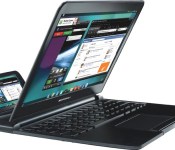
Other PC and smartphone manufacturers have experimented with dual operating systems and other hybrid solutions. Samsung, for example, introduced the ATIV Q, an Ultrabook capable of running and switching between both Windows 8 and Android 4.2.2. Motorola experimented with a docking solution for its Atrix 4G phone, but no manufacturer has thus far combined a dock with a converged mobile/desktop operating system.
 Motorola’s Atrix Dock
Moskowitz believes Apple could introduce iAnywhere sometime in the next 12 to 18 months, but during a recent interview with MacWorld, Apple executives Phil Schiller and Craig Federighi explicitly said that convergence between iOS and OS X was an “absolute non-goal” for the company.
“To say [OS X and iOS] should be the same, independent of their purpose? Let’s just converge, for the sake of convergence? [It’s] absolutely a non-goal,” Federighi said. “You don’t want to say the Mac became less good at being a Mac because someone tried to turn it into iOS. At the same time, you don’t want to feel like iOS was designed by [one] company and Mac was designed by [a different] company, and they’re different for reasons of lack of common vision. We have a common sense of aesthetics, a common set of principles that drive us, and we’re building the best products we can for their unique purposes.
While Schiller and Federighi noted iOS and OS X would share a common sense of aesthetics and design principles to make it easier for customers to switch between iOS devices and Macs, the two operating systems would remain distinctly “different in those things that are critical to their essence.” Given the executives’ strong stance on convergence, it seems unlikely the company has plans to debut the iAnywhere system Moskowitz has outlined.
| |

Report: A new Apple TV is on the way, pending a deal with Time Warner Cable

If sources who spoke with Bloomberg News are correct, a new Apple TV could be “introduced” as early as April. Apple is currently in talks with Time Warner Cable, among other programming partners, to add video content to the set-top box before releasing the next version.
The third-generation Apple TV came out just over a year ago, and while it’s received software updates, both the design and selection of content haven’t changed much since the original launched in 2007. Bloomberg‘s sources echo earlier rumors, saying the next-gen model could include a reworked interface that allows for easier navigation between different types of content. Naturally, there will also be a faster processor in Cupertino’s fourth set-top box. Just don’t get too set on that spring timeframe; though Apple may unveil the new product in April, sources say the release would coincide with the holiday season, depending on the company’s progress in securing partnerships with TWC and others.
Filed under: Home Entertainment, HD, Apple
Source: Bloomberg News

Video Shows Discovery of Steve Jobs’ Lisa Mouse Inside 30-Year-Old Aspen Time Tube [Mac Blog]
National Geographic Channel show Diggers last year unearthed a time capsule containing a piece of Steve Jobs memorabilia that’s been buried for 30 years. A video obtained by CNET shows the excavation and opening of this renowned canister.

The time capsule, known as the “Aspen Time Tube”, was buried in 1983 by the organizers of the International Design Conference. Steve Jobs gave a famous talk at the event and donated the Lisa mouse that he used for the presentation. That mouse, along with other articles were placed in a 13-foot tube and buried in an Aspen field.
Organizers planned to dig up the cylinder in 2000, but they couldn’t find it after a major landscaping project altered the layout of the area. With help from National Geographic and Diggers, the time capsule finally was located last September and brought to the surface. Inside the tube was the Lisa mouse still in its original bag and in excellent condition. Also included in the tube was a script from NBC’s Hill Street Blues TV show, a Rubik’s cube, and a Kodak Instamatic camera.

| |

