



‘Rogue’ Series6XT Graphics for Future iOS Devices Detailed [iOS Blog]
Back in January, Imagination Technologies announced its next-generation Series6XT graphic architecture, providing a glimpse at the graphics capabilities likely to make their way into Apple’s future A-series chips. Apple, a minority investor in Imagination Technologies, has used the company’s integrated graphics since the original iPhone back in 2007, with Apple’s latest A7 chip using the G6430 Series6 graphics package.

AnandTech has now published an in-depth look at the so-called “Rogue” architecture used in Imagination’s current and upcoming graphics packages. The piece was made possible by Imagination taking a rare step to provide increased transparency about its technology as part of an effort to compare and contrast its offerings with NVIDIA’s highly publicized Tegra K1 processor with 192-core Kepler graphics.
Imagination’s principle blog, Graphics cores: trying to compare apples to apples, opens up with an argument over just what a “core” is and how it should be counted. Imagination doesn’t name any names, but from the context of their blog it’s clear that they’re worried about being in a core war and losing based on who’s counting cores and how.
The article is a fairly technical discussion of how GPUs in general and the Rogue architecture in particular function, but basically it outlines how Imagination is trying to redefine “cores” with respect to its designs. Imagination has historically described its graphics architectures in terms of Unified Shading Clusters (USCs), popularly referred to as “cores” as in the “quad-core” G6430. But with NVIDIA now advertising 192-core graphics, Imagination needs to show how its upcoming six-cluster GX6650 can equal or outperform NVIDIA’s Tegra K1.
Imagination lays out its case for emphasizing the use of more efficient but less powerful 16bit Arithmetic Logic Units (FP16 ALUs) over FP32 (32bit) ALUs in its Rogue pipelines, a move that actually makes for improved overall performance in mobile-focused settings. With the upcoming Series6XT, Imagination has placed even greater focus on FP16 ALUs, improving performance even more. MacRumors forum member chrmjenkins provides an excellent summary of what all of the technical details mean:
In short, Rogue pipelines have wide FP16 (floating point 16 bit) ALUs (Arithmetic Logic Units), which allows them to do many FP16 operations in one cycle. Desktop GPUs have done away with FP16 ALUs all together and usually have 2 FP32 ALUs per pipeline (As does Rogue). This obviously saves space since they don’t waste space with FP16 units, but ImgTec has determined that mobile workloads are better suited to using FP16 ALUs, which right away would make them more efficient since they’re using less power to do a FP16 operation (which would waste power on a FP32 unit). In fact, ImgTec made it so that 6XT can execute even more FP16 operations per cycle with respect to 6, so they must really believe in this solution. 6XT can do four FP16 operations per cycle, in comparison to just the two FP32 operations it can do, along with its competitors.
So, if you have an even number of “cores” with a Rogue design vs. a K1 design, you’re probably talking about more actual throughput for a Rogue design in a mobile environment due to its ability to focus on those FP16 operations.
AnandTech compares the specifications of GX6650 to NVIDIA’s Tegra K1 and Imagination’s G6430 from the A7 chip, showing the significant improvements possible for future iOS devices.

As for when Apple will be able to bring the new Series6XT graphics to its iOS devices, historical data on intervals between announcement of new designs from Imagination Technologies and their implementations suggests that A9 chips in 2015 would be the most likely target, but it is possible that Apple could surprise and bring the new graphics to the A8 later this year. As shown in delivering a 64-bit architecture for the A7 last year, Apple has shown that it is able and willing to be aggressive in its chip designs, and as a significant investor in Imagination Technologies likely is able to press forward more rapidly than other licensees.
     |

Broadcom Announces New 5G 802.11ac Wi-Fi Chip for Smartphones
Communications chip maker Broadcom today announced a new 5G Wi-Fi Multiple Input Multiple Output (MIMO) system-on-a-chip (SoC) designed for smartphones, bringing 802.11ac connectivity with 2×2 MIMO to mobile devices.
The Broadcom BCM4354 chip marks the first implementation of 2×2 MIMO for smartphones, bringing up to twice the Wi-Fi performance with 25 percent more power efficiency than the current 1×1 MIMO chips.
 Some smartphones, such as the Galaxy Note S3 from Samsung have previously incorporated 802.11ac Wi-Fi using single stream chips such as the BCM4335 from Broadcom, but the new chip uses two spatial streams for speeds up to 867 Mbps.
MIMO is a technology that uses multiple antennas for both the transmitter and the receiver to improve communication performance. Apple first adopted MIMO technology for the iPad Air and the iPad mini with Retina display.
Broadcom’s chip also uses the newer 802.11ac Wi-Fi protocol for transferring data, which is considered “Gigabit Wi-Fi” with transfer speeds up to three times as fast as 802.11n networks. With the addition of Broadcom’s Transmit Beamforming technology, photo and video uploads can be twice as fast at crowded events.
In addition, Broadcom’s Transmit Beamforming (TxBF) technology further improves rate over range performance in congested environments for data-intense applications. Photo and video uploads to social networking sites, for example, will be twice as fast in crowded sporting events or concert venues.
Apple uses Broadcom’s technology in its line of Macs that support 802.11ac, including the newest MacBook Air, Retina MacBook Pro, and iMac. Broadcom also provides the Wi-Fi/Bluetooth chips for Apple’s iPhones, so it is possible that the iPhone 6 will feature Broadcom’s newest chip, marking the first iPhone with 802.11ac support. Previous iPhone 6 rumors have also pointed to 802.11ac support.
| |
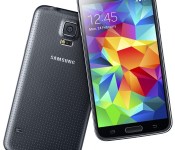
Samsung Reveals Galaxy S5 With Home Button Fingerprint Sensor, Accompanying ‘Gear Fit’ Band
Samsung today revealed its next-generation Galaxy S5 flagship phone at its Unpacked 5 event at Mobile World Congress in Barcelona, Spain. As rumored, the 5.1-inch Galaxy S5 includes a fingerprint sensor built into the device’s home button, mirroring Apple’s own Touch ID introduced with the iPhone 5s.

Unlike Touch ID, which utilizes a round home button that captures a motionless fingerprint, Samsung’s sensor is activated using a swiping motion that scans the finger from base to tip as the phone utilizes a rectangular home button. SlashGear has a demonstration of the fingerprint scanner.
Samsung is working with PayPal on integrating it into mobile payments, too, so that you could effectively buy apps, products, and services and authorize the transaction with a fingertip rather than a password or PIN. We found the hit-rate for the scanner recognizing our fingers was relatively high, though you do have to line your fingertip up properly: the Galaxy S5 prefers a clean downward swipe, not a sideways movement such as if you’re holding the phone one-handed and sweeping your thumb across the sensor.
Design-wise, the polycarbonate Samsung Galaxy S5 looks similar to previous models, though it has a unique soft-touch textured backing, a water resistant casing, and it comes in both blue and copper gold along with black and white.
The 5.1-inch Super AMOLED display features a resolution of 1920 x 1080 and the phone offers a 2.5GHz quad core processor with 2GB of memory. It runs Android KitKat 4.4.2 and includes an upgraded 16-megapixel camera with quick autofocus and real-time HDR. It has a 20 percent better battery life than the previous generation phone and includes a built-in power saving mode that will activate a black and white display with limited app access when the battery is low.
Taking a cue from Apple’s reported interest in health-related applications, Samsung has included a heart rate sensor next to the camera’s flash, able to measure heart rate with a finger on the sensor. The heart rate sensor accompanies the standard accelerometer, gyroscope, proximity sensor, compass and an IR-based gesture sensor.
Samsung’s Galaxy S5 is also designed to work with a new fitness device, the Gear Fit, which accompanies Samsung’s recently revealed Gear 2 and Gear 2 Neo smart watches. The Gear Fit is smaller than Samsung’s other offerings and focuses on measuring heart rate and counting steps. It incorporates an AMOLED touchscreen panel and offers smartphone notifications and alerts, but it does not include a camera, a microphone, or a speaker.

The Galaxy S5 and the Gear Fit will both be released in April, but Samsung has yet to announce pricing.
| |

ReSound LiNX Launches as World’s First ‘Made for iPhone’ Hearing Aid
 A new hearing aid launched today connects directly to iPhones and other iOS devices, allowing wearers to talk on the phone or listen to music, by GN ReSound, a Danish hearing aid manufacturer.
The ReSound LiNX is the first Apple-certified “MFi” or Made for iPhone hearing aid that connects directly to the iPhone or other iOS device without any intermediary devices.
Launching alongside the LiNX is a new iOS app that works as a remote for the hearing aid, allowing wearers to adjust volume levels, equalizers, and switch between preset environments for the hearing aid, allowing the device to optimize to the user’s environment. Hearing aids can have several different modes, adjusting to the acoustics of each environment — the app even uses geofencing to automatically change sound profiles based on the location of the wearer, changing for work, home, or a favorite restaurant. There is also a “Find My Hearing Aid” function to help users find their device if it’s lost.
A company representative told MacRumors that the app was an attempt to connect the hearing aid to the Internet for the first time. By using GPS geofencing, the hearing aid can change and adapt to its environment for the first time without user intervention. The 2.4GHz protocol used by the LiNX is also unique — the company worked closely with Apple to develop a special protocol specifically for communication between iPhones and hearing aids, and that GN built a new hearing aid processor to support it. It is much smarter about turning on and off quickly, saving battery life and delivering five to six days of battery life in normal use, even with the added technology.
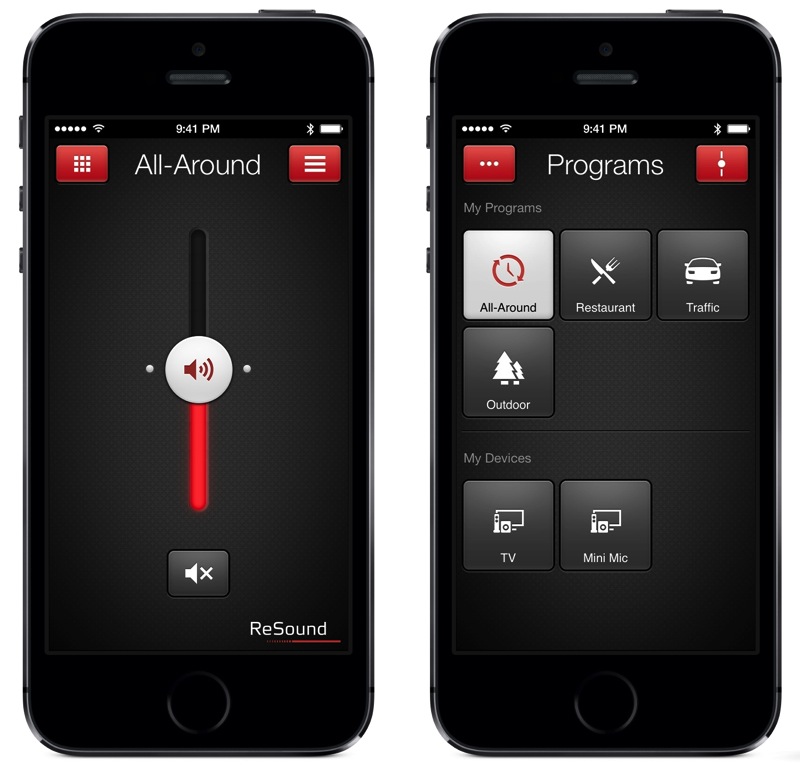
ReSound LiNX launches in global markets today as a revolutionary hearing aid capable of streaming high-quality stereo sound from an iPhone, iPad and iPod touch without the need for an additional pendant-like device. Users can also customize their hearing experience through the ReSound Smart App. ReSound LiNX advances a number of ReSound technologies which already lead the hearing aid industry.
“We saw an opportunity to create the world’s best hearing aid by combining the capability of GN ReSound’s life-changing technologies with the compatibility and global prevalence of iPhone, iPad and iPod touch,” said GN ReSound CEO Lars Viksmoen. “We are committed to improving people’s lives through use of innovative technology and look forward to more people correcting their hearing with this new technology – a triumph in accessibility for the hearing impaired.”
Previously, hearing aid wearers would need to carry a cumbersome pendant or other wireless device in order to make changes to settings on a tiny hearing aid — adjusting volume or switching between profiles — now, users can make those changes directly on the iPhone, a device that many are carrying anyway in a significant quality of life improvement. It also allows users to listen directly to games, calls, FaceTime conversations, music, and any other audio directly from the iOS device, without a handheld dongle or other intermediary devices.
The technology will be available in hearing aids from both GN ReSound and its sister-brand Beltone, available through the company’s network of dealer audiologists. Interested parties can sign up for the company’s mailing list on its website.
| |

Apple Sues Chinese Government Agency and Shanghai Company Over Siri-Related Patents [iOS Blog]
Apple is suing both a Chinese government agency and a Shanghai technology business over patents involving the company’s Siri voice assistant, said Xinhua, the official state press agency of the People’s Republic of China (via AFP).
Apple launched the case against the State Intellectual Property Office, which is in charge of patent rights protection in China, and Shanghai’s Zhizhen Network Technology, which developed software similar to Siri, the report said.
This lawsuit involves a voice recognition patent owned by Zhizhen that covers its Xiaoi chat robot system. Xiaoi began in 2003 as a chat bot for MSN, Yahoo Messenger, and other similar chat networks. It has expanded to other platforms including iOS and Android, where it bears a striking similarity to Siri.
Zhizhen was awarded patent rights for the underlying Xiaoi technology in 2006 and used these rights in 2012 to sue Apple for patent infringement. The case was heard in July 2013, but a decision from the Shanghai court was never announced. Apple failed to block Zhizhen’s infringement claim when a request to invalidate the company’s voice recognition patent was denied by the State Intellectual Property Office
The first hearing in this latest case will be held later this week.
| |

Profile of Apple CEO Tim Cook Gives Insight Into His Alabama Roots
Details on Apple CEO Tim Cook’s early life in Robertsdale, Alabama have been shared by Alabama news site AL.com, giving readers a look at Cook’s high school years and detailing the place where one of the most well-known CEOs in the world grew up.
Don and Geraldine, Cook’s parents, moved to the small town of Robertsdale, Alabama with Tim and his three brothers in 1971, when Cook was 11 years old. Cook attended the local schools and is said to have had a “studious nature.” He joined the yearbook staff, taking care of the business end of things, and was a part of the band, where he played the trombone.
 Tim Cook’s senior yearbook photo, 1978
“You didn’t go around calling him a nerd,” said Barbara Davis, who taught Cook math. “He was just the kind of person you liked to be around.” She added, “He was a reliable kid. He was always meticulous with his work, so I knew it would be done right.”
Cook, who was salutatorian of his graduating class, was voted “most studious” and he was also selected as a Baldwin EMC Youth Tour candidate to take a trip to Washington, D.C. in 1977.
 Tim Cook and yearbook staff, 1978
The Robertsdale school yearbook staff started its tasks very early, in the summer months. In his senior year, Cook was the staff’s business manager, keeping the books and reeling in the ads. He was, said Davis, “the kind of person you need” for such a job.
Following his graduation from Robertsdale High School, Cook went on to attend Auburn University, a longtime goal of his. After working at IBM, Intelligent Electronics, and Compaq, he moved on to Apple in 1998. Following Steve Jobs’ illness and subsequent death in 2011, Cook took over as CEO of the company, aiming to continue on with Jobs’ legacy.
According to the Alabama newspaper, Cook still returns home to Robertsdale for holidays, and visited last December. That month, Auburn University also presented Cook with a lifetime achievement award at an event in New York City, and he gave a speech to attendees on equality. The full account of Tim Cook’s childhood, which has additional details on both his high school years and his later impact, can be read at AL.com.
| |

Tim Cook Honors Steve Jobs’ 59th Birthday: ‘Details Matter, It’s Worth Waiting to Get It Right’
Today marks what would have been Steve Jobs’ 59th birthday, and Apple fans around the world are once again remembering the Apple co-founder and CEO more than two years after his death.

Apple CEO Tim Cook is unsurprisingly one of those remembering Jobs today, and Cook has acknowledged the day in a pair of Tweets honoring Jobs and vowing to continue “the work he loved so much”.
Remembering my friend Steve on his birthday. "Stay hungry, Stay foolish". We honor him by continuing the work he loved so much.
— Tim Cook (@tim_cook) February 24, 2014
While remembering Jobs’ legacy, Cook may also be indirectly addressing Apple’s lack of significant announcements so far in 2014, reminding his followers of Jobs’ philosophy on making sure all details are taken care of.
Remembering Steve on his birthday: "Details matter, it’s worth waiting to get it right."
— Tim Cook (@tim_cook) February 24, 2014
Cook has promised that Apple is working on “some really great stuff” in new product categories, with a smart watch and new television-related products topping the list of rumors. With Apple rarely being a company to rush to market, Cook may be quietly asking for patience as the company continues work on its upcoming products and services.
Coincidentally, today also marks the 14th birthday of MacRumors. Founded in February 2000 before the introduction of the iPad, iPhone, and even the iPod and OS X, the site has grown enormously and fostered the creation of our sister sites TouchArcade and AppShopper. As always, we are grateful to our readers, contributors, sponsors, and all those for whom MacRumors is an online home or a regular stop.
| |
World Wrestling Entertainment Channel Now Available for iOS and Apple TV
World Wrestling Entertainment today announced that its WWE Network channel is now live on the Apple TV and its updated WWE app is available in the iOS App Store [Direct Link]. WWE subscribers will have full access to the 24/7 live streaming network, which includes replays of classic matches, pay-per-view events like WrestleMania and other original programming.
“Today is a historic day for WWE as we transform and reimagine how we deliver our premium live content and 24/7 programming directly to our fans around the world,” said Vince McMahon, WWE Chairman & Chief Executive Officer. “WWE Network will provide transformative growth for our company and unprecedented value for our fans.”

At launch, WWE Network programming is available only to U.S. customers, with access coming to other countries such as the United Kingdom, Canada, Australia, New Zealand, Singapore, Hong Kong and the Nordics before early 2015. The service requires a $9.99 monthly subscription with a six-month minimum commitment. Customers can demo the channel using a free one-week trial, which is available for a limited time.

Fans can sign up for the newly launched WWE Network on the service’s website or via iTunes from the Apple TV or WWE app. The free trial is available as an option during the signup process.
| |

Google and LG Working on Android Smart Watch Set for June Reveal
Google and LG are working on a smart watch that will likely be unveiled at the Google I/O developer conference in June, reports CNET. Google will reveal details on the device’s operating system in advance of the hardware announcement, giving developers time to create apps for the device’s retail launch.

Google’s smart watch endeavor will mirror its Nexus line of mobile devices, with Google providing the software and a manufacturer partner designing the hardware. Google is said to be working with LG on the smart watch, continuing a partnership established with the development of the Nexus 4 and Nexus 5. Similar to their work on the Nexus devices, Google will lead the marketing and sale of the smart watch, while LG will focus on developing the hardware.
Google’s smart watch will be powered by a version of Android that will integrate the company’s Google Now voice assistant and search feature. The Wall Street Journal also adds that Google’s smart watch will be compatible with a variety of Android devices, setting it apart from other smart watches such as the Samsung Galaxy Gear and Gear 2.
Apple is rumored to be working on its own iWatch smart watch that could debut later this year. Recent reports suggest the device may include advanced sensors to track several health-related functions, such as blood glucose and hydration levels. Other rumors also suggest that Apple is developing Healthbook, an iOS 8 app that would utilize both the iPhone and iWatch for monitoring health statistics like weight, heart rate, calories and step counts.
| |

WhatsApp to Add Voice Calling in Q2 2014 [iOS Blog]
 WhatsApp CEO Jan Koum has announced at Mobile World Congress 2014 that the company will add voice calling to its popular messaging platform in Q2 2014, reports TechCrunch. The voice service will be added to iOS and Android first, with other platforms receiving the update at an unannounced future date.
We use the least amount of bandwidth and we use the hell out of it,” he said. “We will focus on simplicity.” Voice will come to Android and iOS first and then following on some Nokia and BlackBerry phones, he added.
Koum also announced the popular cross-platform messaging service has grown to 465 million monthly active users and 330 million daily users, an increase of 15 million from the statistics released last December. The company recently was acquired by Facebook in a deal worth up to $19 billion, including $4 billion in cash, $12 billion in Facebook stock and an additional $3 billion in employee restricted stock units.
Little will change for WhatsApp users following the Facebook acquisition. Koum assured users the service will remain autonomous and operate independently of Facebook. It also won’t change its “no marketing, no ads” strategy and will continue to remain reasonably priced with a $0.99 annual fee after the first free year.

| |

