



Apple may make Siri smarter by tapping into your apps

Right now you can ask Siri to nab you some movie tickets or reserve a table at your favorite restaurant, but there’s still plenty she (or he) can’t handle. According to a report from The Information though, the folks in Cupertino are working to make Siri smarter by giving it the ability to search and point to third-party apps.
Pumping up Siri’s search smarts means that the virtual assistant will reportedly be able to recognize what your apps do and point you to them when you ask for something related. Imagine asking Siri to check for nearby cabs or track your run — it could soon route you to apps like Hailo or RunKeeper. Apple has forged relationships with companies like OpenTable, Fandango and Wolfram Research to flesh out Siri’s feature list in the past. Those agreements resulted in some neat app integrations, but this new approach could ultimately mean similar functionality for all apps, not just the ones Apple inks deals with. The Information adds that Siri may soon be able to decide what apps should be displayed when there’s not enough screen real estate for all of them. Sounds like a crucial feature for something like the fabled Apple smartwatch, doesn’t it?
Via: TechCrunch
Source: The Information

OnLive Revived With New CloudLift Cloud Gaming Service
Cloud gaming company OnLive was revived today with the announcement of two new gaming services, including CloudLift and OnLive Go. CloudLift is a subscription service that allows users to play digital games, such as those from Steam, on any device, while OnLive Go for developers is designed to bring MMOs to mobile devices.
With CloudLift, OnLive is able to link games purchased from Steam or other services to OnLive, uploading the games and their metadata to the cloud to be played anywhere on any PC, TV, or mobile device, continuing where a save left off.
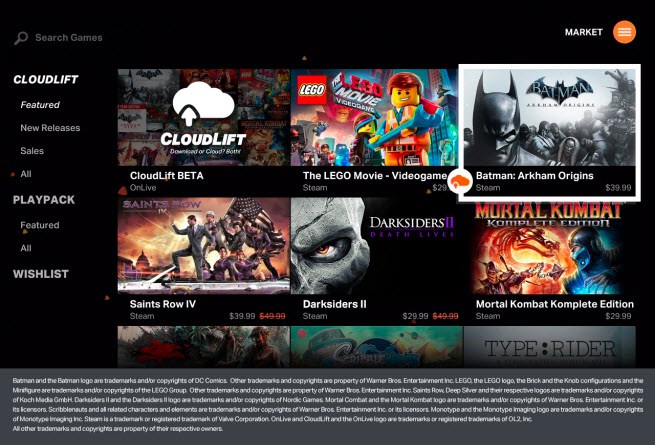
Users only need to purchase a game from a distributor once in order to play it with the OnLive service, which streams the games as a video of game imagery from the cloud to the device. Games are delivered in 720p at 60 frames per second.
At the current time, CloudLift is limited to 20 launch titles such as The LEGO Movie Videogame, Batman: Arkham Origins, Scribblenauts Unlimited, LEGO Lord of the Rings, and Saints Row IV.
OnLive Go is similar to CloudLift, but it is designed to allow massively multiplayer games such as War Thunder or Second Life to be accessible on any device without having to wait for long installs. Players can access MMOs on mobile devices and can launch cloud versions of games while waiting for downloads on Macs or PCs.
OnLive’s first Game Service was introduced in 2010, but issues with Internet connections, latency, and video compression caused it to receive unfavorable reviews. In 2012, the company was forced to lay off most of its employees, later being sold to Lauder Partners for just $4.8 million.
The company has now hired former IGN Chief Mark Jung as executive chairman and hopes to make a comeback with its new services and an expanded set of data servers. In an interview with VentureBeat, Jung said the company is aiming to deliver a higher value service to users.
“In this last year, we have been repositioning the company and redesigning our services for a positive business going forward,” Jung said. “We have rearchitected it to deliver a much higher value proposition for the users.”
The CloudLift service is currently available on Macs, PCs, and Android devices. OnLive has plans to bring connectivity to iOS devices, but the company told Pocket-Lint that getting the technology right around Apple’s limitations is a difficult task.
“iOS is a big platform. We’re not sitting here ignoring it,” he said. “It’s the same thing with Surface. We want to be platform agnostic. We continue to grow and we’ll focus on growing across all of those.”
OnLive’s new CloudLift service is available for $14.99 per month, while OnLive Go is variably priced with Second Life gaming available for $3 per hour. Both CloudLift and OnLive Go require a solid Internet connection of at least 2 megabits a second.
OnLive is also offering its PlayPack subscription service, which provides users with 250 games, for $9.99 per month.
     |
Apple to Introduce Full-Screen Video iAds to Apps This Year
 Apple plans to introduce full-screen video iAds for apps on the iPhone and the iPad later this year, reports AdAge. The new ads, described as “interstitials,” will allow developers to opt into ads that play in between levels within a game or in between articles in a news-style app.
Full screen ads will mark a departure from Apple’s typical advertising style, which has limited iAds within the App Store and iTunes Radio to less obtrusive banners that must be clicked for a video ad to be played. iTunes Radio also features audio ads, but full video ads within apps are arguably more interruptive.
Some free-to-play apps already feature full-screen third-party video ads. Zynga’s Draw Something on iPad, for example, requires users to watch a video ad before allowing them to move on to the next level, a task that takes several seconds away from gameplay.
Since its 2010 introduction as a way for developers to make money on the iOS platform, iAd has been largely unsuccessful attracting developer interest and revenue. Apple has, however, been attempting to revive iAd with a new focus on iTunes Radio.
The in-app video ads may be a way for Apple to rekindle advertisers’ interests in its fancy-but-flawed iAds. The ad product line was unveiled in 2010 with all the pomp and circumstance of a new iPhone, but they’ve struggled to gain traction in the market. Advertisers were initially asked to drop $1 million for the rich-media units, which more closely resemble a mobile microsite than a banner. That price tag has dropped to $100,000 over the years, even as Apple has added features like maps.
Few details are available on the video ads, including how Apple plans to sell and price the spots, but they may be positioned as a way to further entice new advertising partners to advertise via the service. The introduction of iTunes Radio, which has the potential to bring in quite a bit of revenue, already garnered Apple several major advertising partners, including McDonald’s, Nissan, Pepsi, and Procter & Gamble.
Apple’s ad sales, which were at just $125 million in 2012 according to IDC, have lagged significantly behind those of other companies, including Google, but the new video ads along with revenue from iTunes Radio may shift those figures considerably in the years to come.
| |

Gmail for iOS Updated With Background Refresh [iOS Blog]
 Google today updated its Gmail for iOS app to version 3.0, adding both simplified sign-ins and background app refresh. With the new update, Gmail will use iOS 7′s background refresh capabilities to fetch mail even when the app is not open.
Before the update, users could receive notifications when new mail was received, but opening the app was required to download the messages.
The app also supports a simplified sign-in that allows users to sign into all Google apps when signing into a single app such as Maps, Drive, Chrome, or Gmail.
Background app refresh: Gmail now fetches your mail even when it is not open so it will be waiting for you when you open the app. Requires iOS 7 and at least one type of notification (badge, alert, or banner) to be turned on.
Simplified sign-in: Signing into Google Apps such as Gmail, Maps, Drive and Chrome just got easier. Sign in to one, and you’ll be signed in to all automatically.
Note: In some cases, you may need to sign-in to Gmail again after this update.
Gmail can be downloaded from the App Store for free. [Direct Link]
| |
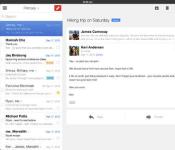
Gmail for iOS now fetches for mail in the background, simplifies log-in

Today, Google updated its Gmail app on Apple’s mobile platform, bringing with it some features bound to be very useful for users. The iOS application is finally capable of fetching mail in the background, so new stuff can hit your inbox at any given time — not just when you open the app. For the background app refresh to work as intended, however, the company points out that notifications will need to be turned on. Google’s also made its sign-in process more streamlined, meaning that once you log into the Gmail app, you’ll automatically be signed in to other iOS apps from the search giant. Because, c’mon, Google wants you to be doing Google things all the time.
Filed under: Internet, Software, Mobile, Apple, Google
Source: App Store

Apple’s A8 Chip Production for iPhone 6 Underway at TSMC
 Apple’s new chip partner Taiwan Semiconductor Manufacturing Company (TSMC) has begun production on the next-generation A8 chip destined for the iPhone 6 later this year, according to a report [Google Translate] from Taiwan’s Commercial Times picked up by AFP.
The world’s leading contract microchip maker last month started producing the A8 chip, which is tipped to power the expected iPhone 6, the Commercial Times reported.
The report, which cited supply chain sources, said TSMC had won most of the manufacturing orders for logic and power management integrated chips for the new handset.
The report claims that the new 20-nanometer A8 will include a quad-core 64-bit processor and quad-core graphics, and that an earlier start to chip production compared to the previous years could give Apple the flexibility to comfortably launch the new iPhone in the third quarter of this year.
Samsung has been Apple’s exclusive manufacturing partner for A-series chips, but Apple has long been reported to be trying to shift orders to TSMC. After years of rumors, Apple and TSMC reportedly struck a deal in mid-2013 to begin chip production in early 2014. TSMC and Samsung were initially reported to be splitting the production load for the A8, but Samsung is now said to have dropped out due to low yields.
| |

‘CloudyTabs’ Brings iCloud Tabs to Third-Party Mac Browsers via the OS X Menu Bar [Mac Blog]
CloudyTabs is a new utility for Mac owners who prefer to use Chrome or Firefox for their browser, but don’t want to give up one of iCloud’s useful features — iCloud Tabs. Created by developer Josh Parnham, the open source app resides in your menu bar and lets you open your iCloud tabs in any web browser you choose. (Via MacStories)

iCloud Tabs was rolled out in OS X Mountain Lion and works with any iCloud-enabled iOS device running iOS 6 or higher. The iCloud service syncs your open tabs across your iOS and OS X devices, allowing you to access your iOS browser tabs from Safari on the Mac. It also works in the opposite direction by displaying open Safari for Mac tabs on your iOS device.
iCloud Tabs is a convenient feature for Mac Safari users, but it is not compatible with Chrome or Firefox for the Mac. If you use an alternative web browser, you need a third-party tool like CloudyTabs to view your open iOS tabs. CloudyTabs compiles the existing iCloud Tab information from OS X and does not require you to enter in your iCloud credentials.
Just like the official iCloud version, CloudyTabs breaks down your open tabs by device, allowing you to see what you have open on your iPad, iPhone and other Macs. Tapping on a tab in the menu bar app will open the URL in your selected browser. You can open tabs individually or choose to open all tabs from a chosen device.
Unlike iCloud Tabs which shares between iOS and OS X, CloudyTabs only works in one direction (iOS to Mac) and does not share your open Chrome or Firefox tabs on your iOS device. If you need bidirectional sharing, you must use iCloud Tabs with Safari on the Mac or switch to Chrome, which can share bookmarks between Chrome for the Mac and Chrome for iOS [Direct Link].
CloudyTabs is open source and available for free to download from Github.
| |

Corning Again Criticizes Sapphire as Potential Alternative to Gorilla Glass
Corning Glass senior vice president Tony Tripeny spoke critically of sapphire as a material for displays during a question and answer session at the recent Morgan Stanley Technology, Media & Telecom Conference (Via Seeking Alpha and CNET). His responses reiterate the company’s earlier opposition to sapphire crystal.

Morgan Stanley’s James Fawcett asked Tripeny about sapphire versus glass now that “there is one large handset and device maker that people suspect maybe looking at Sapphire.” This one large manufacturer is obviously Apple, which is building a plant in Arizona to manufacture sapphire for “a secret project,” possibly the iWatch or the next generation iPhone. Tripeny didn’t hold back in his criticism of the sapphire crystal material.
When we look at it, we see a lot of disadvantages of Sapphire versus Gorilla Glass. It’s about 10 times more expensive. It’s about 1.6 times heavier. It’s environmentally unfriendly. It takes about 100 times more energy to generate a Sapphire crystal than it does glass. It transmits less light which it means either dimmer devices or shorter battery life. It continues to break. I think while it’s scratch resistant product it still breaks and our testing says that Gorilla Glass, about 2.5 times more pressure that it can take than Sapphire on. So when we look at it, we think from an overall industry and trend that is not attractive in consumer electronics.
Fawcett continued to query Tripeny on the material with the Corning executive hinting that Apple is looking at sapphire for its marketing appeal as the material “has got a very sexy name.” Tripeny also mentions the extra cost and lower manufacturing yield of sapphire crystal when compared to Gorilla Glass.
The formation takes about 4,000 times longer than Gorilla Glass at a significantly higher melting temperature. Its hardness makes machining more difficult and costly. Then the cost per unit increases exponentially because when you have defects in boundaries in the crystal growth process, you essentially cut them out and so unlike glass where we have developed technologies so that we can have very large pristine pieces of glass, when you have that on crystals, what you end up doing is always having a yield issue. So it is really those items that make things more expensive.
Corning now is manufacturing Gorilla Glass 3 for use in smartphones and tablets. Announced at CES 2013, the material is three times more damage resistant than its predecessor Gorilla Glass 2. The company earlier this year also announced a new shaped Gorilla Glass product for devices that require a curved display and a version of its Gorilla Glass with antimicrobial properties.
| |
Apple Working to Expand Siri’s Third-Party App Integration for iWatch
 As Apple continues work on its much-rumored iWatch, the company is placing a significant focus on expanding Siri’s ability to interface with third-party apps, according to a report from The Information summarized by TechCrunch.
With input methods for the iWatch limited due to the device’s size, Siri’s voice capabilities may be one of the best tools for Apple to leverage, and that means improving Siri’s capabilities.
The report points out how the Siri of today can’t do things like book a car rental or make a hotel reservation, or use a messaging app other than Messages to send a text. The improvements to Siri would potentially enable those types of things, enabling third-party integrations that don’t require one-to-one business arrangement between Apple and the external company. Current integrations like those with OpenTable and Wolfram Alpha do involve those direct deals, which limits the pace at which new third-party powers can be added to Siri.
The report also claims that Apple is working on technology to dynamically adjust what content is being shown on a device’s display, offering the example of a running app automatically being shown when the user begins jogging. The technology would obviously be useful for a device such as the iWatch with very limited display size and input capabilities.
Apple has been rumored for several years to be working on a smart watch project, with the company reportedly placing a strong focus on biometrics to include health-related data tracking for the iOS ecosystem.
| |
Apple Released Confidential License Terms with Nokia While Sanctioning Samsung for Role in Leaks
Last October, Apple filed a motion seeking sanctions against Samsung and its outside lawyers, accusing both of unlawfully sharing sensitive data about Apple’s 2011 patent license agreement with Nokia. Specifically, the motion stated that a Samsung executive informed Nokia that the terms of the patent settlement were “known to him”, and used that information to negotiate other patent agreements in Samsung’s favor. The license terms between Apple and Nokia were marked “Highly Confidential – Attorneys’ Eyes Only”, but were shared with other Samsung employees.

In January, Judge Paul S. Grewal ruled against imposing sanctions on Samsung, instead choosing to solely penalize the company’s law firm, Quinn Emanuel. Now however, FOSS Patents is reporting that Apple released its confidential license terms with Nokia and the NEC while seeking sanctions against Samsung for its role in the leaks.
The license terms were viewable in a publicly accessible court proceedings document on the Internet for four months before they were removed, as Samsung has filed a new motion asking the court to reduce the penalties against its law firm:
Apple’s and Nokia’s scorched-earth approach to Samsung’s inadvertent disclosure, and the amount of the concomitant fees Apple and Nokia incurred in pursuing those efforts, must be juxtaposed against the fact that Apple had simultaneously posted (and Nokia neglected to notice) this information on the Internet for all the world to see. The fee award should be reduced accordingly.
Samsung also added in its filing that Apple should now be required to provide information as to what happened based on “transparency and evenhandedness.” A hearing on Samsung’s new motion against Apple is scheduled to take place on April 8, as the company also states it may seek further sanctions against Apple after reviewing other information about the situation.
The new motion comes before a second patent infringement lawsuit between Apple and Samsung is set to begin on March 31, 2014. Samsung will only have four patents claims to bring to the upcoming trial, as Judge Koh invalidated two of its patent claims in January. 
| |

