



OS X 10.10 Mockup Shows Off ‘Flat’, iOS-Inspired Design [Mac Blog]
In iOS 7, Apple redesigned the user interface from top to bottom, removing most “skeuomorphic” elements and giving the OS a cleaner and lighter look and feel. Back in January, it was reported that OS X 10.10 — code named Syrah — would also see a flatter redesign, but that it would not see as extensive a reworking as iOS did.
Designer Danny Giebe has posted a series of concept images on Dribbble, showing what an iOS 7-inspired redesign of OS X could look like:


This is a concept for Mac OS X Syrah, expected to be published in September 2014. It’s based on the new flat design approach of the Contacts and Notes App introduced in Mac OS X Mavericks.
It is not known what Apple will call the next version of its OS X operating system, but may show off the new OS — and its new California-inspired name — at WWDC in June of this year. Over the past several years, Apple has tended to release its new Mac operating system in mid-Fall.
     |

Christian Bale Top Choice to Play Steve Jobs in Biopic Written by Aaron Sorkin
Director David Fincher, who is in talks to direct the Aaron Sorkin-scripted Steve Jobs biopic based on Water Isaacson’s biography, is hoping to cast Christian Bale in the leading role as Steve Jobs, reports TheWrap.
Though Fincher has not yet officially signed on to direct the film, he has allegedly said that he will take on the project if Christian Bale plays Steve Jobs. Bale has not been approached about the possible role, but he has reportedly been a front runner for the position due to his undeniable resemblance to Jobs.

While Steve Jobs is a long way from Batman, Bale has been considered a prime contender to play the tech superhero since the project was first announced due to his physical resemblance to the Apple co-founder.
Bale has not been approached to play Jobs yet, as the actor is taking a step away from the business to spend time with his family now that he has wrapped the role of Moses in Ridley Scott’s “Exodus,” which is expected to have him back in the awards conversation after “American Hustle.”
David Fincher, who may direct the yet unnamed biopic, was the director behind The Social Network, another Silicon Valley-based film that won three Academy Awards and was nominated for five more, including Best Picture and Best Director.
Sorkin completed the script for the upcoming Jobs movie back in January, and the film is said to take place across three continuous 30-minute scenes at three different Jobs-led product launches.
The movie, which is still in the casting stages, has no set launch date at the current time.
| |
Pebble Smartwatch Sales Climb to 400,000 Units, Revenue to Double in 2014 [iOS Blog]
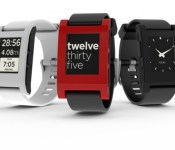
Pebble launched its smartwatch Kickstarter campaign in 2012 and started shipping the device early last year. Since January 2013, the company has sold over 400,000 smartwatch units, earning Pebble an estimated $60 million in revenue, reports Fortune, which spoke to Pebble CEO Eric Migicovsky.

Pebble as a company has grown significantly in the intervening years, becoming profitable in early 2013 and almost doubling its workforce from 45 up to 70 this year. Revenue also is expected to double year over year in 2014.
“When we started working on wearables six years ago, there were few players in the space and a lot of skeptics,” says Pebble CEO Eric Migicovsky of Google’s news. “It’s exciting to see this market grow so quickly — enabling more interesting use cases and keeping all of us laser-focused on creating the very best user experiences we can.”
As the company matures, Pebble’s ecosystem is experiencing its own expansion. The company recently rolled out an Appstore for its smartwatch and has over 1,000 apps in its library, with 12,000 registered developers ready to add more titles in the future.
As for Pebble’s next steps, Migicovsky is not concerned about Google’s recent Android Wear announcement and the unveiling of Motorola’s Android-based Moto 360 smartwatch.
For now, Migicovsky is more worried about making his products better than Google shaking up the market. He’s exploring technologies that could help boost Pebble’s week-long battery life further and keeping tabs on newer screen displays, particularly ones made from flexible materials.
Besides adding an Appstore, Pebble also recently started selling a new version of the smartwatch. The $249 Pebble Steel features a stainless steel body with a leather or steel band and a face covered with durable and scratch resistant Gorilla Glass material.
Apple also is expected to enter the wearables market in 2014 with its iWatch product. Recent rumors suggest the device will focus on fitness with support for heart rate measurement, step count and more. The device may pair with Apple’s Healthbook app, a Passbook-inspired wellness app that could debut alongside iOS 8. The iWatch may also include Siri and mapping functionality. 
| |

GarageBand for Mac Updated with MP3 Export, New Drummers, and More [Mac Blog]
Apple today updated GarageBand for Mac to version 10.0.2, bringing several improvements including the ability to export tracks in MP3 format and three new Drummer options in the $4.99 content pack.

What’s New in Version 10.0.2
– Improves stability and addresses a number of minor issues
– Adds the option to export songs as an MP3
– Contains multiple enhancements to Accessibility
– Includes 3 new Drummers and drum kits from the rock, songwriter, and R&B genres**Part of the one-time in-app purchase that includes the complete set of GarageBand sounds, loops, and drummers, as well as access to the GarageBand Lesson Store.
GarageBand 10 was introduced alongside OS X Mavericks last October and was part of a significant shift in Apple’s business model that saw all iLife and iWork apps for iOS and Mac devices become free for customers purchasing new devices. While the basic GarageBand app for Mac is a free download [Mac App Store], additional content such as virtual drummers, lessons, sounds, and loops are part of a $4.99 in-app purchase package due to licensing costs associated with the content.
| |

Malicious Tor Browser Persists in iOS App Store for Months Despite Protests [iOS Blog]
Developers working on the Tor anonymity service asked Apple months ago to remove a malicious Tor browser that poses a threat to its users from the App Store (Via Ars Technica). After receiving no action through official channels, Tor project members now are using more public means to get this app removed.
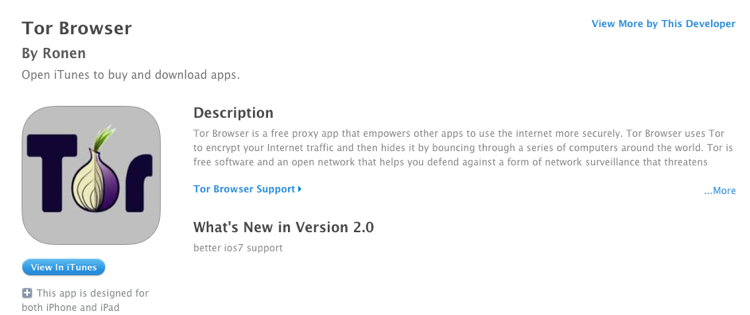
A report ticket published three months ago by volunteer Phobos details the issue with rogue app.
“Tor Browser in the Apple App Store is fake. It’s full of adware and spyware. Two users have called to complain. We should have it removed.”
Tor officials confirmed they filed a complaint with Apple in December 2013 and received a response that the app developer was allowed to defend his app from these accusations.
Several followup emails were sent to Apple, but there was no response from the Cupertino company. Twelve weeks later and the app remains in the App Store, prompting the team to step up their campaign to get the app removed.
“I think naming and shaming is now in order. Apple has been putting users at risk for months now,” writes lunar
“I mailed Window Snyder and Jon Callas to see if they can get us past the bureaucracy.
Otherwise I guess plan C is to get high-profile people on Twitter to ask Apple why it likes harming people who care about privacy. (I hope plan B works.),” writes arma.
Apple’s App Store is known for being a walled garden where apps are vetted before they are allowed entry into the App Store. The process is not flawless, though, with researchers from Georgia Tech last year showing how an innocuous app with hidden malware-type code could slip through Apple’s app approval system.
Once a malicious app is identified in the App Store, Apple has in the past taken steps to remove the app, but the exact process by which an app is removed is not known. In an earlier example, Apple quickly pulled a Russian SMS app that quietly scraped address book contacts and sent them to the developer’s server.
| |

Samsung Bashes the iPad, Microsoft Surface and Kindle in New Ad
Samsung has released a new anti-Apple advertisement that highlights the perceived shortcomings of the iPad in comparison to Samsung’s new Galaxy Tab Pro and Galaxy Note Pro tablets. Targeting not only Apple, the ad also criticizes Microsoft’s Surface tablet and the Amazon Kindle.

The ad uses three scenarios to highlight the advantages of the Galaxy Pro series over its competitors. The first is a business conference call, during which the Galaxy owner is able to talk and simultaneously send a report because of the Galaxy’s multitasking feature that allows him to display multiple Android applications at once on the screen. There’s also a slight jab at the Microsoft Surface, which is ridiculed for being “computer-like” because of its keyboard, battery pack and mouse.
The ad then switches to more personal uses of the tablet with a quick dig at Amazon’s Kindle device, which can only read books, while the Galaxy can pull up YouTube videos during a book club meeting. The harshest comment comes at the end when two ladies at a spa are comparing their iPad and Galaxy tablets. The discourse on the lower screen resolution of the iPad (2048-by-1536 resolution) when compared to the Galaxy Pro (2560-by-1600 resolution) ends with a condescending smile from the Galaxy owner when the iPad owner retorts that her iPad has “the retina thingy.”
Samsung has a history of chiding its competitors in commercials, so it’s not surprising to see the Korean company take on the iPad shortly after unveiling its Galaxy Pro series earlier this year.
The Galaxy Note Pro features Samsung’s S-Pen technology, while the Tab Pro is the company’s standard tablet. The Galaxy Note Pro is available in a 12.2-inch size, while the Galaxy Tab Pro ships with 12.2, 10.1 or 8.4-inch displays. 
| |

China Mobile Adds One Million iPhone Users in First Month of Availability
China Mobile Chief Executive Li Yue confirmed on Thursday that the carrier added one million new iPhone customers in the four weeks following the iPhone’s launch in mid-January, reports the Wall Street Journal. China Mobile released these subscriber figures as part of its earnings statement, which also included the carrier’s first annual profit decline in 14 years.

To offset growing competition from rival carriers China Unicom and China Telecom, China Mobile is trying to attract new customers with the combination of its new 4G network and flagship phones like the iPhone 5s and the iPhone 5c.
“We added 1.34 million new 4G users in February and most of them are iPhone users. We are happy with the progress as we are still building our 4G network and the coverage is only available in some major cities,” China Mobile Chairman Xi Gouhua told The Wall Street Journal.
China is the world’s largest mobile phone market by subscribers, with over 1.24 billion mobile subscribers as of January 2014, and China Mobile is the country’s largest wireless carrier. Analysts predict the addition of the iPhone to China Mobile’s smartphone lineup could boost iPhone sales by 15 to 30 million units in 2014. Apple sold 51 million iPhones globally in Q1 2014 and has sold 472.3 million smartphones in total as of January 2014.
| |

NSA claims that technology firms are aware of its data collection

If you ask technology leaders like Apple or Google, the NSA has been snooping on their customers without permission. However, the NSA has a very different story. Agency general counsel Rajesh De tells an oversight board that these companies are fully aware of and assisting data collection under the PRISM surveillance program, whether it targets servers or internet traffic. There’s a “compulsory legal process” for the firms involved, the attorney says. If accurate, the statement at least partly contradicts repeated claims from these companies that the NSA leaves them in the dark. With that said, it’s still possible for both sides to be right. Leaks from last June suggest that company staff handling these government requests are required to keep the details secret, even when speaking to coworkers — higher-ups won’t necessarily hear about cooperation with the intelligence community.
Filed under: Networking, Internet, Apple, Microsoft, Google, Facebook
Via: CNET
Source: The Guardian

Future iPhones May Offer More Realistic Lighting and Shadows with New Ray-Tracing GPU
Apple’s graphics partner for iOS devices, Imagination Technologies, has announced a new version of its PowerVR graphics architecture that includes ray-tracing capabilities. Apple currently uses the PowerVR G6430 graphics package from Imagination in its latest A7 chip that powers the iPhone 5s, iPad Air, and Retina iPad mini, so Imagination’s new technology is likely of interest to Apple.

Offering more realistic lighting and shadows, the new GPU design known as “Wizard” marks a significant leap forward by bringing ray tracing to mobile devices.
For the better part of the last eight years, we have been busy developing unique hardware and software technologies to radically lower the cost and dramatically increase the efficiency and performance of ray tracing.
This work culminates at GDC 2014 with the official launch of the PowerVR Wizard GPU family, a range of IP processors that offer high-performance ray tracing, graphics and compute in a power envelope suitable for mobile and embedded use cases. This opens up the potential of highly photorealistic, computer generated imagery to a host of new real-time applications and markets not previously possible.


iOS 7.1 Causing Issues With Personal Hotspots
Introduced earlier this month, iOS 7.1 appears to be causing issues with personal hotspots for quite a few iPhone users around the world. Following the update, some users appear to be unable to save APN settings for personal hotspots, which have vanished following the update from iOS 7.0.6 to iOS 7.1.
While information can be entered into the APN fields of the Cellular Data Settings menu, the values do not save, and attempting to establish a tethered connection results in an error message. Apple’s Support Communities currently features a 15-page thread on the issue that was started shortly after iOS 7.1 was released, with many users reporting the same problems with tethering.

Apple’s support staff appears to be confused by the root cause of the issue, with several customer service representatives suggesting the problem lies with carriers. Carriers that have been contacted have indicated that it is an issue with Apple, however.
Same here. Hotspot not working since I upgraded to 7.1. Such an annoying issue. I phoned my carrier this morning and they didn’t want to get involved since “it’s a device issue since settings can’t be saved”. No carrier updates either when I installed 7.1. So right now, no hotspot and no one wants to get involved.
Other users have heard that it is a problem limited to carriers that do not currently have a contract with Apple. The iPhone 4, 4s, 5, and 5s all appear to be affected by the issue, and there is currently no available fix. Users in Germany, India, Austria, Spain, Serbia, Thailand, Estonia, Hungary, Belgium, Italy, Brazil, and more have reported issues with hotspots.
| |

