



Sketchy iPhone 6 Dummy Unit Surfaces in New Photos [iOS Blog]
Photos of a new “dummy unit” of Apple’s alleged iPhone 6 have surfaced on the site of case manufacturer Bling My Thing (via 9to5Mac community post). The photos show a black device that could be used as part of a mold to create cases based on that body design.

There are several issues with the case shown in the photos, however, including a round hole for the LED flash on the rear camera instead of the oval hole introduced on the iPhone 5s to accommodate the new True Tone dual-LED flash. Given the improved flash performance possible with dual LEDs, Apple will presumably continue to use dual-LED flash in future iPhones.

The photos also appear to show a slight change to the design of the earpiece area of the iPhone, with the proximity sensor window moving from next to the earpiece to next to the front camera. The ambient light sensor (not easily visible) is currently in this location. The dummy unit also shows the earpiece/camera/sensor features moved higher on the device’s front, to the point where the front camera unreasonably appears to sit at the very top edge of the device.
The dummy unit depicted in the photos carries a screen size of approximately 4.7 inches if relative sizing compared to the iPhone 5s shown next to the model is accurate. That size is in line with circulating rumors, with the company also rumored to looking at even larger version with a display in the range of 5.5-5.7 inches.
The blog post also includes a list of features for the iPhone 6, although it appears to simply be a recitation of circulating rumors rather than specific claims.
     |

Apple Manufacturer Pegatron Reports Quarterly Earnings Increase of 22% [iOS Blog]
Apple iPhone 5c manufacturer Pegatron reported a 22 percent jump in fourth quarter earnings due to a revenue increase in its communications products division, which is responsible for manufacturing smartphones, tablets and game consoles (Via The Wall Street Journal).

Apple is a major client of the Taiwanese manufacturer, accounting for approximately 40 percent of the company’s revenue, estimates KGI Securities analyst Angela Hsiang. While revenue from its Apple-dominated communications products increased, Pegatron’s overall revenue fell slightly year over year due to sluggish sales from its personal computer business.
“While PCs will still be around, mobile devices are a faster growing sector, and we want an even balance between the different parts of our business,” Pegatron Chief Executive Jason Cheng said at an investor conference on Monday.
Pegatron has long been a manufacturing partner for Apple, working on previous iPhone and iPad models, including the iPad mini. Last year, though, the company for the first time assumed the role as the primary manufacturer for a new iPhone model — the iPhone 5c.
Pegatron also is rumored to be producing the iPhone 6 along with Foxconn in the second quarter of this year. The company supposedly is opening a new factory in Kunshan, China and recruiting workers in an effort to meet manufacturing orders for the upcoming phone.
Apple has moved beyond relying only on Foxconn for its manufacturing needs and has turned to Pegatron as it expands its product lineup and tries to minimize supply problems by balancing production between multiple assemblers.
| |
Apple’s iTunes Radio now streams the news, thanks to NPR

It’s been nearly a year since Apple announced its plans to join Spotify, Rdio and Pandora as a music streaming service provider. However, while beats, melodies and harmony are great, some would say iTunes Radio‘s sonic buffet is lacking — it has no news channels. No longer. NPR has joined the service as a 24-hour news streaming station, with broadcasts starting right now. Of course, folks have long been able to get their public radio fix via NPR’s website, but now fanboys and girls can get it straight from Apple’s service. For now, NPR is the first and only news channel on iTunes Radio, but we’ve a sneaking suspicion that exclusivity won’t last for long.
Source: NPR

iTunes Radio Adds NPR, with More News Channels on the Way
 Apple’s iTunes Radio streaming music service is expanding today with the addition of a new National Public Radio (NPR) channel, reports Re/code.
NPR’s channel, which should be live today, will offer a free stream, 24 hours a day, which mixes live news with segments from pre-recorded shows like “All Things Considered” and “The Diane Rehm Show.” NPR officials say that within weeks, some of the broadcaster’s local stations should begin offering their own channels, with a similar mix of live and taped news.
NPR has also been working on bringing on-demand programming based on users’ tastes to its mobile apps, and it is possible that functionality could come to the station’s iTunes Radio service as well.
The report notes that it is currently unclear what the business relationship between Apple and NPR is in terms of generating revenue for NPR, but NPR vice president of digital media Zach Brand says that Apple has been “very understanding of the business model” used by the nonprofit.
| |

Employee Anti-Poaching Agreements May Extend Far Beyond Apple and Google
Apple, Google and five other large technology companies were caught signing “no solicitation” agreements that prevented the companies from trying to hire away each others’ employees. Court documents newly obtained by Pando Daily suggest these anti-poaching agreements extend far beyond this Silicon Valley seven.

According to these documents, over a dozen companies and as many as one million employees may have been affected by these secret hiring agreements.
Confidential internal Google and Apple memos, buried within piles of court dockets and reviewed by PandoDaily, clearly show that what began as a secret cartel agreement between Apple’s Steve Jobs and Google’s Eric Schmidt to illegally fix the labor market for hi-tech workers, expanded within a few years to include companies ranging from Dell, IBM, eBay and Microsoft, to Comcast, Clear Channel, Dreamworks, and London-based public relations behemoth WPP. All told, the combined workforces of the companies involved totals well over a million employees.
Investigation into these wage-fixing deals focused on Adobe, Apple, Google, Intel, Intuit, Lucasfilm and Pixar, but other businesses such as NVIDIA, British cable company Virgin Media and even recruiting agencies were caught up in this net. Some of these other companies did not sign reciprocal non-solicitation agreements, but, instead, were added by Google and others to “Do Not Cold Call” or similar “Sensitive” company lists.
Google and Apple allegedly signed one of the first wage-fixing agreements in early 2005, with other companies following suit. The discovery of these agreements in 2009 initiated a Department of Justice investigation that resulted in the dissolution of these restrictive hiring deals. A subsequent class-action civil suit was filed in 2011 and is expected to go to trial in May.
| |

Apple to Move Production of iPhone Batteries to Automated Lines
 Apple is set to begin producing all iPhone batteries on automated production lines starting later this year, according to a report from DigiTimes. The move is being done to reduce manpower demand and to allow the company to shift its supply chain resources towards production efforts on other parts.
Apple has already automated its Mac Pro and iMac production lines. Other than materials and final assembly, manpower is not required for the rest of the manufacturing.
The move will likely help Apple with iPhone production going forward, as company supplier Pegatron will reportedly be starting production on the iPhone 6 in the second quarter of this year at its new Kunsahn, China plant. Moving the production of iPhone batteries to automated lines may also help Apple avoid manufacturing defects like ones found in a small number of iPhone 5s last year.
Apple’s next-generation iPhone will likely be unveiled in the fall, and has been rumored to launch with two different models including one with a 4.7-inch display and one with a 5.7-inch display. The iPhone 6 could also feature a durable sapphire display, with other rumors pointing to a thinner chassis and bezel-free design.
| |

UK government closes tax loophole on digital media, could mean the end of the 99p song download

Buried within the latest budget plan for the UK, Chancellor George Osborne announced new laws that would ensure internet downloads from the likes of iTunes, Google Play Amazon and game networks would be taxed in the country they’re bought in. In the case of the UK, that would be around 20 percent VAT, substantially more than selling through countries like Luxemburg where the rate can be around 3 percent. Separate to the government’s grand plans for its digital future, the new rule would start January 1 2015 — “ensuring these are taxed fairly and helping to protect revenue.” According to the government’s estimates, it could net around £300 million in extra tax income, although it’s likely to bring digital download pricing (unfortunately) closer to physical media in the process.
Filed under: Internet, Apple, Sony, Microsoft, Amazon
Source: The Guardian
Wendy’s Updates iOS App to Enable Mobile Payments at U.S. Locations [iOS Blog]
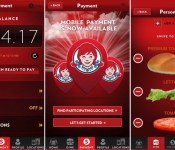
Wendy’s has updated its My Wendy’s app for iOS devices with the ability to take mobile payments at most of its 5,800 locations in the United States, reports The Associated Press. The fast-food restaurant chain has reportedly been developing its mobile payment system over the past year, testing its app at some of its locations throughout the country.
Once opened, the app allows users to find the nearest restaurants accepting the new mobile payment system, which can be enabled through the creation of a Wendy’s profile. Unlike the process of mobile payments by other merchants however, a mobile payment at a Wendy’s restaurant is processed by showing a cashier a generated six-digit number. According to Wendy’s Digital Vice President Brandon Rhoten, this method was enabled to make it more convenient for customers going through pickup windows.

The move reflects a push by fast-food chains to court younger customers by tapping into the attachment they have to their phones.
“If they want to come in and give us business, we want to allow them to pay the way they want to pay,” Craig Bahner, chief marketing officer for Wendy’s, said in a phone interview.
The move comes as a number of other restaurants have begun to implement mobile payment systems, with Chipotle, Domino’s Pizza, and Pizza Hut all adding support in their respective apps. Taco Bell announced last month that it would be rolling out its mobile ordering platform nationwide later this year, with Burger King expected to follow suit with its own platform. McDonalds, the world’s largest fast food chain, is also expected to launch a mobile payment system sometime in future, with testing currently underway at some of its U.S. locations.
The updated My Wendy’s app for iOS devices is available now in the App Store. [Direct Link]
| |
Latest Apple TV rumors have it teaming up with Comcast for streaming

Rumors Apple will launch a new TV-connected device/service seemingly never die, and now the Wall Street Journal reports it’s in talks with Comcast (and that rumored discussions with Time Warner Cable over a “Project Jupiter” team-up stalled when it became a takeover target). With interesting timing, the rumors focus on an aspect of the deal that would give Apple’s streaming of live TV and cloud DVR recordings over a “managed connection” avoiding last-mile bottlenecks. That’s similar to how Comcast sends video on-demand to its Xbox 360 app, and a contrast to the recent net neutrality discussions arising over its deal with Netflix. Noting that the companies “aren’t close to an agreement,” the rumors suggest an arrangement where Apple sells its hardware at retail TiVo-style, although how customers log in and who controls that relationship is something where the two continue to differ.
As the article notes, this proposal is similar to Comcast’s arrangement with TiVo — it sells boxes at retail that in some areas can access Comcast VOD — but going in with Apple to create some kind of hybrid service would be a major change. So far, Comcast has pushed its X1 platform with live TV, internet features and eventually cloud DVR streaming to multiple devices, while also testing out a full IPTV service on college campuses.
Despite years of rumored negotiations and device testing we still haven’t seen Apple jump out with a product to modernize/revolutionize the existing TV experience. Now, we wonder if pressure from regulators on the proposed Time Warner Cable / Comcast merger, cord-cutting (the number of customers paying for cable, satellite and fiber TV dropped slightly last year, the first time that’s happened), and competing internet TV services (Netflix, Sony, Amazon etc.) is creating a new reason for cooperation. If any of those are true, the next steps are figuring out how the two sides will split the money coming in, if the studios and networks that supply content will play ball, and if Reed Hastings will fire off another angry open letter (following up his net neutrality-related posts on Comcast’s Xbox 360 video on-demand and peering).
Filed under: Home Entertainment, HD, Apple
Source: Wall Street Journal
Apple in Talks with Comcast to Provide Streaming TV Service on Future Apple TV
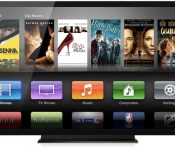
Apple is in talks with Comcast about using the cable provider’s network for a streaming TV service to be integrated in a future version of the Apple TV, reports The Wall Street Journal. According to the report, Apple’s set top-box would be able to access Comcast’s wide variety of channels for a monthly subscription, with the Apple TV receiving “special treatment” from Comcast when connected to its cable network to ensure that it would bypass congestion on the Internet for optimal streaming.

Apple’s intention is to allow users to stream live and on-demand TV programming and digital-video recordings stored in the “cloud,” effectively taking the place of a traditional cable set-top box.
…Under the plan Apple proposed to Comcast, Apple’s video streams would be treated as a “managed service” traveling in Internet protocol format—similar to cable video-on-demand or phone service. Those services travel on a special portion of the cable pipe that is separate from the more congested portion reserved for public Internet access.
People familiar with the matter said that while Apple would like a separate “flow” for its video traffic, it isn’t asking for its traffic to be prioritized over other Internet-based services.
The report also adds that the discussions between Apple and Comcast are still in early discussion, and that Apple’s ultimate goal would be to ensure that Apple TV users receive the same quality that Comcast’s regular set-top TV boxes receive. Apple has proposed to Comcast that users would sign onto the new device using an existing or new Apple ID, as well as a cut of the monthly subscriptions paid by customers.
Apple is expected to launch a new Apple TV sometime in the near future, with some rumors pointing to Apple working on a refined set-top box with expanded functionality that may include gaming and cable box-like capabilities. The move would also come as Comcast announced the acquisition of Time Warner Cable in February, which Apple was reported to be in talks with for quite some time to provide TV shows and other media.
| |

