


Apple: iPad Sales at High End of ‘Internal Expectations’, 2/3 of Users New to Device [iOS Blog]
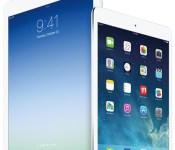
During its financial results conference call for the first calendar quarter and second fiscal quarter of 2014, Apple shared new details on the state of the iPad, including information on sales expectations, the launch of Microsoft Office for the device, the education market, and the use of the tablet compared to competitors.

While the company’s 16.35 million iPad sales fell short of analyst expectations, Apple notes that sales came in at the high end of internal expectations citing two factors: An increased iPad channel inventory in the March 2013 which has since been “significantly” reduced this year, and the ending of the December quarter with a substantial backlog of iPad mini units that were shipped in 2013. The company also added that it hit iPad supply/demand balance earlier this year.
Apple also noted that two-thirds of people registering an iPad in the last six months were new to an iPad, while half of people registering an iPhone were also new to an iPhone. Citing research from App Annie and Chitika, the company stated that the iPad generated 4x mobile web traffic than all Android tablets combined, and that two-thirds of people planning to purchase a tablet within 90 days would be purchasing an iPad.
CEO Tim Cook commented on the recent launch of Microsoft Office for the iPad, stating that the addition of the program suite “helps” and that it would have been better for Microsoft to release the program “earlier.” Overall, Cook noted that customers were “responding well” to Office in a field of many alternatives that were brought to the market, including Apple’s own iWork suite of apps for the iPad and others.
Cook also commented on the use of the iPad in education and elsewhere, stating that Apple has a 95% share in the market and that the company’s focus in getting into more schools to use the tablet. Calling the iPad “the fastest growing product in Apple’s history,” Cook added that the company is determined to stay focused on the things “we do best” and noted that launching the iPad was about getting the details the right as opposed to launching first.
Apple is expected to introduce updated models of the iPad Air and Retina iPad Mini this year, with some rumors suggesting that the company will add a larger “iPad Pro” to its tablet lineup in the near future.

Apple Reports Record March Quarter Results, Splits Stock 7-for-1, and Boosts Share Buyback
 Apple today announced financial results for the first calendar quarter and second fiscal quarter of 2014. For the quarter, Apple posted revenue of $45.6 billion and net quarterly profit of $10.2 billion, or $11.62 per diluted share, compared to revenue of $43.6 billion and net quarterly profit of $9.5 billion, or $10.09 per diluted share in the year-ago quarter.
Gross margin for the quarter was 39.3 percent compared to 37.5 percent in the year-ago quarter, with international sales accounting for 66 percent of revenue. Apple also declared an increased dividend payment of $3.29 per share, payable on May 15 to shareholders as of the close of trading on May 12. The company currently holds $150.6 billion in cash and marketable securities.
In addition to the increase in the dividend payment, Apple said it will dramatically increase its share repurchase authorization to $90 billion from $60 billion and will execute a 7-for-1 stock split as of June 9. The company says it expects to spend over $130 billion in cash under its capital return program by the end of 2015. Apple is now paying $11 billion per year in dividends to shareholders.
Apple previously had a 2-for-1 stock split back in 2005.
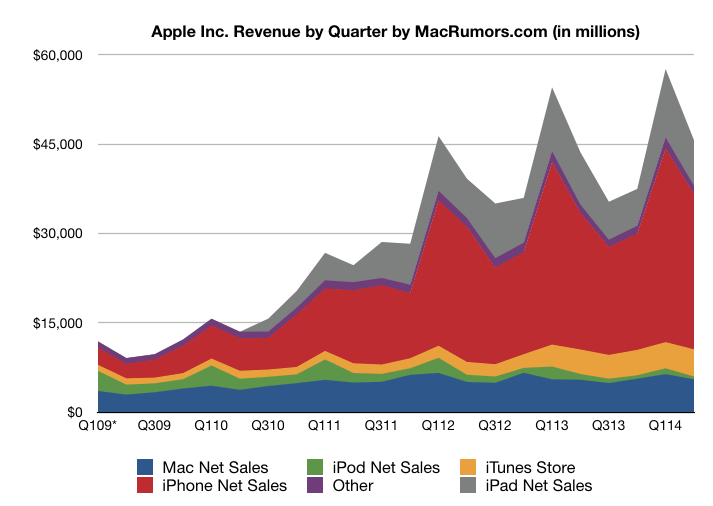
Quarterly iPhone unit sales reached 43.7 million, compared to 37.4 million in the year-ago quarter, and the company sold 16.35 million iPads, down from 19.5 million in the year-ago quarter. Apple sold 4.1 million Macs compared to just under 4 million in the year-ago period.
“We’re very proud of our quarterly results, especially our strong iPhone sales and record revenue from services,” said Tim Cook, Apple’s CEO. “We’re eagerly looking forward to introducing more new products and services that only Apple could bring to market.”
Apple’s guidance for the third quarter of fiscal 2014 includes expected revenue of $36-38 billion and gross margin between 37 and 38 percent.
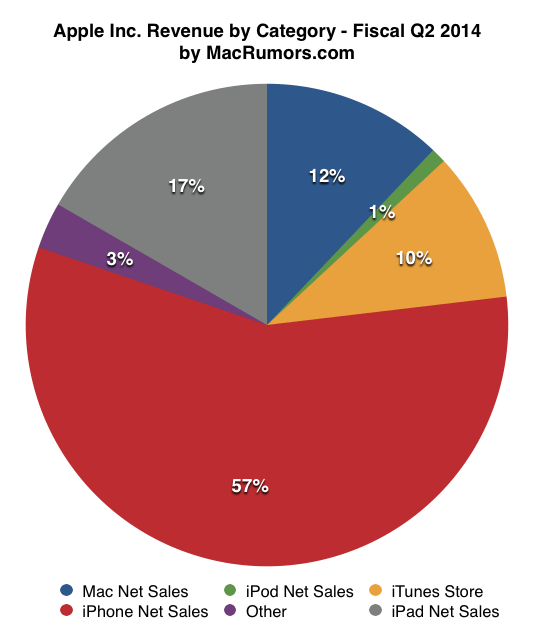
Apple will provide live streaming of its fiscal Q2 2014 financial results conference call at 2:00 PM Pacific, and MacRumors will update this story with coverage of the conference call highlights.
Conference Call and Q&A Highlights are available in reverse chronological order after the jump.
Read more 

Former Burberry CEO Angela Ahrendts to Join Apple Next Week
During today’s second quarter earnings call, Apple CEO Tim Cook announced that the company’s new retail and online leader, Angela Ahrendts, will be joining the company next week.
Ahrendts first resigned from British luxury fashion house Burberry in October of 2013, but was contractually obligated to stay on with the company for another six months. As of April, she became free to leave to join Apple.

Earlier this month, rumors suggested Ahrendts might stay on with Burberry until June in order to pick up a two million pound performance bonus in June, but it appears that she will not be sticking around to collect the payment.
Ahrendts will join Apple as the Senior Vice President of Retail and Online Stores, a position that has seen significant turnover in the past several years. In 2011, Ron Johnson left Apple for J.C. Penney, after building up Apple’s retail presence during his 11-year tenure. Johnson was replaced by Dixons CEO John Browett, who served less than a year at Apple. Since Browett’s departure, the position has been empty.

Tim Cook: Apple’s Shares ‘Undervalued’, Expansion of Share Buyback Program ‘Shows Confidence’ [iOS Blog]
 In a new interview with The Wall Street Journal following Apple’s financial results for the first calendar quarter and second fiscal quarter of 2014, CEO Tim Cook stated that the company’s stock was”undervalued” and that the expansion of the share buyback program”shows how much confidence [Apple] has in the future of the company.”
Cook noted that the iPhone was an area of strength for the company, as Apple sold 43.7 million units last quarter which surpassed analysts’ expectations of 38.2 million units, and was up from 37.4 million units in the year-ago quarter. In addition to these sales, Apple also sold 4.1 million Macs compared to under 4 million in the year-ago quarter, and 16.35 million iPads, down from 19.5 million in the year-ago quarter.
Apple is expected to launch a number of new products in the near future, including a larger-screen iPhone, new models of the iPad Air and Retina iPad Mini, a revamped Apple TV, new MacBooks, and an iWatch smartwatch.
Overall, Apple shared via its financial results report that it posted revenue of $45.6 billion and net quarterly profit of $10.2 billion, or $11.62 per diluted share, compared to revenue of $43.6 billion and net quarterly profit of $9.5 billion, or $10.09 per diluted share, in the year-ago quarter.

iTunes by the Numbers: 800M Accounts, $5.2B in Billings, 70B App Downloads [iOS Blog]
 During its financial results call covering the first calendar quarter and second fiscal quarter of 2014, Apple shared details on the success of its iTunes stores, which have become an increasingly important revenue source for the company, thanks to the App Store.
Last quarter, Apple’s customers spent a total of $5.2 billion on iTunes purchases, up 24 percent year over year. That’s also up from $4.7 during the first quarter of 2014. Cumulatively, Apple’s App Store has seen 70 billion total app downloads, up from 65 billion in January.
Apple has 800 million iTunes accounts, most with credit cards attached, an important fact in light of Apple’s potential interest in entering the mobile payments market. Back in June of 2013, Apple announced 575 million customers had iTunes accounts, marking a massive growth increase.
Overall, Apple shared via its financial results report that it posted revenue of $45.6 billion and net quarterly profit of $10.2 billion, or $11.62 per diluted share, compared to revenue of $43.6 billion and net quarterly profit of $9.5 billion, or $10.09 per diluted share, in the year-ago quarter.

Apple Leaves Users Vulnerable By Not Fixing iOS and OS X Security Issues Simultaneously
Notable computer security researcher Kristin Paget, who worked on Apple’s security team before leaving for Tesla in early 2014, has taken to her blog (via Ars Technica) to criticize Apple for fixing more than a dozen security flaws in iOS weeks after patching them in OS X.

iOS 7.1.1, released yesterday, patched multiple WebKit vulnerabilities that were initially fixed in OS X with the release of Safari 7.0.3 on April 1. The delay between fixes, says Paget, alerted hackers to serious flaws potentially exploitable on Apple’s mobile operating system and then gave hackers ample time to exploit the vulnerabilities.
Is this how you do business? Drop a patch for one product that quite literally lists out, in order, the security vulnerabilities in your platform, and then fail to patch those weaknesses on your other range of products for weeks afterwards? You really don’t see anything wrong with this?
Someone tell me I’m not crazy here. Apple preaches the virtues of having the same kernel (and a bunch of other operating system goop) shared between two platforms – but then only patches those platforms one at a time, leaving the entire userbase of the other platform exposed to known security vulnerabilities for weeks at a time?
Addressing Apple, Paget goes on to write that Apple needs to sit in front of a chalkboard and write out “I will not use iOS to drop 0day on OSX, nor use OSX to drop 0day on iOS.”
In addition to the WebKit vulnerabilities that were patched out of sync, Apple also recently exposed a major OS X flaw when patching the same flaw in iOS. Back in February, with the release of iOS 7.0.6, a major SSL connection verification vulnerability came to light. Known as the “goto fail” bug, it left iOS and OS X users vulnerable to man-in-the-middle attacks where hackers could pose as a trusted website to intercept communications or acquire sensitive information.
Apple launched iOS 7.0.6 on a Friday, fixing the vulnerability on iOS but leaving OS X users vulnerable to attack until the following Tuesday, when it released OS X 10.9.2 to patch the security flaw.

A Siri-controlled Apple TV may be on the way

Soon you might be able to simply ask your Apple TV to start playing ‘House of Cards’ rather than fumbling through a series menus. Code found in iOS 7.1′s software development kit indicates that Siri is one its way to a new device, likely Apple’s set-top box. In the operating system’s documentation, the iPhone, iPod touch and iPad are represented by “1″ and “2.” The most recent files also include a new device indicated by a “3.” For our non-developer friends following along at home, that means the digital assistant is headed to a different product. While the 3 could potentially represent something entirely new (like the fabled iWatch), Apple has previously used the number to represent its TV product in code. It’s also currently being used in several iOS-based Apple TV apps.
I’ve just found a new device family reference in Siri’s ressources in iOS 7.1… New #AppleTV or #iWatch ? pic.twitter.com/Ak1PVuBmqc
– UNiCORN (@bp_unicorn) April 19, 2014
We first heard about a Siri-enabled television several years ago in Walter Isaacson’s biography of ‘ Steve Jobs. In the book, the Apple cofounder says he’s “finally cracked” the television by creating a voice-controlled remote — a dream that as of yet hasn’t become a reality. Apple’s current TV product (which is rumored to be getting an upgrade soon) doesn’t have a built-in microphone. If Siri is coming, she’ll have to bring a new box with her, or at the very least, a new remote with voice input à la Amazon’s new Fire TV. We suspect all mysteries will be revealed in early June at Apple’s annual developer conference, WWDC. Until then, we’ll keep yelling commands at our TV and hope it gets the idea.
Filed under: Home Entertainment, Apple
Via: 9to5Mac
Source: Twitter, iOS Developer Library

GameStop Expanding Beyond Video Games with Aggressive Growth Plans for Simply Mac Stores
Major video game retailer GameStop is making a significant push to broaden its business, expanding its retail operations with new brands and stores that will focus on Apple gear and AT&T Mobility products, reports The Star-Telegram.

While the diversification will include a move into AT&T mobile services through GameStop’s acquisition of Spring Mobile, of more interest for Apple users is GameStop’s plans for Simply Mac, a chain of authorized Apple resale and repair shops that focuses on smaller markets where Apple has not shown interest in opening its own stores. Founded in 2006 in Utah, Simply Mac grew to eight stores by October 2012 when GameStop acquired a 49.9 percent stake in the Apple reseller. In November 2013, GameStop exercised an option to purchase the rest of Simply Mac, which now includes 23 locations focused in the western half of the United States, and GameStop has plans for a significant expansion of the Simply Mac network.
[GameStop CEO Paul] Raines said GameStop’s confidence in rapid growth at the small chains, acquired for about $110 million last year, is buoyed by their strong ties to industry leaders AT&T and Apple.
Steve Bain and Jason Ellis, the executives who built Simply Mac and Spring Mobile, continue to run the operations for GameStop and see strong growth opportunities. After opening 23 stores this year, Bain said, the company plans to open 50 more Simply Mac stores in 2015.
While its stores are smaller and lower profile than many of Apple’s retail stores, Simply Mac’s push to open nearly 75 stores through the end of 2015 appears to dwarf Apple’s own plans in the United States. Apple typically opens around 30 stores per year, but at this point the majority of those are outside of the United States.
The “transformation,” as CEO Paul Raines dubbed it, is intended to keep GameStop growing and leverage its expertise in store operations and buying and selling used devices. He said he envisions GameStop as a “family of specialty retailers that make your favorite technologies affordable and simple.”
As GameStop expands into the lucrative mobile phone and Apple device market, the retailer plans to downsize its video games operations by closing up to 130 of its 6,400 GameStop stores sometime this year. Though video games will remain its primary focus, GameStop CEO Rob Lloyd believes the company’s new technology brands could generate up to $1 billion in revenue and contribute up to 10 percent of GameStop’s revenue by 2016.
This move into Apple’s retail segment comes at a time when Apple is in the middle of a retail transition. The company is awaiting the arrival of retail head Angela Ahrendts, who is completing her transitionary period at Burberry. Apple also is rumored to be working on a mobile payments system under the leadership of Jennifer Bailey, who allegedly left her executive role in online retail to spearhead this new mobile initiative.
Catcher to Supply Apple With iPhone 6 Casings as Sales Estimates Climb to 70 Million [iOS Blog]
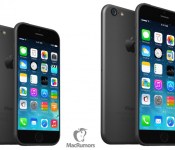
According to Chinese and Taiwanese media sources, Apple again is contracting with Catcher Technology to supply metal casings for the company’s future smartphones, including the rumored iPhone 6. First noticed by GforGames, these reports were published this week in the Taipei Times and The China Post.

Most notably, Catcher is predicted to supply Apple with 10.5 million iPhone 6 casings and 20 million casings for other iPhone models in 2014. These figures are thought to represent 15 percent of the total casings needed for the iPhone 6, suggesting Apple could ship as many as 70 million iPhone 6 units by the end of the year.
Barclays Capital made a similar prediction, noting that Catcher is expected to boost its production between 20 and 40 percent to meet demand for the iPhone 6 in the midst of tight supply. Apple is one of Catcher’s larger clients, contributing approximately 40 percent to the supplier’s revenue.
Barclays said it expects Apple’s next-generation smartphone to be launched in the second half of the year and that shipments of the new model will be 35 to 40 percent higher than the previous one.
Catcher is likely to receive between 10 and 20 percent of the casing orders for the new iPhone, which should help lift its earnings in the second half of the year, Barclays said in a report.
Recent analysis suggests interest in a large-screen iPhone 6 is high in both North America and China, where demand for the iPhone 5s is waning and interest in the iPhone 6 is on the rise. The iPhone 6 is expected to debut this fall with a 4.7-inch display, Apple’s A8 processor, an improved Touch ID fingerprint sensor and iOS 8.


References to Siri for Apple TV Found in iOS 7.1 Code
Amid persistant rumors that Apple is developing a revamped Apple TV set-top box, new code appearing in iOS 7.1 indicates that the company is indeed working on building in support for Siri voice input on the Apple TV, as highlighted by 9to5Mac. The references are included in both iOS 7.1 and iOS 7.1.1, but not in earlier releases such as iOS 7.0.6.

The file is a supporting property-list resource for Assistant (Apple’s internal name for Siri), containing information about the feature. The UIDeviceFamily array declares what platforms are compatible with the feature.
As shown by Apple’s documentation, ’1′ and ’2′ represent the iPhone/iPod touch and iPad families. The ’3′ represents the Apple TV family.
References to a new Apple TV model were previously found in iOS 7 builds, and today’s information suggests that voice input and feedback are likely to be included on the new device.
Apple’s launch plans for a new Apple TV box remain unclear, with rumors of a late 2013 launch giving way to reports centering around an introduction in March or April of this year. Those rumors were then quashed by The Loop‘s Jim Dalrymple, leaving uncertainty about Apple’s television plans. A recent product roadmap prediction from KGI Securities analyst Ming-Chi Kuo indicated that the new Apple TV could arrive around September or October of this year.

