


‘Parallels Access’ Gets Updated with iPhone Support, New File Browser [iOS Blog]
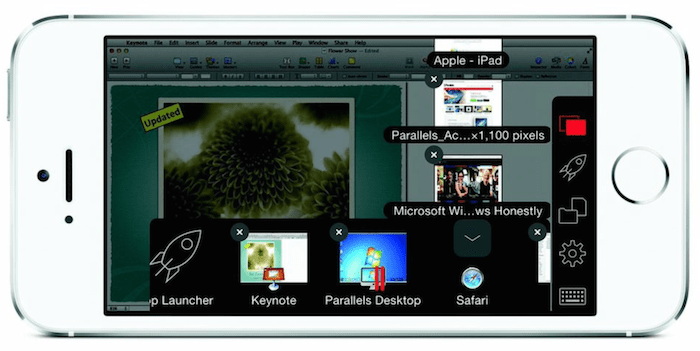
Parallels has updated its Parallels Access app, which allows iPad users access their Mac or Windows desktops on their tablets, with iPhone support, allowing iPhone users to also access their desktops on the go.
“Parallels Access received a tremendously positive reception from iPad users, and now we are extending our solution to millions of Android and iPhone users. While traditional remote desktop products are trying to show a large desktop on a small mobile device, we worked hard to make remote access from mobile devices a truly simple and effective experience,” said Jack Zubarev, president of Parallels.
The update also includes the ability to use an iPhone or iPad’s microphone remotely for desktop apps that may require them, the ability to change the screen resolution, the ability to wake a sleeping remote computer, Facebook login integration and a new file browser. The browser allows users to browse and open files on their iPad or iPhone.
Users must download the free Parallels Access app on both their desktop of choice and iPad or iPhone. They can then launch their desktop apps in “full-screen mode” via a SpringBoard-like App Launcher. While the apps are free, users must subscribe to the service, which costs $19.99 a year for up to five remote desktops. Parallels also offers a two-week free trial.
Parallels Access is a universal app that’s available for free in the App Store. [Direct Link]

Jony Ive Speaks on Future Products, Working With New Materials
 Over the weekend, The New York Times released an in-depth profile of Apple CEO Tim Cook. For that piece, the publication interviewed Jony Ive, Apple’s head of design, and now The New York Times has released a transcript of the full interview with Ive, which points towards Apple’s design philosophies, how the company has changed under Cook, and the new products that Ive is working on.
In an anecdote about Steve Jobs and the creation of small, highly focused design teams as his legacy, Ive says that Cook has continued on with Jobs’ push for innovation, nudging Ive and his team into new areas of exploration that includes all new materials.
I’ve worked for the last 15 or 20 years on the most challenging, creative parts of what we do. I would love to talk about future stuff — they’re materials we haven’t worked in before. I’ve been working on this stuff for a few years now. Tim is fundamentally involved in pushing into these new areas and into these materials.
Ive’s statement about working with new materials is incredibly vague, but rumors have suggested that Apple has been experimenting with a range of materials that have not yet seen wide usage in its devices, including sapphire crystal, which may make its way into the iWatch and the iPhone 6, Liquidmetal alloys, which the company may use for various iPhone parts, and possibly graphene, which is seen as the hot new manufacturing material.
Apple has experimented with sapphire as a cover for the home button and the camera lens on the iPhone 5s, and Liquidmetal has been used in the iPhone 3G’s SIM tool removal device, but both materials are ripe for extended usage in Apple’s future devices.
Along with hinting at future products, Ive also spoke on a recent management change that saw him taking over the software interface design team, saying that the changes made in that department are not as dramatic as one might imagine as the design teams have always worked together closely. According to Ive, titles are unimportant at Apple. “That’s not the lens through which we see our peers,” he says.
The rest of Ive’s interview can be read over at The New York Times. The full piece on Tim Cook, which has details on product development and Apple’s plans for the iWatch, is also well worth a read.

250 New Emojis Introduced Today, May See Inclusion in Future Versions of iOS
The Unicode Consortium today announced version 7.0 of the Unicode Standard, which will see the introduction of approximately 250 new emoji that could be included in future versions of the Android and iOS operating systems.
According to the Unicode Consortium, the new emoji characters are primarily derived from characters used in the Wingdings and Webdings fonts, as seen in an example image:

As noted by The Verge, Unicode member platforms like iOS and Android will need to implement support for the new standard and create pictographs to represent the emoji, which are only described by Unicode in plain text. Unicode
A full list of the new emoji names can be found on Emojipedia, which includes descriptions for each future emoji, such as “white sun behind cloud,” “man in business suit levitating,” “derelict house building,” “chipmunk,” “flying envelope,” and more.
Earlier this year, Apple began working with the Unicode Consortium to introduce more characters to its emoji offerings, adding diversity to the character set, but this update does not seem to focus on people emoji.
The Unicode update will also see the addition of new currency symbols for the Russian ruble and Azerbaijani manat, 23 lesser-used and historic scripts, plus many other symbols.

New Retail Chief Ahrendts to Oversee Apple Store Restructuring, New Store Construction [iOS Blog]
 Angela Ahrendts has plans to initiate a major restructuring of Apple’s Retail stores to promote better customer service and to streamline operations, reports 9to5Mac. At the current point in time, stores are organized into geographical regions, but Ahrendts wants to restructure, instead grouping stores based on sales volume and customer demographics.
This means that stores will now be grouped by how much of certain products they sell. This will heighten customer satisfaction and streamline Apple retail operations as now similar stores will have similar leadership and similar promotions. This move is not designed to institute John Browett-likely sales targets, but it is planned to create even more tailored experiences to individual stores.
In a letter sent to retail employees earlier this month, Ahrendts said she plans to “focus on and evolve the customer journey online and in our stores.” She wants customers to “feel surprised and delighted” by a personalized Apple experience.
Ahrendts has already restructured some of the retail executives working under her to streamline her department, and along with expressing interest in a redesign of the “end-to-end Apple Store sales experience,” she may also have plans to focus on an in-store mobile payments solution and furthering Apple’s business in China.
Ahrendts is expected to oversee the opening of 20 new Apple Stores in China through 2016, along with a new high-profile store in Italy and new locations across the United States.

G-Speed Studio 24TB RAID Storage Solution Takes on Mac Pro Design [Mac Blog]
G-Technology has introduced the new G-Speed Studio (via iLounge), a 4-bay Thunderbolt 2 storage solution configurable in RAID 0,1, 5, and 10. Taking strong design cues from Apple’s 2013 Mac Pro, the revamped G-Speed Studio features a shiny black enclosure that fits right in on a desktop also sporting a Mac Pro.
Wider than the Mac Pro, the G-Speed Studio also features smart fan technology and a plug-and-play Mac setup. With dual Thunderbolt 2 ports that can be daisy-chained, it has transfer rates of up to 700MB/second, supports up to 24TB of storage, and includes four 7200 RPM Sata III Enterprise Class hard drives.
G-SPEED Studio (RAID)- A hardware RAID 4-Bay Thunderbolt 2 storage solution. Configurable in RAID 0, 1, 5, and 10, G-SPEED Studio features Thunderbolt 2 technology for ultimate speed. With sustained transfer rates of up to 700MB/sec and the ability to daisy-chain via dual Thunderbolt 2 ports, this RAID solution ships with Enterprise Class Hard Drives and is designed to support multistream compressed 4K and 2K workflows.
The 12TB G-Speed Studio is available from the G-Technology website for $2,199.95, while the 16TB and 24TB can be purchased for $2,699.95 and $3,599.95, respectively.

OS X Yosemite Designed for Retina Screens?
Macworld’s Jason Snell provides a nice hands-on writeup about Apple’s new OS X Yosemite. Snell focuses on the user-experience from a long term Mac user, focusing on the visual and usability changes of Mac windows. He notes the increased use of transparency and the varying implementation of title bars in many applications:

Overall, Snell feels that many of the design changes were done with Retina displays in mind:
For a while now, I’ve thought that 2014 would be the year that Retina spreads across the Mac product line. After spending time with Yosemite on both Retina and non-Retina systems, I’m more confident than ever in that guess. Yosemite’s new design feels like it was built for Retina displays: Thin Helvetica Neue replaces the long-serving but chunky Lucida Grande as the system typeface.
Apple first introduced Retina displays into the Mac line in with the Retina MacBook Pro in June, 2012. Since that time, Apple has been slow to extend Retina screens to the rest of their lineup.
The MacBook Air seems likely to be the next Mac to deliver a Retina Display. Signs point to a 12″ Retina model later this year, and there has already been early evidence in Yosemite of Retina iMacs in testing.

Samsung May Acquire Nuance, the Company That Powers Siri
 Speech-recognition company Nuance, which is responsible for the technology that powers Siri, Apple’s virtual assistant, is in talks with Samsung Electronics about a possible acquisition, reports The Wall Street Journal. The company has spoken about a possible sale with Samsung and other private-equity firms, but it is unclear if a deal has been reached.
The Burlington, Mass., company has recently spoken about a possible sale of the company with Samsung Electronics Co. and private-equity firms, some of the people said. It isn’t clear where sale talks, some of which happened earlier this year, currently stand or if they will lead to a deal.
Nuance is well known for its speech recognition and dictation recognition software, which includes Dragon NaturallySpeaking. It has also formed partnerships with multiple companies, such as Amazon, and released an API for developers. Nuance’s best known partnership is with Apple, however, as its speech and dictation recognition algorithms are the backbone of Siri.
The exact nature of the partnership between Nuance and Apple was unknown for many years as the deal between the two companies was kept secret, but in 2013, Nuance CEO Paul Ricci confirmed that Nuance’s technology powers Siri’s voice recognition capabilities. “We’re a fundamental provider for Apple,” he said at the time.
It is unclear what impact a possible Nuance acquisition would have on Apple’s relationship with the company. Apple may be forced to find another solution for Siri’s voice recognition abilities, but it’s important to note that many of Siri’s functionalities beyond voice recognition come from integration with other companies like Yelp, OpenTable, and Wolfram Alpha.
Back in 2013, a report suggested that Apple may already be working to move Siri development in-house, stepping away from longtime partner Nuance. Apple has a dedicated Siri team in Boston that may be working on a voice recognition solution in the event that Apple is forced to end its partnership with Nuance. Nuance’s talks with Samsung and other parties remain in the early stages, however, as noted above.
iOS 8 brings several enhancements to Siri, including real-time feedback, Shazam integration, hands-free voice activation, and the ability to open the App Store for the first time.

Skybox Can Predict iPhone Launch Using Satellite Imagery

The Wall Street Journal profiles one of Google’s recent acquisitions which has implications on mapping, competitive intelligence and even privacy. Skybox Imaging is an intelligence company that by the year 2018 will be able to take satellite imaging to the next level:
By the time its entire fleet of 24 satellites has launched in 2018, Skybox will be imaging the entire Earth at a resolution sufficient to capture, for example, real-time video of cars driving down the highway. And it will be doing it three times a day.
The ability to take such frequent imaging will certainly aid Google’s Maps product, but it also opens up a market for competitive intelligence. Skybox says they are already looking at Foxconn every week and are able to pinpoint the next iPhone release based on the density of trucks outside their manufacturing facilities.
Google plans on initially using the technology to improve their Maps product, potentially providing more up-to-date satellite images, but Skybox executives have long term plans for offering their data to outside developers for a fee.

WebMD Launches ‘Healthy Target’ Biometric Data Collection Service
WebMD today announced Healthy Target, a service that collects biometric data from activity trackers, wireless scales and other health monitoring devices and uses this information to deliver tips on healthy living. The release comes as a number of companies, including Apple, are looking at ways to integrate health and fitness tracking from a variety of sensors and devices to give consumers an overall look at their health profiles.

Healthy Target will be integrated into WebMD’s mobile app [Direct Link], allowing iPhone owners to aggregate all their health and fitness data into one application. Users will then receive health recommendations and fitness insights using WebMD’s physician-reviewed content.
“Consumers will appreciate the ease of incorporating their biometric data into our Healthy Target program and the health insights and recommendations offered to help them sustain a healthier life,” said David Ziegler, Director of Product Management for WebMD. “With more than 40%[1] of consumers using mobile devices to access health information, the time is right for a mobile app that can help translate data into life-improving insights.”
Besides pulling in step information from the iPhone 5s’ M7 coprocessor, Healthy Target also connects to devices from Entra, Fitbit, UP by Jawbone and Withings, with additional manufacturers expected to be announced in the coming weeks and months. According to Re/Code, the service uses the FDA-approved, secure online health repository 2net Platform from Qualcomm to sync this health data.
Healthy Target is one of several recent new health app initiatives including HealthKit from Apple, Samsung’s S.A.M.I, and the rumored Google Fit, which may be unveiled at Google’s I/O developer conference later this month.
Earlier this month, Apple briefly introduced its new HealthKit platform and associated Health app. Using HealthKit APIs, device manufacturers and app developers can share health and fitness data with Apple’s Health app, which will debut with iOS 8. Apple’s rumored iWatch product also is expected to be a primary focus of this health and fitness-related platform.
The updated WebMD mobile app with Healthy Target [Direct Link] is available today in the iOS App Store.

MacBook Airs as Low as $649 With Best Buy EDU Deals [Mac Blog]
 Best Buy is offering a $100 discount on all of the newest 2014 MacBook Air models, bringing the entry-level 11-inch model down to $799.
Best Buy is also offering a second deal for students with a valid .EDU email address that gives $150 off any Mac, and these two deals can be combined, cutting prices to the absolute lowest we’ve seen.
– 11.6″ MacBook Air, 4GB, 128GB SSD: $899 -> $799 -> $649
– 11.6″ MacBook Air, 4GB, 256GB SSD: $1099 -> $999 -> $849
– 13.3″ MacBook Air, 4GB, 128GB SSD: $999 -> $899 -> $749
– 13.3″ MacBook Air, 4GB, 256GB SSD: $1199 -> $1099 -> $949
Apple’s MacBook Air was last updated in April, and is considered safe to buy in our Buyer’s Guide. This is a significant discount on recently released MacBook Air computers, and one of the best deals we’ve seen. The combined deal will last until June 21, 2014, while the $150 off deal for students lasts until July 12, 2014.
Best Buy is also offering students $50 off the iPad Air and the Retina iPad mini.
MacRumors is an affiliate partner of Best Buy.

