


Apple Seeds OS X Mavericks 10.9.4 Build 13E25 to Developers [Mac Blog]
Apple today seeded build 13E25 of OS X 10.9.4 to developers, just under a week after seeding the third OS X 10.9.4 beta, build 13E19, and more than a month after the public release of OS X 10.9.3, which included enhanced support for 4K displays and syncing improvements.
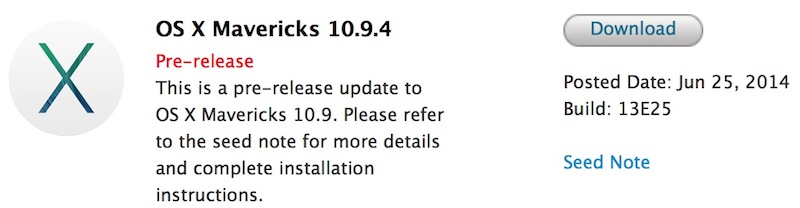
The beta is available through the Software Update mechanism in the Mac App Store and through the Mac Dev Center.
It remains unclear what improvements the 10.9.4 update will bring to Mavericks, but it is likely to include bug fixes and stability enhancements. Apple is asking developers to focus on Graphics Drivers, Bluetooth, Audio Drivers, Finder, App Store, and Safari.

(Product) RED Thanks Apple for Contributions Totaling $75 Million, Explains Recent Comments From Bono
Apple’s (Product) RED contributions towards the fight against AIDS now total $75 million, according to a blog post on the (RED) website. The post, which thanks Apple for its generous contributions, notes that the company is (Product) RED’s biggest partner.
(RED) also addresses commentary from U2 frontman Bono, who leads the charity. At the Cannes Lions festival earlier this week, Bono and Apple design chief Jony Ive gave an interview where Bono commented on Apple’s reluctance to use heavy (RED) branding, calling it “modesty run amok.”

According to the (RED) blog post, Bono was simply teasing Ive and Apple about its reluctance to “take credit for its charitable work,” going on to say that his humor was taken out of context and confirming that both Bono and (RED) are “so grateful” to Steve Jobs, Tim Cook, Jony Ive, and the rest of Apple’s employees
In a reminder that humor doesn’t always travel out of context, some of Bono’s teasing and faux outrage at Apple’s modesty were reported as actual criticism of the company. Nothing could be further from the truth of course. Bono has been one of Apple’s biggest supporters, pushing back publicly on those who have made negative assumptions about the company’s charitable work, simply because they don’t shout it from the rooftops. That modesty is their right, and in many ways admirable.
According to The Loop‘s Shaun King, Apple may be planning to increase support for (RED) in the coming months. Following Bono’s interview, King posted the following: “Great to see Bono calling Apple out on their “understated” approach to this issue. But you’ll see that change within six months,” clarifying in the comments that Apple will boost exposure for (RED).
It is unclear how Apple will boost exposure, but in the past, the company has released several different (RED) branded products, including iPod nanos and shuffles, iPad Smart Covers, iPhone Bumpers, and more, with a portion of the purchase price going directly to the charity. It has also decorated its Apple retail locations with red logos for World AIDS day and last year, Ive teamed up with designer Marc Newson to create a range of one-of-a-kind products that were auctioned off by Sotheby’s, with the proceeds going to (RED).
In total, with all of its partners, which includes Apple, Starbucks, Coca-Cola, and others, (Product) RED has raised more than $250 million to fight AIDS since it was founded in 2006.
Google Launches First Android Wear Devices, Featuring Always-On Displays and Card-Based Interface
At today’s Google I/O event in San Francisco, Google demoed its Android Wear platform and announced availability of the first Android Wear devices. First announced in March, Android Wear is designed to bring the Android platform to a range of wearable devices from several of Google’s manufacturing partners.

As described on stage, Google has designed Android Wear with many of the features and functions that rumors have suggested Apple’s own iWatch might include. Android Wear supports screens of multiple sizes and styles, including both square and circular. With its always-on display and card-based UI, it displays information like notifications and location-based reminders.
Largely controlled by voice via Google Now integration, Android Wear also supports contextual apps that display information at a glance and it also integrates with several sensors, such as those that monitor steps taken and even heart rate on supported devices. It includes Google Maps support, offering turn-by-turn directions on the wrist and it can be used to control other devices, such as speakers.
Android Wear devices are reliant on a connected smartphone, much like the iWatch is expected to be reliant on the iPhone. Apps that are downloaded from the Google Play Store are able to include a wearable portion, which is automatically installed on a compatible Android Wear device when downloaded on a smartphone, extending available app functionality to the wrist.
On stage, demonstrations of Android Wear gave a clear idea of what we might expect from other wearables in the future, including the iWatch. A Lyft car was ordered via a simple voice command, with the watch automatically detecting a location. Ordering the car, payment, and update notifications on the driver’s location were all displayed directly on wrist, without the need to access a smartphone.
 Samsung Gear Live
Google announced the release of the full Android Wear SDK, along with the launch of the first devices supporting Android Wear. The LG G Watch is available for order today, as is the Samsung Gear Live, a new Samsung watch that supports Android. The platform’s first circular watch taking advantage of the round UI, the Moto 360, will be available later this summer, and additional devices are in development by various partners.
By focusing on a platform rather than a device of its own, Google has managed to get Android onto wrists several months ahead of Apple. According to the most recent rumors, Apple’s much-rumored smart watch won’t launch until later this year, possibly at an October event. The iWatch expected to have a strong focus on health and fitness, with more than ten sensors to collect various types of data.

Google Announces ‘Android Auto’ CarPlay Competitor
At its Google I/O developer’s conference in San Francisco, Google today announced Android Auto, its answer to Apple’s CarPlay. Much like CarPlay, Android Auto is designed to bring the Android experience to a car’s in-dash infotainment system.
As described by Google, Android Auto is contextually aware and puts the apps that users need front and center on the car’s dashboard. Google stressed that Android Auto is “completely voice enabled,” relying on Google Now much the way CarPlay relies on Siri for voice commands. Google also noted that it’s able to offer a completely personalized experience that is mobile, working with any Android Auto compatible car as it is reliant on an Android phone.
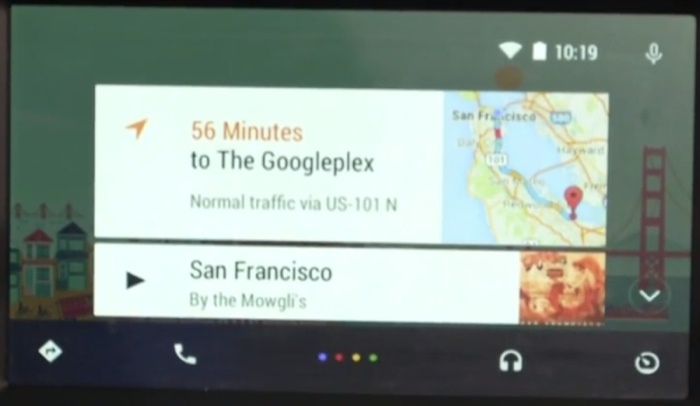
Android Auto integrates deeply with Google Maps, providing drivers with access to all Google Maps features like local search, personalized suggestions, live traffic information, and turn-by-turn navigation.
On stage, Android Auto was demoed planning a trip to the DeYoung Museum in San Francisco. Android Auto was first asked how late the museum was open, providing a response, before it was ordered to navigate to the location, where it offered turn-by-turn directions. It was also demoed composing and sending messages entirely via voice.
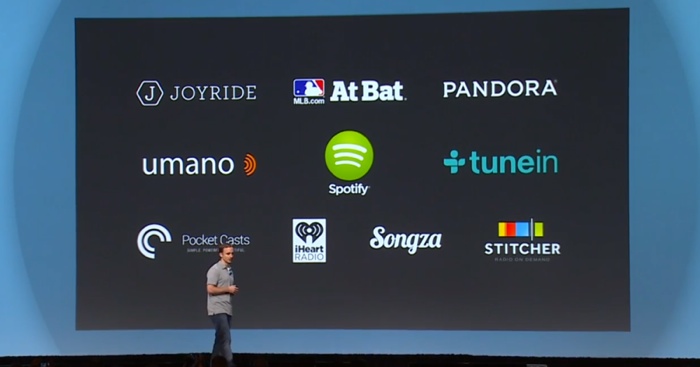
Like CarPlay, Android Auto integrates with several different app partners to provide music and other audio, such as MLB at Bat, Pandora, Spotify, Songza, Stitcher, iHeart Radio, and more.
Google also announced 40 new partners for its Open Automotive Alliance, which is a group of “technology and auto industry leaders” that are committed to bringing Android to cars in 2014. The goal of the alliance is to make “technology in the car safer, more seamless, and more intuitive for everyone.”
According to Google, Android Auto will be available in 25 different car brands, with the first cars rolling off dealer lots before the end of the year. Google is also releasing an Android Auto SDK in the coming weeks so developers can create apps for the platform. Apple’s CarPlay is also expected to be available in several different cars before the end of the year.

EU Regulators Expected to Decide on Apple’s Acquisition of Beats By July 30
Apple’s proposed acquisition of Beats Electronics is facing its first regulatory hurdle after the Cupertino company announced the deal last month. As reported by Reuters, European Union’s Antitrust Commission is expected to make a decision on the purchase by July 30.
The EU regulators can approve the deal unconditionally, demand concessions if they have anti-competitive concerns or order a full investigation if they need more convincing that the acquisition will be a benefit and not a detriment to competition.
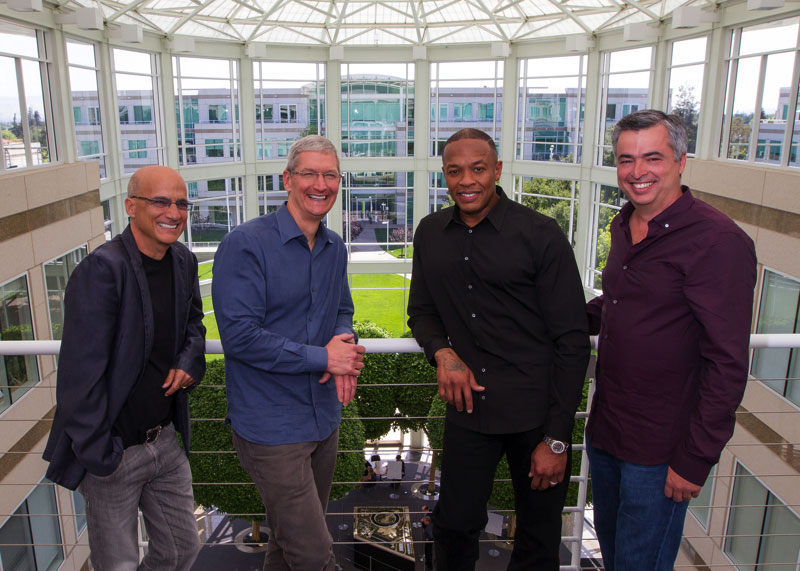
The pending $3 billion deal includes both Beats Electronics, which offers headphones and speakers, and Beats Music, a streaming music subscription service. Under the deal, Beats executives Jimmy Iovine and Dr. Dre will join Apple, giving the company a significant boost to its music industry connections.
Besides the EU, regulators in the United States also must examine the deal and determine whether there are any concerns with competition. Barring any unforeseen regulatory issues, Apple expects the transaction to close sometime next quarter.

Demo of iPad Passcode Theft via Google Glass Highlights Benefits of Touch ID [iOS Blog]
Looking over a nearby person’s shoulder is a common technique used to steal a PIN code for a device that is targeted for imminent theft. But as reported by Wired, a research team from the University of Massachusetts Lowell has taken this shoulder surfing trick to a whole new level by increasing the working distance and automating the process using Google Glass and other similar camera-equipped, mobile products.
The UMass Lowell researchers improved passcode theft by analyzing video captured from wearable and mobile devices such as Google Glass, the Samsung Gear smartwatch and the iPhone. The system anlyzes the incoming video using a custom video recognition algorithm that detects the shadows from finger taps and uses that information to predict PINs codes. Unlike the standard over-the-shoulder method that requires a direct view of the target device’s display, the UMass method also can be employed at an indirect angle, allowing someone to steal a password while standing at your side.

(Image from Cyber Forensics Laboratory at University of Massachusetts Lowell)
The system is surprisingly accurate — allowing a malicious user to capture PIN codes inconspicuously with at least 83 percent accuracy from a distance as far as three meters. This accuracy was improved to more than 90 percent when a sharper camera such as the iPhone was used or manual error correction by the researchers was added to the video analysis.
“I think of this as a kind of alert about Google Glass, smartwatches, all these devices,” says Xinwen Fu, a computer science professor at UMass Lowell who plans to present the findings with his students at the Black Hat security conference in August. “If someone can take a video of you typing on the screen, you lose everything.”
The researchers didn’t test longer passwords, but believe they could reach an accuracy rate of 78 percent when stealing an 8-digit password from a device such as the iPad. If you are concerned about password hacking, your best line of defense is to cover your display as you type or when possible do away with a PIN code entirely such as by using the Touch ID fingerprint in the iPhone 5s.
With the results of this study, the researchers hope to convince mobile operating system companies to improve the security of their PIN input screens by taking steps such as randomizing the layout of the keypad.
Apple’s Touch ID fingerprint authentication is of course another alternative to traditional passcodes. The feature launched on the iPhone 5s last year and is expected to make its way to the iPad and iPad mini later this year. Aside from increased security compared to passcodes, Touch ID has also increased usage of security features, with Apple noting during its WWDC presentation earlier this month that passcode/Touch ID usage has risen to 83% on the iPhone 5s, up from just 49% passcode usage previously.
iPhone 6 Said to Launch on Friday, September 19 in 32 GB and 64 GB Variants
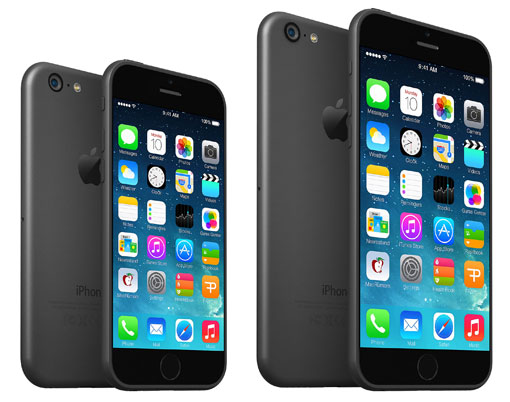
Apple will look to launch the 4.7-inch iPhone 6 on Friday, September 19, according to a new report from Chinese web portal Tencent (Google Translate, via GforGames) citing inside sources. The news comes after German carrier Deutsche Telekom was reported to be informing customers of a similar release date for the device.
The report also notes that Apple will launch 32GB and 64GB capacities of the phone for 5,288 yuan ($846) and 6,288 yuan ($1008), indicating that Apple may launch the iPhone 6 without a 16GB model. Notably, 5,288 yuan is the current price for the 16GB iPhone 5s in China, while the 32GB iPhone 5s is listed at 6,088 yuan.
A September launch would be consistent with the past two iPhone launches, as Apple also typically launches new products on a Friday. A report from Bloomberg earlier this week also claimed that Apple may launch the larger 5.5-inch version of the iPhone 6 and the 4.7-inch version simultaneously, with previous reports indicating that issues with battery and display technology would hold up the larger device’s launch.
In addition to a larger display, the iPhone 6 is expected to feature a thinner design, a faster A8 processor, and more. The iPhone 6 is also expected to feature an improved camera, with the larger 5.5-inch version exclusively utilizing optical image stabilization and the smaller device featuring an advanced lens module.

iWork for iCloud now picks up exactly where you left off

Web-based apps are supposed to let you easily hop between devices without missing a beat, but that hasn’t been the case with iWork for iCloud — you’ve had to open files, tweak settings and otherwise break your flow. The experience should be much smoother after today, though. Apple has updated the online versions of Keynote, Numbers and Pages so that they remember both the last document you were looking at and your settings, such as the last page you were on and the zoom level. You won’t have to spend a few minutes getting everything just so simply because you’ve moved to your laptop, in other words. Although it’s a seemingly small change, it could matter a lot if you’d rather get things done instead of getting fussy.
Source: iWork for iCloud

Optical Image Stabilization May Be Differentiating Factor for 5.5-Inch iPhone 6
Rumors have suggested Apple’s next-generation iPhone may include camera improvements in the form of optical image stabilization with modules produced by sensor company InvenSense, but according to a new prediction from Pacific Crest Securities analysts John Vinh and Kevin Chen, optical image stabilization may be a feature limited to just the larger 5.5-inch iPhone.
Citing a cost premium of $4 to $5 for optical image stabilization over traditional auto focus solutions, the two analysts believe that Apple will use the feature as a differentiating factor between the 4.7-inch iPhone and the more premium 5.5-inch iPhone.
We believe the 5.5-inch iPhone 6 smartphone camera will support optical image stabilization (OIS) and anticipate that it will represent one of several opportunities at Apple that will benefit InvenSense. In our analysis, we believe Apple chose to only include OIS camera technology in the larger iPhone 6 given that there is still a significant cost premium ($4 to $5) over standard auto focus solutions and that it provides a point of differentiation between the 4.7-inch iPhone 6 and the step-up model (5.5-inch)
Optical image stabilization (OIS) is designed to reduce shake and stabilize photos and videos using either a lens with built-in stabilization or a separate sensor. In the past, this has been limited to traditional digital cameras, but recently, cell phone manufacturers like Google, HTC, Nokia have been incorporating OIS systems in order to improve photo quality. Currently, the iPhone 5s uses software-based image stabilization techniques, which are seen as inferior to OIS.
 Comparison image courtesy of Electronics 360
Apple aims to improve photo quality with each iteration of the iPhone, so new image stabilization techniques make sense for the next-generation phone. The company also has a history of limiting features to its flagship offering, such as Touch ID for the iPhone 5s, and it appears that the 5.5-inch iPhone may be the higher-end 2014 model. Rumors have suggested that the 5.5-inch iPhone 6 might include a $100 price premium over the 4.7-inch version and that it might be the only model to receive a sapphire crystal screen.
Along with optical image stabilization for the larger 5.5-inch iPhone, Chen and Vinh are also “increasingly confident” that the iPhone 6 will support NFC, based on supply chain conversations. This is in line with previous rumors that have suggested NFC may finally be deployed in the iPhone 6 ahead of an upcoming mobile payment solution.
While it was initially thought that Apple’s 4.7-inch iPhone 6 would launch first due to manufacturing issues with the 5.5-inch version, it seems Apple may have solved those problems. A report from Bloomberg earlier this week has suggested both the 5.5-inch and 4.7-inch iPhones may launch simultaneously later this year.

iWork for iCloud Updated Gets Minor Update, Will Remember Last Used Settings [Mac Blog]
Apple today updated its iWork for iCloud software suite, adding new features to Pages, Keynote, and Numbers (via The Loop). All three cloud-based applications now remember a user’s last used document settings and a user’s most recent screen name when opening a shared document.
The apps also now include tips on how to perform certain actions using keyboard when right-clicking on objects and they’ve also gained the ability to mask images with a right-click. Here’s a list of the updates to each app:
Pages for iCloud now remembers your last used document settings including zoom level, show/hide format panel, show/hide guides, and more.
Numbers for iCloud now remembers your last used document settings including zoom level, last selected sheet, show/hide format panel, show/hide guides, and more.
Keynote for iCloud now remembers your last used document settings including zoom level, last selected slide, show/hide format panel, show/hide guides, and more.
Prior to this update, iWork for iCloud was last updated in May, adding several new collaborative features. Apple has promised to continually improve iWork for iCloud and its other iWork apps for iOS and Mac in an effort to bring feature parity to the software across all platforms.
The iWork for iCloud software is available to all users for free, and it can be accessed through Apple’s iCloud.com website.

