


iOS and OS X Calendar Glitch Pulls Holiday Data From Wrong Countries [iOS Blog]
A growing number of iOS and OS X owners are reporting a glitch that displays the holidays from the wrong country in the default system calendar app. As noted by one MacRumors reader in Ireland, holidays like the pro-UK Battle of the Boyne are now showing on his iPhone calendar.

This glitch also was documented by Edgardas Balsevičius, who shows in the video below that his iPad is set to Lithuania for its region, but the default holiday calendar is set to other countries, including Mexico, Hong Kong, and Canada. This mismatch between location and calendar is not observed when the region is set to the USA, UK or Russia.
This glitch was reported over the weekend and is present on iOS devices, including an iPhone 5s and an iPad Air, running iOS 7.1.x. Apple support has allegedly confirmed to Balsevičius that this is a known software issue that will be addressed in the next update.
While most reports involve iOS 7.1, a few OS X owners have reported a similar problem with OS 10.9.x that also started in the past week. These users also state that the default holiday calendar now displays events from the incorrect region, with one user on Apple Support forums noting that switching the default currency back to the local designation seems to fix the issue.
Apple Releases iOS 8 Beta 3 to Developers
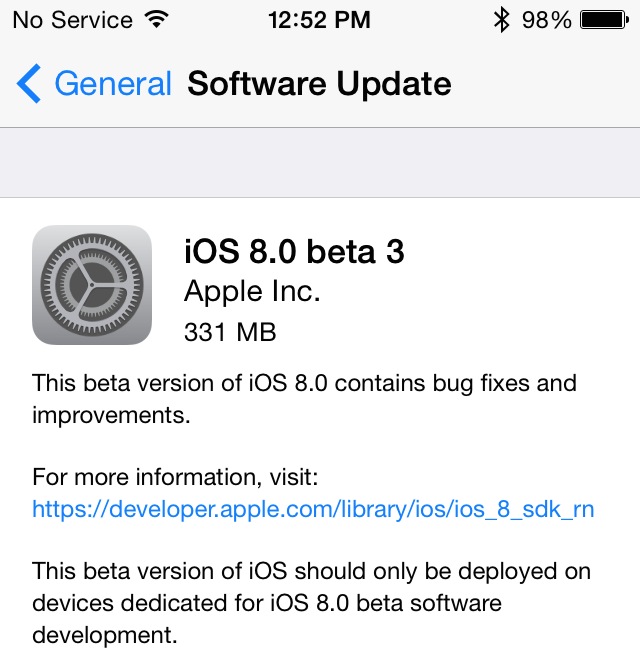
Apple today released the third beta of iOS 8 to developers, three weeks after releasing the second beta update and more than a month since unveiling the new operating system at the Worldwide Developers Conference.
The update, build number 12a4318c, is available through Apple’s over-the-air updating system on iOS devices and will also be available via the iOS Dev Center.
iOS 8 introduces a range of new features, including improved integration with OS X through Continuity, a Health app, Family Sharing features, interactive notifications, a new QuickType Keyboard and improvements to several apps like Safari, Mail, and Messages.
A June report suggested iOS 8 beta 3 would be released on Tuesday, July 8, but it appears the beta has come a day early. Today’s update comes just after Apple announced plans to wipe all CloudKit data for the iOS and Yosemite betas, including data from iCloud Drive, iCloud Photo Library, and Mail Drop.
iOS 8 is currently only available to developers, but it is expected to be released to the public this fall after several beta iterations. Based on past history, iOS 8 will likely be launched alongside new iPhones, and possibly the much-rumored iWatch.

iPhone 6 Front Panel Survives Limited Bending Test
Frequent iOS device part leaker Sonny Dickson has shared a new video of what appears to be the previously seen iPhone 6 front panel being subjected to a limited bending stress test. The panel survives the testing, but is not subjected to extreme bending in the brief video.
The title of Dickson’s video mentions sapphire, but there does not appear to be any confirmation that the part is indeed made of the material. The iPhone 6 has been rumored to be adopting a sapphire crystal display cover for increased durability and scratch resistance, but none of the front panel part leaked seen so far have been confirmed to be made of sapphire.
Apple currently uses Corning’s Gorilla Glass as the iPhone display cover, and Corning has argued that Gorilla Glass offers a number of benefits over sapphire, including better resistance to breakage. Some rumors have suggested that sapphire may only used on the 5.5-inch iPhone 6, so the smaller 4.7-inch model may still include a Gorilla Glass display.
While a bending test offers some indication of durability for the component
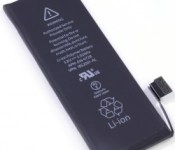
iPhone 6 May See Only Modest Battery Capacity Boost as Apple Pursues Ultra-Slim Designs
 A recent survey suggests consumers are looking forward to improved battery life as well as a bigger screen in the iPhone 6. But according to Chinese media reports (via GforGames), Apple’s next-generation iPhone may disappoint with a lower-than-expected battery capacity that will provide only a slight boost from the battery used in the iPhone 5s.
Chinese media sources claim the 4.7-inch version of the iPhone 6 will ship with a battery between 1,800 and 1,900 mAh, while the 5.5-inch iPhone 6 will include a 2,500 mAh battery. Though larger than the 1,560 mAh battery in the iPhone 5s, these modest capacity increases place Apple behind competitors with similar sized handsets, and leave some wondering if Apple is keeping the battery too small in order to design an ultra-slim device. The larger screens on the iPhone 6 will naturally create more volume for larger batteries while maintaining a slim profile, but the displays themselves are likely to require increased battery to support the higher resolutions.
Of course, these rumored battery capacities for the iPhone provide only part of the equation, with Apple’s tight software-hardware integration also contributing to overall battery life. It is also possible that real-world battery life may be better than these speculated hardware specs imply due to underlying performance improvements added to iOS 8.
Apple is expected to unveil the iPhone 6 during a September media event. The company may debut both a 4.7-inch and a 5.5-inch version that could feature a faster A8 processor, an upgraded Touch ID scanner and an improved camera with some form of image stabilization.
South Korea makes it easier to get refunds for Android and iOS apps

If you’ve ever been burned by downloading a mobile app that you don’t want or doesn’t work, relief may be in sight… so long as you’re in South Korea, at least. The country’s Fair Trade Commission has ordered both Apple and Google to make their app refund policies more consumer-friendly. To start, Apple must make it easier to claim refunds on in-app purchases; if your kid goes wild buying in-game items, you should have an easier time getting your money back. Google, meanwhile, has to let developers set their own refund terms.
There are a handful of smaller tweaks in store. Apple will have to notify shoppers whenever it alters the App Store’s terms of service, and Google must stop apps from automatically charging you the moment a trial period ends. All the new rules are limited to South Korea for now, but Apple says it might change its terms on a global level. Google isn’t considering a similar approach at this stage, but the Fair Trade Commission is hoping that it created a “ripple effect” which leads to similar policies elsewhere. If the rules do spread worldwide, that would undoubtedly be good news — you could try paid apps without the risk of being left high and dry.
[Image credit: Jung Yeon-Je/AFP/Getty Images]
Filed under: Cellphones, Mobile, Apple, Google
Via: Korea Herald, MacRumors

Korean Government Orders Apple and Google to Change ‘No-Refund’ App Store Policies [iOS Blog]
 Apple and Google have been ordered by South Korea’s Fair Trade Commission to revise their “no-refund” app store policies in addition to a number of other provisions, reports The Korea Herald. In response to the ruling, Apple reportedly stated that it would consider applying a revised App Store policy worldwide, with Korean officials requiring that Apple send a notice users when its terms and conditions have changed.
Following the FTC orders, the Google Play webstore will design a customer refund system based on Web developers’ refund polices. Apple’s iTunes app store will have to send a notice to users when it changes the terms in its contract.
“We expect the measure, aimed at protecting consumers, will have a ripple effect on similar cases throughout the world,” the Korea Fair Trade Commission said in a press release.
In 2011, the Taiwanese government also pressured Apple and Google to modify their app store policies, with Apple enabling a 7-day refund period. However, it was unclear at the time what changes were made by Apple in order to comply with the law, as the company may have simply addressed it by granting refunds upon request.
Under the current policy, Apple does not offer an automatic way to get refunds for apps. However, refunds have been made available on a case by case basis, as users are able to “Report a Problem” on their purchases to go through iTunes Support. In May, Apple began preventing updates and reinstallation of refunded App Store apps, which was also extended to the Mac App Store.

Foxconn Set to Deploy Robots to Help Assemble the iPhone
At a recent shareholder meeting, Foxconn CEO Terry Gou announced that the company will soon deploy robots to help assemble devices, noting that Apple will be the first company to use the service, reports IT Home (Google Translate, via GSMDome).

Named “Foxbots”, each robot will be able to assemble an average of 30,000 devices and costs anywhere from $20,000 to $25,000 to make. Gou stated that the assembly devices are undergoing their final testing phase, as Foxconn plans to deploy 10,000 robots to its factories.
Foxconn has been Apple’s longtime primary partner in assembling its iPhones, iPads, and iPods. In 2011, it was reported that Foxconn would be replacing a portion of its workers with 1 million robots, although it was not clear at the time how many jobs would be replaced by the robots.
As a part of its 2013 10-K annual report last year, Apple also revealed that it was investing a record $10.5 billion on advanced supply chain technology, with some of that investment going towards advanced machinery including assembly robots. A report earlier this year noted that Apple would be moving production of iPhone batteries to automated lines, allowing suppliers to reduce manpower demand and shift resources towards production efforts on other parts.
Foxconn has recently ramped up its production efforts ahead of the launch of Apple’s iPhone 6 this fall, with the company bringing on 100,000 new workers to help assemble the iPhone 6. Production of the new device is reportedly set to ramp up next month ahead of a launch around September. The iPhone 6 is expected to come in two sizes of 4.7-inches and 5.5-inches, and feature a thinner profile, an improved camera, a faster A8 processor, and more.
The evolution of the PC: A decade of design

Computers have gone through nothing short of a renaissance in the decade since Engadget was born. When we started in 2004, desktops still ruled the roost; laptops were frequently clunky; and tablets were niche devices for doctors.
That state of affairs didn’t last for long, though. Netbooks briefly took over the world, bringing tiny laptops to the masses. Ultrabooks proved that slim machines could still be powerful. And just about the entire PC market has had to confront the rise and domination of touchscreen-enabled mobile devices like smartphones and tablets. In short, it’s pretty remarkable how much of a difference 10 years can make in tech.
2004: Sony VAIO X505

Notable specs: 1.1GHz Pentium M processor, 20GB hard drive, 1.73-pound weight, 10.4-inch (1,024 x 768) display.
Sony didn’t realize it at the time, but it was laying the groundwork for the next decade of laptops with the VAIO X505. The 10-inch system was so featherlight and slender that it was easy to take anywhere, much like a netbook or Ultrabook. If it weren’t for the astronomical $2,999 price tag, it’s possible it could have started a mobile-computing revolution.
2005: IBM ThinkPad T43

Notable specs: 1.6GHz to 2.13GHz Pentium M processors, 30GB or larger hard drive, 6-pound weight, DVD drive, 14.1-inch (1,024 x 768 or 1,400 x 1,050) display.
The ThinkPad T43 was the swan song for an era of computing when laptops were mostly for globe-trotting professionals. One of the last PCs to bear the IBM name before Lenovo closed its acquisition of IBM’s PC business, it represented everything good about the ThinkPad badge: It was fast, well-built and relatively easy to carry in a briefcase.
2006: Dell XPS 700

Notable specs: Core 2 Duo or Core 2 Extreme processors, dual 320GB hard drives, dual DVD drives, dual GeForce 7900 GTX graphics.
Dell had built up a reputation for high-performance PCs well before 2006, but the XPS 700 was the system to own that year if you wanted a gaming desktop from a major brand. Its aggressive design still holds up today, and it was often as powerful as custom-built rigs. It was a dream machine at a time when you still needed a giant tower for serious online gaming.
2007: ASUS Eee PC 701

Notable specs: 800MHz or 900MHz Celeron M processors, 2GB to 8GB solid-state drives, 2-pound weight, 7-inch (800 x 480) display.
The Eee PC 701 marked the official start of the netbook craze, which lasted until the iPad’s arrival in 2010. Its screen, speed and storage were very modest even when new, but it showed that you didn’t need a big, expensive portable just to check your email at the coffee shop.
2008: Apple MacBook Air

Notable specs: 1.6GHz or 1.8GHz Core 2 Duo processors, 80GB hard drive or 64GB solid-state drive, 3-pound weight, 13.3-inch (1,280 x 800) display.
The archetypal Ultrabook. While it wasn’t without its quirks, the MacBook Air successfully bridged the gap between ultraportables and full laptops. It was fast enough for most tasks, yet light enough that you’d hardly notice it in your bag.
2009: HP Firebird

Notable specs: 2.66GHz or 2.83GHz Core 2 Quad processors, dual 250GB or 320GB hard drives, DVD or Blu-ray drives, dual GeForce 9800S graphics.
While HP’s Firebird line wasn’t perfect by any stretch, it showed how efficient desktops had become. You could get a reasonably quick, ready-made gaming PC that both looked good and didn’t swallow up too much surface area. It’s arguably the prototype for the small-yet-strong Steam Machines that would follow five years later.
2010: Lenovo IdeaCentre A300

Notable specs: 2.2GHz Core 2 Duo processor, 500GB hard drive, 21.5-inch (1,920 x 1,080) display.
Although the iMac is virtually synonymous with all-in-one computers, Lenovo’s sleekly designed IdeaCentre A300 was proof that Apple didn’t have a complete lock on the category. Rather than glom the computer on to the A300′s back, Lenovo tucked it away in the base. The result was a relatively subtle, stylish desktop that looked right at home in just about any environment.
2011: Samsung Chromebook Series 5

Notable specs: 1.66GHz Atom processor, 16GB solid-state drive, 3.3-pound weight, 12.1-inch (1,280 x 800) display.
Unlike the other PCs here, the Chromebook Series 5′s real revolution was its software — with Chrome OS, both Google and Samsung were betting that you only needed a web browser for most of your day-to-day computing. That was optimistic on a slow, Atom-based machine circa 2011, but the Series 5 helped launch a wave of stripped-down, affordable laptops that could do a lot without relying on conventional apps.
2012: Apple MacBook Pro with Retina display

Notable specs: 2.3GHz or 2.6GHz Core i7 processors, 256GB to 768GB solid-state drives, 4.5-pound weight, 15.4-inch (2,880 x 1,800) display.
Apple’s 2012 MacBook Pro redesign was just an iterative upgrade in some ways, but it was also a bellwether for where laptop design would go. It wasn’t just that extra-sharp Retina display that turned heads; this was also one of the first high-end, full-size laptops to ditch optical discs and hard drives in the name of both an easier-to-carry body and faster, flash-based storage.
2013: Acer Aspire R7

Notable specs: 1.8GHz Core i5 processor, 500GB hybrid hard drive, 15.6-inch (1,920 x 1,080) adjustable display.
Windows 8′s touch-friendly interface prompted a flood of PCs that tried to be everything to everyone, and that’s epitomized in Acer’s one-of-a-kind Aspire R7. Depending on how you adjusted its multi-hinged display, the R7 could serve as a desktop, laptop or tablet. It wasn’t especially good at any of these, but it revealed how eager PC makers were to keep you from buying mobile tablets.
2014: Microsoft Surface Pro 3

Notable specs: Core i3, i5 or i7 processor, 64GB to 512GB solid-state drive, 12-inch (2,160 x 1,440) display.
If you want a system emblematic of the changes to PCs in the past 10 years, you only need to look at Microsoft’s latest flagship device, the Surface Pro 3. So long as you get its (practically mandatory) keyboard cover, it blurs the lines between tablet and laptop — it’s as useful for watching movies on the couch as it is for serious media editing at your desk.
Jon Turi contributed to this post.
Filed under: Desktops, Laptops, Tablets, Apple, Samsung, Microsoft, HP, Dell, Acer, Lenovo

Apple recruits one of the watch industry’s most important sales execs

Apple’s recent hires in wearable tech have largely taken place outside the watch industry, which is slightly odd for a company rumored to be making a watch of its own. However, it just addressed that discrepancy in style — LVMH’s watch division has confirmed that Apple has snagged Patrick Pruniaux, TAG Heuer’s sales and retail VP, as part of a broader campaign to poach talent from watchmakers. We’ve reached out to Apple to learn more about its plans, but LVMH group head Jean-Claude Biver tells CNBC that Pruniaux will be working on the “iWatch.” Clearly, the team in Cupertino wants someone who can market wristwear to a large audience.
Biver says he’s relieved that Pruniaux is leaving for Apple, since the California firm isn’t a “direct competitor” to LVMH’s luxury-oriented TAG Heuer, Hublot and Zenith brands. While that’s true, the move suggests that Apple may creep on to their turf by marketing its future wearable more like a conventional watch than a phone accessory. If so, that’s a sharp break from the approaches we’ve seen so far — even the relatively stylish Moto 360 and Pebble Steel are more often pitched to tech-savvy types than the fashion-conscious.
[Image credit: Andreas Knudsen, Flickr]

Apple Planning to Wipe CloudKit Data for iOS 8 and Yosemite on July 7 Ahead of Beta Updates
Apple has notified developers of plans for a server-side data wipe on CloudKit public and private databases for both the beta versions iOS 8 and OS X Yosemite. The wipe, which will take place on Monday, July 7, will erase data for iCloud Drive, iCloud Photo Library, and Mail Drop.

The wipe comes just a day ahead of the rumored launch date of iOS 8 beta 3 and also the likely launch date of the third Yosemite Developer Preview. Apple commonly seeds early versions of its iOS beta operating systems on roughly two-week intervals, moving on to three-week intervals later in the testing period. OS X beta updates have followed a similar update pattern in the past as well.
Apple’s second iOS 8 and Yosemite betas came approximately two weeks after the software was first provided to developers at the Worldwide Developers Conference, and it has now been three weeks since those updates were seeded.
Both iOS 8 and OS X Yosemite are expected to be released to the public in the fall, after an extended beta testing period.
Thanks, Daniel!

