



Intel’s Broadwell Chips for Most Macs Not Shipping Until Early to Mid 2015
Intel’s line of 14-nanometer Broadwell chips, which are expected to be included in future versions of the MacBook Air, Retina MacBook Pro, and iMac, have been further delayed, reports Chinese site VR Zone [Google Translate] (via CPU World).
According to the site, while Intel will begin production on its extremely low power Core M processors in July and August for a 2014 launch, production on the U and H Broadwell chip series will not begin until much later in the year.
As a result, the Broadwell U 2+3 dual-core chips with GT3 (HD 5000 or Iris) graphics, likely slated for use in the MacBook Air and the 13-inch Retina MacBook Pro, won’t be ready to ship until February of 2015. The Broadwell H 4+3e quad-core chips with Iris Pro graphics designed for the larger Retina MacBook Pro and iMac won’t be shipping until July 2015 at the earliest.
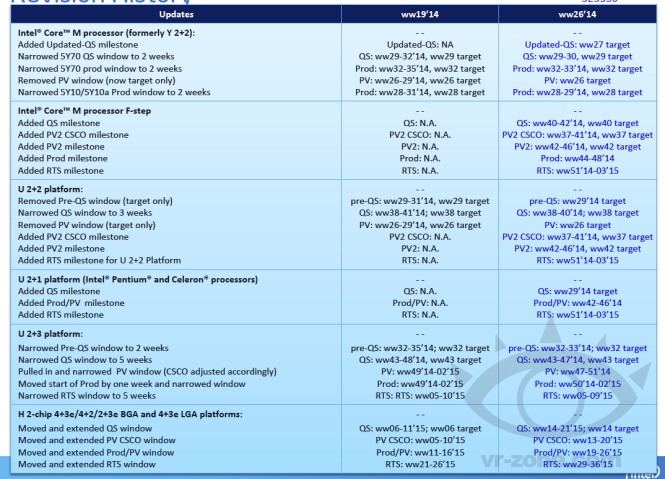
Back in May, Intel CEO Brian Krzanich promised Broadwell processors for the 2014 holiday season, but it appears that the promised chips will be limited to the company’s Core M processor series, used in ultra low power products like two-in-one computers. Broadwell chips suitable for Apple products will not make their first appearance until 2015, which Intel essentially confirmed to CNET in June.
“We expect the initial Broadwell-based devices, including fanless 2-in-1s built on the Core M processor, will be on shelves by the end of this year with more products and broader OEM availability in 2015,” Intel told CNET on Wednesday.
Intel’s Broadwell chips have seen several delays over the course of 2013 and 2014, and were originally slated to enter production in late 2013 before production was delayed until Q1 2014 and then Q3 2014. The delays are reportedly due to problems with the 14-nanometer process used to manufacture the chips.
Intel’s continual Broadwell delays are likely impacting Apple’s own release plans. Rumors have suggested Apple is planning a fall launch of a refreshed Retina MacBook Pro and a new 12-inch MacBook Air, but it is unclear which chips the company will use. Apple may only be able to offer a minor Haswell processor boost for the Retina MacBook Pro, which will be the only update the line sees until Broadwell is ready. Apple has already given the MacBook Air a Haswell refresh bump alongside a price drop with an update in late April.
On the desktop side, Apple introduced a new low-end iMac last month, but otherwise the lineup has not been updated since last September. The Mac mini has not even been updated to Haswell yet, with its last revision coming in October 2012. It is unknown why Apple has not released updated Mac mini models, as appropriate Haswell chips are readily available.
Intel’s Broadwell chips are said to be 30 percent faster and more power efficient than Haswell, offering even greater increases in battery life and performance. According to Intel, the Broadwell delays will not affect the company’s next line of processors, Skylake, as the chips are based on new architecture. Broadwell, however, will have a very short lifespan as Skylake has a prospective late 2015 release date.

Former Apple SVP Ron Johnson Recounts Early Days of Apple Retail Stores [Mac Blog]
Former Apple retail chief Ron Johnson spoke earlier this year at his alma mater Stanford University and talked about the early years of Apple retail stores (via ifoAppleStore). Johnson oversaw the development of the Apple Store and is credited with creating the company’s distinctive retail experience.
After joining Apple in 2000, Johnson was given complete control over the company’s retail project by then-CEO Steve Jobs. The first Apple Stores featured high-speed Internet connections to attract new customers and were originally designed to create a sense of community among Apple users, not necessarily sell products.
“It was a pure play,” Johnson said of the store design. “There was really no compromise on any of the intuition. And I think that’s how the Apple stores connected (with visitors).” Even today, he said, people go to the stores, “just to go. They don’t go to buy. There are so many reasons to come.”
Johnson joined Apple as Senior Vice President of Retail Operations in January 2000 and remained in that role until 2011, when he departed for a CEO position at J.C. Penney. Under his leadership, Apple’s retail operations exploded, generating over a $1 billion in annual sales within two years and eventually leading all U.S. retailers in terms of monetary sales per square foot.
Johnson was succeeded by Dixons’ John Browett, who served as Apple’s retail chief for a short seven months. Apple’s retail operations, which now include 425 retail stores in 16 countries worldwide, are now under the leadership of former Burberry CEO Angela Ahrendts, who joined Apple earlier this year. Ahrendts is best known for her transformation of Burberry from a struggling retailer into a global fashion powerhouse.

Foxconn’s ‘Foxbot’ Robots to Play Supporting Role in Factories
Over the weekend, it was reported that Foxconn would be soon deploying its own “Foxbot” robots to its factories to help assemble devices, with CEO Terry Gou noting that Apple would be the first use the service. Now, Taiwan’s United Daily News (Google Translate, via GforGames) is sharing more details on the assembly robots, stating that they will play a supporting role in Foxconn’s factories alongside employees.

According to the paper, the assembly robots will be used for less intensive tasks such as tightening screws and positioning exterior components for polishing. Foxconn factory employees will still be responsible for more important tasks such as quality control and general assembly, however the company expects its robots to help greatly with device yield and output.
Foxconn is reportedly on track to deploy 10,000 robots to its factories, with each robot costing anywhere from $20,000 to $25,000 to make. The company has recently gone on a hiring spree ahead of the launch of Apple’s iPhone 6 this fall, bringing on 100,000 new workers to help assemble the device.
The iPhone 6 is expected to launch this September, and will come in two sizes of 4.7-inches and 5.5-inches. In addition to a larger display, the device will also likely feature a thinner profile, an improved camera, a faster A8 processor, and more.
Apple Hires Two Former Nike FuelBand Engineers, Possibly for iWatch Team
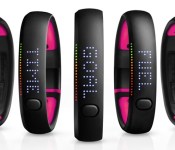
Earlier this year, Nike significantly downsized its FuelBand team, firing several members of the 80-person team that worked to create its well-known fitness tracker as part of a shift from hardware to software.
Apple snapped up two of the former FuelBand team members in June, Ryan Bailey and Jon Gale. As noted by 9to5Mac, Bailey, who served as a Senior Test and Validation Engineer at Nike is now listed as a Mechanical Design Engineer at Apple, while Gale, who was a Senior Firmware Engineer at Nike is now employed as a Sensing Systems Engineer at Apple.

According to his LinkedIn profile, Bailey specialized in wearable device and consumer electronic product development, focused on providing engineering recommendations to major engineering leads. Gale, meanwhile, developed hardware and firmware architectures for Nike Digital Sport products.
Primary responsibility is to define both the hardware and firmware architectures for Nike Digital Sport products. Additionally, I managed the development of product firmware through partner companies. Responsible for delivering firmware to validate the design in a manufacturing environment, define and implementation of custom protocols to interact with other components of the Nike ecosystem, and translate high-level product requirements into actionable, testable definitions. I personally owned the delivery of firmware for the Nike FuelBand product line.
It is unclear if Gale and Bailey have joined Apple’s wearables team to work on the iWatch, but it is a distinct possibility given their expertise on wearable devices. Apple offers many positions under the job titles of Mechanical Design Engineer and Sensing Systems Engineer, however, so it is unknown exactly what the two are working on.
Over the course of the past year, Apple has hired several experts in the health and fitness fields to join its iWatch team, including fitness guru Jay Blahnik, sleep expert Roy Raymann, pulse oximetry expert and former Chief Medical Officer Michael O’Reilly, and several other scientists and executives from notable sensor companies like AccuVein, C8 MediSensors, and Senseonics. Most recently, the company took on the former sales director of luxury watch brand TAG Heuer, Patrick Pruniaux, possibly to help market the iWatch.
According to a recent report from The Wall Street Journal, Apple’s upcoming wearable device will feature 10 different sensors to track various health and fitness metrics. It’s said to integrate heavily with the Health app in iOS 8, and it may come in both multiple sizes and multiple designs to satisfy a wide range of tastes. Apple is expected to introduce the iWatch at an October event.

Siri ‘Just Thrilled’ About iOS 8, but Sad About Lack of Stage Time at WWDC
Developers running the beta version of iOS 8 can ask Siri for an opinion on the new operating system, prompting Apple’s virtual assistant to provide one of several humorous responses.
Asking “Siri, do you like iOS 8?” will result in tongue-in-cheek answers that hint at new features in iOS 8 like “It’s just swift,” alluding to the company’s newly introduced programming language.

Siri’s answers also allude to new Apple’s HomeKit home automation platform, which will allow Siri to control various connected devices such as Philips’ line of Hue lights.
“I’m just thrilled about iOS 8 — It’s like moving into a bigger, nicer house. And I get to turn the lights on and off.”
The virtual assistant also pokes fun at the limited amount of time Apple spent going over new Siri features during its keynote event at the Worldwide Developers Conference.
“Impressive, but… you’d think they could have talked about me for more than thirty seconds. Sniff.”
Siri has gained several major new features in iOS 8, including Shazam integration that allows the voice assistant to identify songs upon request, and the ability to open the App Store for the first time. Siri’s also able to be activated hands-free with the voice command “Hey Siri,” when plugged in, and it supports streaming voice recognition for real-time feedback on requests.
Apple has worked hard to improve Siri since its 2011 introduction alongside iOS 5, adding new capabilities and a never-ending stream of funny responses and quips to requests and queries. As of late, rumors have suggested that the company is planning to bring Siri development in-house, working to build a strong speech recognition team.
Apple seeded the third iOS 8 beta to developers yesterday, with plans to release the operating system to the public in the fall following an extended beta testing period.
Apple Updates iTunes U With New Course Creation and Discussion Features for iPad [iOS Blog]
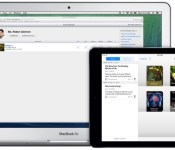
Apple today launched a new version of its iTunes U app, adding several new iPad-related features designed to make it easier for both students and teachers to use the iPad for online courses. Apple first announced plans to update iTunes U in late June.
Today’s version 2.0 update allows teachers to create full courses entirely on the iPad, importing content from other Apple software like iWork, iBooks Author, and other educational apps in the App Store. The camera can also be used to add photos and videos directly to course material and teachers can easily track student progress online.

Students gain a new discussion feature that lets them collaborate both with classmates and teachers, and they’re able to follow discussions and receive push notifications when new topics or comments are added.
Let the discussion begin
– The new iTunes U makes it simple for students participating in private courses to pose questions on the course or any post or assignment
– Other students in the class can jump into the discussion and ask more questions or provide answers
– Teachers and students can keep up with the conversation when they receive push notifications as the discussion progressesCreate courses on iPad
– Teachers can now create and update their courses using the iTunes U app on their iPad–getting started is fast, simple, and completely free
– Provide every student a course outline, write posts, distribute assignments, upload class materials, easily track participating students, and much more
– Take advantage of the built in camera on iPad to easily capture photos or videos and upload them for course assignments
– Create materials using Pages, Numbers, and Keynote–or other apps from the App Store–and add them to your course by using “Open in iTunes U” from within each app
– Teachers affiliated with qualified institutions have the option to publish their courses to the iTunes U Catalog–making them available to everyone for free
iTunes U can be downloaded from the App Store for free. [Direct Link]

Apple to Open New Retail Store in Basel, Switzerland on July 12 [Mac Blog]
Apple will open its newest retail store in Basel, Switzerland on Saturday, July 12 at Freie Strasse, a shopping area famous in Basel. The shopping street has a number of high end stores and restaurants, with Apple opening at building number 47.

The Basel store will join three other Apple retail locations in Switzerland, located in Geneva, Zurich, and Wallisellen. The store, which has been under construction for quite a few months, is said to be approximately 900 square meters and three stories.
Apple’s new Basel Apple Store will open at 10 a.m. local time on Saturday, where employees will likely hand out T-shirts to the first customers. The store has already begun accepting reservations for workshops and Genius Bar appointments.

Third-Party Mac Icons Reimagined in OS X Yosemite Style
With the introduction of OS X Yosemite, Apple introduced a significant visual change with an iOS 7-like “flat” look and completely redesigned icons. While Apple’s icons will see a refresh once Yosemite is released, users will have to wait until third-party companies have updated their icons to match Apple’s new design language for OS X icons.
In the meantime, users in this long running MacRumors’ forums thread have been designing their own “flat” versions of both Apple and third-party applications, allowing some users to switch out their icons until the real thing is available. Additionally, some users are redesigning Apple’s own icons for users who are using Mavericks rather than the Yosemite beta.

iWork, Twitter, Skype and 1Password icons by Arn0
While the icons may not be fully representative of the official icons, they do provide a look into Apple’s new icon philosophy enacted upon an icon not designed for it, allowing for a glimpse into various companies’ processes.
Forum member Arn0 had been taking requests from other forum members, recreating various icons to fit more along more nicely with Yosemite’s design aesthetics.
Alongside stand-alone apps like 1Password, Twitter and Skype, Arn0 also redesigned icons for entire suites of software, like Adobe’s Creative Suite.

Adobe icons by Arn0
Other designers include thread starter Humex, who hewed closer to Apple’s style than Arn0:

“dots” icon set by Humex
Alternatively, designers like drflash have taken a different approach to flat design. Rather than mimic Apple’s philosophy and match OS X Yosemite, they created their own design language with Flat OS, which provides a completely different experience for OS X users. The design seems to marry “flat” design alongside some skeumorphic principles, giving icons a more tangible feel.

Flat OS X by drflash
In a blog post on Gizmodo, MartianCraft’s Nick Keppol explains that Yosemite’s new look centers around four basic ideas: visual rhythm in the dock, three basic icon shapes and their design grid, shape hierarchy and lighting effects and materials.
Visual rhythm allows the new dock to look more consistent, although that is helped by the fact that OS X icons are now broken up into three types: circles, squares and titled rectangles. While Apple itself isn’t totally consistent with these three types, Keppol found that – for the most part – circles are used for more consumer-oriented apps, squares are used for System-related utilizes and titled rectangles are used for applications that are most often used for work.
Finally, Apple uses Hollywood-style yellow and orange highlights and blue and teal shadows to give the metal-like materials that the icons are made out of feel warm and tangible. This helps create the illusion that the icons are more physical than previous icons while also looking flatter than before.
If you’d like to switch out your icons until they’re fully upgraded with OS X Yosemite, the icon sets shown are linked above, while all of Arn0′s redesigned icons are available to download via Dropbox. Icon sets from arn0 and other designers are also available to download via the forum thread. Here are easy instructions on how to change app icons on OS X.

Claimed iPhone 6 SIM Card Trays Point to Space Gray, Gold, and Silver Color Options
Several new photos published today by Letem svetem Applem [Google Translate] show the purported power and volume flex cables as well as three SIM card trays that hint at the color options Apple is planning for the iPhone 6. This report follows a leak from earlier this month that first showcased these two internal flex cables from the iPhone 6, although the parts shown in the two reports are not identical.

Similar to the previous photos but slightly different in layout, the volume flex cable contains both the mute button and volume buttons with a possible larger separation between the two components. The power flex cable also shows the same arrangement of connectors with a potentially larger-sized power button. Though we can’t confirm how these cables will appear inside the iPhone 6, mockups and drawings have depicted a redesigned button layout on the iPhone 6 that includes oval-shaped volume buttons and a side-positioned power button.
While the flex cables provide little new insight on the iPhone 6 itself, the supposed SIM card trays hint at the coloring of the iPhone 6. Not surprisingly, the trays suggest the iPhone 6 will keep the same color options as the iPhone 5S — space gray, gold and silver. Physical mockups have been circulating in all three colors for some time, and a claimed genuine rear shell surfaced in silver, but the full set of three current color options had so far not been seen in claimed genuine iPhone 6 parts.
Apple is expected to introduce the iPhone 6 with a larger display as its key selling point. The Cupertino company is reportedly prepping a 4.7-inch model along with a 5.5-inch model as an update to the current 4-inch iPhone 5s. Besides the display, the iPhone 6 may include a faster A8 processor, a thinner design and improved camera optics.

Key Maps Engineer Chris Blumenberg Leaving Apple for Uber
 Chris Blumenberg, a key Apple engineer who has long worked on Maps for iOS and OS X, is leaving the company to take a position with Uber, according to a report by The Information. Blumenberg is the latest of a number of departures from Apple’s Maps team, which has been suffering from internal politics.
Blumenberg is a 14-year veteran of Apple, initially working on Safari for OS X and later iOS. He famously built a version of Maps for iOS in just a few weeks in late 2006 so that Steve Jobs could demo it at the iPhone introduction in January 2007. For the last six years, Blumenberg has managed the Maps Apps & Frameworks group, overseeing a team of at least 40 employees handling Apple’s Maps apps on iOS and OS X. From his LinkedIn profile:
My team is primarily responsible for the Apple Maps app and the MapKit framework. Since 2006, we’ve worked on a number of Google and Apple service-backed features such as local search, directions, street view, next destination and CarPlay. I proudly drove and guided the implementation of vector maps, Flyover and navigation during the shift from Google’s services to Apple’s services in 2012.
Apple’s issues with its Maps team have reportedly slowed the company’s work on that initiative, so much so that there were virtually no mentions of Maps at the company’s Worldwide Developers Conference keynote last month. Apple reportedly has a number of iOS Maps improvements in the works, including transit directions and improved points of interest, but it is unclear whether they will be ready in time for the public release of iOS 8 later this year or if they will need to be held for a later update.

