


Bose Sues Beats for Patent Infringement Over Noise-Cancelling Headphones
Bose today filed a lawsuit against Beats Electronics, accusing Beats of infringing on a number of patents related to noise cancellation and other audio technologies (via TechCrunch). The lawsuit accuses Beats Studio and Studio Wireless branded headphones, which advertise “Adaptive Noise Cancellation,” of violating five separate Bose patents in the United States.
In the filing, Bose points towards the 50 years of research, engineering, and development of noise cancellation techniques that went into the creation of its QuietComfort line of noise-cancelling headphones, which use the technology Beats has allegedly stolen.

Beats has been accused of infringing on the following five U.S. patents, which pertain to various noice-cancelling techniques:
No. 6,717,537 – “Method and apparatus for minimizing latency in digital signal processing systems”
No. 8,073,150 – “Dynamically configurable ANR signal processing topology”
No. 8,073,151 – “Dynamically configurable ANR filter block topology”
No. 8,054,992 – “High frequency compensating”
No. 8,345,888 – “Digital high frequency phase compensation”
The lawsuit asks for an injunction that prevents Beats from continuing to produce products that infringe on Bose patents and it requests a damages award for using the company’s technology. Bose has also filed a complaint with the International Trade Commission, seeking a sales ban on the Beats products that violate its patents.
Bose’s infringement lawsuit against Beats is set to become Apple’s problem as the company’s purchase of Beats is expected to close this quarter. Apple initially announced its $3 billion acquisition of the headphone manufacturer in May. Apple is currently embroiled in a number of lawsuits, including an ongoing dispute with Samsung Electronics and several class action suits brought against it by former employees.


Verizon to Begin Spot Throttling of High-Usage Customers on Unlimited LTE Plans [iOS Blog]
Following a report by Droid Life yesterday, Verizon has now confirmed to Gigaom that starting October 1 the carrier will begin spot throttling of certain high-usage customers connecting to carrier’s LTE network. The policy affects users on grandfathered unlimited data plans that are no longer offered and who rank in the top five percent of data users at Verizon.

While Verizon has had a similar policy in place for its 3G network for several years, the extension of it to the LTE network that now handles 76 percent of the carrier’s data traffic will be noticeable for a number of users.
On October 1, Verizon will start throttling back LTE speeds on its heaviest unlimited-plan subscribers when they move into congested cells on its networks. What that means is that when the network gets crowded, Verizon will prioritize 4G customers who buy their data by the gigabyte over unlimited plan customers who fall into the top fifth percentile of monthly data usage.
As of today, the top five percent consists of customers who use 4.7GB or more of data each month, though that number will fluctuate month-to-month as traffic patterns change.
Rather than blanket throttling of users speeds when they hit certain thresholds, Verizon will be weighing demand on individual cell sites and assigning these unlimited users lower priority and thus slower speeds than other customers during periods of high demand.
Verizon said that its new policy will only apply to customers who have fulfilled their contract terms (so if you renewed your data plan under contract in the last two years, you’re safe). The policy remains in effect for a subscriber for the entirety of a billing period. If you’re still in the top 5 percentile of users at the end of that month, then the throttling policy continues for another billing period. But if you’re not, then all restrictions are lifted – at least until your next bill.
With the explosion in smartphone usage in recent years, carriers have been turning to throttling to help manage demand on their networks. The policies are also being used to encourage users to move away from the unlimited data plans that were popular in the early smartphone days but which have been phased out by carriers in a shift to tiered data plans in which the amount users pay is tied to their data usage.

Now that Apple is buying Beats, Bose sues over noise-cancelling patents

The ink is likely dry on the Apple/Beats deal, but it has yet to be officially stamped with regulatory approval. Bose is now going after Cupertino’s big purchase though, as the audio outfit is suing over alleged patent infringement. The suit takes aim at Beats’ noise-cancelling tech in its $300 Studio line of wireless cans, claiming that the company swiped items from five of Bose’s patents. As you may recall, Dr. Dre’s outfit is also facing legal proceedings from MOG founder David Hyman who’s looking to recoup over $20 million in compensation. We’ve reached out to both sides and we’ll update this post when we hear back, but until then, the full complaint is accessible below.
[Photo credit: Glenn Asakawa/The Denver Post via Getty Images]
Filed under: Portable Audio/Video, Apple
Via: CNBC (Twitter)
Source: Priorsmart
OS X Yosemite Beta Failing to Download for Some Users
After announcing its OS X beta program at WWDC in June, Apple yesterday released the first beta version of the operating system to the public amid favorable reviews. For a growing number of people, the early impressions of OS X have not been positive due to a downloading issue that has prevented the installation of the OS.

Users in MacRumors forums, Apple support forums and on Reddit have complained about not being able to download OS X Yosemite from the Mac App Store. These users have successfully redeemed a promo code and initiated the installation, only to have it fail during the download process. This issue has persisted more than 24 hours after the beta was released, suggesting it is not a problem with server overload.
Can’t get OS X Yosemite to download properly. Maybe it’s the limit I can download per month or something. Gonna go to Starbucks and try it.
— Micah (Trivol) (@TheMajesticW0lf) July 25, 2014
All Apple’s online services are fully operational, and Apple support has not mentioned any potential issues that could interfere with OS X downloads. Several users have reported that using a VPN and selecting an alternative country such as Canada has solved the download issue, while others have chosen to delay the install indefinitely.
Apple’s beta program has made OS X Yosemite available to up to a million new, non-developer users who now are experiencing the OS for the first time. Beta users can check out our first impressions post as well as our forums for troubleshooting tips, known issues and more.
Apple’s Quarterly Spending Points to Major Product Launches, Significant Revenue Growth
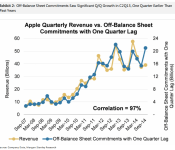
Looking at Apple’s quarterly SEC quarterly filing, Katy Huberty of Morgan Stanley believes Apple’s revenue is poised to explode in the coming quarters. Huberty based her prediction on increases in Apple’s off-balance sheet commitments, which have a historical correlation with revenue growth.
Off-balance sheet commitments are those investments in components and services that are involved in the mass production and launch of new devices. These line items include component purchases, manufacturing process equipment investments, advertising, and other services. Huberty notes that Apple’s total spending in these areas has climbed 46 percent yearly and 36 percent quarterly in fiscal Q3 2014, making last quarter’s jump the largest spending increase since Apple first launched the iPhone in 2007.
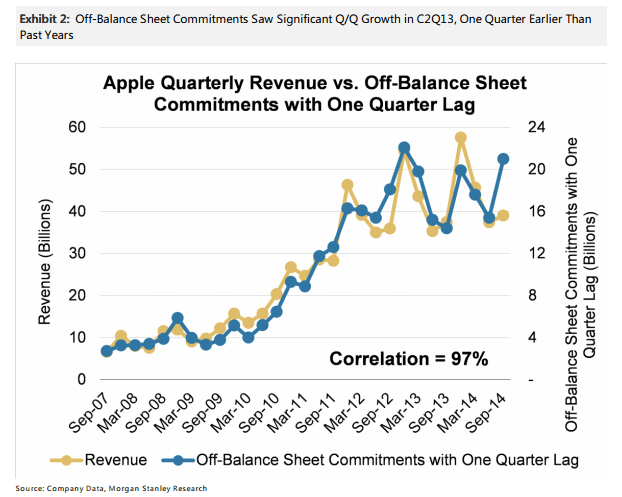
Huberty, not surprisingly, attributes this spending increase to Apple’s iPhone 6 and iWatch wearable, both of which are expected to launch later this year. These new products, along with services such as mobile payments, could accelerate growth and boost margins.
Apple has the opportunity to take share in slower growth smartphone and tablet markets with larger screens and new services. New product categories like iWatch, and services like payments could further boost growth.
Apple is rumored to be launching its next-generation iPhone 6, refreshed iPad models and a new iWatch smartwatch later this year. The company may also update its Mac hardware to coincide with the debut of OS X Yosemite.

Apple Begins Mass Production of 4.7-Inch iPhone 6, 5.5-Inch Model and iPads Start in September
China media sources (via GforGames) report that mass production of Apple’s 4.7-inch iPhone is underway ahead of the phone’s expected fall launch. These same sources claim the 5.5-inch version of the iPhone 6 has not entered mass production, further suggesting that the launch timeframe for this larger iPhone model is still uncertain.

Besides the iPhone 6, Apple also is preparing the next-generation iPad Air and Retina iPad mini for mass production starting in September. Apple is expected to unveil its new iPads, possibly alongside the iWatch, at an October event that also will likely be used to announce the public release of OS X Yosemite.
As Apple prepares to launch new iPhones and iPads later this year, the company’s Asian suppliers are gearing up to boost production by as much as 85 percent by Q4 2014. Some of this increased production may be handled by Foxconn robots, “Foxbots”, with the company reportedly deploying as many as 10,000 robots at a cost of up to $25,000 each.
Anticipation for Apple’s fall lineup of devices is high, fueled by comments from Apple executives that suggest the company will enter new product categories with a device lineup that is the best it has had in 25 years.

Sense Sleep Monitor Tracks Sleep Behavior and Bedroom Environment [iOS Blog]
Hello Inc’s new Kickstarter project Sense is an iOS-compatible sleep tracking system that allows users to monitor their sleep patterns and bedroom environments without the need for intrusive hardware.

The primary Sense device is a glow-in-the-dark polycarbonate orb that derives data from factors such as noise, light, temperature, humidity, and air particles to measure sleep quality. Sense also comes with the Sleep Pill, which is a small sensor that clips onto a pillow to track movement with a 6-axis accelerometer and gyroscope.

Sense works with its own companion app for iOS to provide users a snapshot of their last night’s sleep, offering an overall sleep score in addition a timeline of events throughout the night that triggered movement. The app can even play back noises that were captured by Sense, allowing users to listen to sound disturbances that may have led to an interruption in sleep.
The app also includes a Smart Alarm feature, which works with the Sense monitor and Sleep Pill to wake a user up at the right time. For instance, if a user begins to move more frequently after an extended period of rest, the app’s Smart Alarm will sound off in sync with a sleep rhythm. Sense also includes a number of pre-made sounds and alarms to aide the sleeping experience.
The Sense sleep monitor and Sleep Pill can be preordered for a special price of $99 on Kickstarter, with regular pre-orders costing $129 afterward. The first Sense monitors and Sleep Pills are expected to begin shipping in November 2014.

Engadget Daily: the Oppo Find 7, shoes that vibrate in the right direction and more!

Today, we review the Oppo Find 7, learn where not to fly drones, contemplate Apple’s rumored 12-inch Retina Display MacBook and take a look at smart shoes that vibrate in the right direction. Read on for Engadget’s news highlights from the last 24 hours.

Oppo Find 7 review: A solid phone that faces stiff competition
What you’re looking at is the Oppo Find 7. This Android-powered handset has a gorgeous Quad HD display and plenty of horsepower under the hood, but can it compete with the Galaxy S5 or LG G3? Read our review and find out.

Apple reportedly releasing OS X Yosemite in October alongside 4K desktop and 12-inch Retina MacBook
The OS X Yosemite public beta just went live today, and now… more rumors. According to 9to5Mac’s Mark Gurman, the final version of the OS will be released in October, accompanied by a 12-inch Retina MacBook and 4K monitor.

These smart shoes vibrate to point you in the right direction
Tired of being a distracted walker? Lechal’s interactive haptic footwear can help. These shoes pair with your smartphone and guide you around town with vibrations, no screen required.

Want to fly a drone? Don’t do it here
You’ve probably never tried to pilot your drone through a nuclear power plant, but that’s not the only sort of no-fly zone that should be avoided. Check out this map of locations where you should never fly your UAV.
You also might like:
OS X Yosemite Beta: First Impressions, Installation Tips, Known Issues, and Bug Fixes
Today marked the first day of Apple’s public beta testing program for OS X Yosemite, letting thousands of non-developers download the software for the first time. With so many new users, new issues and bugs in the beta are coming to light and being catalogued in our Yosemite forum.
We’ve pulled out some user reactions from the forums to share, along with some tips on troubleshooting possible issues. For users having problems with the beta, the Yosemite forums can be an invaluable resource, and for users still debating whether or not to install the beta software, make sure to check out this post and our forums before taking the plunge as Yosemite is still somewhat unstable.
First Impressions
A lot of new Yosemite users think that the operating system looks great. According to one user, it makes Windows and Mavericks look antiquated in comparison with its new focus on translucency and clean lines. A “Yosemite is Beautiful” thread is full of praise, with users calling it “stunning” and “the best OS X has ever looked.”

While there are a lot of Yosemite users who like the changes Apple’s brought with Yosemite, there’s a much longer complaint thread entitled “Yosemite Looks Terrible” that includes complaints about Dark Mode, “crappy” fonts, and the bland look of the translucency. Users also say Yosemite looks far less appealing on a non-Retina display.
 Yosemite’s Dark Mode, screenshot from Yosemite forum thread
Thus far, most users have not noticed significant performance improvements going from Yosemite to Mavericks, but that could change as Yosemite is still very much in a beta form.
Bugs and Issues
A lot of users have received an error message suggesting their Yosemite codes had already been redeemed after requesting a code. According to Apple, simply refreshing the beta page will provide an entirely new code.
One new Yosemite user who installed the operating system on a partition discovered that Yosemite may cause problems with partitions. Other users have also reported issues with partitions after installing Yosemite, while some have had no problems at all. The linked thread contains some Terminal fixes for users experiencing issues.
There’s a lengthy bug thread on OS X Yosemite that has been added to throughout the beta testing period. Some remaining bugs include poor management of dual iTunes accounts, crashes in Activity Monitor, making and receiving calls with the FaceTime app, and unreliable WiFi connections. Problems with specific apps are listed in a separate thread, but some issues include frequent crashes with apps like Spotify and Microsoft Office. Apps like Final Cut Pro X, Aperture, iMovie, and Pixelmator also do not appear to be fully functional.
Handoff and Continuity
For users who have the iOS 8 beta installed on their iOS devices, MacRumors forum member Armen has put together a detailed walkthrough on how to set up Continuity and Handoff, new integration features introduced with the two new operating systems. Continuity appears to be largely functional for users with compatible machines, which have a Bluetooth LMP version of 0×6. Handoff does not appear to be working with 2011 MacBooks, but those machines do appear able to access SMS texts and phone calls.
New Features
New Yosemite users and those who are thinking about installing the beta should also check out the OS X 10.10: All The Little Things forum thread that details all of the lesser-known changes made to Yosemite throughout the beta testing period thus far to get familiarized with the operating system. For example, the latest developer preview introduced an entirely new version of iTunes, a new calculator app, and more.
Installation
Users who signed up for the public beta program can access promo codes to install Yosemite through the beta program website. Apple has also been sending out emails to those who have been selected to beta test Yosemite.
Apple recommends Yosemite be installed on a secondary machine as it is beta software, but users who do not have a secondary machine may want to install the operating system on an external drive or on a separate partition. OS X Daily has a set of instructions that walk users through both scenarios, explaining how to install on a partition or external hard drive. A MacRumors forum member has also explained how to create a bootable USB installer.
OS X Yosemite is expected to remain in beta testing until October, with new versions being seeded to both Appleseed participants and developers. Public beta test members will not, however, get as many updates to the software as developers.

Possible 5.5-inch iPhone 6 Volume/Power Flex Cable and SIM Card Tray Shown in New Images
We’ve seen several different parts for the 4.7-inch iPhone 6, but parts for the larger 5.5-inch version have thus far been in short supply. Apple.club.tw [Google Translation] has shared some new images of what might be the first leaked internal parts for the 5.5-inch iPhone 6, offering up pictures of power/volume flex cables and SIM trays said to be for the device.
The two flex cables that separately house the left side volume buttons/mute switch and the top power button are similar in design to an earlier set of leaked flex cables said to be for one of the iPhone 6 models. There are, however, some design differences that suggest there are two distinct sets of flex cables designed for two different devices floating around the Asian supply chain. For example, the new set of flex cables depicts less space between the volume buttons and the mute buttons and the two flex cables for the power button have different shapes.
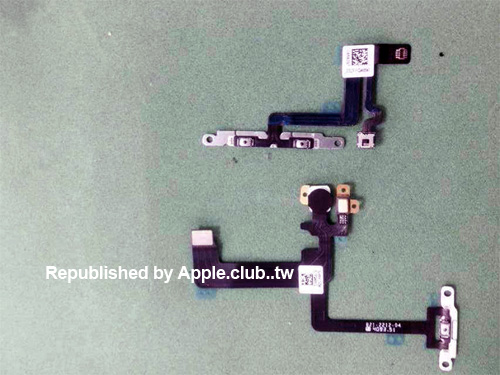 iPhone 6 volume/mute flex cable on top, power button flex cable on bottom
Like the earlier cables, the flex cables in the new images resemble parts from other devices and have an Apple-style part number.
As it is difficult to determine size based on images, it is unclear which set of leaked flex cables might be designed for the 4.7-inch iPhone and which is destined for the 5.5-inch iPhone, but as both cables are different than existing parts for the iPhone 5s, iPad Air, and iPad mini, they point towards two separate devices if legitimate.
Apple.club.tw has also shared images of a longer flex cable with an unknown purpose and a set of SIM card trays in a cobalt blue color. Blue is not expected to be a color for the iPhone 6, as current rumors have pointed towards a release in the existing silver, gold, and space gray for both models, so the blue SIM trays are somewhat questionable.

As we move closer to the September launch date of the iPhone 6, we expect part leaks to become more frequent. We may also see more parts designed for the larger iPhone 6 as it is expected to enter mass production in August or September. The 4.7-inch iPhone is said to have entered mass production in July.
Rumors have suggested that Apple may ship the 4.7-inch iPhone 6 ahead of the 5.5-inch iPhone 6 due to supply constraints with the latter, so it remains unclear if we will see the bigger phone at Apple’s prospective iPhone 6 launch event in September.

