


iPhone 6 Said to Feature Faster Qualcomm MDM9625 LTE Modem with LTE-Advanced Support
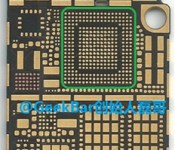
The iPhone 6 may incorporate Qualcomm’s MDM9625 LTE modem, according to a new photo of the device’s supposed logic board shared by GeekBar (Google Translate, via G for Games).

Originally announced in 2012 and featuring support for speeds of up to 150 MBPS and improved LTE networking along with faster speeds, the Category 4 chip would mark an improvement over the Qualcomm MDM9615 chip found in the iPhone 5s and iPhone 5. The MDM9625 is also more durable than its predecessor, allowing for lower temperatures thanks to a refined 28-nanometer production process.
Along with those features, the MDM9625 includes support for next-generation LTE Advanced networks, which have yet to roll out in most parts of the world. News of the MDM9625′s inclusion in the iPhone 6 also contrast a detailed yet sketchy report from VentureBeat posted earlier this month, which stated that the iPhone 6 would include a Category 6 LTE modem capable of 300 MBPS throughput speeds. That radio however was said to not include support for LTE Advanced as featured in the MDM9625.
GeekBar also posted a supposed schematic from the iPhone 6 yesterday, which appeared to show support for near field communications (NFC) in the device. The schematic also references NAND flash memory, which was originally thought to be 1 GB of DRAM in the device.
Apple will announce the iPhone 6 at an event on Tuesday, September 9. The launch of the 4.7-inch version will probably follow soon after, as production issues may hold back the release of the 5.5-inch version until late this year or early next year. In addition to a larger display, the iPhone 6 will feature a thinner chassis, a faster A8 chip, an improved camera with stabilization, and more.
.CPlase_panel display:none;

Apple Expands Lineup for 8th Annual iTunes Festival in London with Lenny Kravitz, Others
 Apple today announced that it has added 21 more acts to the lineup for this year’s iTunes Festival in London, adding artists such as Lenny Kravitz, The Script, Foxes, and more. Those acts will join artists such as Maroon 5, Pharrell Williams, David Guetta and many others for 30 nights of concerts at The Roundhouse throughout September.
Free tickets for the concerts in London will be available through iTunes in a lottery system as well as through local radio stations. For those not attending in person, the iTunes Festival will be broadcast via Apple TV, iOS app, and the iTunes Desktop application.
Earlier this year, Apple held the first iTunes U.S. Festival at South by Southwest (SXSW) 2014, which was held at Moody Theater. The 2013 iTunes Festival in London featured performances from a large lineup including Justin Timberlake, Thirty Seconds to Mars, Jack Johnson, and more.
.CPlase_panel display:none;

Video Shows New Lightning Cable with Reversible USB Connector in Action
Last Friday, a report and photos of a new Lightning cable with a reversible USB connector surfaced, which was followed by another image from frequent iOS device part leaker Sonny Dickson. Now, Dickson has shared a new short video of the Lightning cable in action, showing its USB connector being reversed and plugged in both ways.
Apple could start shipping a new Lightning cable alongside the next wave of iOS device releases this fall, which will likely start with the iPhone 6 next month. It is unknown if the updated cable will contain any new features aside from a reversible USB connector, although past rumors have pointed to support for high-definition audio playback.
An Apple patent discussing a reversible USB connector was also published last month, and discussed a more user-friendly design compared to current cables. However, it is unknown if this new cable will face challenges from the likes of California company UltraTek, which already holds a patent itself for a reversible connector and currently sells cables through major online retailers.
.CPlase_panel display:none;
Sprint Announces New Data-Heavy Family Share Pack Plan With Incentives for New Subscribers
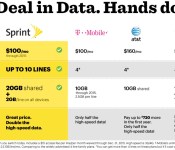
Sprint today announced the debut of a new Sprint Family Share Pack plan, aiming to draw customers by offering significant amounts of data. Sprint’s new plan provides customers with 20GB of shared data, which is double the amount that Sprint offered with its previous Framily plans.
For a limited time, customers who switch to Sprint will get the 20GB of shared data plus an additional 2GB of data per line for $100 per month until the end of 2015, with support for up to 10 lines (including a waived $15/month device fee). That equates to 40GB of shared data for 10 lines, up from the 1GB per line Sprint originally offered under its Framily plans.

The Sprint Family Share Pack, offering double the high-speed shareable data for smartphones, basic phones, tablets and mobile broadband devices, will be available starting Aug. 22. For example you can get four lines and 20GB of data for $160 compared to 10GB of data for the same price from AT&T or Verizon.
But wait, there’s more. To kick off Sprint’s “new day for data” campaign, Sprint is offering a limited-time promotion for the Sprint Family Share Pack: For a family with up to 10 lines, get 20GB of Shared Data and Unlimited Talk & Text for only $100 a month through 2015 – and, as an added bonus, customers will get an additional 2GB per line for up to 10 lines. For a family of four, that’s a savings of $60 per month better than AT&T’s and Verizon’s current pricing through 2015; double the data of Verizon; and more than double the high-speed data of AT&T and T-Mobile.
To further sweeten the deal and attract new users, Sprint is offering up to $350 (via Visa Prepaid Card) to cover early termination fees for users switching from other carriers. Sprint’s device fees are still applicable, requiring both Easy Pay users and those who sign up for subsidized phones to pay device fees in the range of $15 to $25 (minus the $15 discount).
While the promotional $100/month price is only for new customers, existing Sprint subscribers can get 20GB of shared data for up to 10 lines for $160 per month. Current subscribers cannot, however, get the 2GB of bonus data being offered to new customers.
Sprint’s website also promises to bring more “great announcements” in the near future. Sprint’s new CEO, Marcelo Claure, has pledged to bring more disruptive pricing to Sprint following its failed merger with T-Mobile.
Sprint’s new plans will be available beginning on Friday, August 22.
.CPlase_panel display:none;

The government shouldn’t be in charge of smartphone kill switches

Few things are worse than realizing your smartphone’s been stolen. Your personal information is now in the hands of a dishonest soul, who can decide to either erase and sell the device or — even worse — do whatever they want with your contacts, photos and texts. If it’s happened to you, you’re not alone; millions of people have gone through the same nightmarish experience. The technology to deter thieves, known as “kill switches,” exists, but it’s up to phone makers and carriers to implement it.
Most major phone companies have committed to adding kill switches to their products, and some have already begun selling phones with the tech included. A handful of state governments, like California and Minnesota, don’t believe this is good enough, so they’re passing bills that mandate anti-theft measures in every phone sold in those states beginning next year. This seems like a great idea, but let’s take a closer look at what exactly these laws mean and if they make sense.
What is a kill switch?

The most basic definition of a kill switch is a feature that allows an owner to render a phone useless after it’s been lost or stolen. In theory, it’s supposed to deter thieves from being able to sell your phone or access any of the data on board; if every phone can be disabled remotely, why would thieves even bother trying to steal them anymore? If anything can be done to curb smartphone theft, it’s worth considering. An FCC report states these types of theft comprised nearly 30 to 40 percent of robberies in most major cities across the country in 2012. And it appears to be getting worse: According to Consumer Reports, 3.1 million Americans had their smartphones stolen in 2013 alone, which is a jump from 1.4 million in 2012.
There are two kinds of kill switches: Hard and soft. The former would “brick” the phone so it becomes a permanently disabled hunk of circuitry, never to be enjoyed or loved again, while the latter — the more popular alternative among companies and legislators — can be reversed as long as you have the authorization to do so. (At this moment, every existing switch is soft, as hard switches are much more difficult to implement.)
Even if your phone doesn’t have a kill switch, it likely can be remotely locked and wiped. This clears all of your personal data from your phone and reverts it back to the way it was when you bought it. Android’s official Device Manager is an example of this. Problem is, your device can be sold and reused. If you activate a kill switch and the thief can’t figure out how to bypass your authorization (more on that later), he or she has a useless and unsellable phone.

Regardless of government involvement, some companies are already adding soft kill switches to their products. Apple added Activation Lock to iOS 7 last year, which allows users to turn on Lost Mode (using Find my iPhone) and prevents others from unlocking your device without your Apple ID and password. Samsung’s added a similar feature called Reactivation Lock to the Galaxy Note 3 and Galaxy S5 that does essentially the same thing. Both options are opt-in, which ensures that your phone doesn’t get disabled by pure accident. That said, it also means a lot of phones will still be vulnerable if they’re stolen, so thieves still have a good shot at success if they snatch your handset.
A few preliminary studies show that kill switches have already caused a drop in smartphone theft. Police officers in London and San Francisco reported a noticeable drop in iPhone robberies (24 percent and 38 percent, respectively) between the six-month period before the feature came out and the six-month period after. This is an encouraging report, but it’ll be even more telling as a larger chunk of the wireless industry follows Apple’s and Samsung’s lead.
Within the next year, we may see exactly that — if you trust tech companies to live up to their word. Google and Microsoft have vowed to incorporate kill switch tech into the next major releases of Android and Windows Phone; and the CTIA, a lobbying group that represents nearly every wireless carrier and manufacturer in the country, teamed up with the US branches of LG, Samsung, HTC, Huawei, Motorola and Nokia, as well as the five largest US networks, to commit to adding “baseline anti-theft tools” to their devices by July 2015. Curiously, phone insurance provider Asurion was also listed as one of the supporters of the CTIA’s pledge; the company makes money by convincing people they need insurance to cover stolen phones, so the fact that it’s even voicing support for anti-theft measures is important.
Government to the rescue!

Phone makers and carriers may be getting their gears in motion, but it’s not enough for the government. In May, Minnesota passed a bill requiring that any smartphone manufactured (and sold or purchased in the state) on or after July 2015 “must be equipped with preloaded anti-theft functionality or be capable of downloading that functionality.” Additionally, it mandates manufacturers and carriers submit a report describing the anti-theft tool they use.
At first, it sounds like this is a foolproof method of ensuring that all phones will now come with a built-in kill switch, but the text of the bill is incredibly vague. It never mentions a kill switch, nor does it even specifically describe what the anti-theft functionality is supposed to do. Furthermore, it also doesn’t have to be installed on the device at launch; at minimum, it needs to be available as a free download for anyone who wants it.
Last week, California passed a very similar bill after its second run through the state Legislature, and it’s awaiting a signature from Governor Jerry Brown. In this case, the text of the bill, known as SB962, is more clear: It states that any smartphone manufactured on or after July 1, 2015, must have anti-theft functionality included at the time of sale. As long as the essential features of the phone are rendered inoperable when it’s stolen, it doesn’t matter if it’s a hardware or software solution. The feature should, “when enabled, be able to withstand a hard reset … and prevent reactivation of the smartphone on a wireless network except by an authorized user.”

The bill specifies that a soft switch is required; it must be reversible so that the owner can reuse their phone if it’s recovered. It’s also opt-out, which implies that manufacturers can enable the kill switch right out of the box as long as they let the user disable it at any time.
Arguably, California’s bill is important because it could impact devices all across the country. Since the state boasts a good chunk of the nation’s smartphone buyers, it likely doesn’t make sense for manufacturers to push out state-specific firmware. And because most companies are already committed to adding kill switches to their products anyway, this is simply more incentive for them to do so on all of their devices — precisely what the government wants.
Enforcing kill switches on a state-by-state basis might be messy, so it makes sense that it’s also being considered on a federal level. Members of Congress have proposed the Smartphone Theft Prevention Act, which is very similar to California’s in that a soft kill switch be made available to all new phones. It hasn’t been brought to the floor yet, and there’s no indication of if or when it’ll actually be voted on.
That’s a bad thing?

Just because these laws may seem innocent and even helpful doesn’t mean they’re the best idea for the consumer. If companies are already adopting kill switches, do we really need the government getting in the way? The Electronic Frontier Foundation (EFF), a nonprofit that focuses on defending digital civil liberties, doesn’t think so. The group argues that numerous kill switches are already available to the end user, either as built-in features or as third-party approaches (such as Lookout, Avast, Prey and others). And once the government gets in the way, SB962 could potentially “lock in” options that aren’t as effective and could therefore stifle competition and innovation among third-party developers. “Technology is fast; the law is slow,” the EFF’s Adi Kamdar said. The other issue, the EFF claims, is that the bill isn’t specific enough in its language regarding who’s “authorized” to activate the kill switch. If it’s not explicitly defined, the group argues, what’s stopping the government or wireless providers from considering themselves authorized to do it as well?
Even the CTIA, which (as mentioned earlier) voiced its support for the installation of kill switches in April, opposes SB962 for several reasons. The CTIA argues that the bill doesn’t make mention of educating consumers on smartphone theft and how to protect yourself; a stolen-phone database was established late last year and the government hasn’t given it enough time to prove its usefulness; state law may interfere with federal smartphone requirements, such as the mandate that each phone gets 911 service at all times; and if individual states pass bills with different requirements, it’ll make it more difficult for manufacturers to produce phones that can be sold in all 50 states.
Finally, other opponents of the measure, such as California state Sen. Mark Wyland, believe that the maximum $2,500 penalty that manufacturers would have to pay per phone is too high — especially if the wrong devices accidentally get shipped to California instead of some other part of the country. “It’s a big burden on a retailer to ensure that every single product they sell meets every single standard,” Wyland told the LA Times.
California and Minnesota may be the first states to pass legislation, but they may not be alone for long. New York and Illinois are also discussing similar measures, and other states — especially those with high rates of smartphone theft — could follow along as well. Additionally, a group of elected officials and law enforcement leaders signed the Secure Our Smartphones Initiative in June 2013, which calls for a hard kill switch in every device.

Kill switches in their current form aren’t foolproof, either. They can’t be activated without an internet connection, so the thief can simply activate airplane mode before the victim realizes the phone is missing. Hackers may also be able to find ways to bypass the switch and falsify authorization. After Apple introduced Activation Lock, a few loopholes were found in the phone’s security that allowed knowledgeable thieves to bypass the kill switch; the iPhone has fallen victim to a few of these bugs, and to its credit, Apple is often quick to fix them. But will other manufacturers take care of similar issues in a timely and effective manner? Especially when they require additional carrier tests before they can roll out? Proper and successful kill switch implementation takes time.
Sadly, although there are plenty of reasons to oppose legislation, state mandates still hold more weight than the CTIA’s commitment. Just because a group of companies have agreed to add anti-theft tech to their phones, doesn’t mean they’re held to a blood oath. The agreement isn’t an enforceable contract, nor will ramifications befall any of them if they fail to get it done in time.
There’s no longer any reason a phone shouldn’t have kill switches installed, but companies — not the government — need to be in charge of making sure the functionality is done properly. State involvement isn’t anywhere close to a perfect solution, but without their interference, individual companies won’t be held accountable if they sit on their hands and take forever to add this functionality to their phones. States like New York and Illinois aren’t going to wait around and see if companies will stay true to their word; if the wireless industry puts it off for too long, the government will simply take matters into its own hands.
[Image credits: Getty Creative (pickpocket), Getty Images (Killswitch Engage, California chambers)]
Filed under: Cellphones, Wireless, Mobile, Apple, Microsoft, Google
.CPlase_panel display:none;

Flappy Bird Creator Set to Release New ‘Swing Copters’ Game This Thursday [iOS Blog]
Flappy Bird creator Dong Nguyen is preparing to launch a new iOS game in the near future, called Swing Copters. Previewed exclusively by our sister site TouchArcade, Swing Copters adopts the ultra tough Flappy Bird-style gameplay, adding new mechanics and a fresh skin.
In Swing Copters, players are tasked with navigating platforms with swinging hammers while climbing upwards towards the sky, a deviation from the original side-scrolling gameplay in Flappy Bird. According to TouchArcade editor-in-chief Eli Hodapp, Swing Copters emulates the “one more try” gameplay of Flappy Bird while being even more “brutally difficult.”
That five point run that I busted out at the start? That’s the best I’ve done so far, and that two minutes worth of video is basically my magnum opus as of this writing. Swing Copters is hard. Just getting through the gates themselves would be tricky enough, but adding in the swinging hammer things below them is just ridiculous, particularly as you’re desperately trying to control your guy as he wildly swings from one direction to the other.
…But, like Flappy Bird, I love it. It feels like it’s got all the same qualities that made Flappy Bird so sticky for me. Once you see even the smallest bit of success in the game, you can’t help but play again, and again, and again, always trying to (in my case, anyway) top that amazing five point flight.
Back in March, Flappy Bird creator Dong Nguyen promised that the once popular game that spawned thousands of clones would return to the App Store in August. It is unclear whether Swing Copters is Nguyen’s replacement for Flappy Bird or if Flappy Bird will also return to the App Store at some point.
Flappy Bird‘s incredible success in early 2014 prompted Nguyen to pull the game from the App Store in February, after the attention and media requests became overwhelming. At the height of its popularity, Flappy Bird was generating upwards of $50,000 per day. Nguyen also expressed concern over the response he was getting from parents and children, causing him to believe the game was simply too addictive. One woman reportedly told him he was “distracting the children of the world.”
Nguyen has said that he would ensure that any future version of Flappy Bird would be “less addictive.” He also suggested it would include multiplayer gameplay, but Swing Copters does not appear to include multiplayer capabilities at this time.
Swing Copters is set to be released this Thursday, August 21. The game will be a free download with a $0.99 in-app purchase to remove ads.
.CPlase_panel display:none;

Apple Releases OS X Yosemite Developer Preview 6
Apple today released a new version of OS X Yosemite to developers, two weeks after releasing the fifth Developer Preview and more than two months after unveiling the new desktop operating system at its annual Worldwide Developers Conference.
The update, build 14A3429f, can be downloaded from the Mac App Store and through the Mac Developer Center. Apple has also released Xcode 6 beta 6.

OS X Yosemite brings a flatter, more modern look to OS X, with an emphasis on translucency and redesigned dock, windows, and more. It also includes a multitude of new features, such as improved integration with iOS 8 through Continuity, a new “Today” view in Notification Center that offers integration with third-party apps, a retooled Spotlight search with new data sources, and several new features for apps like Mail, Safari, and Messages.
Over the course of the beta testing period, each Developer Preview has added new features and refined the look and performance of OS X Yosemite. DP 4, for example, added a revamped version of iTunes with a streamlined design and support for Family Sharing, while an earlier beta introduced a new Dark Mode.
Today’s Developer Preview is limited to registered developers, but in late July, Apple made a version of OS X Yosemite available to the public as part of a wide-ranging beta test. The pre-release version of Yosemite available to those participating in the public beta program is not expected to receive as many updates as the developer version.
.CPlase_panel display:none;

Apple’s Rumored Reversible USB Connector Supported by Patent Filing, but Likely to Face Challenge
Several leaked photos in recent days have suggested Apple may be looking to move to a reversible USB connector for its next-generation Lightning cables, making it easier for users to plug the cables into their computers, chargers, and other equipment with standard USB ports.
As noted by Patently Apple late last week, the idea is actually supported by an Apple patent application filed in January 2014 covering just such a design. The application was published just a few weeks ago and cites as priority a provisional patent application filed by Apple in January 2013.
Apple isn’t the only company with this technology, however, so it is unclear exactly how this situation will play out given that Apple’s patent application was only assigned to an examiner ten days ago. A California company by the name of UltraTek already holds a patent for the reversible connector and is selling cables through major online retailers.

UltraTek first filed a patent application for its “User-Friendly USB Connector” technology in 2009 and was awarded the patent by the U.S. Patent and Trademark Office in 2010. In the patent, the company describes a cable with two sets of conductive contact pins that allow it to be inserted into a USB port in either orientation.
A new user-friendly USB (Universal Serial Bus) male connector is physically and functionally compatible to the existing and future USB female connectors. Unlike the conventional keyed, polarized and position dependent USB male connector. The new user-friendly USB male connector provides spare connections, eliminates potential connector damage and allows normal and opposite insertions to the USB female connectors.
More than just a patent, UltraTek is marketing its reversible cable under the brand name, Flipper, with distribution through TrippLite. Different configurations of the reversible USB cables can be purchased through retailers such as Newegg, TigerDirect and others for less than $10.
Given its resources, Apple would undoubtedly be able to overcome the existing patent protection on the concept of reversible USB connectors, either through licensing/purchasing the existing patent or finding a way to work around it. The existing patent is, however, rather broad in describing the concept of a reversible “Type A” USB connector of the sort apparently being considered by Apple.
.CPlase_panel display:none;

Rumored NFC Chip for iPhone 6 Highlighted in Claimed Schematic
Rumors of near field communications (NFC) support for the iPhone surface nearly every year, and this year’s iPhone 6 rumors are no different, with reports split on whether the device will include the short-range communications technology frequently used for mobile payments. A couple of new reports do, however, come down on the side of NFC being included in the iPhone 6.
The first mention came in a separate leak showing a purported battery from Apple’s 5.5-inch iPhone 6 late last week. That report from Taiwanese newspaper Apple Daily also mentioned in passing that the iPhone 6 will include a PN65V NFC chip from NXP, but offered no specific evidence in support of the claim.
 NXP PN65 NFC chip from Nexus 7 (Source: iFixit)
But now Chinese repair firm GeekBar has shared what is said to be a wiring schematic for just such a chip to be included on the iPhone 6. NXP has been the rumored partner for NFC in the iPhone 6, and the company’s PN65 NFC package is used in a number of Android mobile devices.
 Claimed iPhone 6 schematic for NXP PN65V NFC chip
While GeekBar’s interpretation of such schematics is questionable given a leak earlier today in which it claimed the iPhone 6 will contain only 1 GB of RAM as the schematic appears to be addressing NAND flash rather than DRAM, the appearance of a PN65V chip on the schematics seems straightforward if they are indeed legitimate.
Apple has been rumored for some time to be working on a mobile payments system, with a launch coming perhaps as soon as this year in partnership with Visa. Details on the system are unclear, but Apple has reportedly been taking a “go-slow” approach for a number of years as it has tried to figure out the best way to deploy such a system without simply competing with existing providers “all fighting over their piece of the pie.”
.CPlase_panel display:none;

Apple Awarded Creative Arts Emmy for ‘Misunderstood’ Holiday Commercial [iOS Blog]
The Television Academy this weekend announced the winners for the 2014 Creative Arts Emmy Awards, recognizing the technical side of television in honoring the outstanding “behind-the-scenes crafts essential to television production.” Apple was among the winners announced during a ceremony held Saturday night in Los Angeles.
Apple, along with Park Pictures production company and TBWAMedia Arts Lab ad agency, was awarded an Outstanding Commercial Emmy for its holiday “Misunderstood” advertisement. In the commercial, a family participates in a traditional Christmas celebration while a younger member records all of the activities on his iPhone. Chided for being on the sidelines, the misunderstood teen delights his family at the end of the commercial with a heart-warming montage of the holiday celebration streamed via AirPlay to the living room television.
The award was shared with Apple’s longtime ad agency, TBWAMedia Arts Lab, which allegedly now has a rocky relationship with the Cupertino company. Emails from Apple’s head of marketing Phil Schiller hint at discord between the ad agency and Apple’s executives following a scathing criticism from The Wall Street Journal. A more recent rumor suggests Apple is ready to sever its ties to TBWA/Media Arts Lab, with Beats co-founder Jimmy Iovine stepping in to help spearhead the company’s future marketing campaigns.
.CPlase_panel display:none;

