



Apple Negotiates Lower Transaction Fees With Credit Card Issuers for Mobile Payments Initiative
 As part of its upcoming payments initiative, Apple has reportedly negotiated deals for lower credit card transaction fees with several credit card issuers. According to Bank Innovation, Apple has entered into agreements with American Express, JP Morgan Chase, Citigroup, Capital One, and Bank of America.
The banks have agreed to allow all of Apple’s transactions to be conducted as “card present,” a set fee charged when a customer uses a card in a physical retail location. Typically, there’s also a higher “card not present” fee that’s charged when a card is used online, due to security issues. Apple’s also managed to secure a lower “card present” fee on top of that, cutting its costs further.
Beyond that, Apple has also managed to bump down the actual “card present” rate by 15 to 25 basis points, according to people with knowledge of the talks. Normal “card present” discount rates, which are shared by issuers and networks but determined by the network, are about 1.5%, which means that Apple appears as though it will get around a 10% discount on the processing rate it will pay. Last quarter, Apple generated $4.5 billion of iTunes revenue — this implies that Apple will save at least $27 million as a result of these deals with the banks. Of course, more revenue volume is expected upon launch of Apple’s payments venture.
Apple has reportedly been able to negotiate this lower rate by ensuring banks that transactions will be secure, both through the use of the NFC chip which reports location, and through Touch ID, which will be used to authenticate transactions.
In addition to signing deals with several financial institutions, Apple has also managed to secure deals with major credit card companies Visa, MasterCard, and American Express, and it’s also been speaking with various retailers about its upcoming payments service.
Rumors have suggested that Apple’s payment service will allow iPhone owners to use their devices to make payments both online and in retail stores, possibly linking credit cards to existing iTunes accounts. Apple is expected to announce its mobile payments initiative during its September 9 media event.
.CPlase_panel display:none;
iPhone 6 to Support ‘One-Handed Mode’ to Address Usability on Larger Screens
In a lengthy article covering Apple’s iWatch and iPhone 6 plans for next Tuesday’s media event, The New York Times reports the iPhone 6 will support an optional “one-handed mode” to make it easier for users on the larger-screened devices.
To deal with concerns that a bigger phone will make typing with one hand difficult (the current iPhone has a 4-inch screen), some changes to the design of the iPhones’ software interface will allow people to type or use apps with just one hand — there will be a one-handed mode that can be switched on and off, two employees said.
The report reiterates rumors that the iPhone 6 will come in 4.7-inch and 5.5-inch sizes, considerably larger than the 4-inch screen included on recent iPhone models. Apple has touted the ease of one-handed use on its current lineup as competitors have moved to even larger displays, and this new one-handed mode will clearly serve as an answer to Apple’s own previous criticism of large-screen phones. Exactly how this mode will work is unclear, however.
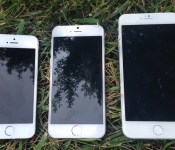
 iPhone 5s next to physical mockups of 4.7-inch and 5.5-inch iPhone 6
The New York Times also reiterates circulating rumors that the 5.5-inch iPhone 6 will be priced higher than the 4.7-inch model, with both devices also including near field communications (NFC) to support a new mobile payments initiative.
Apple’s media event kicks off at 10:00 AM Pacific Time next Tuesday, and Apple will be providing a live video stream of the event. MacRumors will also be providing coverage of the event with a liveblog and Twitter updates.
.CPlase_panel display:none;

Apple’s ‘iWatch’ to Feature Flexible Display, Wireless Charging
 Adding to this morning’s report from The Wall Street Journal pointing towards a curved OLED screen for Apple’s upcoming “iWatch”, The New York Times has released several details about the wearable device, suggesting it will have a flexible display and wireless charging capabilities.
Echoing past rumors, The New York Times says the iWatch will come in two separate sizes, focusing on health/fitness and mobile computing tasks, and that it will allow people to make purchases with included NFC support. Its flexible display is described as “unique,” and Apple is said to have settled on wireless charging after a failed experiment with solar charging.
It has a flexible display panel that is protected by a cover composed of sapphire, a type of tougher glass, they said. The device’s circuit board, which includes its sensors and chips, was described as tiny, about the size of a postage stamp.
For replenishing the battery, the smartwatch will rely on a wireless charging method. Apple had at one point tested solar charging for the watch, but that experiment failed.
According to unnamed employees who spoke to The New York Times, Apple’s iWatch is “one of Apple’s most ambitious projects to date,” with an “enormous” amount of time and money put into the health and fitness sensors in the device, which will be “much more” accurate than existing fitness devices. Rumors have suggested the iWatch will measure an array of different health-related metrics, from steps taken and sleep quality to blood pressure.
The iWatch is said to take advantage of HealthKit, a set of APIs Apple introduced alongside iOS 8 that will integrate into existing health devices and apps, reporting data to a central location. It’s also going to rely on Handoff, a Continuity feature that lets users seamlessly transition tasks from one iOS or Mac device to another.
The report also echoes a litany of rumors that have suggested Apple’s wearable device will not be available for purchase until 2015, despite Apple’s plans to unveil the iWatch at its September 9 media event. The gap between the introduction of the iWatch and its debut will give Apple time to finish work on the device as well as provide an opportunity for developers to create new apps suited to the smaller form factor.
(Image: 2.5-inch iWatch concept by SET Solutions)
.CPlase_panel display:none;

Apple Store App Gets Redesigned Look, Improved Navigation
 Apple today updated its Apple Store app to version 3.0, adding several new improvements and design updates. The app now features new icons along the bottom bar, with the “Products” section renamed to “Shop” to make it easier for users to make purchases within the app. The overall app icon has shifted from a cart to a bag.
There’s also a new icon for “Stores,” and an “Account” tab that replaces the previous “More” tab. Several other UI elements have been redesigned as well, giving the iPhone app a cleaner feel that’s more in-line with the iPad version.
According to Apple’s release notes, it’s now possible to start shopping on one device and seamlessly switch to another device, including a Mac or PC. That means that a user who puts an item in the cart in the app will see the same item in the cart on Apple’s website if logged in, allowing for easy transitions between devices.
Along with purchasing improvements, the “Stores” tab has been updated to display information about upcoming events at a user’s local retail location, and the app, which is now universal, has been updated with the ability to create One to One reservations on the iPad.
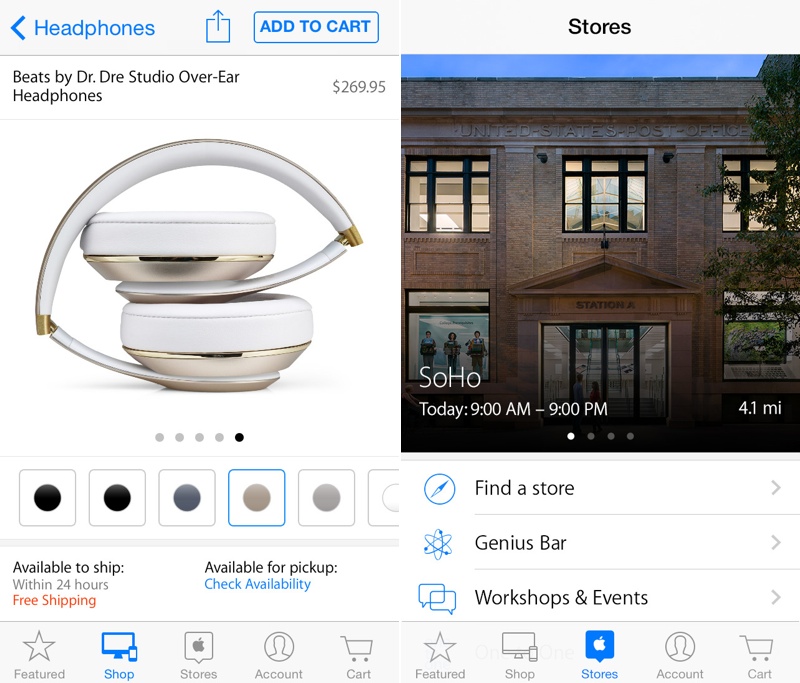
What’s New in Version 3.0
– Now start shopping on one device and finish on another, or even on your Mac or PC.
– Find out about upcoming events and workshops at nearby Apple Retail Stores using the new Stores tab on your iPhone.
– On iPhone and iPod touch, there’s an all-new design with more refined navigation and imagery.
– On iPad, you can now make One to One reservations.
The update to the Apple Store app comes just days before Apple’s upcoming iPhone 6 event and a few weeks before the iPhone 6 is expected to go on sale. Prior to this update, the Apple Store app was last given a minor update in March to add notification improvements. The app’s last major update came in late 2013, when the company released a version of the app for the iPad.
Apple’s newly updated Apple Store app can be downloaded from the App Store for free. [Direct Link]
Update: As the iPhone version of the Apple Store app is now universal, replacing the original Apple Store app for the iPad, users in countries outside of the U.S. are now able to install the app on their iPads. Previously, the Apple Store app for the iPad was limited to U.S. customers.
.CPlase_panel display:none;
Get an Inside Look at Apple’s Early Field Failure Analysis Program Ahead of the iPhone 6 Launch [iOS Blog]
Ahead of the iPhone 6′s launch, Adam Satariano of BloombergBusinessweek has shared some details on Apple’s early field failure analysis (EFFA) program, designed to solve potential iPhone issues quickly and efficiently. The EFFA Program, which is run by Apple’s AppleCare team, has been in place since the late 1990s.
As outlined by Satariano, shortly after any iPhone release, the EFFA program sees couriers shuttling defective units received from returns to a testing room in Cupertino, where they are inspected by iPhone engineers in an attempt to fix problems in a timely manner. As soon as a fix is in place, it’s deployed across the company’s global supply chain.

“They take them apart to diagnose what’s happening right then and there,” says Mark Wilhelm, who helped lead Apple’s returns program. […]
Often, they jury-rig a hardware fix, then coordinate a solution across Apple’s global supply chain. Sometimes the problems can’t be solved quickly–remember Apple Maps leading people astray. “Every day they don’t recognize a problem, they are potentially manufacturing more bad products,” says Michael Fawkes, the former head of supply chain for Hewlett-Packard (HPQ).
With the EFFA program, engineers in Cupertino learn of a potential problem as soon as a return is made in a retail store, and the serial numbers of each device allow the company to track defective devices down to “individual workers on an assembly line.”
An example of EFFA in action came in 2007, with the release of the original iPhone. Several devices returned with a faulty touchscreen caused by an earpiece flaw that let in a user’s sweat. Apple engineers fixed the problem with a new coating, which rolled out to assembly lines shortly after and prevented a more widespread issue.
According to former employees, EFFA testing is most crucial during the weeks after a device first launches, but the team remains active for many months, and publishes a weekly report highlighting common issues reported by customers. Apple’s EFFA team will be called to action in just a few short weeks, as Apple is expected to introduce the iPhone 6 at a media event on September 9, with a launch coming shortly after.
For additional details on EFFA, make sure to check out Satarino’s full piece over at BloombergBusinessweek.
.CPlase_panel display:none;
Apple’s Digital Stores, iTunes Radio Down for Some Users [Update: Fixed] [Mac Blog]
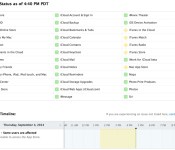
According to Apple’s System Status Page, some users are unable to access the App Store, iTunes Store, Mac App Store, and iBooks Store. iTunes Match, iTunes Radio, and iTunes in the Cloud also appear to be experiencing issues.
App Store users were also seeing problems accessing apps on Tuesday, making this the second outage the sore has seen this week. Problems appear to have began at approximately 1:30 PM Pacific Time, and are ongoing.
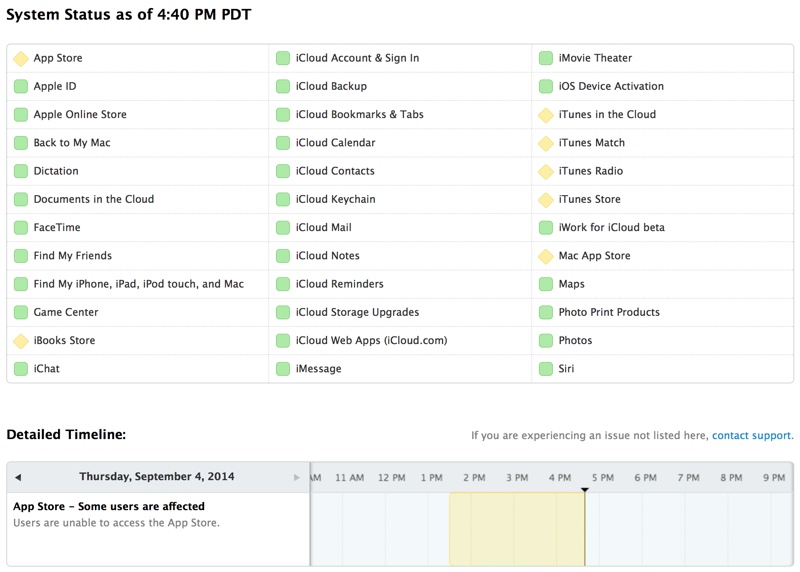
Apple does not say how many users are affected by the outage, but there are multiple reports of problems on Twitter and other social networking sites. Some users are not experiencing any issues, however, and appear to be able to access all services without a problem.
Update 5:40 PM PT: Apple’s System Status page suggests the outage is now over.
.CPlase_panel display:none;

Tim Cook: Apple to Add Security Alerts for iCloud Users, Broaden Two-Factor Authentication
 Apple will add security alerts for iCloud users, broaden two-factor authentication and make a more aggressive effort to alert users about protecting their accounts, Apple CEO Tim Cook told the Wall Street Journal in his first interview since the recent hacking incident involving celebrities’ iCloud accounts.
To make such leaks less likely, Mr. Cook said Apple will alert users via email and push notifications when someone tries to change an account password, restore iCloud data to a new device, or when a device logs into an account for the first time. Until now, users got an email when someone tried to change a password or log in for the first time from an unknown Apple device; there were no notifications for or restoring iCloud data.
Cook said the new notifications will begin in two weeks and will allow users to take action on potential hacking immediately, allowing them to either change the password to retake the account or alerting Apple’s security team. Cook echoed Apple’s previous press release on the hackings, stressing that the best prevention for future incidents are more human than technological.
“When I step back from this terrible scenario that happened and say what more could we have done, I think about the awareness piece,” he said. “I think we have a responsibility to ratchet that up. That’s not really an engineering thing.”
Apple will also broaden use of its two-factor authentication system, allowing it to also cover access to iCloud accounts from mobile devices like iPad and iPhone. Cook said the majority of Apple’s users don’t use two-factor authentication, so the company is planning on aggressively getting its users to turn on the feature. Cook also mentioned that had the celebrities been using two-factor verification, the hackers would not have been able to guess their security questions.
Apple has previously explored expanding two-factor authentication to some iCloud services, but an official expansion of the feature had not yet been introduced.
.CPlase_panel display:none;
NYT: the new, larger iPhones will feature a one-hand mode

Now that we’re nearing Apple’s September 9th reveal, more and more details about the event are starting to leak out. According to The New York Times, the new and bigger iPhones will have a one-handed mode that can be toggled on or off to make their large screens easier to use. The new phones (and yes, there might be more than one) will reportedly come in 4.7-inch and 5.5-inch variants, you see, and both are a lot larger than the current model’s 4-inch screens. While we’ve yet to find out what the mode can do, it could very well be similar to comparable features in large Android devices.
The 5.7-inch Samsung Galaxy Note 3 and the 5.9-inch LG G Pro 2, for instance, come with shrinkable interfaces so you can reach apps and everything else more easily with your fingers. Huawei’s Ascend Mate, on the other hand, lets you shrink its keyboard and dial pad. Aside from that, the NYT also reports that the company’s upcoming wearable, the iWatch, will be equipped with a circuit board the size of a postage stamp loaded with sensors and chips. Despite its size, it’s apparently so powerful that it can detect heart rates and other vital signs more readily and accurately than other wearables, which can do the same. Both these details haven’t been verified by Apple, of course, but you only need to wait a few more days to know if they’re true anyway.
Filed under: Cellphones, Wearables, Mobile, Apple
Source: The New York Times
.CPlase_panel display:none;

Tim Cook says new security alerts for Apple’s iCloud are coming soon

Although Apple’s initial response to a recent release of stolen celebrity photos stated that its iCloud and Find My iPhone systems had not been breached, now CEO Tim Cook is talking about how to beef up its security. In an interview with the Wall Street Journal, Cook said that several changes are coming very soon, with email and push notifications to alert users any time someone tries to change their iCloud password, restore data to a new device or add a new device to an account. When the notifications pop up, users can respond by changing their password or alerting Apple to a possible breach. Those changes are due in two weeks, however Cook reaffirmed that criminals gained access to victim’s accounts by using phishing scams to get their IDs and passwords, or answering their security questions. In response, Apple is also going to start pushing two-factor authentication harder (which currently does not cover access to iCloud from a mobile device, but will after the release of iOS 8), and Cook said its aim will be to increase “awareness” of hackers, and using security measures like strong passwords — we’ll see if there are any other security changes revealed during next week’s new iPhone event.
Filed under: Cellphones, Internet, Mobile, Apple
Source: Wall Street Journal
.CPlase_panel display:none;

Apple supplier tagged with another round of labor violations

Apple’s gearing up for a very big day next week, but it to the people inside it must seem like this one will never end. First the company was implicated in perhaps the biggest celebrity leak of all time, and now it’s getting wrapped up in another round of alleged labor violations thanks to one of its China-based suppliers. A report released by China Labor Watch and the environmental watchdogs at Green America maintains that some workers at a Catcher Technology factory in Suqian that produces aluminum cases for Apple products were found putting in crazy overtime hours (up to 100 hours a month in some cases) and used toxic chemicals without without being safety trained.
All told, the report lists 22 labor violations ranging from sealed fire doors to dumping industrial chemicals into the sewer. The unfortunate kicker? China Labor Watch performed the same sort of investigation over a year ago — they found that the labor violations originally spotted at the Catcher factory had either persisted or gotten worse over time. To hear the two nonprofits tell the tale, these findings were culled from some 100 interviews with Catcher employees, along with the first-hand documentation from a special investigator — a worker who joined Catcher to see what was going on inside. Apple hasn’t stayed quiet on the matter, though: the company has planned a follow-up visit to the Catcher factory next month and reaffirmed its commitment to “safe and fair” working conditions for the employees powering its supply chain.
Filed under: Mobile
Via: Wall Street Journal
Source: GreenAmerica.org (PDF)
.CPlase_panel display:none;

