


iPhone 6 Component Costs Estimated to Begin at $200, Samsung Supplying Some A8 Chips
 As it routinely does for new devices, IHS iSuppli has taken apart the iPhone 6 and iPhone 6 Plus in an effort to estimate Apple’s costs for the components included in the new devices, sharing the results with Re/code. According to IHS iSuppli’s teardowns, parts and labor costs for the iPhone 6 are estimated to begin at $200 for the 16 GB iPhone 6 model, giving Apple a roughly 69 percent gross profit margin on the devices.
That number of course does not take into account an array of other costs, from research and development to software to marketing and distribution, but it does offer an interesting glimpse at what goes into an iPhone.
The margins are in line with more recent iPhone models but higher than the earliest ones. The gross margin on the iPhone 5, released in 2012, and the iPhone 5s, released last year, were about 69 percent, teardown studies at the time of their release showed. On the lower-priced iPhone 5c, also released in 2012, the gross margin was closer to 68 percent. By comparison, the gross margin on the very first iPhone, released in 2007, was closer to 55 percent.
Apple does earn slightly higher margins on higher-capacity iPhone 6 models, as the 128 GB of storage is estimated to cost $47 more than the base 16 GB storage while the device retails for $200 more.
The iPhone 6 Plus is also a higher-margin item for Apple, with IHS iSuppli estimating the device costs just $16 more to produce than the corresponding iPhone 6 models, with roughly half of that difference coming from the display and the remainder presumably related to the rear camera module with optical image stabilization, a larger battery, and other minor differences.
Another interesting observation from IHS iSuppli is that Samsung does indeed remain involved in production of the main A-series processor for the iPhone. Early teardowns had shown the iPhone 6 and 6 Plus using A8 chips manufactured by TSMC for the first time, but IHS iSuppli says TSMC is providing 60 percent of A8 chips while Samsung is handling the remaining 40 percent.
.CPlase_panel display:none;

Apple Opening Retail Store in Hanover, Germany on September 27 [Mac Blog]
Apple has announced on its official retail website (via Apfelpage.de, Google Translate) that it will be opening its new retail store in Hanover, Germany on Saturday, September 27 at 10 AM.

The announcement follows a prior report which stated that the store would open at some point in September after a year of work. Apple originally put up its traditional black barricades at the store in April 2013, however issues with physical defects, mold, and ventilation issues pushed back its grand opening.
The layout of the Hanover store is said to be similar to that of the Apple Store Opéra in Paris, France, which boasts a wide space and multiple floors for numerous products and services. The Hanover store will be Apple’s 14th location in Germany, joining stores in Berlin and Frankfurt among others.
.CPlase_panel display:none;

Apple’s App Store Usage Numbers Suggest 46% Adoption Rate for iOS 8
Roughly a week after its initial release, iOS 8 is now installed on 46% of devices connected to the App Store, according to the latest numbers posted on Apple’s App Store developer support page (via iClarified). The numbers also indicate that 49% of users are using iOS 7 while 5% of users are on older versions of iOS.

Earlier this month, Apple’s analytics indicated that 92% of devices connected to the App Store were using iOS 7, while 7% were using iOS 6 and 1% were on earlier versions of the mobile operating system. In December 2013, iOS 7 usage was at 74 percent, which jumped to 78 percent later that month. In late January, iOS 7 usage was at 80% and then scaled to 85% in March.
iOS 8 was released last Tuesday and brought several new features like Continuity, third-party keyboards, interactive notifications and more. However, a number of users have experienced a variety of problems with the operating system’s initial release, including irregular battery drain, slow Wi-Fi, app crashes, and more.
.CPlase_panel display:none;

Google Chrome plugs into iOS 8 app extensions

Enjoy how Chrome and other apps share data back and forth on Android? Now you can get that feeling on iOS, since Google has updated Chrome to take advantage of the app extensions supported by iOS 8. That doesn’t mean you’ll be able to install any of Chrome’s desktop extensions — it just means links can be shared directly to any other apps on your iDevice, as long as they also support the feature. The update is rocking “iOS 8 compatibility” but no tweaks for the extra size of the iPhone 6 family have appeared yet.
Filed under: Software, Mobile, Apple, Google
Source: Chrome (iTunes)
.CPlase_panel display:none;

Apple Debuts New Ads ‘Huge’ and ‘Cameras’ Starring Jimmy Fallon and Justin Timberlake
Apple today debuted two brand new ads called “Huge” and “Cameras”, focusing on the larger sizes of the iPhone 6 and iPhone 6 Plus and all of the new features of the highly praised new camera in both devices. Both ads once again feature Jimmy Fallon and Justin Timberlake having some banter.
The first ad, “Huge”, has Fallon and Timberlake talking about how big the new phones are. While Fallon points out “huge” new features like the Health app while Timberlake repeatedly points out how the phones are literally “huge”.
The second ad, “Cameras”, has the duo talking about the camera features like time lapse, 240 frames per second slow-motion video and image stabilization for video while using their voices to vocally represent what each app does.
The ads are the third and fourth in a new series of ads starring Fallon and Timberlake. Earlier today, Apple announced that the company sold 10 million iPhone 6 models over the weekend.
.CPlase_panel display:none;
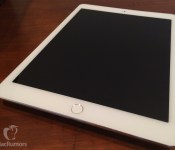
iPad Air 2 Rumored to Launch in October, Updated Retina iPad Mini May Come Later
Apple has plans to introduce the next-generation iPad Air in October, according to Taiwan’s Commercial Times [Google Translate]. The site says the updated tablet will enter production in September, shipping next month.
Commercial Times also suggests that the next-generation Retina iPad mini might not launch alongside the iPad Air, coming instead in early 2015, with the 12.9-inch iPad Pro to follow in the second quarter of 2015.
 Physical mockup of the second-generation iPad Air
While the rumor suggesting the 12.9-inch iPad Pro will be coming in the second quarter of 2015 is in line with previous rumors, there has been no prior indication that second-generation iPad Air and the next-generation Retina iPad mini will see separate launch timelines.
Previous rumors have indicated that both the Retina iPad mini and the iPad Air 2 will be introduced simultaneously at an event in October. Recently, a rumor suggested the two tablets could be introduced at an October 21 media event, but that prediction was quickly shot down by The Loop‘s Jim Dalrymple. Dalrymple did not, however, rule out an event at another date in October, so an October unveil of the two tablets remains likely. According to recent report from Bloomberg, the iPad Air 2 is in production and the Retina iPad mini 2 is entering production soon.
Both the next-generation iPad Air and Retina iPad mini are expected to gain updated A8 processors, camera improvements, and the Touch ID fingerprint sensor first introduced with the iPhone 5s. Apple’s iPad Air 2 may also gain an anti-reflective screen coating and it may also ship in gold, silver, and space gray, much like the iPhone.
.CPlase_panel display:none;
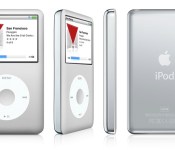
‘iPod Father’ Tony Fadell Comments on Discontinuation of iPod Classic [iOS Blog]
Tony Fadell, who formerly worked at Apple and is widely known as the “father” of the iPod, today commented on the recent discontinuation of the iPod Classic in an interview with Fast Company, saying that he’s “sad to see it go.”
“The iPod’s been a huge part of my life for the last decade. The team that worked on the iPod poured literally everything into making it what it was.” Eighteen months after launch, the iPod owned the portable media player category, and for the next decade, it continued to do so. “Products just don’t come around like that often,” laments Fadell. “The iPod was one-in-a-million.”
Though he’s sad to see the end of the iPod, Fadell notes that the product was “born to die,” with employees speculating in 2003 or 2004 what would kill the device. “Even back then, at Apple,” says Fadell, “we knew it was streaming. We called it the ‘celestial jukebox in the sky.’ And we have that now: music in the cloud.”

The final iPod classic was introduced in September of 2009, and rumors of a discontinuation of the product circulated for years before Apple retired the device in September of 2014. Following the announcements for the iPhone 6, 6 Plus, and the Apple Watch on September 9, Apple removed the iPod classic from its online store.
Apple’s iPod sales have been dwindling for the last several years, and in January, Tim Cook noted that the iPod was a “declining business” for Apple. As of Q3 2014, the iPod made up just one percent of Apple’s total revenue, being dwarfed many times over by the iPhone and iPad, both of which have adopted the iPod’s music playing capabilities.
.CPlase_panel display:none;
iOS 8 Users Seeing Issues With Battery Drain, Slow Wi-Fi
 Released last week, iOS 8 is Apple’s latest operating system update, bringing several new features like Continuity, third-party keyboards, Notification Center Widgets, and more. As with any new iOS update, users have been reporting several bugs in the operating system, with some of the more prevalent complaints pointing towards slow Wi-Fi speeds and problems with battery life.
As outlined by PCMag, iOS 8 users on the Apple support forums have been complaining about Wi-Fi problems in a thread that now spans multiple pages, an issue that was confirmed by the site’s own testing. It appears, based on complaints, that multiple devices may be affected by a Wi-Fi bug, including the iPhone 5s, the iPhone 6, the iPhone 6 Plus, the iPad Air, the Retina iPad mini, and more.
I also got an iPhone 6 on Friday, and noticed some sluggishness when connected to my home Wi-Fi network in New York. Twitter and Instagram photos took forever to appear, and opening a news story in Safari was hanging. I did a speed test using the Ookla app and got an abysmal 0.01 Mbps download and 1.05 Mbps upload. Minutes later, another test jumped up to 4.75 Mbps download and 0.24 upload, but a third test was again at 0.02 Mbps download and 0.76 upload.
Some users reportedly had luck fixing the problem by disabling Wi-Fi Networking under Privacy –> Location Services –> System Services.
Significant battery drain appears to be another complaint that’s popping up frequently on the Apple Support forums, with users complaining of their batteries draining much faster than usual. According to one user, his battery drained from 100 percent to zero in four hours with minimal usage, a complaint echoed by several other users.
While those seem to be some of the more prominent problems on the Apple forums, iOS 8 users are running into plenty of other bugs and issues with the software. On our own MacRumors forums, there’s an eleven page thread cataloguing complaints, which range from app crashes to the same battery issues Apple forum members are seeing, and a second thread where people are posting a list of bugs. There’s also a thread on people experiencing excessive battery drain and a thread on people seeing slow Wi-Fi speeds.
Apple already has plans for an iOS 8 update that’s coming in the near future, bringing support for Apple Pay and several features that are currently missing from the software, including SMS Relay. The update may also be used to fix some of the bugs that users are experiencing.
.CPlase_panel display:none;

TechCrunch: Apple plans to shutter Beats Music (update: service to continue, brand may change)

Whatever Apple has in the works for its future audio offerings, it may not include keeping Beats Music in app stores. TechCrunch reports that Apple plans to shut down the music streaming service, noting that CEO Ian Rogers has already been tasked with running iTunes Radio. The move wouldn’t be a huge shock as it makes sense for Tim Cook and Co. to bring new listening options under the iTunes umbrella rather than keeping Dr. Dre’s young moniker. It also goes to show that in addition to nabbing the hoards of faithful headphone wearers, Apple’s purchase was just as much about getting the talent behind the brand’s full line of products — including Dre and Jimmy Iovine — under its wing. I reached out to Beats for comment, and I’ll be sure to update if it offers any additional information. Of course, we’re interested to see how “the first subscription service that finally got it right,” according to Cook, will get molded into a new audio option.
Update: Well, Apple’s Tom Neumayr told Re/code that the TechCrunch report is simply not true. But that doesn’t mean there won’t be changes to Beats Music. The service may stay, but the Beats Music brand may disappear. And that makes perfect sense when the iTunes brand is already so strong.
Source: TechCrunch
.CPlase_panel display:none;
Apple Releases OS X Yosemite Mail Update for Developers and Public Beta Testers [Mac Blog]
Apple today released a new version of Mail for OS X Yosemite, fixing an issue that could prevent users from composing a message. The update is available to all developers with the Yosemite Developer Preview installed, as well as public beta testers.
The software can be downloaded through the software update function of the Mac App Store.

A new public beta version of Yosemite and Yosemite Developer Preview 8 were released last week, on Monday. The software is expected to continue on in its beta testing phase until late October, when it will be released to the public.
OS X Yosemite brings several new features to the operating system, including Continuity, which offers unprecedented integration between iOS and OS X. The operating system also includes a complete visual overhaul with a flatter iOS 7-style look.
.CPlase_panel display:none;

