


Apple Passes Nikon to Become Second Most Popular Camera Brand on Flickr
Flickr over the weekend released data detailing the most popular camera rankings of 2014 for the online photo sharing service. With 100 million users uploading 10 billion photos last year, the usual standouts of Canon and Nikon edged out most of the competition, but most interesting was Apple moving past Nikon to take second place in the rankings (via The Next Web).

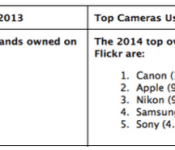
Focusing solely on the top 5 camera brands used on the service last year, Canon took first place with 13.4 percent, followed by Apple with 9.6 percent and Nikon with 9.3 percent. Samsung and Sony round out the other top spots.
Individual iPhone models have long registered as the most popular camera devices on Flickr, but in looking at overall brand performance, major traditional camera manufacturers Canon and Nikon with as many as several hundred different models on the market long held down the top spots until Apple’s entry in 2014.
Flickr also looked at the top mobile device cameras used on Flickr, where Apple unsurprisingly dominated the top ten list. In first through fourth were the iPhone 5 (10.6 percent), iPhone 4s (7.0 percent), iPhone 4 (4.3 percent), and the iPhone 5c (2.0 percent). The iPhone 6, iPad, and iPad mini also placed in the top ten. It is unclear why the iPhone 5s is not included on Flickr’s year-end lists, as it has been registering as the most popular camera overall for a number of months now.

Though Flickr’s data can’t exactly be used to specifically track the rise or fall of full-fledged DSLR and professional cameras, as Flickr is used by both paid professionals and everyday amateurs, it’s still interesting to see Apple’s own hardware slowly edge out such big brands in the photography space.
Apple processor order for smartwatches appears to be with Samsung

There is certainly no love lost between Apple and Samsung after years of contentious courtroom battles. In a sign of how severe the dislike between the companies was, at one point Apple decided to seek other manufacturers of processor chips for their mobile devices instead of continuing with one of the biggest suppliers on the block, Samsung. Despite that enmity, which has been cooling recently, business is business. In this case, Apple is trying to get a smartwatch out to market and that means they need chips for the devices. A new report indicates Apple has decided to utilize Samsung as the supplier for their forthcoming wearable.
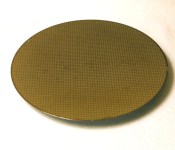
The processor will be one part of Apple’s S1 system-in-package (SiP) which includes DRAM, NAND flash, the processor and some other peripheral chips. To supply the processor piece, Samsung will reportedly produce 3,000 to 4,000 12-inch wafers each month.
Analysts have already started the march to revise forecasts of Apple smartwatch sales downward for 2015. The wisdom seems to be the initial product may only sell 10 million units in 2015 while many consumers wait for the second generation smartwatch product from Apple to be announced. Although Samsung apparently has succeeded in winning the order for this round of Apple wearables, Taiwan Semiconductor Manufacturing Company (TSMC) is bidding heavily againt Samsung to win the contract for the next generation of the device. TSMC is the company that Apple shifted to as a supplier to replace the Samsung A8 chips in their other mobile devices.
source: Digitimes
Come comment on this article: Apple processor order for smartwatches appears to be with Samsung

Siri Control of HomeKit Devices While On the Go Requires Apple TV as Hub
 One of the major focuses at CES this year was home automation, with a number of vendors announcing their plans for devices integrating with Apple’s new HomeKit ecosystem. One of the key features of these HomeKit devices has been the ability to control them from iOS devices via Siri, allowing users to turn lights on or off, close garage doors, and more with just their voices.
As noted by The Verge, however, users hoping to accomplish such tasks while away from home will need to have an Apple TV on their home network to serve as the hub for these devices.
So, while commands like “Siri, turn off the lights in the living room” will always work while connected to your home Wi-Fi network, they won’t from the airport unless you have an Apple TV. But that’s it — you can still switch off the lights with an app, no Apple TV required. This behavior has been confirmed by a source close to HomeKit’s development as well as two launch partners who wish to remain anonymous. Only third-generation or later Apple TVs running software 7.0 or later will support HomeKit.
Apple has quietly included HomeKit in the Apple TV’s software, but The Verge notes Apple will not be marketing the set-top box specifically as a home automation hub.
Many of the home automation vendors have been fairly vague about launch plans for their devices, and sources indicate that uncertainty is due in large part to the need to wait for Apple to finish polishing its HomeKit tools to ensure proper functionality. With HomeKit-enabled chips only recently beginning to ship to vendors and Apple’s vendor licensing program still getting underway, most of these companies still have a few hurdles to cross before they can make their products available for sale.

A detailed examination of the Selfie Brush (iPhone 6 edition)

Historically, if you wanted someone to know what you looked like after you’d died, you hired a portrait artists to work for weeks recreating your face in agonizing detail. With the advent of video conferencing, however, the forward-facing camera went from technological oddity to vital necessity. It wouldn’t be long afterward that people rediscovered the art of self-portraiture with a more immediate result. When Instagram launched, it enabled everyone on the planet to instantly show the world how good their ass looked. It was only natural, therefore, that someone would fuse the worlds of self-portraiture and personal grooming to form the Selfie Brush.
Hardware

This is actually the second generation of JD Beauty Group’s styling device-cum-smartphone case, which has been widened to accommodate both the iPhone 6 and Galaxy S4. Unfortunately, a compromise had to be made with these larger devices, so the strip of reflective plastic that was found on the iPhone 5/S version has been abandoned. Thankfully, the shift has enabled the price to come down a little, and the Selfie Brush can now be picked up for as little as $14.99 online.
Set the hardware down on a table and you’ll see a rigid silicone paddle brush that falls down to a fancy handle with a hole in the middle for attaching a strap. Looking at the top end, you’ll see a wide slot that’s around 2.65-inches wide, where you’ll slot in your smartphone. There are also access holes cut into both sides of the body for access to your device’s volume and display / power buttons.
Unfortunately, there is one build-quality issue that is readily apparent from our photographs. The bright pink outer coating is, unfortunately, susceptible to dye-run, which meant that when we dropped the brush into a cheap black tote bag, it came out with a significantly tarnished look. Otherwise, however, we had no problems with the otherwise solid hardware.
In use: as a brush

Each one of the 144 bristles (our review unit is missing one) is tipped with a soft pink dome, and using it to de-tangle my hair is easy and relaxing. In fact, an unstated feature of the Selfie Brush is that it’s almost as good as a stress relieving device as it is to rectify hair-based disasters. Unfortunately, it’s better designed for long hair, and what you gain in “broad brush” straightening you lose in the sort of pin point accuracy you normally find in a comb. Another unstated feature is that the solid construction would enable the brush to pull double duty as a spanking device for an impromptu BDSM party. We assume.
In use: as a smartphone case

The first thing that you’ll instantly notice when sliding your iPhone into the Selfie Brush is that the bristles instantly obscure the primary camera. It’s a high price to pay for this combination of style and self portraiture, and each prospective buyer will have to weigh this compromise up for themselves. That said, since it’s called the Selfie Brush, it does force you to insert yourself into every image you take: which, you have to agree, is kinda the point. Oh, one other issue is that there is a warning on the underside of the case informing you that you should remove your smartphone before brushing wet hair. Which does undermine the point of using it somewhat.
If you use a purse or bag to transport your smartphone from place to place, then you’ll not have any issue with using this as a case. If you, like me, normally keep your smartphone in your pocket, then you will notice a small drop in portability and, without wanting to resort to hyperbole, is a tad uncomfortable.
Performance and battery life

The Selfie Brush is a solid object, which means that it has an infinite battery life, vulnerable only to time’s endless march.
The competition
There are no other products like this on the market, in fact, I’m not sure about anything any more. Will you be my friend? I’m in here on my own and it’s starting to get dark.
Wrap-up

To be a little personal for a moment, I do find the excessive gendering of the Selfie Stick to be something of a concern. After all, in the same way that the technology industry should be looking to eradicate booth babes, it should also stop assuming that women like devices that are pink. As for if you should make a splash and buy a Selfie Brush, it all comes down to personal preference. After all, if you struggle with your hair and also own a smartphone, this seems like a slam dunk. Still, for $14.99, it’s not as if you’ll break the bank trying one out.
Photography by Nicole Lee.
Filed under: Cellphones, Peripherals, Apple
Source: Selfie Brush
The original iPhone was announced eight years ago today, something everyone should be thankful for
History was made when the original iPhone was announced eight years ago. When Steve Jobs took the stage in his patented garb that fateful day in 2007 to announce the iPhone, he couldn’t have known the effect it would have on the smartphone market, spawning a battle between iOS and Android that has yet to see […]
The post The original iPhone was announced eight years ago today, something everyone should be thankful for appeared first on AndroidSPIN.
Buyer’s Guide: Deals on Retina iMac, Older iPads, Apps, and Apple Accessories [Mac Blog]
With the holidays firmly in the rear view mirror, January deals are a bit sparse, but there are still a few discounts to be had on previous-generation iPads, the Retina iMac, the Retina MacBook Pro, and a handful of Apple-related accessories.
iMac
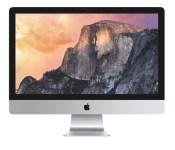
Apple’s 27-inch 3.5GHz/8GB/1TB Retina iMac is available for $2,299 from Adorama, which is $200 off the standard price from Apple.

iPads
We don’t recommend buying an iPad Air 2 or Retina iPad mini 3 this week because there are no sales going on, but Best Buy is still offering now-discontinued higher-capacity Cellular versions of the iPad Air and the iPad mini 2 at discounted prices up to $130 off the standard price.
– iPad Air Cellular Silver 64GB (AT&T) – $499.99
– iPad Air Cellular Space Gray 64GB (AT&T) – $499.99
– iPad Air Cellular Silver 128GB (AT&T) – $599.99
– iPad Air Cellular Space Gray 128GB (AT&T) – $599.99

– iPad mini 2 Cellular Silver 64GB (AT&T) – $399.99
– iPad mini 2 Cellular Space Gray 64GB (AT&T) – $399.99
– iPad mini 2 Cellular Space Gray 128GB (AT&T) – $499.99
– iPad mini 2 Cellular Silver 128GB (AT&T) – $499.99
Retina MacBook Pro
– 13-inch 2.6GHz/8GB/128GB (Adorama) – $1,149, $150 off
– 13-inch 2.6GHz/8GB/256GB (Adorama) (B&H Photo) – $1,399, $100 off

Apps
Apple’s free app of the week is MUJO, a match three puzzler that our sister site TouchArcade gave four stars and called “pretty fun.” It’s certainly worth a download. [Direct Link]
The SuperSlo slow motion camera app is also available for free for a limited time, down from its original price of $1.99, [Direct Link] as is endless runner Line Runner 2 [Direct Link].
Nuance’s Dragon Dictate 4.0 for Mac is available for $80 from Amazon, down from $200. Both boxed versions and digital downloads are available at that price.
Apple Accessories
Groupon is offering a refurbished Jawbone UP24 for $69.99, down from the original price of $99. Groupon is also offering the LG Bluetooth Docking Speaker with Lightning Connector for $99, down from $179.

Apple’s standard Lightning cable is available for $9.99, down from $19, from Living Social. StackSocial is selling the Quirky Apple Accessory Bundle for $36, regularly $49. It includes a cord manager, a flexible power strip, two charger cord wraps, and an earphone wrap. Best Buy has the Beats Solo 2 ear headphones for $20 off, dropping the price to $179.99.

Minor iOS 8.1.3 Update Likely Coming Next Week
In mid-December, we reported that Apple was working on a minor iOS 8.1.3 update as developers test iOS 8.2, and it appears that the iOS 8.1.3 update could be close to seeing a public release.
According to BGR‘s sources, Apple is planning on debuting an iOS 8 software update “sometime in the next week” and while the site cannot confirm whether it’s a new beta or a public release, our own data suggests the upcoming update is most likely iOS 8.1.3.
Over the course of the past week, MacRumors has seen an increase in visits from devices on Apple’s networks that identify themselves as running iOS 8.1.3, and as of yesterday, that number jumped significantly, suggesting a larger number of Apple employees are now testing the software ahead of a public launch.
The first hints of iOS 8.1.3 appeared on December 8 just ahead of the release of iOS 8.1.2, and while initial visit numbers were in the dozens for much of the month, we are now seeing hundreds of visits from devices that are running iOS 8.1.3.

Visitors to MacRumors.com via Apple’s networks from devices running iOS 8.1.3
We are also seeing a larger number of general devices (not specifically from Apple-based networks) running iOS 8.1.3 and while there are likely some faked identifiers in the general pool of web visitors, an increased number of visits directly from Apple networks has historically hinted at Apple’s software development plans.

Overall visitors to MacRumors.com from devices running iOS 8.1.3
Like iOS 8.1.2, which fixed a ringtone issue along with other bugs, iOS 8.1.3 is expected to be a minor update that bundles in small bug fixes and performance improvements. As with the previous release, iOS 8.1.3 is likely to be launched to the public without a beta test.
iOS 8’s next major update is iOS 8.2 with the WatchKit SDK, which was seeded to developers in November. As an update that introduces significant system changes, iOS 8.2 will see an extended beta testing period before launching alongside the upcoming Apple Watch. It remains unknown when Apple plans to debut the Apple Watch, but recent rumors have hinted at a March launch.
Aside from iOS 8.1.3 and iOS 8.2, Apple employees also appear to be testing both iOS 8.3 and iOS 9, but visits from devices running those versions of iOS remain low.

Recent iPod Shuffle Shortages Due to Supplier Changes, Not Imminent Discontinuation
Earlier this week, it was observed that Apple’s retail stores were running short of iPod shuffle units, leading to speculation about whether the shortages were just a temporary blip in Apple’s supply chain management or if they were a sign of an impending discontinuation of the diminutive music player. The iPod shuffle’s only updates since September 2010 have been occasional changes to color options, opening the door to questions and speculation about the device’s fate.

According to Billboard, however, the iPod shuffle shortages are indeed just a temporary issue related to component supplies.
Rather than being discontinued, however, sources with knowledge of the situation tell Billboard that Apple is actually going thorough component supplier changes that have interrupted production of the Shuffle.
Apple declined to comment.
Supplies of the iPod shuffle remain tight, with Apple’s online stores generally quoting shipping estimates of 7-10 business days for all colors. Some of the company’s retail stores do have stock of some colors, but many others show the device as unavailable with Apple offering to have units shipped to the stores for customer pickup.
As the iPod market has declined with customers opting to use smartphones for their music needs, Apple’s investments in the family have declined and product cycles have lengthened. As a result, it is unclear what Apple’s longer-term plans are for the future of the iPod, particularly the iPod shuffle and iPod nano that are more limited in their capabilities than the iOS-based iPod touch.

App Store Prices Increase in Europe and Canada Amidst Product Price Hikes in Brazil
After sending out an email to developers earlier in the week detailing App Store price changes coming to a few territories, Apple has today raised the price of apps in all countries within the European Union, Norway, Russia, and Canada. The price increases are due to shifting currency exchange rates and tax increases in some countries.
The price of the least expensive paid apps in the App Store, which are priced at $0.99 in the United States, moved from £0.69 to £0.79 in the UK, €0.89 to €0.99 in EU countries, and $0.99 to $1.19 in Canada, with similar price increases hitting the likes of Norway and Russia. On the other hand, app prices in Iceland are seeing a cut from where they were earlier in the week.

Simultaneously, the company has raised the prices of its products in Brazil by an average of 10 percent, where they’re already the highest priced in the world. As reported by ZDNet, the 16 GB iPhone 5s jumped to R$ 2,500 ($938), a 13.6 percent increase from R$ 2,200 ($825). The iPhone 6 Plus saw a smaller 6.81 percent hike to R$ 4,700 ($1,763) from an original R$ 4,400 ($1,651).
Just last week Apple raised developer program prices in a number of countries, most notably Germany and the UK, so today’s app price hikes in these territories no doubt fall in line with the company keeping up with fluctuating currency values and foreign exchange rates.
Both changes come on the heels of Apple celebrating the App Store’s biggest sales day in history on New Year’s Day, along with a prosperous 2014 that saw total developer earnings hit $25 billion since the store’s opening.
California Judge Dismisses Notebook Logic Board Lawsuit Against Apple [Mac Blog]
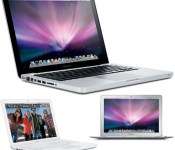
U.S. District Judge William Alsup this week dismissed a lawsuit filed against Apple over allegedly defective Apple notebooks, reports Reuters. Filed on behalf of Uriel Marcus and Benedict Verceles with class action status, the suit accused Apple of deliberately selling notebooks with logic boards the company knew were faulty.

The plaintiffs claim Apple in May 2010 stated selling defective MacBook, MacBook Pro, and MacBook Air notebooks with logic boards that failed within two years. Apple was accused of misrepresenting the faulty notebooks by advertising them as “state of the art” and the “most advanced” notebooks on the market. According to the suit, Tim Cook allegedly was made aware of the logic board issue in 2011 but did nothing to remedy the issue.
In his dismissal of the suit, Alsup said the plaintiffs failed to show that Apple’s notebooks were of a substandard quality, noting that both plaintiffs were able to use their computers for a reasonable amount of time.
“Plaintiffs have failed to allege that Apple’s logic boards were unfit for their ordinary purposes or lacked a minimal level of quality,” Alsup wrote. “Both plaintiffs were able to adequately use their computers for approximately 18 months and two years, respectively.”
Alsup also refuted the plaintiffs’ claim that Apple misrepresented its products. Following this dismissal, the plaintiffs have until January 22 to amend their lawsuit.
Apple is facing another MacBook-related lawsuit that accuses the company of selling MacBook Pro models with defective graphics cards. This second suit is the result of a growing number of consumer complaints citing screen glitches, GPU failures, and system crashes in Apple’s 2011 line of MacBook Pro notebooks.

