



New ‘SlatePro TechDesk SE’ Comes Equipped with Built-In iPhone Dock, Mac Air Vents and Whiteboard [iOS Blog]
Back in March of 2014, iSkelter launched the SlatePro TechDesk on Kickstarter, which was designed with built-in docks and cutouts to accommodate Apple devices like iPhones, iPads, and MacBooks.
The desk was highly successful, leading the company to create a range of furniture products aimed at MacBook and iPhone users, including the new SlatePro TechDesk Special Edition. The SlatePro TechDesk Special Edition is a new version of the original SlatePro desk, introducing an entirely revamped design and several additional features like felt pockets and a dry erase board.

Like the original SlatePro TechDesk, the new edition’s main attraction is its built-in air vents for keeping laptops or desktop computers cool and its cutouts that are able to house an iPhone and an iPad. Design wise, the Special Edition SlatePro takes on a more popular U-shape with steel legs and a hazelnut bamboo surface.

The filing rack has been replaced with a set of recessed felt trays able to hold accessories, pens, and more, and there’s now a stainless steel cupholder instead of the original wood. With the hazelnut bamboo and a new beveled edge, the updated version has a much sleeker look. Finally, there’s a large dry erase board built directly into the desk for taking notes.

When ordering a SlatePro, it can be customized with a variety of options. Users can choose a left or right setup, and opt to remove any of the available features like the ventilation holes, dry erase board, display docks, mousepad, or drink holder.
The SlatePro TechDesk Special Edition is currently on sale and can be purchased from the iSkelter website for $598. The original SlatePro TechDesk is available for purchase at prices starting at $498. iSkelter also produces a range of lap desks and device docks, with prices that start at $30.

Facebook’s ‘Paper’ App for iOS Updated With Photo Sharing Improvements [iOS Blog]
 Facebook today updated its Paper app to version 1.2.5, adding several improvements to the app’s photo management capabilities. It’s now possible for users to access their “Favorited” photos album on iOS for faster sharing of preferred photos, and the Camera Roll in the app organizes photos by date.
The “Favorites” album was introduced with the iOS 8 Photos app revamp and houses all of the images that a user favorites via tapping the heart icon on individual pictures within the app.
Today’s Paper update also includes performance enhancements that are designed to make various features within the app run faster, including photo uploads.
We’ve been working to perfect your experience with Paper. In this release, we’ve focused on making it even faster and easier for you to share photos, in addition to fixing a few issues you’ve let us know about. Thanks for your feedback!
Here’s what’s new and improved:
– Camera Roll organized by date. When selecting media to share in the composer, photos and videos are now organized by the date they were taken.
– Share your Favorited photos. Quickly share photos from the new Favorites album introduced with iOS 8.
– Faster performance. We’ve improved the responsiveness of several parts of Paper including posting a photo.
First introduced in January of 2014, Facebook’s Paper app is a news creation and curation tool that pulls in content from a user’s Facebook news feed and other well-known publications, organizing it into a magazine-style layout for easy reading. Many people have come to prefer Paper over the standard Facebook app to read through their news feeds.
Facebook’s Paper app can be downloaded from the App Store for free. [Direct Link]

FTC Levies $40M Fine Against TracFone for Throttling Unlimited Data Customers
 In recent months, the Federal Trade Commission has taken a significant interest in carrier throttling practices and today handed down a ruling that could have future ramifications for carriers who throttle their unlimited customers.
As reported by Re/code, the FTC has ordered prepaid wireless carrier TracFone to pay $40 million to consumers who paid for unlimited service and were then throttled after reaching certain data limits.
TracFone advertised “unlimited text, talk, and data” for $45 a month under the brands Straight Talk, Net10, Simple Mobile, and Telcel America, and until September 2013, did not clearly disclose its throttling policies that saw customers experiencing data speeds that were cut by up to 90 percent, thereby violating the FTC Act.
While this ruling only affects TracFone at the current time, there are several other carriers that have similar practices for their unlimited customers. AT&T and Verizon no longer offer unlimited data plans, but continue to provide unlimited data for many people who remain on grandfathered plans. AT&T has engaged in throttling practices for years, often cutting off customers who exceed 5GB of LTE data usage.
“The issue here is simple: when you promise consumers ‘unlimited,’ that means unlimited,” said Jessica Rich, director of the FTC’s Bureau of Consumer Protection. “This settlement means that Straight Talk, Net10, Simple Mobile, and Telcel America customers will be able to get money back from the company for services the company promised but didn’t deliver.”
Last year, Verizon planned to throttle its high-usage unlimited data LTE customers, sparking interest from FCC chairman Tom Wheeler, who said he was “deeply troubled” by the decision. Verizon ultimately reversed course and opted not to throttle its unlimited customers, but the FCC’s attention was already roused, and the agency began questioning all carriers on their unlimited throttling practices.
The government’s interest in carrier throttling practices led the FTC to file a federal complaint against AT&T in October of 2014, accusing the carrier of misleading its smartphone customers by charging them for unlimited data and then going on to reduce data speeds. Based on today’s TracFone decision, AT&T may also be facing hefty fines in the future, and the FTC’s ongoing interest in carrier throttling of unlimited customers could finally put an end to the practice.

Marissa Mayer Says Yahoo Would ‘Welcome the Opportunity’ to Become Default Safari Search Engine
 Yahoo chief executive Marissa Mayer, during the company’s quarterly earnings call on Tuesday, expressed interest in Yahoo becoming the default search engine in Safari. Mayer recognized the significance that getting Yahoo in front of Mac, iPhone and iPad could have for the search engine, referring to Apple’s default web browser as “one of the premier search deals in the world if not the premier search deal in the world.”
“The Safari platform is basically one of the premier search deals in the world if not the premier search deal in the world,” Mayer told RBC Capital Markets analyst Mark Mahaney. “We’re definitely in the search distribution business. I think that we’ve stated that really clearly in the past and I think with Mozilla and also in addition we brought Amazon eBay on board with smaller distribution partnerships in Q4.”
Google renewed its search partnership with Apple in 2010, although the contract is reportedly set to expire in 2015 and, supported by the fact that Google Maps and YouTube are no longer stock iOS apps, Apple is speculated to be considering a number of options. Back in November, it was reported that both Microsoft and Yahoo were courting Apple to become the default search engine in Safari.
“We’re in the search distribution business and anyone who is in that business needs to be interested in the Safari deal. The Safari users are among the most engaged and lucrative users in the world and it’s something we would really like to be able to provide.
We’ve worked really closely with Mozilla to ultimately bring to their users an experience that they designed and that they feel really suits those users and we would welcome the opportunity with any other partner to do the same, particularly one with Apple’s volume and user base.”
The New York Times, citing various reports from analysts, suggests that Google losing its Safari contract may not have much impact on the company’s bottom line. The two important factors involved are how much Google is paying for its Safari search engine deal, and how many users would simply switch back to Google if Apple switched to Yahoo or another search provider as default.
FCC Warns Hotels About Intentionally Blocking Wi-Fi Hotspots [iOS Blog]
The U.S. Federal Communications Commission on Tuesday issued a public enforcement advisory that warns hotel chains and other commercial establishments about intentionally blocking or interfering with Wi-Fi hotspots. The FCC’s Enforcement Bureau claims that interfering with Wi-Fi hotspots is illegal and that it will take appropriate action against violators by imposing substantial fines.

The warning follows an FCC investigation in which the government agency discovered a so-called “disturbing trend” where hotels and other commercial establishments were purposefully blocking wireless customers from connecting to their Wi-Fi hotspots. Marriott Hotels was found to have “deployed a Wi-Fi deauthentication protocol” to block customers from accessing Wi-Fi and agreed to pay a $600,000 fine.
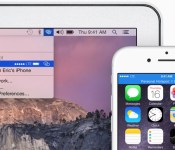
iPhone users have long resorted to Personal Hotspot to turn their cellular data connection into a Wi-Fi network for the purpose of tethering a Mac or other connected device. Apple made Personal Hotspot more convenient in iOS 8 with Instant Hotspot, a new feature that automatically detects when an iPhone is within close range of an iPad or Mac and displays the device in the list of available Wi-Fi networks.
iPod Shuffle Shipping Times Improve to 5-7 Days in Europe Following Reports of Supplier Change [iOS Blog]
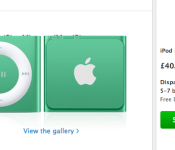
Earlier this month, the iPod shuffle’s shipping estimates slipped to 7-10 days in the United States, Europe and other regions, leading to speculation as to whether the portable media player would soon be discontinued or was going through reported supplier changes. Today, we are beginning to see a clearer picture.

For now, it appears that the iPod shuffle will continue to live on. iGen.fr was first to notice today that shipping times for the iPod shuffle have improved to 5-7 days on the Apple Online Store in the United Kingdom, France, Germany and some other European countries. The improved shipping times are not reflected in the United States or Canada storefronts yet, which still display shipping estimates of 7-10 days.
While demand for the iPod shuffle has been overshadowed by devices such as the iPhone and iPod touch, the portable media player remains a convenient and affordable option for incorporating into a daily workout routine or similar. The current fourth-generation iPod shuffle with front-facing media controls was introduced in 2010 and has not been updated since outside of a few color changes.
Twitter Updating iOS App With Group Messaging and New Video Features [iOS Blog]
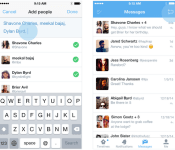
Following a soft update that added a recap feature for top tweets last week, Twitter today announced a substantial feature update to its iOS and Android mobile apps that includes two new additions to the service: group messaging and “a new mobile video experience.”
Similar to the Direct Message feature, Group Messages will allow multiple users to converse privately amongst one another in a group chat room. Most notably, however, users won’t need to already follow one another to be able to begin and engage in a Group Message conversation.

Private conversations on Twitter are a great complement to the largely public experience on the platform. You might prefer to read (or watch) Tweets but converse about them privately. You might want to continue a public conversation privately with a smaller group, or start one based on a Tweet you saw. Many of you use Direct Messages to reach the people and brands you’re only connected to on Twitter. Whatever the case may be, the ability to converse privately with groups gives you more options for how and with whom you communicate on Twitter.
The new video camera allows Twitter users to capture up to thirty seconds of footage and edit it in-app, with the ability to post videos as both tweets and into Group or Direct Messages. iOS owners will be able to upload a video from their camera roll, a feature which will roll out soon to Android users.

Twitter noted the features will be rolling out to all users in the coming days, but until available to a wide audience, users will be able to interact in Group Messages started by someone else and watch videos posted by others, as well.
Twitter can be downloaded from the App Store for free. [Direct Link]
Lockitron Introduces New $99 App-Enabled Smart Deadbolt Lock ‘Bolt’ [iOS Blog]
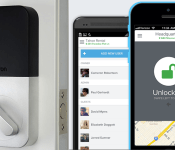
Lockitron today announced a new product in its lineup of smart keyless home locking system devices, the $99 Bolt. Lockitron previously entered the market a few years back with the somewhat rocky launch of an earlier smartphone-enabled deadbolt lock, and the company is now shifting gears to focus on Bolt.
The basics of the device allow users with the free-to-download app to unlock and lock their home deadbolts via Bluetooth Low Energy, meaning a user must be near the lock to interact with it, but the lock will keep working in event of a power outage.
As reported by TechCrunch, Lockitron co-founder Cameron Robertson assures customers the company has learned a lot from the problems faced with its last product. The team simplified component costs by sourcing high quality parts elsewhere, and subsequently got both the lock’s price and size reduced.

Bolt is smaller, more elegant and more robust than the crowdfunded Lockitron. It has a better battery life, more fault tolerant embedded architecture and includes Lockitron’s most popular features like sharing access, activity logging and Sense. Most importantly, however, Lockitron Bolt has been designed with mass manufacturing in mind from day one.
The Bolt also features sharing access to other smartphone users, activity logging to track when someone interacted with the lock, and “Sense,” which either automatically unlocks the Bolt when you walk up to the door, or prompts the user with an easy-to-confirm notification. Lockitron will also sell the Bolt Bridge, which connects the Bolt to the internet and acts as a middle man to send a Bluetooth signal via a user’s phone to the Bolt itself, meaning customers could unlock the deadbolt for someone else while away from home.
The new device replaces a deadbolt on a user’s door altogether, versus the original’s attempt at universality in fitting over an existing deadbolt. While the company’s aims were admirable, many users found difficulty in setting up and properly using the slotted-on device. Lockitron decided to look to learning thermostat Nest as an example of a product that requires a signifcant amount of setup but leaves its users with a far more agreeable experience upon completion.
“Basically, as long as we could break the setup down into 20 tiny, doable steps, it didn’t really matter that it required removing the old deadbolt,” Robertson told TechCrunch last week.
The Lockitron Bolt can be pre-ordered from the company’s official website. A Preview Edition, with a limit of 1,000 units, will begin shipping in March. A final consumer-ready edition is slated for “late Spring” and will arrive in a variety of finishes to match a user’s door.
Apple Predicted to Report Record-Breaking First Quarter on Strength of iPhone 6 and 6 Plus
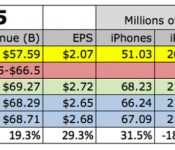
Apple is set to report its financial results this afternoon for Q1 2015, a three-month period spanning October through December that directly followed the launch of the highly-anticipated iPhone 6 and iPhone 6 Plus. Despite offering guidance of between $63.5 to $66.5 billion in total sales, many analysts are predicting that Apple outpaced those numbers in what could amount to a record-breaking quarter.
Fortune has averaged the estimates of 35 analysts, including 20 professionals and 15 amateurs, and determined that expectations are for Apple to report earnings of $2.68 per share, a nearly 30% year-over-year increase, and revenue of $68.7 billion, about a 20% increase from the year-ago quarter and $2.2 billion higher than Apple’s high-end forecast.

The first quarter has historically been the most lucrative for Apple, as the company typically launches new or refreshed products in the fall ahead of the busy holiday shopping season. Apple has posted record-breaking first quarter earnings results for over a decade, a span in which it announced several iconic products such as the iPod, iPhone, iPad, MacBook Pro and MacBook Air.
Analysts believe that Q1 2015 will be a home run for Apple on the strength of the iPhone 6 and iPhone 6 Plus. The larger screen sizes of the new smartphones were a major draw for many existing iPhone users looking to upgrade, and enough of a reason for some Android users to make the switch. Apple also launched a few other noteworthy products in the quarter, including the iMac with Retina 5K Display and new iPads.

MacRumors will be providing live coverage of Apple’s financial results as they are reported around 1:30 PM PT (4:30 PM ET), including the subsequent earnings conference call with CEO Tim Cook and CFO Luca Maestri at 2 PM PT (5 PM ET). At that time, we’ll have a clearer picture of just how well Apple managed to perform in the quarter.
Hands-On With the Reach79 Signal Boosting Case – Does It Work?
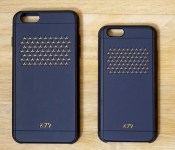
Earlier this month, we shared an iPhone case called the Reach79, which debuted at CES. The Reach79 case claimed to boost the signal strength and performance of the iPhone, improving battery life, reducing dropped calls, and improving download speeds, statements that were quite controversial in our forums.
Readers were understandably skeptical of the Reach79’s promise that it could deliver up to 2x stronger signal strength, so MacRumors decided to go hands-on with the Reach79 case to see if we could prove the company’s claims.
 We’ve been extensively testing the Reach79 case on an iPhone 6 Plus for more than a week in various areas around the San Francisco Bay Area, but after several days of use, it remains difficult to conclusively say that the case improves signal in a meaningful way due to mixed test results. For a quick summary of what we found, scroll down to the “Bottom Line” section, or read on for our full results.
Our Testing
We used the Reach79 case on an iPhone 6 Plus connected to the AT&T network on multiple days, at multiple times, and in multiple locations, both indoor and outdoor. The phone was put into Field Test mode so that signal strength could be viewed as a raw decibel number rather than as dots or “bars,” in order to better determine if and when the case was improving signal. All testing was done in the hand or up against the head, which is how the case is designed to work.
We also tested with the Ookla Mobile Speed Test app to see if the case improved data speeds, but we were told that this is not a particularly reliable testing method due to the many factors that can affect data transfer.
If there’s one word that sums up our testing, it’s inconsistent. At times, when the Reach79 case was placed on the iPhone, signal definitely improved as evidenced by the raw numbers and speed tests, but just as often, putting the case on did nothing to improve signal, or even seemed to degrade it somewhat.
Read more 

