


iOS Continues to Lead in Mobile Ad Revenue Despite Increasing Competition From Android [iOS Blog]
Apple continued to be the leader in mobile ad revenue by a significant margin in 2014, based on the latest insights from Opera Mediaworks (via TechCrunch). According to the report, iOS captured 51.67% of ad revenue and 27.18% of traffic during the fourth quarter to close out the year as the leader in dollars earned. Meanwhile, Android trailed in second in revenue with a 41.20% share despite generating an all-time high in ad impressions and commanding 62.69% of traffic among mobile operating systems.

Android may have expanded and taken the lead in traffic, but iOS retained its solid lead for revenue generation and monetization. Apple’s tenacious grip on revenue generation is driven to a large extent by its favorable market position in western markets, such as the United States, Germany and the United Kingdom. In these markets, rich media and video advertising are more common and the high volume of mobile application usage (vs. mobile browsing) drives a robust user acquisition market.
The mobile advertising market, much like the overall smartphone industry, is largely a two-horse race between iOS and Android. BlackBerry, Symbian and Windows each accounted for around 1% or less in traffic and revenue during the fourth quarter, while all other smaller mobile platforms grouped together held a 5.55% share of traffic and 5.89% share of revenue. Social networking, games, and music, video and media lead the way in traffic volume and revenue generation.

iOS 8.2 May Be Released in March, Ahead of April Apple Watch Launch
Apple’s next major iOS update, iOS 8.2, includes the WatchKit API and support for the Apple Watch, so it’s been widely assumed that the software will launch alongside the device. According to sources that spoke to BGR, iOS 8.2 may not be released at the same time as the Apple Watch after all, coming instead in March.
An unspecified March release date means the software could come just a week or so ahead of the Apple Watch, or over a month, depending on the specific launch date of the Apple Watch. Tim Cook recently confirmed the Apple Watch will be released in April, but he did not narrow down the month-long timeframe. It is not clear why Apple might choose to launch the update ahead of the Apple Watch, as it is heavily focused on the device aside from some bug fixes and other minor improvements to the iOS 8 software.
As we reported last week, Apple has been asking some high-profile developers to have their Apple Watch apps ready by mid-February, a request that could be related to a potential March software launch and accompanying event.

BGR has been fairly accurate with its iOS release date predictions. The site correctly determined several iOS 7 beta release dates, most notably targeting March of 2014 for the launch of iOS 7.1, which turned out to be accurate. The site has, however, been wrong on some occassions, like when it inaccurately predicted the launch of iOS 7 beta 6 and beta 7.
Apple has seeded five iOS 8.2 betas to developers thus far, and the most recent beta was released just yesterday. We’ve already been seeing hints of what the Apple Watch will be capable of thanks to developer efforts thus far, and Apple Watch sightings have been picking up as employees in Cupertino test the device ahead of its launch.
Report: Apple and Qualcomm orders to boost Samsung semiconductor earnings this year

Although Samsung may not be having the easiest time in the mobile market, 2015 is expected to be an excellent year for the company’s foundry (chip manufacturing) business. Industry sources are confident that Samsung’s 14nm FinFET technology will see exceptional demand this year.
Qualcomm, Apple and Nvidia are said to be looking to collaborate with big foundry players to quickly shrink down the size of their application processors, in the pursuit of additional energy efficiency for mobile products. We heard talk of similar deals with Apple and Qualcomm throughout 2014. While Samsung is not the only chip manufacturer in the mobile industry with smaller processes on the way, its 14nm FinFET manufacturing process is considerably further ahead than that of the competition.
“Samsung’s system semiconductor business is going to mass produce and supply chips to Apple, Qualcomm, and Nvidia starting in the second quarter of this year. As a result, the Korean tech giant is projected to exhibit stellar performance.” – Park Yu-ak, Meritz Securities
While TSMC is looking to make the move from 20nm to 16nm early this year, Samsung and Global Foundries already have a 14nm process in place, giving the company a notable lead. Furthermore, application processor manufacturers are expected to try and lower their costs this year, as prices for mobile processors have been falling lately. Without additional investment on the part of its rivals, Samsung is likely to retain this advantage.
Strategy Analytics estimates that Qualcomm shipped 40 percent of the global AP market last year, accounting for 50 percent of sales, with Apple accounting a further 16 percent of the market. If these two companies place large orders for 14nm chips from Samsung semiconductor, the business could end up producing processors in huge volumes this year.
Last year, Samsung’s semiconductor business generated KRW 10.66 trillion ($9.72 billion) in revenue and KRW 2.7 trillion ($2.46 billion) in profit, mostly from strong demand for memory modules and 20nm application processors. This profit has helped to somewhat offset its stalling mobile business, and a boost in AP revenue this year could go a long way to shoring up Samsung’s bank balance.

HTC Calls Out Apple and Samsung in New Rap Video ‘Hold the Crown’ [iOS Blog]
HTC last week published a video to its YouTube channel, HTCAmerica, which satirizes HTC’s biggest competitors – namely Apple and Samsung – with a song sung by rapper Greg Carr, known as “Doc G.”
The video, fully titled “Doc G’s HTC Anthem “Hold the Crown” w/ David Bruce,” centers around the rapper interacting with various people dressed up as smartphones from the various companies. Carr, known mainly for his time in the group P.M. Dawn, is joined for a majority of the video by HTC’s own David Bruce.
The song’s lyrics (via Engadget) include jokes about everything from Apple’s inferior performance and sound (“Your chip is slower, But you’ll never touch our BoomSound”) to Samsung’s “overrated” Galaxy (“More than a few clowns stole what we originated, We own the universe, your Galaxy is overrated”). It also includes general riffs on HTC’s most popular features like Extreme Power Saving Mode and references to HTC CEO Peter Chou.
The company also released an interview on the same YouTube channel in which Bruce questions Carr about various topics ranging from his time with HTC products to his thoughts on the competition. During it, the rapper states he’s been “a huge HTC supporter for years,” and believes HTC has “the best phones created.”

Hands-On With Olloclip’s New Telephoto/Polarizing and Macro 3-in-1 Lenses for iPhone 6 and 6 Plus [iOS Blog]
Following the October release of its redesigned “Selfie” 4-in1 Photo Lens for the iPhone 6 and 6 Plus, Olloclip is today introducing two new lens sets to expand the range of options available to iPhone photographers.
The new Macro 3-in-1 Lens offers three new magnification levels at 7x, 14x, and 21x, while the new Telephoto + Circular Polarizing Lens brings 2x magnification alongside a polarizing lens that minimizes reflections and reduces glare. MacRumors went hands-on with both of the new Olloclip sets over the weekend to give you a look at what kind of images the new accessories are capable of producing.

What’s in the Box
Like the 4-in-1 Lens for the iPhone 6 and 6 Plus, the two new Olloclip lenses come with a lens attachment that’s compatible with both the front and rear iPhone cameras.
The Telephoto + CPL accessory features a 2x telephoto lens attachment along with a polarizing lens that is detachable and compatible with other Olloclip lenses thanks to interchangeable filter mounts.
 Box contents of both lens sets combined.
The Macro 3-in-1 accessory comes with a 21x macro lens on one side, and a 7x/14x lens on the other side. Switching between magnifications is done by unscrewing the lens. There are also two lens hoods which serve as positioning guidelines to help you determine the optimum position for an in-focus macro shot.
Both lens sets come with three interchangeable carrying clips in green, blue, and black, lens caps, carrying pouches, a detachable wearable lanyard, and two removable inserts to adjust the fit to either the iPhone 6 or the iPhone 6 Plus.
Design
The lens accessories feature a reversible body made of a thick plastic that allows them to be fitted over the rear and front facing cameras of the iPhone 6 and 6 Plus, and the lenses themselves are made of high-quality aluminum and glass. As with all Olloclip photo accessories, the new lenses cannot be used with a case or a screen protector due to the tight fit, but Olloclip is working on a very nice iPhone 6 and 6 Plus case that we were able to check out at CES. It should be coming in the near future.
The lens sets are compatible with the iPhone 6 and the iPhone 6 Plus, with the different fit accounted for with plastic inserts. Each lens slides easily over the protruding rear-facing camera and locks into place. On the smaller iPhone 6, when the rear-facing camera is in place the opposite lens fits over the front camera, but with the larger iPhone 6 Plus, the lenses need to be tilted to the left when switching between the front and rear cameras.
Even though it’s necessary to slightly adjust the lenses on the iPhone 6 Plus, getting them on the phone is super quick and takes only seconds, which means you’re not likely to miss an important moment fumbling around to try to get the lenses attached. Read more 

Apple salvages its US job plans by turning a factory into a data center

Apple has long had dreams of bringing more manufacturing to the US, but the reality has been harsh at times — the Arizona sapphire plant it helped build went down the tubes last year after its key partner, GT Advanced, went bankrupt. However, the tech giant has at least managed to salvage something out of this messy situation. Apple tells Bloomberg that it’s converting the failed factory into a solar-powered “command center” for its worldwide networks. The effort will see it pour $2 billion into the facility (one of Apple’s biggest investments yet, the company claims) and create 150 direct jobs, not to mention 300 to 500 related positions in construction and support. It’s not clear when the data center will be ready, but GT has control of the place until the end of 2015.
The handover is good news if you were worried that the plant would languish. With that in mind, it’s apparent that this isn’t quite what Apple was envisioning when it gave GT Advanced a $578 million loan back in November 2013. Originally, the goals were to both create 2,000 jobs and add to an American manufacturing base that includes the Mac Pro factory and a screen glass plant in Kentucky, among others. While the command center undoubtedly helps soften the blow of a sapphire deal gone south, it’s not going to mollify critics who think Apple still leans too heavily on overseas production.
[Image credit: Justin Sullivan/Getty Images]
Filed under: Cellphones, Tablets, Wearables, Mobile, Apple
Source: Bloomberg
iPad Momentum Falls Flat as Tablet Market Experiences First Year-Over-Year Decline
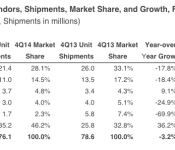
iPad sales slowed in the fourth quarter as the worldwide tablet market experienced its first year-over-year decline since being established in 2010, according to the latest numbers from market research firm IDC. Apple shipped 21.4 million iPads for 28.1% market share in the fourth quarter to maintain a comfortable lead over Samsung, which shipped 11 million tablets for 14.5% market share during the three-month period ending December.

The worldwide tablet market continues to be mainly a two-horse race between Apple and Samsung, with smaller competitors such as Lenovo, Asus and Amazon shipping just 3.7 million, 3 million and 1.7 million tablets respectively during the fourth quarter. IDC says that, despite a year-over-year decline, worldwide tablet shipments increased 4.4% to total 229.6 million units in 2014.
“The tablet market is still very top heavy in the sense that it relies mostly on Apple and Samsung to carry the market forward each year,” said Jitesh Ubrani, Senior Research Analyst, Worldwide Quarterly Tablet Tracker. “Although Apple expanded its iPad lineup by keeping around older models and offering a lower entry price point of $249, it still wasn’t enough to spur iPad sales given the excitement around the launch of the new iPhones. Meanwhile, Samsung’s struggles continued as low-cost vendors are quickly proving that mid- to high-priced Android tablets simply aren’t cut out for today’s tablet market.”
 Apple CEO Tim Cook and CFO Luca Maestri cautioned investors during last week’s earnings call that iPad sales are unlikely to see a dramatic year-over-year improvement in the near future. Nevertheless, Apple is optimistic about pushing the iPad further into the enterprise through its IBM deal announced last July and is also seeing first-time buyer rates for the iPad as high as 70% in emerging markets such as China.

FCC to Propose Regulating Internet Service as a Utility for Stronger Net Neutrality Rules
Federal Communications Commission (FCC) chairman Tom Wheeler plans to submit a proposal that would allow the agency to regulate Internet service much like a public utility, reports The New York Times and The Wall Street Journal. The move would let the FCC introduce strong rules that could prevent Internet providers from creating “fast lanes” letting certain sites pay for faster speeds.
It is expected that the proposal will reclassify high-speed Internet service as a telecommunications service, instead of an information service, under Title II of the Communications Act, according to industry analysts, lobbyists and former F.C.C. staff members.
Net neutrality, which is the principle that all data on the Internet should be treated equally, has been a major topic of discussion in recent months as the FCC in 2014 approved commercially reasonable “Open Internet” net neutrality rules that could potentially allow companies to pay for better service.
In November, President Obama urged the FCC to instead implement strong rules to protect net neutrality, following a four tenet path that would prevent ISPs from blocking or throttling Internet sites. Obama’s proposal also called for the prevention of paid prioritization, keeping companies from shelling out money for faster speeds, and it suggested greater transparency between ISPs and their customers.
More than any other invention of our time, the Internet has unlocked possibilities we could just barely imagine a generation ago. And here’s a big reason we’ve seen such incredible growth and innovation: Most Internet providers have treated Internet traffic equally. That’s a principle known as “net neutrality” — and it says that an entrepreneur’s fledgling company should have the same chance to succeed as established corporations, and that access to a high school student’s blog shouldn’t be unfairly slowed down to make way for advertisers with more money.
Obama’s call for stronger net neutrality rules caused FCC Chairman Tom Wheeler to reverse course from his original plan that did allow for paid prioritization, and he is said to be aiming to submit the new proposal to FCC commissioners on Thursday. Wheeler may, however, aim for a “light-touch approach” to the plan, avoiding meddling in pricing decisions. A vote on the proposal is expected on February 26.
Apple has been working on developing its own content delivery network and has been pursuing deals with various ISPs to ensure the efficent delivery of content to customers, but it’s possible these types of deals will no longer be allowed if the FCC’s newest proposal is implemented.
Note: Due to the political nature of the discussion regarding this topic, the discussion thread is located in our Politics, Religion, Social Issues forum. All forum members and site visitors are welcome to read and follow the thread, but posting is limited to forum members with at least 100 posts.

RadioShack May Close Half of its Retail Locations, Sell Other Half to Sprint [iOS Blog]
 The end may be near for RadioShack retail stores after a dire September warning that the company would not be able to finance operations “beyond the very near term” without a sale, investment, or company restructuring. According to Bloomberg, RadioShack may be planning to sell half of its stores to Sprint and close the other half in a move that would potentially see the termination of the RadioShack brand.
The locations sold to Sprint would operate under the wireless carrier’s name, meaning RadioShack would cease to exist as a stand-alone retailer, said the people, who declined to be identified because the talks aren’t public.
RadioShack was established in 1921 and flourished for many years, but in the early 2000s, the retail chain began seeing some decline in sales. In 2006, RadioShack closed 500 stores and laid off more than 400 employees in an effort to cut costs, but the brand has continued to struggle since that time as consumers have turned towards online retailers like Amazon and dedicated carrier stores from AT&T, Sprint, T-Mobile, Verizon, and more.
The company warned investors in September that it could be forced to file for bankruptcy protection, but RadioShack bankruptcy rumors have circulated since 2012, when RadioShack first began seeing major losses. A second consolidation was announced in 2013, with an additional 1,100 stores to be closed, but that move has since morphed into the liquidation plan to sell to Sprint or another company as RadioShack has continued to lose value over the course of the past year.
Terms are still being discussed between RadioShack and Sprint and Bloomberg warns that negotiations could break down or that plans could change. The two companies have discussed co-branding, and it’s still early enough in negotiations that another bidder could purchase RadioShack and keep the retail chain operational.

Apple to Build $2B ‘Global Command Center’ in Former GT Advanced Plant
Apple plans to take over the Mesa, Arizona factory where GT Advanced was formerly producing sapphire boules, transforming the facility into a massive $2 billion data center, reports CNBC. The data center will reportedly act as a “command center” for Apple’s global data network.

According to Arizona Governor Doug Ducey, the center will house 150 full-time Apple employees and its construction at the 1.3 million square foot facility will create 300 to 500 additional jobs.
BIG NEWS: #Apple making $2 billion investment in our state. First #SB49, now this. Arizona is open for business! http://t.co/pPunvL7Wjf.
— Doug Ducey (@dougducey) February 2, 2015
In a statement, Apple called the investment one of the largest it had ever made and pledged that the facility would run on 100 percent renewable energy like the company’s other data centers.
“This multibillion-dollar project is one of the largest investments we’ve ever made, and when completed it will add over 600 engineering and construction jobs to the more than one million jobs Apple has already created in the U.S. Like all Apple data centers, it will be powered by 100 percent renewable energy, much of which will come from a new local solar farm,” Apple said in a statement on the project.
After GT Advanced filed for bankruptcy and abandoned the Mesa, Arizona plant, there were questions about what Apple would do with the facility. GT Advanced’s closure caused a massive loss of jobs in the area, but Apple pledged to find a way to repurpose the location.

