



Tim Cook Speaking at Goldman Sachs Conference Today, Apple Providing Live Audio Stream
Apple CEO Tim Cook will be speaking at the annual Goldman Sachs Technology and Internet Conference this afternoon, beginning at 12:30 PM Pacific Time. While Cook was not present at last year’s conference, he has attended many times in the past.

Cook is not likely to make product announcements during today’s session, but previous conferences have seen him divulging details on Apple’s philosophies and business practices. In 2013, for example, he spoke about Apple’s cash usage, innovation, design choices, retail strategy, iPhone growth, and more.
Streaming audio of the Goldman Sachs conference will be available beginning at 12:30, and MacRumors will also provide highlights and coverage on what Cook has to share this year.

Tim Cook: Our Objective With Apple Watch is to Change the Way People Live Their Lives [iOS Blog]
Apple CEO Tim Cook spoke at the annual Goldman Sach’s Technology and Internet Conference today, where he covered a range of topics from Apple’s dedication to the environment, the major products the company launched in 2014, and his thoughts on the Apple Watch.
When asked by Goldman Sachs COO Gary Cohn what makes the Apple Watch different from other smart watches on the market, Cook recalled the MP3 industry.
If you think about the MP3 industry, we weren’t the first company to make an MP3 player, there were lots of companies in this. They weren’t used very much. They were fundamentally hard to use — the user interface was bad and you almost needed a PhD to use them. They’re not memorable. […]
I see the smart watch category very much like that. There are several things that are called smart watches, but I’m not sure you could name any. There hasn’t been one that changed the way people live their lives. At Apple, that’s our objective. We want to change the way you live your life.
Cook went on to say that he believes the Apple Watch will do just that, impact people’s lives in a meaningful way. He says that one of the major surprises will be the breadth of what the Apple Watch can do, and he expects that everyone will find something in the Apple Watch that they can’t live without.

Cook highlighted the many design options for the Apple Watch, its “fantastic” look, and the innovative ways of communication that it will enable. Cook says that he “constantly” uses Siri on his Apple Watch, and that he uses it when working out to measure activity.
He also pointed out the feature that pings people when they’ve been sitting for too long, which he sees in use on a daily basis at Apple. During meetings, he says, towards the end of the hour, people will begin standing up as their Apple Watch alerts them to do so. “A lot of doctors believe sitting is the new cancer,” he said. “Arguably, activity is good for all of us.” Cook says that he is “super excited” about third-party apps that are being developed for the Apple Watch.
I think everyone’s going to have their favorite thing, just like when the App Store came out. Remember the saying ‘there’s an app for that? There’s an enormous number of things it will do.
Earlier this month, Tim Cook confirmed that the Apple Watch is still on track to launch in early 2015, with shipments that will begin in the month of April. Pricing will start at $349 for the lower-end version of the device.

Apple to Open Massive $850M Solar Farm in Monterey, California [Mac Blog]
During today’s Goldman Sachs conference, Apple CEO Tim Cook announced that Apple is planning its “boldest, biggest, most ambitious project,” yet in the form of a 1,300 acre solar farm in Monterey County, California.
The solar farm, which puts out enough power for almost 60,000 California farms, will provide enough renewable energy for Apple’s new campus, every other office it has in California, all 52 stores in the state, and its data center in Newark, California. The solar farm is an $850 million project, which Cook says Apple is doing “because it’s right to do.”
 Image of Apple’s North Carolina solar farm courtesy of Gigaom
We know at Apple that climate change is real and our view is that the time for talk has passed and the time for action is now. We’ve shown that with what we do.
Though the solar farm good for the environment, Tim Cook also highlighted the fiscal impact of such a decision, explaining that there’s a significant price difference between the fixed price of renewable energy and the price of brown energy. “We’re thrilled to continue on the course of leaving the world better than we found it,” said Cook.
Apple has already built a series of large solar farms in North Carolina , but at $850m, the Monterey County solar farm will be its most ambitious project yet.

Apple CEO Tim Cook Speaking Live at 2015 Goldman Sachs Technology Conference
 Apple CEO Tim Cook is speaking at the Goldman Sachs Technology and Internet Conference today, with the session kicking off at 3:30 PM Eastern / 12:30 PM Pacific. Cook’s presentation is being broadcast on Apple’s website and MacRumors will be updating this post to summarize Cook’s comments.
Cook has spoken at the annual conference a number of times over the years, although he did not appear in 2014. While Cook has not made any major announcements at the venue in the past, he has at times offered an interesting perspective into Apple’s business, so it generally worth paying attention to his comments.
Cook will almost certainly be asked about Apple’s blockbuster iPhone sales and earnings in the last quarter, the company’s strategy for managing cash and capital return to investors, company philosophy and more, and he is generally fairly open and thoughtful in sharing his ideas on many topics. The company’s future product plans are not, however, something he has shown willing to discuss, maintaining a long tradition of secrecy for the company.
iMac Buyer’s Guide: Is the 5K iMac Right For You? [Mac Blog]
The new Retina iMac, also known as the iMac with 5K Retina display, came at a time when the iMac line needed an infusion of something new, something dramatic — after all, it’s difficult to get really excited about another speed bump. The last time Apple made a major change in the iMac was in late 2012, and that was when Apple shrank the iMac to 5mm at the edge, a change that was nice, but a thinner iMac wasn’t on most people’s wish list.
The Retina iMac is the change in the iMac lineup we’ve all been waiting for, but it’s not quite the computer for everyone — yet. This buyer’s guide, and the video below, take a look at what needs to be considered when deciding to buy the Retina iMac.
What is the iMac with 5K Retina display?
The Retina iMac looks like your typical iMac from the outside. The key difference is the screen; you’ll notice that it shows amazing detail, and images look crisper and cleaner on the Retina iMac than on a standard iMac.
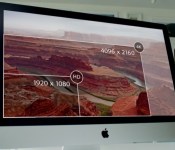
Apple calls a display “Retina” when a user, at a typical usage distance, can’t discern the individual pixels on the screen. The Retina iMac achieves this with a 5120-by-2880 pixel resolution. A standard 27-inch iMac has a resolution of 2560-by-1440. That’s a lot more pixels (four times, to be exact) on the Retina iMac.
 Screen resolutions compared with the Retina iMac
If you’re still trying to wrap your head around the enormity of the Retina iMac’s resolution, Apple provides a sample 5K image that you can look at on your Mac. The Retina iMac can show this complete image on its display.
In order for the iMac to handle so many pixels, Apple had to create a new timing controller. It’s currently found only in the Retina iMac — the Mac Pro doesn’t even have the graphics capability to handle 5K resolution (yet).
Who is the 5K iMac for?
The Retina iMac is $2499, out of the price range for many consumers. For most users, a 5K display is a luxury, not a necessity to be productive.
Content producers will benefit the most from a 5K display. There’s enough screen resolution for video editors working with 4K content to show video at actual size and still have room for app menus in the editing app. Photographers who work with large files will also benefit from the display, and designers will have the space to create and modify projects.
That being said, if you have the money, there’s nothing stopping you from buying a Retina iMac. Who wouldn’t want a display capable of such gorgeous graphics? And with so many pixels, you can fit more windows on the screen, so you many not need a second display.
It’s undoubtedly only a matter of time before Apple outfits the whole iMac line with Retina displays. Apple will eventually figure out how to reduce the costs to make such machines. Waiting to see if a more affordable Retina iMac is released isn’t a bad idea, especially if your current machine still meets your performance needs.
Specifications
The Retina iMac is not just the high-end iMac with a better display. The specs between the standard configuration $1999 iMac and the $2499 5K iMac are different in three major areas (besides the display).
At the heart of the Retina iMac is a 3.5GHz quad-core Intel Core i5 with Turbo Boost up to 3.9GHz. That’s slightly faster than the 3.4GHz quad-core Intel Core i5 with Turbo Boost up to 3.8GHz found in the $1999 iMac. For $250, you can customize the Retina iMac with a faster, 4GHz quad-core Intel Core i7 with Turbo Boost up to 4.4GHz.
Another major difference is the graphics card. The standard $1999 iMac has a 2GB Nvidia GeForce GTX 775M, while the Retina iMac has a 2GB AMD Radeon R9 M290X (and don’t forget the special timing controller). You can upgrade the graphics card in the Retina iMac to a 4GB AMD Radeon R9 M295X for $250.
The final major difference is the storage device. The older 27-inch $1999 iMac comes with 1TB hard drive standard, while the Retina iMac has a faster 1TB Fusion Drive. Apple offers Fusion Drive and flash storage upgrades for an additional fee.
All iMacs include 8GB of memory. The 27-inch iMacs, including the Retina model, allow the user to upgrade the memory. Apple supplies the 8GB as a pair of 4GB RAM modules, so you can add a couple of modules if you’d like later on after your purchase.

All iMacs include the following:
- Four USB 3 ports
- Two Thunderbolt ports (not Thunderbolt 2)
- Ethernet port
- SDXC card slot
- Headphone jack
Mac Pro vs. 5K iMac
Apple’s quad-core Mac Pro is $2,999 without a display. 5K displays aren’t in wide distribution yet; the only ones you’ll find are Apple’s iMac and Dell’s $2,500 UltraSharp 27 Ultra HD 5K Monitor, which you can’t use with the current Mac Pro. More 5K displays are coming (and it’s possible Apple will update the Mac Pro so it can drive a 5K display), but you can consider a 4K display, which range in price from $700 to $3,000. The Retina iMac doesn’t support target display mode, so you can’t get one, connect it to your Mac Pro, and use it as an external display.
A 5K display or a quality 4K display can cost as much or more than a standard configuration $2,499 Retina iMac, so it’s tempting to get the Retina iMac instead of the low-end quad-core Mac Pro.
Outside of price, there are software instances where you’re better off with a Retina iMac. If your daily usage involves productivity apps, Internet access, and even iLife apps, the Retina iMac is a better choice. It outperforms the quad-core Mac Pro (and even the six- and eight-core models) in single-core performance, according to GeekBench 3 benchmark results.

A Mac Pro is the better choice if you use pro apps like Final Cut Pro, Logic Pro, and Photoshop. These apps are designed to use multiple processing cores, and the Mac Pro excels in multi-core performance, according to GeekBench 3. The higher-end Retina iMac with a 4.0GHz processor does outperform the 4-core Mac Pro, however.

Many pro apps still need to be optimized for the Retina iMac, so keep that in mind. Retina iMac owners have found that UI elements may have some performance issues. For example, in his review of the Retina iMac, Jason Snell found that Logic Pro X had issues when scrolling through a timeline, but this has since been fixed in an update.
Should you buy a 5K iMac?
The Retina iMac offers top-notch performance with the best display Apple has ever made. If you own an iMac that’s more that four years old and you’ve been holding out for a game-changing upgrade, the Retina iMac fits the bill.
If you’ve bought an iMac within the past three years, you’re probably happy with the performance of your current machine. The Retina display is more of a luxury, unless you often use pro app — then you’ll be able to take advantage of the high resolution.
The Retina iMac is really targeted at pro users who are working in different forms of media and use apps that take advantage of multiple processing cores. Editors of high-resolution video will benefit from the Retina display, and even if you’re working in audio or lower-resolution video for the web, you may not need to rely on a second display as much as you do now — the Retina display gives you plenty of space to do your work.

New DisplayPort 1.4a Standard Points to 8K Notebook and All-in-One Desktop Displays in 2016
The Video Electronics Standard Association (VESA) yesterday announced a new Embedded DisplayPort Standard, version 1.4a, that the association claims “enables a higher video data transfer rate for increased panel resolution, greater color depth and higher refresh rates.”
Along with other upgrades, the new standard will be able to take advantage of more advanced GPU video performance and display technologies, meaning a wider range of computing devices – laptops and all-in-one PCs like the iMac in particular – will be able to produce 8K content sometime next year.

The new standard is for “embedded” panels with the ability to produce up to 8K quality display images, meaning eDP 1.4a won’t work with external displays. The current DisplayPort standard is 1.2a, with VESA having announced the next-generation 1.3 standard with 5K support last September.
Full support of DisplayPort 1.3 will, however, need to wait until Intel releases its next-generation Skylake chips late this year or early next year. Apple’s current 5K Retina iMac uses a custom solution to manage its 5120 x 2880 display, and 8K displays supported under the future 1.4a standard would come in at 7680 x 4320 pixels.
These higher-resolution displays at 8K should result a more power-hungry machine, but VESA claims its new Multi-SST Operation will support a Segmented Panel Display feature, bringing lighter, lower-cost display architecture to the new eDP standard. According to Vice President Bong-Hyun You of Samsung Display Co., Ltd., this new strategy can “reduce panel thickness, reduce power draw, and reduce cost.”
According to Craig Wiley, senior director of marketing at Parade Technologies, VESA board member, and editor for eDP 1.4a, “The adoption of eDP for embedded displays is now positioned for growth as eDP 1.4a has become highly optimized, especially at resolutions above quad HD. Compared to other embedded interfaces, it has the richest feature set along with the lowest power, wire count and EMI radiation, particularly when used with high-resolution panels. It will continue to evolve, along with DisplayPort, but with its own unique features specifically optimized for embedded applications such as all-in-one PCs, notebooks, tablets and smart phones.”
Currently, only select high-end television support 8K video playback, and the highest quality display Apple device is last year’s 27-inch iMac with Retina 5K Display. Though not much content even exists to truly take advantage of an 8K display at this time, VESA’s estimate of laptops, all-in-one PC’s, and other devices gaining the new standard in 2016 may give enough time for the new technology to grow.

Engadget giveaway: win an iPhone 6 and 5TB of cloud storage courtesy of MediaFire!

Finding enough space to house your worldly possessions in a place like New York City can be a bit pricey, but unlike a hulking vinyl collection, stashing digital files is more affordable than ever. MediaFire currently offers a free cloud storage option (15GB) and its Pro (1TB) and Business (up to 100TB) accounts are currently 50-percent off, making it a simple and affordable way to organize your digital self. Those files are readily accessible through the MediaFire website or its dedicated desktop and mobile apps. You get unlimited downloads as part of the service, too, so you can share files to your heart’s content. The company wants to get two lucky Engadget readers started right away, so it’s provided an iPhone 6 and a 5TB (for life!) MediaFire account for each of them. Plus, five additional winners will each get a Pro account with one full year of cloud storage. Just make your way to the Rafflecopter widget below for up to three chances at winning one of Apple’s latest and some online acreage for all your digital stuff.
- Entries are handled through the Rafflecopter widget above. Comments are no longer accepted as valid methods of entry. You may enter without any obligation to social media accounts, though we may offer them as opportunities for extra entries. Your email address is required so we can get in touch with you if you win, but it will not be given to third parties.
- Contest is open to all residents of the 50 States, the District of Columbia, and Canada (excluding Quebec), 18 or older! Sorry, we don’t make this rule (we hate excluding anyone), so direct your anger at our lawyers and contest laws if you have to be mad.
- Winners will be chosen randomly. Two (2) winners will each receive one (1) iPhone 6 (AT&T, MG4P2LL/A, Silver, 16GB) and a 5TB MediaFire cloud storage account for life. Five (5) additional winners will each receive a 1TB MediaFire Pro account for one year.
- If you are chosen, you will be notified by email. Winners must respond within three days of being contacted. If you do not respond within that period, another winner will be chosen. Make sure that the account you use to enter the contest includes your real name and a contact email or Facebook login. We do not track any of this information for marketing or third-party purposes.
- This unit is purely for promotional giveaway. MediaFire and Engadget / AOL are not held liable to honor warranties, exchanges or customer service.
- The full list of rules, in all its legalese glory, can be found here.
- Entries can be submitted until Feb 11th at 11:59PM ET. Good luck!
Filed under: Announcements, Apple
Next-Generation iPhone Said to Feature Upgraded Touch ID With Reduced Errors
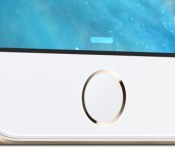
KGI Securities analyst Ming-Chi Kuo, who has provided reliable information about Apple’s upcoming product plans in the past, claims that Apple’s next-generation iPhone will feature an upgraded Touch ID module with reduced reading errors for an improved and safer Apple Pay experience. 
“We think the new iPhone,expected to launch in 3Q15, will be equipped with an upgraded Touch ID module, with which Apple (US) intends to offer a better and safer Apple Pay user experience with reduced reading errors. We therefore raise our 2015F shipments of Touch ID module by 12.4% to 262mn sets, boosted by Apple Pay and new iPhone models.”
Kuo wrote in a note to investors that he expects the next-generation iPhone to ship in the third quarter of 2015, lining up historically with past releases of iPhones in September. 

JetBlue to Become First Airline to Accept Apple Pay In-Flight
Passengers on select JetBlue Airways flights will be able to use Apple Pay to purchase things in-flight starting next week, according to USA Today. It will become the first airline to accept Apple Pay in-flight.

Starting next week, passengers on select JetBlue Airways flights can use Apple Pay on their iPhone 6 and 6 Plus handsets to buy food, drinks and certain onboard amenities when the plane reaches cruising altitude. You’ll be able to upgrade to available premium seats, too.
Eddy Cue, Apple’s VP for Internet software and services, told USA Today that “somebody else doing it always puts pressure on the other guy” and that other airlines could follow suit.
JetBlue’s flight attendants will have iPad minis outfitted with a special case that will accept both credit cards and Apple Pay. Starting next week, only intercontinental flights from JFK to Los Angeles and San Francisco will accept Apple Pay, with additional flights in March and plans for all JetBlue flights to accept the payment service in June. Like iPhone 6 and 6 Plus, the upcoming Apple Watch will also work with the system.
http://c.brightcove.com/services/viewer/federated_f9?isSlim=1
Cue notes that expanding Apple Pay into areas like travel is important. “Most people would prefer not to carry cash or worry about cash. There’s a lot of opportunity there,” Cue told USA Today. Apple would like to expand to subways and public transportation, but Cue said working with local governments and gaining funding for those initiatives moves slower than they would like. He says the eventual plan is to completely replace the wallet, and that Apple Pay is only the start.
Apple has continued to work with third parties to expand Apple Pay’s reach, most recently having ChowNow update nearly 700 food and restaurant apps with the payment service.

Tim Cook to Speak at White House Cybersecurity Summit [iOS Blog]
Apple CEO Tim Cook will speak at a White House cybersecurity summit on Friday at Stanford University, according to The Hill. The summit is another battleground in which tech companies and the government will discuss encryption.

The White House is expected to reveal its next executive action on cybersecurity at the summit, which will bring together tech executives, leading academics and government officials to discuss ways in which the government can better collaborate with the private sector on cybersecurity initiatives.
Cook and other technology executives have called for government surveillance reform, calling for limitations on government authority to collect users’ information, oversight and accountability, transparency about demands and more.
Meanwhile, the FBI has been in talks with companies like Google and Apple about their privacy features and have expressed concern that their encryption makes it difficult for investigators to infiltrate a kidnapper or terrorist’s device for information that could prevent crimes or attacks. One Department of Justice official told Apple that investigators’ inability to access their devices could lead to children dying.
FBI Assistant Director Joe Demarest Jr. and Secret Service Deputy Director A.T. Smith are two of the government officials who will give remarks on Friday.
Note: Due to the political nature of the discussion regarding this topic, the discussion thread is located in our Politics, Religion, Social Issues forum. All forum members and site visitors are welcome to read and follow the thread, but posting is limited to forum members with at least 100 posts.

