


Apple Showcases Final Cut Pro X Usage in Production of Hollywood Film ‘Focus’
Just a few days before the release of the Hollywood romantic comedy film Focus, starring Will Smith and Margot Robbie, Apple has provided a behind-the-scenes look at how Final Cut Pro X was used to produce the movie. The feature page provides an in-depth profile of how Final Cut Pro X was used for editing, screen-ready effects and post-production.

Focus directors John Requa and Glenn Ficarra opted to use Apple’s professional video editing software because they found it provided a fast and straightforward workflow. The software gave the directors fine-tuned control over all aspects of the film and provided the flexibility to easily move between editing on a Mac Pro and working with a MacBook Pro on location.
After researching several workflows, Requa and Ficarra decided to cut their major studio feature entirely in Final Cut Pro X. The results were even better than they’d expected. The movie came in on time and under budget, and it played and looked just as they’d envisioned it. “We got exactly the film we set out to make,” says Requa. “What I love about Final Cut Pro X is that it allowed me to be involved with, and in control of, every aspect of making our film.”
Final Cut Pro X was highly criticized by some professional video editors when it was released in 2011, but the directors of Focus told USA Today that they value how the software is easier to use and resembles the look of iMovie. These comments come amid criticism that Apple is dumbing down certain areas of OS X, including the removal of Aperture in favor of the all-new Photos for Mac app.
“Many editors called the new FCPX ‘iMovie Lite,’ when it was released, and not ready for the big leagues, but Ficarra says he likes that FCPX is easier to use, and that it’s look and feel is akin to iMovie. ‘We have a whole generation of kids learning on iMovie,’ he says. ‘They’ll be familiar with this tool when they get into the real world.’”

The film crew used Mac Pro-equipped on-set mobile post systems from a cutting-edge Los Angeles-based post-production company and used metadata markers to identify the best shots taken each day. Final Cut Pro X enabled this metadata to be searchable and handled full-resolution ProRes 4444 files with ease.
Ficarra believes that the metadata advantage gave them unprecedented control over their story line. “I was able to say, ‘I need Will’s side in this take,’” he says. “And because even his improvisations were specially tagged, we were able to filter and come out with it. The upshot was just infinite searchability. We could change direction so fast and do multiple iterations. Sometimes while we were editing we felt as if we were actually rewriting the movie.”
The full-length feature page on Apple’s website goes into further details about how Final Cut Pro X was used throughout all stages of the film’s production. The in-depth page also outlines other Apple products and third-party hardware used to make the film a reality, including the Mac Pro, iMac, MacBook Pro, iPad, iPhone, Logic Pro X, Motion 5, Xsan, Apogee Quartet, Quantel Pablo Rio system and more.
Final Cut Pro X is $299.99 on the Mac App Store [Direct Link].

Apple Expands Apple Watch Marketing Efforts With New Multi-Page Spread in Vogue Magazine
Apple appears to be gearing up for a big marketing push for the Apple Watch ahead of its April launch, featuring the device on several magazine covers. The Apple Watch made its U.S. magazine cover debut earlier this month in the March issue of Self, and it’s also being featured in a multi-page spread in the March issue of Vogue.

The Apple Watch is shown on multiple pages of the magazine, depicting different watch casings and band designs in clean ads that feature nothing but the Apple Watch itself. The images are actual size, giving readers an idea of how big the watch is in real life.

There’s a heavy focus on Apple Watch bands, several of which are depicted in close up images that show off details on their construction. The Milanese Loop is featured on one page, while the navy-colored Leather Loop is shown on another page. The Apple Watch sport with a green band is also shown, as is the fitness interface for one of the Apple Watch’s built-in fitness apps. Yet another page features the rose gold Apple Watch Edition with a Rose Gray Modern Buckle band.

It’s likely that several other publications beyond Self and Vogue will be featuring the Apple Watch in the coming weeks as the device’s April launch date approaches. Apple has targeted fashion and fitness markets thus far, and is expected to market the Apple Watch to a wide range of potential customers.
Up until this month, Apple’s Apple Watch marketing has been somewhat reserved, limited to an appearance at Parisian fashion boutique Colette in September and the Vogue China cover in October, but the company appears prepared to begin more serious marketing efforts.
As we reported last month, Apple asked some developers creating content for the Apple Watch to have their apps completed by mid-February, possibly to have apps ready to go for marketing purposes or an upcoming event. Apple also invited select developers to its Cupertino headquarters to put the finishing touches on Apple Watch apps and it may be gearing up for a series of Apple Watch popup stores in various locations around the world.

Podcasts Entering ‘Golden Age’ After Experiencing Surge in Growth [iOS Blog]
 The continued rise of smartphone and tablet adoption and the addition of Podcasts as a stock app on iOS 8 has resulted in significant growth for podcasts in the United States, reports Ad Age. Overall consumption of podcasts experienced 18% growth in the U.S. between Spring and Fall 2014 as Americans now listen to approximately 21.1 million hours of podcasts per day, according to Edison Research.
The resurgence of podcasts arrives around a decade after the audio format became established for iPod and iTunes, and the sudden rise in popularity has some podcast makers excited. “Creatively, we are entering a new golden age,” said Matthew Lieber, co-founder of the podcasting startup Gimlet Media. “In terms of the golden age of the business,” he added, “we’re just getting started.”
A direct beneficiary of the so-called “podcast renaissance” is Serial, a spin-off of This American Life that has amassed close to 72 million downloads since it started being aired last fall. Serial is based upon a Baltimore murder case in 1999, in which detectives arrest the ex-boyfriend of a high school senior that disappears after school one day. All twelve episodes are available through iTunes and on the Serial website for free.
While we may be entering the “golden age” of podcasts, the report finds that brand advertisers are still spending significantly less dollars on the medium than more traditional forms of media such as broadcast television, radio, newspapers and magazines. Advertising agency ZenithOptimedia reported last year that podcast ad spending growth would remain flat through at least the next two years.
Podcasting has been an advertising backwater. A ZenithOptimedia report from June 2014 — before “Serial” debuted — said podcast ad spending would remain at $34 million annually through 2016. That’s a small fraction of what marketers earmark for other media. Ad buyers and media executives say about 80% of the ads played during podcasts are direct-response, prompting listeners to visit a website or call a 1-800 number. Only 20% represents brand advertisers.
The rise in popularity of podcasts is attributed to several other factors, including the wider availability of connected cars that make in-car listening to podcasts much easier for daily commuters. New York Magazine noted last October that the renaissance of podcasting goes hand-in-hand with the improved quality of podcasts, as more content makers turn to the platform as a cheaper alternative over hosting a TV show or radio show.
Podcasts emerged around 2005 as episodic audio series that can span anywhere from a few minutes to several hours in length. Apple users with an iPhone, iPad, iPod, Mac or other device to listen with can subscribe to podcasts through iTunes to receive the latest podcasts. A wide range of podcasts are available in iTunes based on genres such as news, technology, fashion, food and restaurants, general talk shows, education and more.
Tim Cook Talks Apple Watch Water Resistance and European Apple Pay Expansion
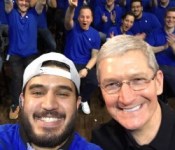
 While on a trip in Germany to visit with German Chancellor Angela Merkel and meet with a few German-based Apple staff members, Apple CEO Tim Cook told Apple Store employees in Berlin that he wears his Apple Watch constantly, “even in the shower”, according to iGen.fr [Google Translate].
The new piece of information from the Apple CEO could mean the company’s been working on adding more water resistant features to the upcoming wearable, since at its early-September reveal event the company warned off wearing the device in the shower.
Cook went on to say that he charges his Apple Watch every night, which seems to fall in line with what he’s said previously on the topic. But, as Apple Insider points out, some of his comments regarding the new information on the Apple Watch could have been lost in translation.
He also told a few of the Apple Store workers, specifically in fielding a question asked by a visually impaired employee, that apps and accessibility features focused on aiding the disabled would be coming to the watch over time. Cook even commented on a few recent bits of bad press the company has faced in regards to the working conditions at its Chinese facilities.
He said that Chinese workers want to work hard and their employers want them to always work more. Apple is trying to ensure that there is no abuse, and the number hours worked per week decreases with time. He said that wages in China are increasing much faster than anywhere in the world. While recalling that the cost of living is much lower there, compared for example to Germany or the United States.
Concerning the overseas launch of Apple Pay, which has been gaining steam in rumors lately, Cook stated that a European launch for the contactless payment service will come “before the end of the year.” Cook’s trip continues this week (via The Marker) [Google Translate], with the CEO moving on to Israel to visit the newly-built Apple offices in Herzliya and a planned meeting with former President Shimon Peres.

Apple Ordered to Pay $532.9 Million in iTunes-Related Patent Lawsuit
 A federal jury in Tyler, Texas has ordered Apple to pay $532.9 million to patent licensing firm Smartflash LLC for using its patents without permission, reports Bloomberg. The court found certain iTunes apps to be infringing upon the Texas-based company’s patents related to digital rights management, data storage and managing access through payment systems.
Apple argues that Smartflash is exploiting the patent system and plans to appeal the decision.
“Smartflash makes no products, has no employees, creates no jobs, has no U.S. presence, and is exploiting our patent system to seek royalties for technology Apple invented,” said Kristin Huguet, an Apple spokeswoman. “We refused to pay off this company for the ideas our employees spent years innovating and unfortunately we have been left with no choice but to take this fight up through the court system.”
Smartflash was originally seeking $852 million in damages from Apple for infringing three patents, claiming that it was entitled to a percentage of sales of Apple products used to access iTunes, such as iPhones, iPads and Macs. Apple believed that $4.5 million was fair at most, arguing that it was not infringing upon the inventions and that the patents were invalid. Developers Game Circus and KingsIsle Entertainment Inc. were also defendants in the case but were later dismissed from the lawsuit.
“Apple doesn’t respect Smartflash’s inventions,” the company’s lawyer, John Ward of Ward & Smith in Longview, Texas, told the jury. “Not a single witness could be bothered with reviewing the patent.”
Smartflash has also sued Samsung Electronics in a separate lawsuit that is scheduled to begin following the end of this Apple trial. The patent licensing firm also recently filed against Google, which has attempted to move its lawsuit to California, and Amazon in December. This case is Smartflash LLC v. Apple Inc., 13-447, in the U.S. District Court for the District of Texas.

Android snags 81% of the market in 2014 with over 1 billion units shipped
 With 2014 in the books, we’re finally getting the numbers to see how each manufacturer and OS did over the past year. The good news for Google and Apple (and bad news for the likes of Microsoft and BlackBerry) Android and iOS accounted for a whopping 96.3% of all smartphones shipped. That leaves a very small 3.7% for Windows Phone and everything else that’s competing for scraps.
When you break the numbers down between Android and iOS, though, Android came out a clear victor in the market share battle. Android devices accounted for 81.5% of all phones shipped, finally breaking the 1 billion mark for smartphones. Compared to those 1 billion Android smartphones, Apple shipped 192 million phones for 14.8% of the market.
In the Android camp, Samsung still pulled in the most market share among Android OEMs. Samsung actually shipped more than the next five vendors combined, which is a phenomenal amount of devices. However, growth year-over-year was nearly non-existent, while smaller manufacturers saw quite a bit of growth.
It’s nearly set in stone that Android is going to stay the top dog, at least when it comes to global market share. The next big battle will be between Samsung and everyone else in 2015.
source: IDC
Come comment on this article: Android snags 81% of the market in 2014 with over 1 billion units shipped

How Upcoming ‘Modern Family’ Episode Was Shot Entirely on iPhone and iPad Cameras [iOS Blog]
Last week, it was announced that the February 25 episode of Emmy-winning sitcom “Modern Family” would take place solely on a MacBook screen and only be shot with cameras from iPhones and iPads. BuzzFeed News got in touch with the episode’s director and series co-creator Steven Levitan to find out how they shot the episode.

In a video originally provided to BuzzFeed News, and now available for download on iTunes [Direct Link], Levitan explains that all of the iPhones were kept in holsters held by cameramen. To avoid making the shot look like it was being filmed by a floating device, the actors were told to hold their arm near the cameramen’s arm.
Initially, Levitan and the crew wanted the actors to hold the phone throughout film, but they found it wasn’t as east to control and that actors would misplace the devices as well as shoot off-set.
The episode took over three months to complete, with a lot of time dedicated to post production as the special effects team had to rebuild OS X Yosemite from the ground up, mimicking its animations and art style while also taking artistic license to make certain things better suited for the story they wanted to tell.
While the episode’s format isn’t the same as the standard “Modern Family” format, Levitan says there have been other instances during the show’s six year run where they’ve used iPhones to shoot certain scenes. For instance, instead of staging a basketball game for a scene where a character dresses as a mascot, Levitan shot his son’s basketball game on his iPhone and used special effects to splice the character into that basketball game.
The episode, which is called “Connection Lost” airs Wednesday, February 25 on ABC.
Chase: Over 1 Million Wallets Provisioned on Apple Pay
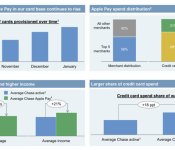
During its investor call today, Chase announced (via AppleInsider) that over 1 million customers have provisioned their credit and / or debit cards for use with Apple Pay. Additionally, the company provided a look at the demographics of its Apple Pay users.  Eileen Sierra, CEO of Chase Card Services, said that its customers who use Apple Pay tend to be young and have higher incomes, with 69 percent of their Chase card Apple Pay transactions credit based.
Sierra also revealed that the financial company has seen “good growth” in the number of its customers provisioning their cards on Apple Pay. Those customers have been using their Chase cards through Apple Pay at the top five merchants 58 percent of the time, with all remaining merchants making up the remaining 42 percent.
While Apple hasn’t provided adoption details on Apple Pay, CEO Tim Cook did announce in January that Apple Pay accounted for two of every three contactless dollars spent on American Express, Visa and MasterCard. Bank of America announced in January that nearly 800,000 of its customers were using Apple Pay, and point-of-sale suppliers have seen a massive increase in interest following Apple Pay’s launch last October.
Although Apple Pay is having early success in the United States, it has yet to expand past its borders. Reports indicate Apple is in talks with Canadian partners to launch Apple Pay in that country as soon as March, while Visa today announced it would launch tokenization in Europe in mid-April, paving the way for Apple Pay to expand into the continent.

Search apps, including Siri, Cortana, and Google Now may be saving recordings of your commands

A user on reddit has posted about his experience as a new employee with a company that has access to voice recordings that he claims are commands given to mobile devices. According to this individual, some of the recordings specifically refer to Siri, Apple’s voice-activated search and command app. The reddit poster also implicates Microsoft’s solution, Cortana, and other posters have pointed out that Google is also saving Google Now commands. Although this user has access to the recordings, the employer is none of these major companies.
It is not clear how the recordings ended up with a third party. Access to the recordings is supposedly for the purpose of listening to the sound bites and comparing that with the generated text to help improve the voice to text translation. It may be possible the company has been hired by the major companies to provide this service rather than having this work done in-house.
If you want to get an idea of what information Google is saving, you can login to your Google account and surf over to history.google.com/history/audio. According to that page only you can see the history of recordings and Google does not provide any indication on this page that they share the recordings with others. In all likelihood, the recordings that are being saved are mostly mundane attempts at commands or searches. As the reddit user pointed out though, there are users out there trying some interesting commands that could be embarrassing if they got into the hands of the wrong person.
The problems caused by the way voice activation works are not new. In the past, Facebook has had to deal with claims that their app was always listening to users and more recently Samsung acknowledged private conversations should not be held in front of some of their smart TVs that are listening for commands. Voice activation is a great convenience for users, but as we continue to see, the potential is there for a lot of devices in our world to be turned into monitoring devices and now we see, all that data may be getting saved as well.
Does the potential for others to listen in on what you say, either live or via recording, cause you to adjust your behavior any?
source: reddit
Come comment on this article: Search apps, including Siri, Cortana, and Google Now may be saving recordings of your commands

iOS and Android Combine for 96.3% Smartphone Market Share in Fourth Quarter
The latest numbers from research firm IDC reveal that the smartphone market continues to be a largely two-horse race between iOS and Android, which accounted for 19.7% and 76.6% market share in the fourth quarter respectively. The mobile operating systems combined to dominate Windows Phone, BlackBerry and all other platforms with 96.3% market share during the three-month period ending December.

iOS increased 2.2 percentage points to 19.7% during the fourth quarter over its 15.1% market share in the year-ago quarter, while Android experienced a marginal year-over-year decline as its market share slipped from 78.2% to 76.6%. Apple shipped a record-breaking 192.7 million iPhones during 2014 on the strength of the iPhone 6 and iPhone 6 Plus, while overall Android device shipments on the year surpassed the 1 billion mark.

Android and iOS continue to dominate the smartphone operating system race, resulting in a smaller battle between Windows Phone, BlackBerry, Firefox OS and less popular platforms for third place. Windows Phone and BlackBerry were the closest runner-ups to iOS and Android, claiming 2.8% and 0.4% market share in the fourth quarter respectively to close out 2014. All other platforms held 0.6% market share on the year.

