


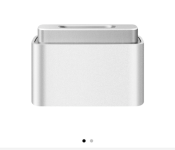
Apple Store Listing MagSafe to MagSafe 2 Converter as Discontinued
Apple has quietly listed the MagSafe to MagSafe 2 converter as discontinued on the Apple Online Store in the United States and Canada this week. The converter is required to charge a MagSafe 2-equipped MacBook Air or MacBook Pro when the notebook is connected to a Thunderbolt Display or Cinema Display. The converter still appears to have in-store availability, although for how long remains unknown.

Apple discontinuing the MagSafe to MagSafe 2 converter would prove problematic for Thunderbolt Display and Cinema Display users. The company does include the converter in the box for the Thunderbolt Display, but not being able to purchase a replacement if you misplace one would be an issue. We have reached out to Apple for comment and will update this story if we hear back.
(Thanks, Chris!)

Apple to Replace AT&T in Dow Jones Industrial Average on March 18
 Apple will be joining the Dow Jones Industrial Average, according to S&P Dow Jones (via The Wall Street Journal). Apple will be added to the Dow Jones at the close of trading on March 18, replacing AT&T as one of 30 members on the major price-weighted index. Apple is currently listed on Nasdaq with a pre-market share price hovering around the $128 mark as of writing.
“Apple is the clear choice for the Dow Jones Industrial Average, the most recognized stock market measure,” says David M. Blitzer, chairman of the Index Committee at S&P Dow Jones Indices.
The addition of Apple on the Dow Jones Industrial Average will occur just weeks after the iPhone maker recorded the most profitable quarter of any company ever, posting record-breaking quarterly revenue of $74.6 billion and quarterly net profit of $18 billion on sales of 74.5 million iPhones during the first quarter of the fiscal year. Apple is currently the world’s most valuable company with a market cap exceeding $735 billion.
The Dow Jones Industrial Average provides a price-weighted average of 30 significant stocks traded on the New York Stock Exchange and the Nasdaq, which offers valuable insight into how the stock market is performing at any given time. Other members of the Dow Jones include American Express, Boeing, Chevron, Coca-Cola, Disney, Exxon Mobil, Goldman Sachs, IBM, Intel, JPMorgan and Chase, Microsoft, Verizon and Visa.

Apple and Other Companies Push Forward in Fight for Marriage Equality [Mac Blog]
A total of 379 companies, including Apple, Facebook, Microsoft, and Google, have joined together to urge the Supreme Court to rule in favor of blanketed nationwide support for marriage equality (via The Verge).
The companies filed an amicus brief yesterday, represented by law firm Morgan Lewis, in the on-going Obergefell v. Hodges case, wherein two men are arguing that the state of Ohio discriminates against legal out-of-state same-sex marriages. Apple, along with the 378 other companies, angled towards a business-focused case for supporting every couple’s right to marry.

Apple at the 44th Annual Pride Parade in San Francisco
The brief claims that due to “a fractured legal landscape with no uniform rule on same-sex marriage”, both employees and employers face increasingly burden-filled relationships, making it difficult to conduct proper business practices. The coterie of companies isn’t represented by just well-known tech companies, but small family-owned businesses and other big non-tech brands like Nike, Coca-Cola, and United Airlines, as well.
“The competition for top talent crosses state and even national borders. State laws that prohibit same-sex marriage make it harder for businesses to recruit and retain talented employees,” says Morgan Lewis Partner Susan Baker Manning, counsel of record on the brief. “The patchwork of inconsistent state marriage laws makes it challenging and more costly for employers to administer benefits systems when some employees are unable to marry, and other employees’ marriages are not recognized by the state. This burdens businesses by costing them both time and money.”
Obergefell v. Hodges will enter the Supreme Court in April, and is one of a few others it will hear regarding the marriage equality issue. The main issue expected to be covered is whether the Constitution protects all same-sex couples in their right to marry regardless of their state, or if individual states will retain the right to prohibit gay marriage.
Apple has, unsurprisingly, voiced support for same-sex marriage in the past and marched in pride parades in San Francisco, with CEO Tim Cook coming out as gay in a letter written to Bloomberg Business just last October. Most recently, last December the company voiced support in naming a proposed bill in Alabama after the Apple CEO that would focus on anti-discrimination in regards to sexual orientation in the work place. Currently, there are 36 states, and Washington, D.C., that support gay marriage.
Note: Due to the political nature of the discussion regarding this topic, the discussion thread is located in our Politics, Religion, Social Issues forum. All forum members and site visitors are welcome to read and follow the thread, but posting is limited to forum members with at least 100 posts.

Apple, Microsoft, Facebook, Google team up to support marriage equality

A total of 379 companies, including tech’s biggest names, are trying to convince the Supreme Court to rule in favor of nationwide marriage equality. These corporations, including Apple, Facebook, Google and Microsoft have filed an amici curiae or a friend-of-the-court brief prior to the high court’s April hearing that will decide the future of same-sex marriage in the US. The court is slated to discuss whether same-sex couples have the constitutional right to get married anywhere in the country. In case that doesn’t pan out, the court will also discuss whether same-sex marriages performed in states where it’s legal must be recognized even in states where it’s not. If you read the filing, you’ll see the companies emphasize repeatedly how marriage equality benefits American businesses.
They listed a number of ways how, such as that it will allow them to offer everyone the same benefits to entice top talent. It can also prevent employees from leaving and moving to states that recognize their marriage. Diversity in the workplace, brought in part by members of the LGBT community, is “crucial to innovation and marketplace success,” the companies’ wrote.
We’ve pasted parts of the filing below that explain their stance in greater detail (emphasis ours):
Some of the states in which amici (the 379 companies) do business make marriage equally available to all of our employees and colleagues; others prohibit marriages between couples of the same sex and refuse to recognize existing same-sex marriages. This dual regime burdens amici. It creates legal uncertainty and imposes unnecessary costs and administrative complexities on employers, and requires differential employer treatment of employees who are similarly situated save for the state where they reside.
State laws that prohibit or decline to recognize marriages between same-sex couples hamper employer efforts to recruit and retain the most talented workforce possible in those states. Our successes depend upon the welfare and morale of all employees, without distinction. The burden imposed by inconsistent and discriminatory state laws of having to administer complicated schemes to account for differential treatment of similarly situated employees breeds unnecessary confusion, tension, and diminished employee morale.
A diverse, inclusive workplace environment increases the total human energy available to the organization. People can bring far more of themselves to their jobs because they are required to suppress far less. Inclusive companies are more open to new ideas and opportunities, while less prone to overconfidence when approaching challenges. Companies that are diverse and inclusive obtain better profits and other outputs, thanks to improved team collaboration and commitment.
Aside from the Big Four, other tech companies in the list include Amazon, Comcast, Cisco, DocuSign, Dropbox, eBay, EA, GE, HP, Intel, Oracle, Qualcomm Incorporated, Symantec, Twitter, Verizon, Xerox and Zynga. There are multi-national corporations from other industries, as well, such as Coca-Cola, Pepsi, Walt Disney and United Airlines. You can see the full list in the amici curiae document, along with links to the studies the group used to back their arguments.
[Image credit: Shutterstock / govicinity]
Filed under: Misc, Apple, Microsoft, Google, Amazon, Facebook
Via: The Verge
Source: Morgan Lewis
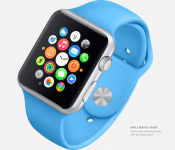
New Report Provides Look into Apple’s Secret Lab For Apple Watch Developers
Three weeks ago, it was reported that Apple was inviting developers to the company’s Cupertino headquarters to receive help finalizing Apple Watch apps. A new report from Bloomberg Business provides a look into the secret lab where Apple is helping developers, offering a look at Apple’s strategy for Apple Watch apps as well as the security around the project.

Developers from Facebook, BMW, Starwood Hotels and others have been making multiple trips to Cupertino, with each visit requiring confidentiality.
Apple, which will share more details about the gadget at a March 9 event, uses extreme measures to keep the work secret. Internet access is blocked inside the rooms, and no outside materials can be brought in to the labs with the test watches, a person who attended said. The companies, sometimes sharing a room, must bring in source code for their apps on a computer hard drive that can’t leave Apple’s headquarters. To prevent information from leaking out, Apple is storing the code and sending it to the companies closer to the watch’s introduction date, the person said.
The unreleased Apple Watch is also available for the developers to test out their apps, allowing them to check for glitches and optimize user experience for the Digital Crown and Force Touch, two of the watch’s unique interface options.
One of the challenges for both Apple and its developers has been to balance the apps so that they are useful but not annoying. Apple has recommended that developers be “judicious” about interrupting users with alerts that would constantly buzz or drain the battery. Instead, they suggest that apps should be used for no longer than 10 seconds at a time.
Another challenge for developers has been working on an unreleased product, as developers have noticed problems that still need to be worked through. One developer tells Bloomberg that the Bluetooth connection between the iPhone and Apple Watch caused lag with some applications. Additionally, some developers like Starwood have had to use computer simulations and cardboard cutouts to explain to the designers who weren’t invited to Cupertino how its app would work.
Apple is expected to show off the Apple Watch apps developers have been working on, as well as more information about the new device, at its “Spring Forward” event on Monday, March 9 at 10:00 a.m. Pacific Daylight Time. Apple plans to provide live coverage for the event on its website and through a channel on Apple TV, and MacRumors will also be covering the event with both a live blog on MacRumors.com and through our MacRumorsLive Twitter account.
Oracle Now Bundling Ask.com Adware with Java for Mac
For years, Oracle has been bundling an Ask.com search toolbar with Java for Windows, relying on what some call deceptive methods to get users to install the add-on to their browsers. Now, the company has extended its adware strategy to Java for Mac, according to ZDNet.
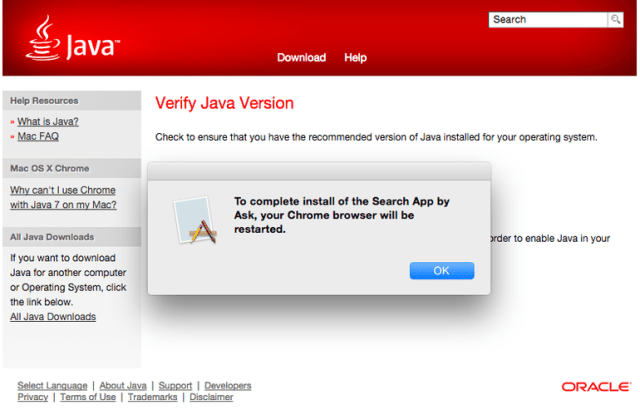 Image via ZDNet
The unwelcome Ask extension shows up as part of the installer if a Mac user downloads Java 8 Update 40 for the Mac. In my tests on a Mac running that latest release of OS X, the installer added an app to the current browser, Chrome version 41. (In a separate test, I installed Java using the latest version of Safari, where it behaved in a similar fashion.)
The Java installer selects the option to install the Ask extension by default, which means that users casually clicking through the dialogue boxes would find the extension installed and enabled on their browser of choice. Oracle has also updated its installation instructions for Mac to account for the change.
As noted by ZDNet, Ask.com typically provides low-quality search results and numerous ads with little distinction between ads and organic results. Ask.com parent company IAC pays a commission to Oracle and other companies that bundle the Ask extension with its products.
Users who want to remove the Ask toolbar can do so from the Help menu for the Ask toolbar on Chrome. Alternatively, users can go to the Chrome menu bar, then Preferences, then the settings page, then Manage Search Engines to remove Ask, followed by removing the extension from the Extension tab. Safari users can do so by going to Extensions in the Safari preferences and turning it off.
Hidden Diagnostic Port on Apple Watch Could Allow for Smart Band Accessories
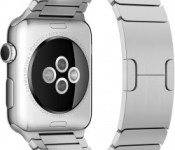
 Ahead of Monday’s media event where Apple is expected to provide final details on the Apple Watch, a new report from TechCrunch details a hidden “diagnostic port” inside one of the channels on the Apple Watch where watch bands slip into place. While the port is currently used only for diagnostic purposes, the report argues it could be used in the future to interface with “smart band” accessories bringing additional functionality to the watch.
The port has a 6-dot brass contact array inside the groove for the ‘bottom’ strap connector slot. Several sources have confirmed its existence and placement to me. It is very similar to the connector for the Lightning connector in iPhones, as that connector currently only uses 6 of its 8 available pins. Apple recently began opening up the Lightning port for use by third parties. A source says that this port is currently for diagnostic purposes only — but that there is nothing preventing it from being a connection port for future accessories.
TechCrunch‘s Matthew Panzarino is careful to state that he has no knowledge of any plans by Apple to launch such smart band accessories, but the idea remains an intriguing one. Possibilities for such bands include additional sensors, external batteries integrated into a band, and more.
Apple revealed a number of high-level details about the Apple Watch at the device’s unveiling last September, but even now with a launch set for next month there is still much that remains unknown, including pricing details beyond the $349 starting price. Apple will undoubtedly address many of the details at Monday’s events, but some of the technical details will likely need to wait until the device launches and users and technical experts can get a closer look at the device.

Apple will reportedly debut its music streaming service at WWDC

If you’re hoping that Apple will launch its retooled music streaming service alongside a smartwatch next week, you’ll have to wait a bit longer. 9to5Mac reports that Monday’s “Spring Forward” event won’t include details on the next phase of iTunes/Beats Music. Instead, the audio subscription option will launch at WWDC in June as part of an iOS update that annually rolls out soon after. Reportedly priced around $8 per month, the music service is said include features like curated playlists and content tailored to users’ personal tastes — both of which are key pieces of Beats Music. As you might expect, an app for the new service will make its way to Apple TV, and the same report claims a redesigned (read: slimmer) case and more capable remote control are on the way for Cupertino’s set-top box. However, with the rumored 13-inch iPad and Retina MacBook Air that we may see this year, it’ll be interesting to see how Apple plans to reveal a highly-anticipated update to its living room tech.
Filed under: Internet, Software, Mobile, Apple
Source: 9to5Mac

iOS 8.2 to Launch Next Week as Final Beta Seeded to Employees and Carrier Partners
 After initially reporting that iOS 8.2 would be released to the public this week, BGR now claims that the upcoming software update will arrive next week as Apple decided to seed one last beta to employees and carrier partners for testing. The final GM carries a build number of 12D508 and includes Health app improvements, stability enhancements and bug fixes.
While the initial report was incorrect, this new timeframe appears more plausible given Apple’s upcoming “Spring Forward” media event for the Apple Watch on March 9. Apple also promised that a fix would be prepared by next week for the recently discovered “FREAK” security vulnerability affecting devices such as the iPhone, iPad and Mac. The security flaw was disclosed to Apple well in advance of the public.
The release notes for iOS 8.2 outline several improvements to Apple’s stock Health app, including the ability to select units of measurement for body temperature, weight, height, distance and blood glucose. The software update also delivers stability enhancements for Mail, Flyover in Maps, Music, VoiceOver and Made for iPhone hearing aids.
Health App improvements
Adds the ability to select the unit of measurement for body temperature, weight, height, distance, and blood glucose Improves stability when dealing with large amounts of data Includes the ability to add and visualise workout sessions from 3rd-party apps Addresses an issue that may have prevented users from adding a photo in Medical ID Fixes units for vitamins and minerals Fixes an issue where Health data wouldn’t refresh after changes data source order Fixes an issue where some graphics showed no data values Adds a privacy setting that enables turning off tracking of steps, distance, and flights climbed
A number of bug fixes have been made in iOS 8.2, including a long-awaited fix for the so-called “GMT bug” causing calendar syncing issues for several iPhone and iPad users. Google quietly fixed the GMT bug on their backend early last month, but Microsoft Exchange calendar users have still been experiencing syncing issues. Other bug fixes are outlined in the full release notes shared in the MacRumors discussion forums.
iOS 8.2 will also include support for the Apple Watch ahead of its launch in April.
Microsoft Launches Office 2016 for Mac Preview, Available for Free to Mac Users
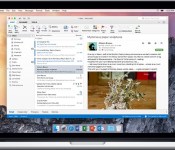
Microsoft is today introducing a preview of the next iteration of its office software designed for Mac users, Office 2016. Office 2016 for Mac is the company’s first major Mac release since Office 2011, and it brings new versions of Word, Excel, and PowerPoint with redesigned Retina-optimized interfaces, new features, and a heavy focus on collaboration and cloud integration.
Office 2016 for Mac, which is free to all Mac users running OS X Yosemite during the preview period, is the next step in Microsoft’s plan to make its Office products available anywhere, anytime, on any device, and as such, it’s been designed to work with Office 365 and OneDrive. Users will get the best experience when signed into Office 365 because that allows them to access all of their documents on all of their devices, but an Office 365 account is not required to use the software.

Office 2016 for Mac has adopted many elements previously found in both the Windows version of Office and in the mobile Office apps, released last year. There’s a new Ribbon that reorganizes tools and formatting options, a task pane interface for greater graphics customization within all three apps (which can be manipulated and repositioned within each app), new themes and styles, and there’s a Yosemite-style look that takes advantage of features like full-screen support.
Office 2016 for Mac is powered by the cloud so you can access your documents anytime, anywhere, and on any device. It’s unmistakably Office – but thoughtfully designed to take advantage of the unique features of the Mac. The new apps offer full retina display support with thousands of retina-optimized graphics, full screen view for native immersive experiences, and even little Mac affordances like scroll bounce.
Microsoft believes that cloud connectivity is a key feature that people have come to expect from their software, so that’s become a focal point for the company. With cloud support, Office 2016 for Mac lets users access a list of files created on any device, keep files up to date on all of their devices, and collaborate with other users. Each of Microsoft’s new Office apps have received several new cloud-based features and other updates, as outlined below.
Word 2016 focuses heavily on collaboration. It’s designed to improve the multi-author experience, with a consistent sharing interface at the top right of the app. Through this menu, users can invite coworkers to work on a document, send out links, and see who a document has been shared with.

Threaded comments have been added to the Mac for the first time and in Word’s new Styles pane, users can make detailed edits on styles within the app as they can on Office for Windows.
Excel 2016 has deeper data analysis functionality with advanced statistical functions. There are also Slicers in PivotTables, a popular Windows feature that should make it easier for users to analyze large chunks of data to find patterns. With Office 2011, many users were frustrated that the Mac shortcut keys were not the same as the Office for Windows shortcut keys, so Microsoft has made all Windows shortcuts available on the Mac. Users already used to existing Mac shortcuts can continue to use them.

PowerPoint 2016 has a revamped presenter view, which is similar to the presenter view in the PowerPoint for iOS app. In the top left, the presenter sees exactly what the audience sees, including animations in real time. There’s also a visual preview of the next slide, access to notes, a timer, and thumbnails for the entire slide deck.

As with the other two apps, there are deeper editing tools available through the right-side pane, which allows for functions like customized animations or shapes, with results that can be seen in real-time.
Along with Word, Excel, and PowerPoint, Microsoft’s Office 2016 for Mac preview also includes Outlook for Mac, which was released in October, and Microsoft OneNote for Mac, released last March. Outlook for Mac has been limited to Office 365 users since its release, but as of today, it’s available for anyone to use.
The Office 2016 for Mac preview has a built-in feedback mechanism, which Microsoft is hoping its customers will use to report bugs and share what they like and don’t like about the software. Customer feedback will be an important tool that helps Microsoft decide on the next features to add to its software. According to Microsoft, the company is “data obsessed” and reads all of the feedback it receives.
Though it’s been years since Microsoft last delivered a software update, the company plans to introduce bug fixes and feature updates quickly in the future, as such updates are possible now that the Microsoft Office experience is unified as a service across a range of devices.
Microsoft’s Office 2016 for Mac preview is available today at no cost for all Mac users. It is officially supported on machines running OS X Yosemite. Microsoft has plans to launch the software in the summer following this beta testing period.

