


‘Hacking Team’ Data Breach Confirms Firm’s Ability to Infiltrate Jailbroken iPhones
Cybersecurity firm Hacking Team experienced a data breach earlier today, resulting in 400 GB of its documents being leaked onto the Internet, reports The Guardian. The documents confirm Hacking Team’s ability to infiltrate and monitor jailbroken iPhones on behalf of government law enforcement agencies like the NSA, as noted by Macworld.

Much has been speculated before and after Edward Snowden’s release of a trove of National Security Agency (NSA) documents in 2013 about the capabilities of the United States’ agencies as well as those of allies and enemies. The Hacking Team dump reveals quite a bit more about the routine functions of third-party suppliers into that ecosystem, including specifically enumerated capabilities.
iOS users should therefore take note that the long-running concern that jailbroken iPhones and iPads were susceptible to vulnerabilities that could include access by so-called state actors appears to be confirmed by the data breach.
Hacking Team’s software would need to be installed on a jailbroken iPhone, but the firm has the ability to jailbreak and infect a phone with its software via a malware-infected trusted computer the phone is connected to. In the firm’s pricing list [PDF, requires Chrome], it’s revealed hacking an iOS device costs €50,000 ($55,242) and includes “features” like Skype, WhatsApp and Viber chats, location, contacts and lists of calls. However, this service also includes a prerequisite of a jailbroken iPhone.
Hacking Team uses a legitimate Apple enterprise signing certificate, which is used by corporations to create software that can easily be installed on employee devices, combined with jailbroken iOS devices to bypass iOS app installation protections. Additionally, Hacking Team developed the ability to create a malicious Newsstand app that could capture keystrokes and install monitoring software.
Last year, researchers working independently of each other at Kaspersky Lab and Citizen Lab discovered components of Hacking Team’s tools and how they were used by government agencies to steal data from mobile devices, but the full extent of the software hadn’t been confirmed until now.
Data breaching software and Apple devices have been in the news before, most famously in last year’s celebrity iCloud data breach, where it was discovered that hackers were using ElcomSoft Phone Password Breaker, software intended for government and law agencies, to steal usernames and passwords to access iCloud backups.
While much of the discussion around government agencies and citizen data has revolved around mass collection, Hacking Team’s software is designed to attack individual devices rather than a vast network. It’s likely that the exploits detailed in Hacking Team’s documents will be addressed and patched up in future iOS and Mac software updates.
Note: Due to the political nature of the discussion regarding this topic, the discussion thread is located in our Politics, Religion, Social Issues forum. All forum members and site visitors are welcome to read and follow the thread, but posting is limited to forum members with at least 100 posts.

Apple Working to Add Home Sharing for Music in iOS 9
 With the release of iOS 8.4 and the new built-in Apple Music service, Apple removed Home Sharing for music on iOS devices, a move that many Home Sharing users have been upset about.
It was unclear if Home Sharing for music would be re-added in the future, but according to iTunes chief Eddy Cue, Apple is planning to add Home Sharing to iOS 9. In response to a tweet about the removal of Home Sharing for music, Cue tweeted “We are working to have Home Sharing in iOS 9.”
Wording in the release notes for the last iOS 8.4 beta suggested that Home Sharing and Genius Mixes were “not currently available,” hinting that the features could return at a later date, and it appears that is indeed Apple’s plan.
While Home Sharing for music has been removed in iOS 8.4, the feature is still available for video. Home Sharing for music also remains available on the Mac and the Apple TV. It is unclear when Home Sharing for music will be introduced in iOS 9, but the next beta is expected later this week.
In recent weeks, Apple has been embracing social media, with Eddy Cue answering several questions about Apple Music and related services. Cue also used Twitter to announce Apple’s plans to pay artists during the Apple Music free trial after an open letter from Taylor Swift, and he informed users about an upcoming iOS 9 beta seed that will add Apple Music to the new operating system.

Apple Stores to carry third-party accessories in custom boxes

Apple is well-known for being very particular about its packaging… and it apparently cares about other companies’ packaging, too. According to 9to5Mac, the tech giant is telling retail staff that it will soon sell third-party accessories in boxes co-designed by Apple… and possibly only in those boxes. Yes, that familiar minimalist look would soon spread to just about everything in the store. The move would ostensibly help you find what you’re looking for and make sure that it works with your devices. Many of the familiar brands in Apple stores are reportedly on board with the idea, including Incase, Mophie and Logitech.
If the leak is accurate, you could see this change spread to all stores next week. Apple’s recently opened Upper East Side store in Manhattan might already serve as a good preview, in fact. Whether or not you’ll like the shift is another matter. It could save you from having to explore confusing packaging to see if a case will work with your iPhone, but it could also introduces a not-so-helpful sameness — is the iPad keyboard you want in this modest white box, or that modest white box? Also, the implication is that you may lose easy access to some products whose manufacturers can’t or won’t partner on new packaging. This wouldn’t be a surprising move for a company that cares a lot about its image, but it might not help if it forces you to visit multiple stores to get everything you want.
Filed under: Peripherals, Apple
Source: 9to5Mac
Apple Retail Stores to Offer Third-Party Accessories in New Apple-Style Packaging
Apple is planning to introduce new co-designed packaging for many of the third-party accessories that it sells in its stores, according to retail store information shared by 9to5Mac. Apple has reportedly been working with several third-party accessory manufacturers on packaging design, helping to create a new look for boxes to better fit in with the packaging that’s used for Apple’s own products.
Companies participating in Apple’s revamped packaging efforts include Tech21, Sena, Incase, Mophie, Logitech, and Life Proof. When these products are sold in Apple Stores, they’ll be sold with simple, no-frills white boxes with minimal labeling as seen in photos.

According to the memo, the packaging will be mostly white to match the Mac, iPhone, and Apple Watch boxes, while they will also include simpler fonts, new photography, higher-quality materials, and more consistent compatibility labeling. This shift is yet another in a string for third-parties that has included new environmental guidelines and a ban on leveraging early iPhone leaks.
Apple’s new head of retail, Angela Ahrendts, has been working to revamp the Apple Store experience in recent months, streamlining the purchasing process and reimagining both product discovery and customer-employee interactions. The packaging redesign is part of a larger effort to overhaul Apple’s in-store accessory lineup, limiting the number of products that are sold for a more refined look.
News of the revamped packaging was first shared by Mac Otakara in June, and a sneak preview of what the accessory sections of Apple’s retail stores might look like can be seen at the company’s Upper East Side store in New York.
 Apple’s Upper East Side store, image via Mark Lennihan, Associated Press
Apple Store accessory sections are expected to begin seeing changes starting next week, which is when the new packaging will be introduced.

NBA Player Blames Elbow Injury on Larger-Screened iPhone [iOS Blog]
 San Antonio Spurs player Matt Bonner recently revealed in an interview with Concord Monitor (via Yahoo) that he suffered from tennis elbow during the 2014-2015 NBA season, a condition that he theorized was caused by Apple’s larger-screened iPhones and led to a lower-than-normal 3-point shot success rate.
“Everybody is going to find this hilarious, but here’s my theory on how I got it,” he said. “When the new iPhone came out it was way bigger than the last one, and I think because I got that new phone it was a strain to use it, you have to stretch further to hit the buttons, and I honestly think that’s how I ended up developing it.”
According to Bonner, his two-and-a-half months of tennis elbow made it so painful for him to shoot that he’d “almost be cringing” before catching the ball. He spoke to a Spurs strength and conditioning coach, who reported suffering from a similar injury after spending time playing a game on a larger-screened iPhone.
Tennis elbow is attributed to any activity involving the repetitive use of the muscles in the forearm, causing muscles and tendons to be damaged from excessive use and leading to pain and inflammation in the elbow. A quick Google search suggests that tennis elbow caused by iPhone is not a common condition, but a few others have complained about similar iPhone-related stress injuries over the years.
It’s not entirely clear if Bonner was making a tongue-in-cheek joke when he gave the tidbit of info to the Concord Monitor, but at 6’10” tall, it’s a bit difficult to believe he would have trouble using the 5.5-inch iPhone 6 Plus or the 4.7-inch iPhone 6, even one-handed. As iMore points out, there’s likely another cause for his elbow issues.

How to Customize Apple TV to Show Only the Channels You Use [Mac Blog]
We’ve been waiting for the fourth-generation Apple TV for at least two years now, and we’ve been teased with vague comments, leaks from the supply chain, and analyst predictions for several years running. We thought we’d get a look at it this year at the Worldwide Developers Conference, but Apple was still not ready to show it off.

Until we get a whole new model with, hopefully, a brand new look to the operating system, we have to stick with what we’ve got. The number of media channels is not getting any smaller, with Apple adding new content on a regular basis. For example, Apple recently added NatGeo TV. Content options are great, but sifting through dozens of channels can be a pain sometimes.
If you’re tired of scrolling through the nearly seven dozen channels looking for the ones you use most, you can hide everything you don’t want to access, making it much easier to get to the content you want. We’ve got a quick tutorial to show you how.
Read more 
LG G4 bests Samsung, Apple in latest Consumer Reports’ testing

With both the LG G2 and LG G3, Samsung and Apple have increasingly had to deal with a smartphone competitor that more and more consumers are taking a look at and opting to buy. Although LG may not be meeting internal sales expectations with the LG G4, the phone is still a hit and attracting a lot of attention from buyers. That interest may increase after a recent report from Consumer Reports that ranked the LG G4 ahead of the Samsung Galaxy S6 and Apple iPhone 6 on performance testing.
According to the latest testing results from Consumer Reports, only last year’s Samsung Galaxy S5 managed to perform better than the LG G4 and the LG G3, both of which scored 78 out of a 100-point scale. In the most recent round of testing, the Samsung Galaxy S6 and Apple iPhone 6 ended up tied for fifth place.
The LG G4 was probably helped in the Consumer Reports‘ rankings by the large display and a laser-assisted focus system for a strong camera system included in the smartphone. LG has also set the device apart from the rest of the leaders in the smartphone market by staying away from the glass and metal construction trend, opting instead for leather or plastic backs.
source: BusinessKorea
via: phoneArena
Come comment on this article: LG G4 bests Samsung, Apple in latest Consumer Reports’ testing
Purported Schematic Suggests ‘iPhone 6s’ Could Be Slightly Thicker, Retain Home Button
A purported schematic for the so-called “iPhone 6s” obtained by Engadget Japan (via BGR) reveals that the next-generation smartphone could have a thickness of 7.1mm, a slight increase over the iPhone 6 and iPhone 6 Plus, which measure 6.9mm and 7.1mm respectively. The schematic also suggests that the “iPhone 6s” will still have a home button, while all other buttons and ports remain unchanged.

The slight 0.2mm increase in thickness could be the result of Apple adding pressure-sensing Force Touch technology to the next iPhone, enabling the smartphone’s display to distinguish between a light tap and firmer press and complete different actions accordingly. The “iPhone 6s” is also rumored to adopt 7000 Series aluminum, which could possibly contribute to marginally different dimensions.
The schematic is consistent with leaked photos of the “iPhone 6s” rear shell, which confirm that the handset will have only minor design changes. In particular, the Lightning connector, speakers, microphones, headphone jack, volume rocker, mute button, sleep/wake button, SIM card slot, antenna lines and cutout for the rear-facing camera and LED flash are all identical to the iPhone 6.
The lack of exterior design changes on the “iPhone 6s” is unsurprising given that “S” model iPhones have historically looked almost identical to the iPhone released one year prior. The iPhone 3GS, iPhone 4S and iPhone 5S, for example, each had virtually the same design as the iPhone 3G, iPhone 4 and iPhone 5. Instead, the focus of the “iPhone 6s” will likely be on internal improvements.
Leaked photos of the “iPhone 6s” logic board reveal that the smartphone will likely feature Qualcomm’s MDM9635M chip, capable of theoretical LTE download speeds up to 300 Mbps, double the max speed of 150 Mbps in the iPhone 6 and iPhone 6 Plus. The next iPhone is also rumored to feature an A9 processor with 2GB of RAM, an updated NFC chip for Apple Pay and an improved 12-megapixel rear-facing camera.

‘World’s First Swim App’ on Apple Watch Put to the Test in New Video [iOS Blog]
In the days and weeks after its launch last April, one of the biggest curiosities surrounding the Apple Watch was its tolerance to water. Thanks to a few initial tests — from showers to high dive pools — we now know that the Apple Watch is indeed a bit more waterproof than Apple promises, and with that in mind a few London-based iOS developers have created the “World’s first swim app on the Apple Watch,” and put it through its paces in a new video.
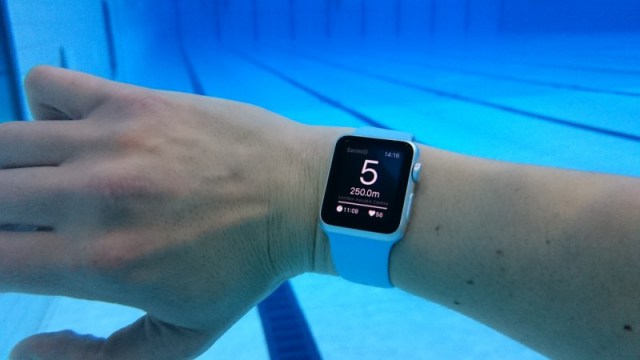
Having designed a similar app for the Pebble, Ted Bradley and his team decided to take that idea — a lapping, time, and heart rate monitoring swim app — and transplant it onto the Apple Watch. The developers put each smartwatch to the same test, swimming four full lengths of the London Aquatic Centre’s 50 meter pool. The test proved successful, with the Apple Watch mirroring the Pebble’s results of a four lap, 200 meter swim. Apple’s smartwatch even continued to measure heart rate successfully, raising from an initial 88bpm to 138bpm immediately after the test finished.
The only downside for the app is that the Apple Watch experiences a tiny bit of lag when waking it up to check out lap times, the developers explaining that only when the screen is awake can the app run through the data samples collected from the swim and take a few seconds to parse through the information and display it on screen. Elsewhere, the swimming data isn’t locked into the app, all of the workout and heart rate information getting delivered to HealthKit like any other workout and adding to a user’s daily exercise and move goals.
Of course, even though the app works, the developers are still referring to it as an “interesting technology demo,” seeing that App Store Guidelines will immediately shut it down for encouraging users to use the Watch “in a way that may cause damage to the device.” In the end, the app’s creators just hope that Apple hears the calls for a fully-waterproof smartwatch and includes such features in the device’s next generation.
We really hope that Apple see the demand for an official, fully waterproofed Apple Watch. Once that is available, we’ll be able to ship a fully featured swimming app. In the mean time, it would be great to see swimming become a first class citizen in the Apple Health and Activities apps. Running and cycling both have their own distance graphs you can view in the dashboard whilst for swimming you have to drill down to individual workouts.
Although you can’t swim with the Apple Watch, many people swim with other devices as well as logging their swim workouts manually on other apps. If there is a future ambition for Apple Health/HealthKit, Apple Watch, the new Activity app and ResearchKit to all tie up and tell the narrative that “Apple user’s live longer healthier lives”, then recording all fitness activity, including swimming, is a must.
The full blog post, where Bradley goes into detail about everything from his inspiration for creating the swim app to architectural challenges the team faced in creating it, is definitely worth a read.

Apple Pay reportedly reaches the UK on July 14th

Irked that Apple Pay is only officially slated to reach the UK sometime in July? Don’t worry — you might not have to wait all month to see it. Multiple retailer leaks at 9to5Mac point to Apple launching its iPhone tap-to-pay service in Old Blighty on July 14th, or soon enough that you can likely use it if you’re off to one of the country’s many summer music festivals. Just don’t expect to splurge on more than a quick bite to eat while you’re out. That £20 (soon to be £30) contactless payment cap seriously limits how much you can spend, so the British implementation won’t be quite as convenient as it is for Americans.
Filed under: Cellphones, Internet, Mobile, Apple
Source: 9to5Mac

