


A Closer Look at Apple’s CPU Improvements for iPhone 7 and Apple Watch
At last Wednesday’s media event, Apple introduced two new processors – the A10 Fusion for iPhone 7 and 7 Plus and the S2 for Apple Watch Series 2. Although Apple only briefly covered the S2 during the presentation, it did spend a good deal of time talking about A10 Fusion. The ‘Fusion’ suffix refers to the heterogeneous architecture that the A10 features, which has two high-power, high-throughput cores and two much smaller cores that are more power efficient.
Apple also introduced another very important piece of standalone silicon in its new AirPods, dubbed the W1 chip. In total, this represents a great deal of engineering work done by Apple over the last year, and the A10 is the most significant to Apple’s system-on-a-chip (SoC) line since the company’s transition to 64-bit.
Apple unveiled the biggest technical changes featured in the A10 at the very beginning, boasting a four-core CPU with 3.3 billion transistors. While Apple never disclosed a transistor count for the A9, it very likely fell somewhere in the middle between the 2 billion count on the A8 and the 3.3 billion of the new A10. A transistor count well under 3 billion seems probable for the A9; otherwise it would have been worth boasting about on its own.
The 3.3 billion number for the A10 is well over 50 percent larger than the A8, and the large jump is likely mostly thanks to the addition of two new, albeit small, CPU cores along with a greatly enhanced image signal processor (ISP). Apple also disclosed that the GPU remains a six-cluster design, while benchmarks suggest that the L1 and L2 cache sizes remain unchanged.
Given that the process node is not expected to be different than the A9 fabricated on TSMC’s 16nm FinFET process, it is very likely we’ll be looking at a larger die size compared to its predecessor. However, it is also likely Apple was able to optimize placement and sizing on what is now a more mature process, without the added complexity of producing a twin design on Samsung’s competing 14nm FinFET process.
The leaked logic board shots also suggest a larger device package than the Apple A9, although it is unclear if the new InFO packaging processor has any influence on device package footprint.

Apple also revealed that A10’s peak performance could be up to 40 percent greater than the A9 featured in the previous generation. The 2.33 GHz core speed showing up in benchmarks is roughly 25 percent faster than the 1.85 GHz seen in the A9, meaning Apple has found another 25 percent peak improvement through architecture enhancements.
A 25 percent clock speed increase is significant given that the process node likely did not change, meaning the increase was likely enabled by the better thermal performance of InFO packaging. It is also likely only possible because of Apple’s heterogeneous architecture which now features a pair of high-speed cores along with a pair of low-speed, power conscious cores.
Apple’s clock speed increase is probably more than just turning up the dial on voltage to make the cores run faster. By introducing the pair of low-speed cores, Apple opened up a whole new spectrum of dynamic voltage and frequency scaling (DVFS) options for completely disabling cores or their sub-parts. Apple designed its own performance controller to manage workloads between the cores, and we know from some industry sources that Apple does cache-sharing so that the caches don’t have to constantly read each others’ contents to be ready for a switch lest they face a delay in getting current data when they switch on.
This concept may sound familiar because ARM introduced it all the way back in 2011 with the Cortex-A15 “Eagle” design in 2012 with the “big.LITTLE” moniker. ARM’s big.LITTLE scheme also features a performance controller and cache coherency mechanisms, but it had to be designed with Linux OS performance management in mind, whereas Apple can retool iOS as needed for any software interfaces to the performance controller. As time goes on, we may learn more about which caches are shared versus which are updated with some coherency mechanism.
The boost to 2.33 GHz clock speeds brings Apple much closer to the clock speeds of competitors from SoC makers such as Qualcomm and Samsung, and Apple may also have made some transistor changes to reach those speeds. By increasing voltage, and choosing transistors with higher static leakage (unavoidable waste power), Apple can get to these higher clock speeds. Apple’s chip team can also make architectural designs that have a higher power footprint in general, whether it be at a higher transistor count, more management power overhead, or more switching activity through a different logic implementation.
The takeaway is that making these sacrifices is now okay because they are more equipped to deal with the thermal implications, and they don’t have to deal with the static power draw of all of these changes when the circuit is not in active use because they can simply turn it off and switch to the low power core.
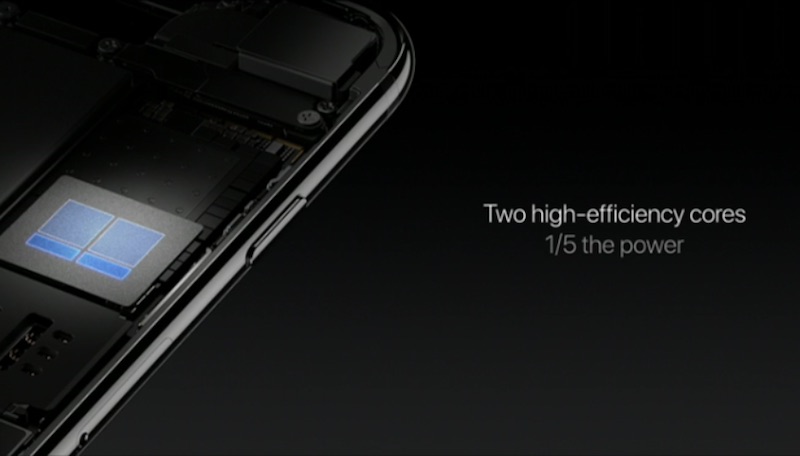
Apple’s two small cores in the A10 have drawn just as much interest as their larger cousins, with a lot of speculation centered on whether they too are an Apple custom design, or if they are a variant of a stock low-power core from ARM, such as the Cortex-A53. After so many years of full custom designs, it is fair to ask why Apple would opt for an off-the-shelf solution for its low power CPU, but there is certainly still precedent for it.
By all indications, the first-generation Apple Watch features a Cortex-A7 CPU design. The Apple Watch comparison is interesting because Series 2 was merely increased to a dual-core design up to 50 percent faster than the original. The same question of custom vs. stock design is relevant here, and it is possible that the dual-core CPU in S2 is the same dual-core featured as the low-power option in A10.
The main question centered around this architecture shift is why now would be the appropriate time for Apple to do a heterogeneous architecture. One possibility is that Apple’s main core designs had been optimized so much that there were few gains to be had, and those gains would have been with serious diminishing returns. Ratcheting up the clock speed is an easy way to get more performance, but the thermal and power costs associated with that may have been the driving force for the split.
Die size is not unlimited either, and as long as there were gains to be had by making the CPUs bigger, Apple may have opted to go that route. The enhanced functions of the ISP may have also been a good reason to raise the L3 SRAM cache from 4 MB to 8 MB, which does have some impact on the die size as well. Going forward, it’s important to remember that CPU clock speed won’t be unlimited either, as high-end desktop CPUs have been stuck between 3 GHz and 4 GHz for the past decade, for example.
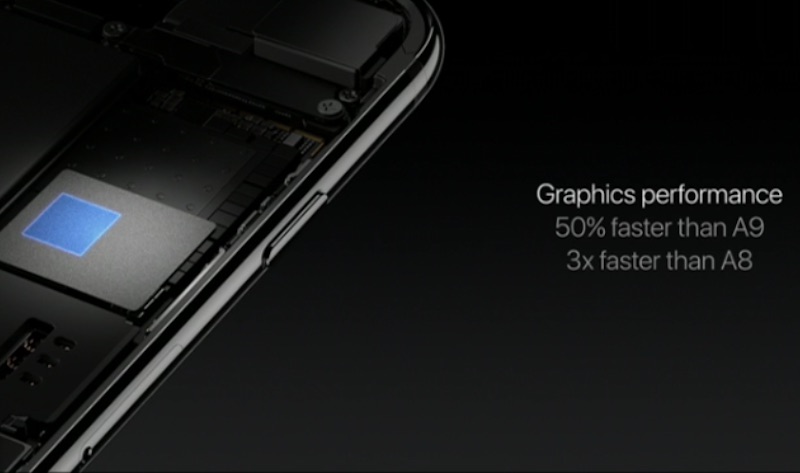
Apple finished up its technical disclosure by talking about the graphics power of the A10. Fortunately, Phil Schiller mentioned it was a six-cluster design, so we know it matches the cluster count on the A9. Apple’s performance claims also suggested that the A10 GPU can be up to 50 percent faster than the A9’s GPU while consuming only 2/3 the power.

We also know Apple used the same process node for the A10 as on the A9. Since the announcement of the 7XT series of GPUs from Imagination Technologies that was featured in the A9, there has only been one new type of high-performance GPU announced from ImgTec, and it was simply to add computer vision and compute performance enhancements to the existing 7XT line.
The power reduction alone rules out that Apple increased clock speeds to make these performance claims, so we are likely looking at some significant changes that feature an unannounced GPU, an Apple-designed GPU, or some other major architectural shift that we don’t know about. It is possible Apple could claim some gains through enhancements in metal, but up to 50 percent improvement in speeds seems a rather high claim for that.
Apple’s performance boost claims have historically tended to actually show in benchmarks, so this will be an area of particular interest when the GPU gets fully benchmarked and pictured under a microscope.

The introduction of Apple’s AirPods was also an important moment because they feature Apple’s new W1 wireless connectivity chip. In the announcement, Phil Schiller put special emphasis on it being Apple’s first wireless chip, suggesting that there are more to come. We have been waiting several years since Apple first hired several RF engineers from Broadcom, and this small Bluetooth chip could be a stepping stone to Apple providing its own RF components such as the Wi-Fi chip or even the cellular baseband modem in future devices.
This is a very tough sector to get into and be a competitor in the general marketplace, however, as seen with Intel’s own LTE offerings likely featured in the new iPhone, for example. Rather than being built from the ground up, those chips are the product of Intel’s acquisition of Infineon and manufactured on a TSMC process rather than Intel’s own. The potential gains for custom wireless chips are also less clear than with fully custom CPU solutions seen in SoCs, so this does not necessarily mean Apple’s ambitions stretch that far.
We’re likely to find out much more in the coming weeks as the teardowns begin, exhaustive benchmarks are run, and the more advanced analyses from firms such as Chipworks begin to trickle out. From there, we’ll have a better picture of the specific methods and techniques Apple has used to increase chip performance and potentially have a better idea of what’s coming next.
Related Roundups: Apple Watch, watchOS 2, watchOS 3, iPhone 7
Tags: A10 Fusion, S2, W1
Buyer’s Guide: Apple Watch (Buy Now)
Discuss this article in our forums
Apple Watch Series 2 Shipping Estimates Slip to 2-3 Weeks, Best Buy Still Promises Launch Day Delivery
Just hours after Apple Watch Series 2 pre-orders became available, shipping estimates for most 38mm and 42mm models have slipped to 2-3 weeks in the U.S. for new orders placed through Apple’s online store.
Apple Watch Nike+ models are expected to ship in late October, while the new 42mm ceramic Apple Watch Edition ships in 5-7 weeks. Apple Watch Series 1 models remain available for September 16 launch day delivery.
Best Buy, however, still appears to be offering shipped-to-home September 16 launch day delivery in the U.S. for several Apple Watch Series 2 models, including aluminum and stainless steel variants. It does not appear to be selling the ceramic Apple Watch Edition.

For those that elected not to or are uninterested in pre-ordering online, Apple Watch Series 2 models launch at Apple retail stores and authorized resellers like Best Buy on September 16. In-store stock will likely be very limited, with customers accepted on a first come, first served basis.
Apple Watch Series 2 models feature a built-in GPS, water resistance up to 50 meters, a faster S2 dual-core processor, and a display that is two times brighter than the original Apple Watch. Series 2 models will come with watchOS 3 preinstalled, while the software will be released as a standalone update on September 13.
Related Roundups: Apple Watch, watchOS 2, watchOS 3
Tag: Best Buy
Buyer’s Guide: Apple Watch (Buy Now)
Discuss this article in our forums
Apple Watches Now Have Shorter 1M Charging Cable in Box
While the original Apple Watch has a 2-meter charging cable in the box, Apple says new Apple Watch Series 2 and Series 1 models come with a shorter 1-meter charging cable in the box.
Apple continues to sell a 2-meter Apple Watch Magnetic Charging Cable for $39 online and in stores, while extra 1-meter cables remain available as a standalone purchase for $29 in the United States.
Apple Watch Series 2 models also include a 5W USB Power Adapter in the box, while Series 1 models do not. The wall charger costs $19 on its own.
Both new series became available for pre-order today, with shipping estimates quickly slipping to 2-3 weeks or later for most models. Best Buy still promises launch day delivery for some models.
Related Roundups: Apple Watch, watchOS 2, watchOS 3
Tag: Apple Watch accessories
Buyer’s Guide: Apple Watch (Buy Now)
Discuss this article in our forums
Macy’s Department Store to Start Selling Apple Watch
Macy’s is set to become the first major department store to offer the Apple Watch, reports Fortune. Starting before the holiday shopping rush, Macy’s will begin offering the Apple Watch at more than 180 stores across the United States.
“It will be in all of our top buildings for the holiday season,” said Macy’s president and future CEO Jeff Gennette. In addition to offering the Apple Watch in many of its retail locations, Macy’s also plans to open a dedicated Apple Store inside of its flagship Herald Square location in New York, which will sell a variety of Apple products including iPhones, iPads, MacBooks, and Apple Watches.
Since its April 2015 debut, the Apple Watch has become available for purchase from many major third-party retailers around the world. In the United States, the Apple Watch can be purchased from stores like Best Buy, Target, Walmart, and B&H Photo, making it easy to walk into any local brick and mortar store to pick up one of Apple’s wearable devices.
Last year, steep holiday discounts on the Apple Watch from retailers like Best Buy and Target helped spur its popularity. Apple has never divulged sales numbers for the Apple Watch, but market research suggests it is by far the most popular smart watch on the market.
Apple this week introduced its second-generation Apple Watch, the Apple Watch Series 2. The new devices feature a much faster S2 processor, better waterproofing, a GPS chip, and a brighter display. Apple also introduced Series 2 Apple Watches created in collaboration with Nike and Hermès, along with a new high-end ceramic material. The Series 1 Apple Watch, which features a lower price tag, was upgraded with the S2 processor but none of the other new features.
Macy’s and other Apple Watch retailers will offer the new Series 1 and Series 2 models in stores as soon as they are available. Apple Watch Series 2 goes on sale on September 16, with pre-orders starting on September 9.
Related Roundups: Apple Watch, watchOS 2, watchOS 3
Tag: Macy’s
Buyer’s Guide: Apple Watch (Don’t Buy)
Discuss this article in our forums
Apple’s Online Store Down Ahead of iPhone 7 and Apple Watch Series 2 Pre-Orders
Apple has taken its online storefront down in order to prepare for the launch of the iPhone 7, the iPhone 7 Plus, and the new Apple Watch Series 2 models. Pre-orders are expected to begin at 12:01 a.m. Pacific Time or 3:01 a.m. Eastern Time on Friday, September 9.
Pre-orders will be available through Apple’s website, the Apple Store app, several carrier sites, and from major retailers like Target and Best Buy.
Apple will accept pre-orders in first wave launch countries including Australia, Austria, Belgium, Canada, China, Denmark, Finland, France, Germany, Hong Kong, Ireland, Italy, Japan, Luxembourg, Mexico, Netherlands, New Zealand, Norway, Portugal, Puerto Rico, Singapore, Spain, Sweden, Switzerland, Taiwan, UAE, the UK, US Virgin Islands and the US.
The 4.7-inch iPhone 7 is available in 32, 128, and 256GB capacities in the United States for $649, $749, and $849, respectively. The 5.5-inch iPhone 7 Plus is also available in 32, 128, and 256GB options for $769, $869, and $969.
Apple’s iPhone Upgrade Program is available in the United States, United Kingdom and China, allowing customers pay a monthly fee for their iPhone 7 with the option of trading it in after 12 months of payments. Pricing, which includes AppleCare+, starts at $32.41 for the iPhone 7 and $37.41 for the iPhone 7 Plus.
Announced earlier this week, the iPhone 7 and the iPhone 7 Plus feature significant camera improvements, a 4-core A10 Fusion chip, better battery life, water resistance, a revamped pressure-sensitive Home button, stereo sound, new colors, and most controversially, no headphone jack.
Both the Apple Watch Series 1 and the Apple Watch Series 2 will also be available for pre-order. Prices for the Series 1 devices, which include a S2 processor but no other features, start at $269. Prices for the upgraded Apple Watch Series 2, which includes a GPS chip, better waterproofing, and a new display, start at $369.
Related Roundups: Apple Watch, watchOS 2, watchOS 3, iPhone 7
Buyer’s Guide: Apple Watch (Don’t Buy)
Discuss this article in our forums
Apple Watch Series 2 Impressions: Iterative Design, but Ceramic Impresses and Fitness Shows Promise
Alongside the iPhone 7 and iPhone 7 Plus, the Apple Watch Series 2 was a major hardware announcement at Apple’s media event in San Francisco yesterday. The company pivoted slightly from the Apple Watch’s original, fashion-focused unveiling, this time focusing on the internals of Series 2, and what it can do to push Apple forward in the fitness tracking category.
As journalists got hands-on time with Apple Watch Series 2 after yesterday’s event, a handful of impressions have surfaced online surrounding the new wearable device. Since most of its features are activity-focused (swimming, running, etc.), opinions on how the new Apple Watch functions under these conditions were left to speculation, but otherwise the resounding takeaway appeared to be that Apple has successfully innovated in areas where Series 1 lacked, despite the fact that extended battery and a slight design change would have been welcome.
Images via The Verge
Starting off with the most expensive Ceramic Apple Watch Edition, which runs for $1249 (38mm) and $1299 (42mm), Wareable noted that the ceramic finish “felt smooth and light to the touch” and was “more attractive in real life.” The case was also reflective of more light in comparison to aluminum and stainless steel, but given Series 2’s ultra-bright display, it doesn’t seem to be an issue. Ultimately, Wareable sees Series 2 as Apple’s next step “to be taken seriously in the fitness sphere.”
I strapped on the new Edition, which starts at a casual $1249. Apple claims ceramic is one of the toughest materials in the world, and it felt smooth and light to the touch. It’s more light-reflective than I expected, and looks more attractive in real life than from the presentation’s images, if you’re a fan of the gently rounded cube display and chunky straps.
While Series 2 doesn’t offer much for those longing for new designs, the under-the-hood changes are clear indications of Apple’s desire to be taken as seriously in the fitness sphere as Garmin and Polar, while retaining its minimalist design.
The Verge compared the thickness of Series 1 with Series 2, noting that Series 2 is about one millimeter thicker than Series 1, “though you really have to look closely.” The site also commented on the similar battery life of each Series — 18 hours, according to Apple — but retained any in-depth opinions on the new Apple Watch for a future review.
TechRadar gave one of the most detailed opinions on Series 2, commenting on the “simplicity” of the fitness-focused features in the device, which might also be its “greatest drawback.” The site gives an example of the Apple Watch miscalculating the user’s stroke during a swimming workout, and not being able to alter the data because the bare-bones workout app doesn’t offer such a feature. TechRadar feared that “if you can’t trust what you’re seeing, then you’ll come to disregard it as a training tool.”
The big question is whether these changes are enough – sure, the fitness credentials are good, and a solid upgrade, but these are the things we were hoping to see last time around, rather than having to wait two years for.
But then again, the smartwatch market is incredibly turbulent, and while Apple never disclosed sales figures of its first Watch, it was certainly the best-selling device of its kind by an absolute street. The Apple Watch Series 2 builds on that success, comes with water resistance and fitness smarts and a brighter, more useful screen – but it’s iterative again.
Focusing on one of the cheaper collections, SlashGear took a dive into the Apple Watch Nike+ Edition, which won’t launch until sometime in late October. The site called the Nike-branded Apple Watch “extremely similar” to the rest of the Sport collections, noting that “it’s relatively light on the wrist.” Still, given the short time in the Apple event showroom, the site is unsure whether or not the Nike branding, exclusive watch faces, and Siri commands will all be enough to pick this edition over other models.
 Image via TechRadar
This version of the Apple Watch feels extremely similar to that of the rest of the series – especially since it’s nearly identical save the Nike branding on its back and the new set of straps. It’s relatively light on the wrist and the strap seems to fit well for a wide variety of wrists.
Whether or not this particular version of the watch will be worth buying over the standard Apple Watch, we can’t quite yet tell. We’ll have to give the whole lot a try before we can give any definitive answers.
As the September 16 launch date for Apple Watch Series 2 gets closer, we should begin seeing more detailed reviews and impressions of the device, particularly how Apple’s claims of a truly swimproof smartwatch hold up in daily use. In the meantime, check out even more initial impressions of Series 2 from the sites below:
– The Next Web
– ZDNet
– Wired
Related Roundups: Apple Watch, watchOS 2, watchOS 3
Buyer’s Guide: Apple Watch (Don’t Buy)
Discuss this article in our forums
Apple Watch Series 2 is Slightly Thicker and Heavier Due to Larger Battery
While the Apple Watch Series 2 looks virtually indistinguishable from the Apple Watch Series 1 to the naked eye, tech specs confirm that second-generation models are actually slightly thicker and heavier than original models.
38mm models of the Apple Watch Series 2 are 11.4mm thick and weigh 28.2 grams, compared to 10.5mm and 25 grams for original 38mm models.
Similarly, the new 42mm models are 11.4mm thick and weigh 34.2 grams, compared to 10.5mm and 30 grams for original 42mm models.
This means that all Apple Watch Series 2 models are 0.9mm thicker and up to 4.2 grams heavier, likely due to the inclusion of an up to 35% larger battery, but the real-life difference on the wrist should be relatively unnoticeable. The width and height of the Series 2 models remain unchanged.

Apple did not confirm that Apple Watch Series 2 models have a larger battery, but it is likely considering that battery life is equal to original models despite the Series 2’s inclusion of a faster S2 chip and GPS. A future teardown of the device should confirm the larger battery capacity.
Related Roundups: Apple Watch, watchOS 2, watchOS 3
Buyer’s Guide: Apple Watch (Don’t Buy)
Discuss this article in our forums
New Colors Launch for Apple Watch Sport Band, Woven Nylon, and Classic Buckle
Along with a slew of new collections for the Apple Watch Series 1 and Series 2, Apple today introduced new first-party bands into its pre-existing band categories, including ones for the Sport Band, Woven Nylon, and Classic Buckle. Elsewhere, Apple has decided to minimize colorways for bands like Modern Buckle and Leather Loop, but it’s kept the same silver and space black options for the Milanese Loop and Link Bracelet.
We’ll go through each first-party band available for purchase below, with an emphasis on the new colors available to purchase on Apple’s website.
Sport Band
New to the Sport Band line are four colors: Pink Sand, Ocean Blue, Cocoa, and Concrete. The high-performance fluoroelastomer band has a few traditional colors carried over from the Apple Watch’s previous iteration, including: White, Midnight Blue, Yellow, Light Pink, Mint, Black with Space Black Pin, Turquoise, and Product Red.
For Sport Bands, the only discrepancy between 38mm and 42mm case sizes is Royal Blue, which is available only for 38mm. As usual, each Sport Band is available for $49.00, and some of the older colors are still facing availability issues, which have been propagating online since the summer.
Woven Nylon

There are five new colors in Woven Nylon users can choose from: Light Pink/Midnight Blue, Yellow/Light Gray, Space Orange/Anthracite, Toasted Coffee/Caramel, and Navy/Tahoe Blue. Apple Watch fans can expect to see a few old Woven Nylon colors still available in the store: Pearl, Gold/Red, Pink, Royal Blue, Scuba Blue, and Black.
Similar to the Sport Band, there’s a small difference between the Woven Nylon options available to 38mm and 42mm Apple Watch owners, with Gold/Royal Blue sold only in 38mm. Otherwise, the two sizes have the same colors. Each band is available for $49.00, and a few of the older colors are facing the same “sold out” or “currently unavailable” labels as the Sport Bands.
Classic Buckle

In the higher-quality $149.00 Classic Buckle, a new color option comes in the sole form of Sea Blue. Otherwise, in 38mm users can choose from the expected options of Saddle Brown, Midnight Blue, Black, and Red, while 42mm owners get the added options of White and Marigold.
Modern Buckle, Leather Loop, Milanese Loop, and Link Bracelet

In the rest of the bands, Apple has paired down options to only a few colors without introducing any new alternatives for buyers. Modern Buckle has the most with four options of Midnight Blue, Black, Marigold, and Red. The other three have only two: Smoke Gray and Midnight Blue for Leather Loop, and Silver and Space Black for both Milanese Loop and Link Bracelet.
Apple has also kept the same pricing scheme on each of these bands, so Leather Loop and Milanese Loop run for $149.00, Modern Buckle runs for $249.00, and Link Bracelet is priced highest at $449.00.
Anyone interested in the new bands can order them from Apple’s website, with the fastest shipping options coming in as soon as Friday, the same day that pre-orders begin for both Apple Watch Series 2 and iPhone 7.
Related Roundups: Apple Watch, watchOS 2, watchOS 3
Tag: September 2016 event
Buyer’s Guide: Apple Watch (Caution)
Discuss this article in our forums
After Math: iPhone 7 edition
The newest iPhone is out, well all of it except for the headphone jack. But that’s not all that Apple announced during its press conference in San Francisco this morning. The company also showed off its new Apple Watch, boasted about its wildly popular App Store and Music service, explained the 7’s dual camera system and debuted some fancy new wireless earbuds. Numbers because how else will you know how much it’ll cost to replace those AirBuds you’ve already lost?
Apple Introduces New Collections for Both Apple Watch Series 1 and Series 2
During today’s big media event, Apple unveiled the Apple Watch Series 2, with an emphasis on the wearable’s swimproof and activity tracking features. To a lesser degree, the company mentioned the casing materials — aluminum, stainless steel, and now ceramic — and detailed new versions of its bands created with collaborator Hermès.
Interestingly, it didn’t divulge any of the new versions of its own first-party bands and collections, of which there are quite a few. Below we’ll list out each new collection of the Apple Watch Series 1 and Series 2 by case type. Unless specifically designated, each collection has both 38mm and 42mm sizes.
Aluminum Cases
For aluminum, the pricing structure is as follows: $269 (38mm) and $299 (42mm) for Series 1 models, and $369 (38mm) and $399 (42mm) for Series 2 models.
Series 1 and Series 2 collections:
– Silver Aluminum Case with White Sport Band
– Gold Aluminum Case with Concrete Sport Band (38mm only)
– Gold Aluminum Case with Cocoa Sport Band (42mm only)
– Rose Gold Aluminum Case with Pink Sand Sport Band (38mm only)

– Rose Gold Aluminum Case with Midnight Blue Sport Band (42mm only)
– Space Gray Aluminum Case with Black Sport Band
Series 2 collections:

– Silver Aluminum Case with Pearl Woven Nylon
– Gold Aluminum Case with Yellow/Light Gray Woven Nylon (38mm only)
– Gold Aluminum Case with Toasted Coffee/Caramel Woven Nylon (42mm only)
– Rose Gold Aluminum Case with Light Pink/Midnight Blue Woven Nylon (38mm only)

– Rose Gold Aluminum Case with Space Orange/Anthracite Woven Nylon (42mm only)
– Space Gray Aluminum Case with Black Woven Nylon

– Space Gray Aluminum Case with Black/Volt Nike Sport Band
– Space Gray Aluminum Case with Black/Cool Gray Nike Sport Band
– Silver Aluminum Case with Flat Silver/Volt Nike Sport Band
– Silver aluminum Case with Flat Silver/White Nike Sport Band
Stainless Steel Cases
Given the various bands included with stainless steel cases in these collections, pricing is more varied than the aluminum models. The collections start at $549 (Sport Band), $649 (Classic Buckle and Milanese Loop), $699 (Leather Loop and Space Black Milanese Loop), $749 (Modern Buckle), $949 (Link Bracelet), and $1049 (Space Black Link Bracelet).
Series 2 collections:

– Stainless Steel Case with White Sport Band
– Space Black Stainless Steel Case with Black Sport Band
– Stainless Steel Case with Saddle Brown Classic Buckle
– Stainless Steel Case with Midnight Blue Modern Buckle (38mm only)

– Stainless Steel Case with Midnight Blue Leather Loop (42mm only)
– Stainless Steel Case with Milanese Loop
– Stainless Steel Case with Link Bracelet
– Space Black Stainless Steel Case with Space Black Milanese Loop

– Space Black Stainless Steel Case with Space Black Link Bracelet
– Stainless Steel Case with Hermès Etoupe Swift Leather Double Buckle Cuff (38mm only)
– Stainless Steel Case with Hermès Rose Jaipur Epsom Leather Single Tour (38mm only)
– Stainless Steel Case with Hermès Fauve Barenia Leather Single Tour

– Stainless Steel Case with Hermès Feu Epsom Leather Single Tour (42mm only)
– Stainless Steel Case with Hermès Fauve Barenia Leather Single Tour Deployment Buckle (42mm only)
– Stainless Steel Case with Hermès Etoupe Swift Leather Double Tour (38mm only)
– Stainless Steel Case with Hermès Fauve Barenia Leather Double Tour (38mm only)
Ceramic Case
Only available in one collection, the ceramic collection is available for $1249 (38mm) and $1299 (42mm).

– White Ceramic Case with Cloud Sport Band
The Apple Watch Series 2, as well as the upgraded Series 1, will go on pre-order this Friday, September 9. After that, the wearable device will launch in more than 25 countries — including the United States, United Kingdom, and Canada — on September 16.
Check out the MacRumors event recap post for every piece of news from today’s media event, including articles on the iPhone 7 and iPhone 7 Plus, as well as details on the Apple Watch Series 2.
Related Roundups: Apple Watch, watchOS 2, watchOS 3
Tag: September 2016 event
Buyer’s Guide: Apple Watch (Caution)
Discuss this article in our forums
 AIVAnet