


Romoss Portable Charger Station: The king of power banks has arrived (review)
We review quite a few portable power banks at AndroidGuys. Generally most portable charging solutions are rather boring, but they’re essential for many of us as our smartphones, tablets and other tech gear need power beyond the typical charge.
Have you ever been at the gym, a restaurant or at a coffee shop doing work/homework when you ran out of power? It’s happened to all of us and the anxiety of losing power is real in the age of the smartphone. LG has named it ‘Low Battery Anxiety’; instead of offering us smartphones with two day battery life, we are still stuck with subpar battery performance on our devices.
The need for power on the go is only growing as we increasingly use our devices, especially in cases like Pokemon Go which is a leach on battery life. Backup power is also becoming more of a necessity due to the power outages caused by weather, natural disasters, and other odd scenarios that are occurring much more frequently.
I’ve been using something for the past month, that I had never even heard of, until Romoss informed me of its charging station that holds and charges eight battery packs. For a single guy like me, this charging station is well beyond my needs.
Those with large families, or small business owners who try to differentiate themselves by providing free power to their customers, like gyms, coffee shops, restaurants, and other public venues, the Romoss Charging Station is an investment that will keep your clients ‘Low Battery Anxiety’ free.
Let’s check it out.
Design
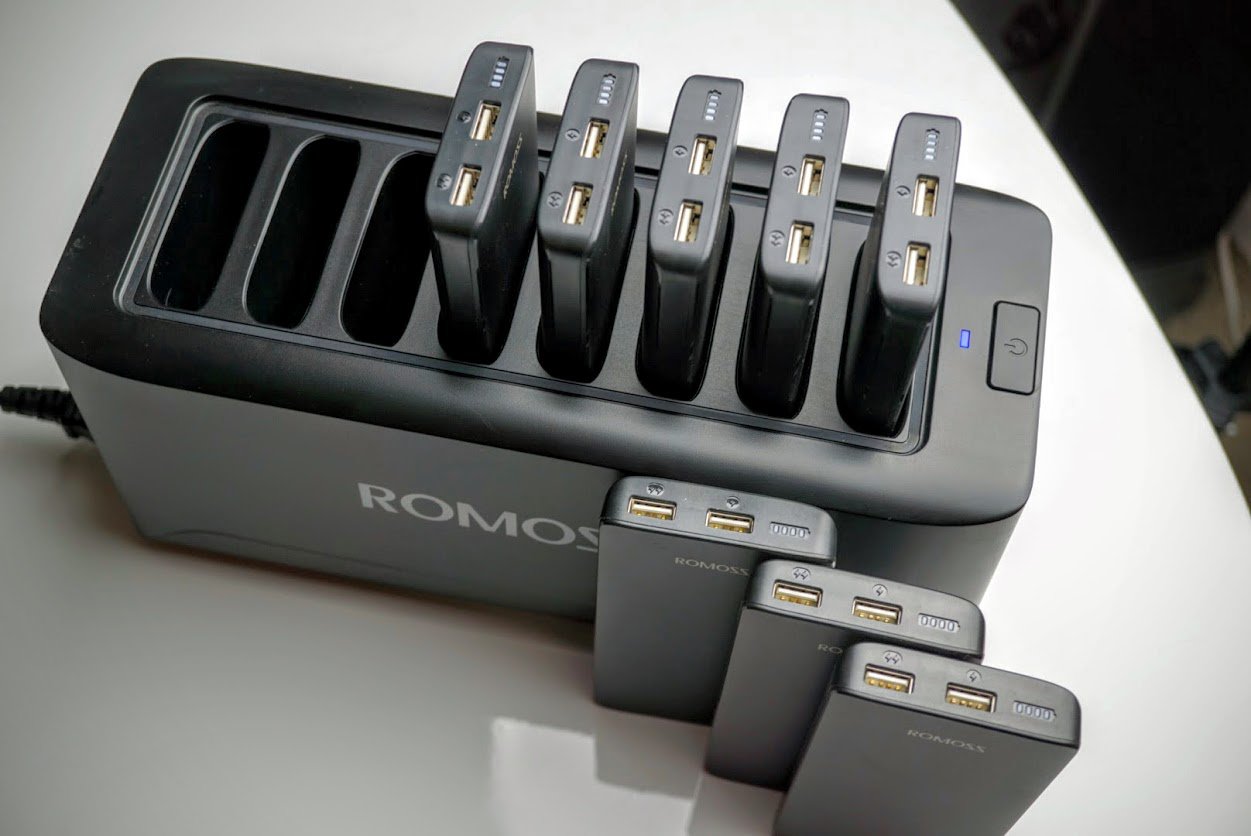
At first glance the Romoss Charging Station reminds me of a toaster oven on steroids. Instead of two slots, it has eight, and instead of dropping bread into those slots, they’re made to accept and charge eight individual portable power banks.
The Charging Station is made of matte black plastic that can be customized to suit individual business needs. If you opt for black, it comes with a matte finish which keeps away scratches and fingerprints. The build quality is top notch; all of the seams line up perfectly with no overlap of plastic on the edges. The station itself has one power input that accepts standard 100-240V, and can be daisy chained to keep wires clean if you need more than one.

Each individual power bank holds a 10000mAh lithium battery with inductive charging as the input. The inductive charging is built into each battery for ease of use (versus plugging in each battery to recharge) as well as to prevent thieves from taking the batteries home with them. There’s no way to recharge this battery other than with the charging station.
There’s a fan to keep the charging station cool while it’s under max load and recharging all eight batteries at the same time.

The fan kicks on for no more than 30s at a time in my experience, and is barely audible unless you are sitting right next to it.
Each individual battery pack has a 10000mAh rating, which is enough to charge most smartphones 3-4 times. There are also dual USB output ports so users can charge two devices at the same time at 2.4A which is the fastest iOS devices can be charged, but not quite fast enough to keep up with Android Quick Charge 2.0 and 3.0 standards.
Romoss kindly includes eight coiled charging cables with combo microUSB/lightning charging tips to suit almost all needs. It did not come with USB Type-C cables but it still can charge those devices safely with intelligent circuitry built into each power pack.

The only downside to the cables is the fact they are not permanently built into each battery pack. While you would hope users wouldn’t take them, it’s simply too easy not to in this case.
Usage
It’s nearly impossible for me to test out every single battery pack on my own. While I do not work in a coffee shop or gym, I do work a M-F 9-5pm job with 200 other employees at a biotech in San Diego. My colleagues provided the perfect testing ground for this review.
I dropped off the Romoss Charging Station in the Research group’s meeting room where we have most of our meetings, and get-togethers as well. At first the group thought the concept of the charging station was a cool novelty, but within a few days I would check on it and it was being used regularly. I frequently saw the station empty as some colleagues would bring the battery packs into the labs, offices and even home.
Since 10000mAh is enough to charge most phones 3-4 times, I had colleagues who gave me feedback that they loved taking them on the weekends on their family excursions. More importantly, it provided power to those who forgot to charge their phones before coming into work. Instead of bumming a charge off of someone else, they would grab an individual power bank and return it when finished. Romoss even provides a large vinyl sticker indicating what the charging station is so people don’t stare at it in confusion.

My coworkers use a variety of smartphones; iPhones, Nexuses, Galaxies, and a variety of budget smartphones I recommend to them as an alternative to higher priced flagships. Not one of them had a single complaint about the battery, and I work with some whiny people. The Romoss Charging Station scores high marks there for ease of use and reliability. We’ve used the station for over six weeks without a single complaint.
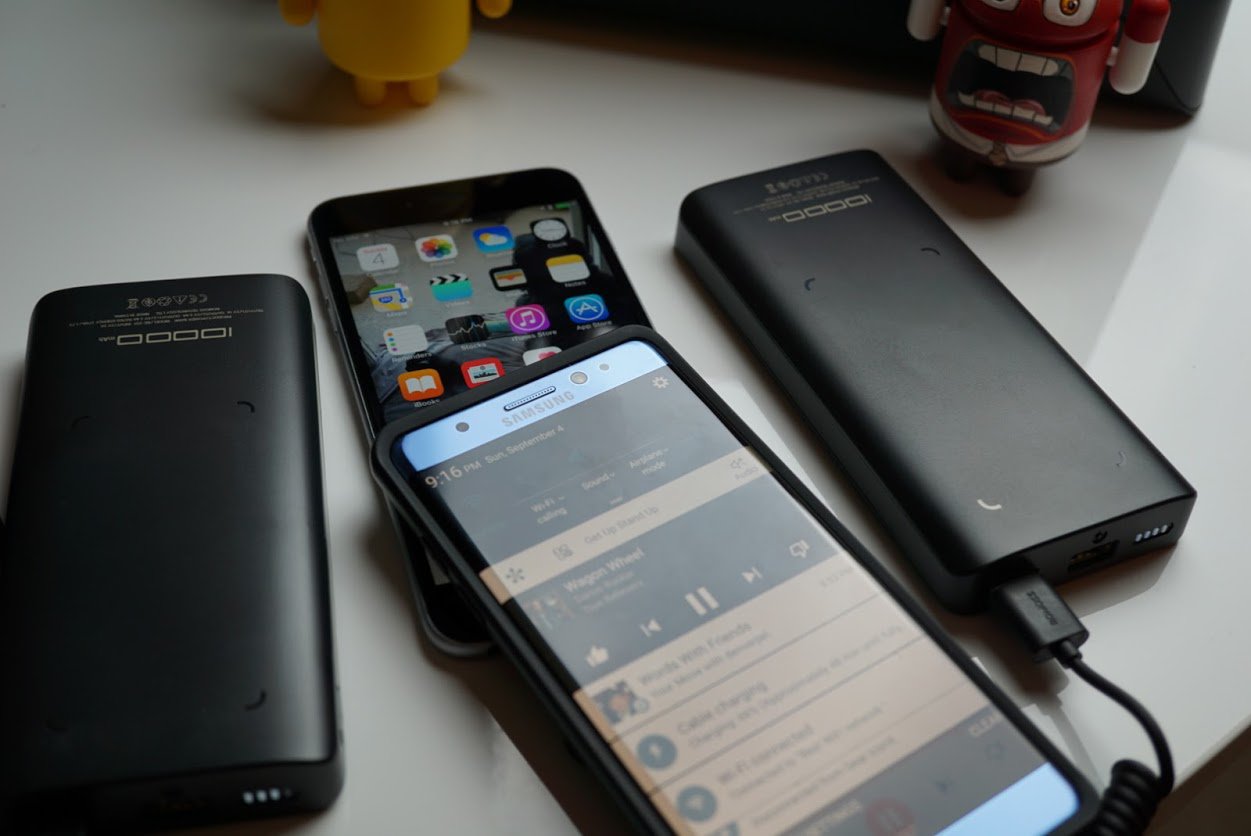
I used the power banks with a variety of smartphones and tablets myself to ensure wide range compatibility. Here is a list of devices I used:
- Nexus 6P
- Xiaomi Mi5
- iPad Pro 12.9″
- Pixel C
- Samsung Galaxy Note 7 (no it didn’t catch fire)
- Samsung Galaxy S6 and S7 edge
- iPhone 6S plus, 6S, 6 and 5SE
- Moto Z Droid
- LG G5
Not one device ran into issues. While the iOS devices charged at the fastest speed, the other Androids didn’t reach Quick Charge 2.0 or 3.0 speeds. That’s not really an issue since the power is free to use. It’s also something you probably wouldn’t want to include in a charging station like this since Quick Charge can be hard on batteries.
Recharging all eight batteries at the same time is no concern with the charging station. If you’re worried about vampire power draining out of this at night, you can turn it off with the power button on top of the station.

Summary
I am sure glad I reviewed the Romoss Charging Station with eight power banks. It’s an ingenious concept that is perfect for large families or small business owners. Portable power is becoming almost essential for every one of us who rely on our smartphones and this power station is sure to keep family members and customers happy. It sure kept my coworkers happy during the review process, and when I had to take it home for review, every single one of the users asked me when I was bringing it back. Luckily for them I will be bringing it back into work on Tuesday after the holiday weekend.
If you’d like to learn more about the Romoss Charging Station, head on over to http://www.romoss.com.

Syllable D700 Wireless earbuds: Amazing quality and sound for just $14 (review)
It’s amazing what kind of wireless headphones you can buy for $13.99.
Mobile accessories are much more accessible to everyone as long as you do your research. At $13.99, it has to make you wonder how much electronics actually cost to make. That’s cheaper than a pound of a quality cut of beef which can be consumed in less than an hour by one hungry person.
We’re bombarded with advertisements from companies like Bose and Beats by Dre, so much so that those two brands are exclusively known as the premium audio providers to people who don’t know audio. You’ve seen NFL athletes forced to wear Bose headphones and you see NBA superstars who wear Beats by Dre like it’s a dress code requirement. While Bose and Beats by Dre arguably make quality headphones, there’s a high premium consumers pay for all of that advertising.
That’s where we come in. We aren’t here to push what’s popular, we are here to help inform you of products that you probably never heard of that can save you money. I’ve been using the Syllable D700 wireless earbuds for the past few weeks and can confirm there is no point in paying for the brand name marketing any longer.
Build

The Syllable D700 earbuds are Bluetooth enabled meaning you do not need to connect them to a 3.5mm audio jack which is now missing in some of the latest flagships like the Moto Z and possibly the next iPhone. There is one wire that connects to two earbuds, with an inline remote that houses the battery and mic.
The earbuds themselves are small and can fit in almost all ears, with swappable silicone ear tips, so you can create the perfect fit for blocking out background noise. The ear hooks are flexible plastic that hook onto your ears to keep them in place no matter which activity you decide to perform while wearing the Syllable D700s.
The quality of the D700s is nothing but impressive especially when you factor in the discounted price I paid for these at $13.99. I’ve used dozens of wireless headphones in the past and there are major improvements budget earbuds with each release. The fit and form factor of wireless headphones continue to get better and better, and the D700s are no exception. The ear hooks, in combination with the adjustable slider on the earbuds make these easy to get the perfect fit. Some wireless earbuds put all of the components into ear earpiece which makes for large canisters that can be uncomfortable for those with smaller ears.

The headphones I am reviewing are all black, but they also come in blue and yellow if you prefer more color.
Usage – Audio

After taking five minutes to get the correct fit and pair to my Android smartphone, the first thing I always test is the loudness capability. Wireless headphones like the D700s are meant to be worn in noisy environments like a gym or outdoors. Loudness and sound isolation are key factors when considering any wireless headphones, and these D700s get loud. So loud that there are three extra clicks I have in reserve to notch up the volume when I need it. But I try to avoid turning it up that loud as it starts to pierce my ears.
I have yet to find a set of wireless earbuds, even those that cost upwards of $300-400 that can perfectly match their wired counterparts in terms of sound quality. If you’re looking to hear every nuance with a HiFi song from your own personal WAV collection or TIDAL subscription, you won’t find that with the D700s.
However when it comes to sound quality for wireless earbuds, these D700s are almost as good as anything I’ve heard without a 3.5mm audio cable. That’s what impresses me the most, these cost a fraction of what I’ve paid for other wireless headphones, like the Gear IconX from Samsung which cost $200, and I get the same audio quality if not better from these D700s. Some of you think, ” you get what you pay for” and that’s absolutely true. With the Gear IconX you pay for true wireless earbuds that can track your heartbeat, and you also pay for one expensive marketing team. The D700s you get pure quality and sound without all of those advertising overhead fees.
The sound of the D700s is bright. The highs are front and center with above average bass, and neutral mids. This type of sound signature is perfect for the gym or working out. These D700s are really quite fun to listen to and help me tune out all of the noise and distractions in the gym.
Microphone
As with most wireless headphones, the D700s have an integrated mic with noise blocking technology. I always test out microphone capabilities by talking to my mom on the phone, because if someone is going to have a hard time hearing me, it is always her. My standard test is an hour phone call while walking my dog outside with background noise coming from cars and people passing by in the background. My mom would occasionally tell me she couldn’t hear me, but nonetheless we still made it through the entire call.
Battery
The advertised battery life of the D700s is 4-5 hours of talk and playback time. Over several weeks of testing, I frequently got 5-6 hours. I attribute the extra time due to not turning these up to the maximum volume. I need wireless headphones to last a minimum of three hours a day, 1.5 hours for my workout and up to 1.5 hours for when I am walking my dog in the morning and evening. There’s also enough battery life to get from one end of the country to the other on a cross country flight without needing to recharge.
The D700s aren’t the longest lasting wireless headphones I’ve used before, but they are definitely above average. To fully recharge from near dead take just over an hour and a half.
Summary
The Syllable Wireless earbuds are on sale now for $13.99 at Amazon with discount code VPDGAWOH. They’re normally priced at $19.99 which I still consider a bargain for these all around solid wireless earbuds.
Wireless, water resistant, excellent build quality, solid battery life and exciting sound reproduction for a bargain price of $13.99 blows my mind. You really should consider these Syllable D700s, especially if you’re tired of paying for big brand names.
Check out the Syllable D700s at Amazon and use discount code VPDGAWOH to purchase them for $13.99.

Glass cracks and that’s why you need to protect your glass Note 7 with a Caseology case
I learned a tough lesson this year with my Samsung Galaxy S7 edge, and it’s one most of you already know; dropping your cell phone sometimes results in cracks on the glass display. In the case of the S7 edge, it can also result in cracks on the back of the phone as well.
I rarely ever used cases on my smartphones in the past. I almost never dropped them, and even if I did, they never cracked as the falls were usually from sitting down when they slip out of my pocket. After almost a decade of owning smartphones, I cracked my first smartphone and it was the S7 edge. It was kind of a freak accident. Sitting outside at a picnic table, the smooth S7 edge slipped out of my atheletic pants and fell. As a result of the fall on the edge, was a spiderweb of cracks that ruined the IP68 rating as well as the look of my beautiful device.

Insurance isn’t an option for me as I never opt to buy it for my devices. Insurance has gotten much more expensive for smartphones over the last five years, and with deductible fees and all of the fine print on what is and isn’t covered, were enough for me to avoid them.
To replace the glass on my cracked S7 edge would cost over $250. Considering I could buy a brand new S7 edge for $600-700 off contract it just wasn’t worth the money. Instead I covered it up with a skin from dbrand so I never have to look at the cracks again.
The take home lesson for me, is I should have bought a case for this phone. Cases range in price from $5-100, they come in all shapes and sizes, and most importantly they protect and prevent cracking the glass.
Caselogy cases
If you are a regular user of smartphone cases there is a good chance you know Caseology. It is a company based just north of me in Cerritos, CA. The company profile says it is made up of ordinary people like you and me who have the desire to do the extraordinary.
They make cell phone cases, how extraordinary does that get?
While cell phone cases are very ordinary, Caseology adds in the “extra” factor. I see the “extra” in the two example cases I was sent to protect my all glass Samsung Galaxy Note 7 which I will not make the mistake of going case free again.
I’ve tested quite a few cases from other reputable brands, and while they checked all of the boxes of protection, I never left them on my phones because I ended up not liking them for a multitude of reasons.
For the first time in a long time, I’ve found cases that I have no problem recommending to everyone.
Caseology Skyfall Galaxy Note 7 case – $12.99 at Amazon, $24.99 at Caseology

Caseology’s Skyfall case is perfect for those who want to show off their beautiful Galaxy Note 7s and protect it at the same time. In the image above you can see it is clear as glass. Even though it is 100% optically clear and free of defects, it is made from plastic. The sides are silver, although it does come in gold, black and rose gold as well.  Those silver sides are soft on the inside which offers drop protection, and the button slots are clear which allows the gold accent to show through from the Note 7.
Every cutout lines up perfectly for each slot – microphone, 3.5mm audio jack, USB C charging port, speaker and of course the stylus.
Caseology managed to design the case so that it doesn’t change the way you eject the stylus from the Note 7, and while it may seem like a small issue, this is where the designers went the “extra” distance. I’ve already tested out other cases that do impede the stylus, and for those of you who use it regularly like I do, you want a case like this. Adding difficultly to ejecting the stylus is enough for me to eject a case from my life.

Above I stated that the case is perfectly clear. This allows you to show off the natural beauty of the Note 7, but my only issue is that it draws fingerprints just like any other clear surface. As long as you don’t touch the inside of the cover when installing the case, you can wipe off the back with a soft cloth to make it clean and clear once again.
Design, attention to detail, high quality look and feel set this Skyfall case apart from the crowd. The best part of the case though is its incredible price at just $12.99 at Amazon. I could buy 20 of these cases for the cost of the broken glass replacement from Samsung, and if you’ve ever had glass replaced, it rarely works like it did when it was new.
Caseology Wavelength Galaxy Note 7 case – $15.99 at Amazon, $24.99 at Caseology

I’m a big fan of the Wavelength series case from Caseology. It’s a two piece case that is made up of a soft rubber covering, with a rigid second piece that holds it in place around the phone. While maintaining a slim profile, it manages to bring in features like a full front lip on the front to protect the screen as well rigidity found in bulkier cases.

The outside and inside are texturized with lines that give this case the ultimate grip factor. The Note 7 is a small form factor with a phone of its display size, but it is still large making it hard to grip with the smooth sides and back. When I used my Note 7 case free for the first day, I never felt safe holding it in one hand. That led me to grip it tighter than I would have liked, which lead to a few aches in my hand.

The Wavelength case feels extremely tough while providing the grip that gives me confidence to hold this phone with less force. Just like with the Skyfall series, all of the cutouts and buttons line up perfectly with the Note 7.

Priced at $15.99 on Amazon, you really can’t go wrong with this case. It’s durable, affordable and very well designed. I prefer the black color for this case, although it does come in black/gold, coral pink, mint green and navy blue to suit your individual taste.
Summary

Caseology is a brand you can trust and might be a brand you already trust. Its products frequently sit atop the ranks at Amazon and these two examples show the “extra” that Caseology adds to ordinary. Design, price, and protection all score perfect marks in this review and I suggest you keep your Note 7 protected to prevent damage like I encountered with my Galaxy S7 edge.
Learn more at Caseology.com.
Facebook Messenger’s ‘Instant Video’ looks awfully Snapchatty
Bots have been all the rage in Facebook Messenger over the last few months, but today the social network is adding a new way to chat with your pals. The company announced a tool called Instant Video that allows you to have those quick conversations face-to-face in addition to text and photos. Yes, video calling was already available in Messenger, so what’s new here? Well, Instant Video is meant to be easily and instantly (get it?) accessible inside a chat conversation rather than having to go through the process of making a call. It’s all about efficiency.
If that sounds familiar, it’s because Snapchat allows you to do something similar. Inside that messaging app, you can tap to share video with the person you’re already having a text conversation with in a flash. Facebook’s version works pretty much the same way with an Instant Video icon situated at the top of the window. As long as you and the person you’re talking to are both running the latest version of Messenger for Android or iOS, you’ll be able to employ the feature. Instant Video only works as long as you keep the chat open and you can continue conversing via text while the window floats over your chat. Audio is turned off for the recipient of the video by default.
This isn’t the first time Facebook or one of its apps has taken cues from Snapchat. Instagram Stories arrived in early August to compile images and videos in a format that’s very similar to Snapchat’s own Story feature. Facebook also nabbed face-swapping app Masquerade back in March to add photo filters to its arsenal of apps. In fact, the social network has already announced that those features would be available in Facebook Live at some point. Zuckerberg & Co. have clearly taken notice of Snapchat’s popularity, so it’ll be interesting to see it Facebook decides to take any more inspiration from that app in the future.
Via: The Verge
Source: Facebook
Microsoft’s Sunrise calendar app gets a stay of execution
When Microsoft made a final appointment to terminate Sunrise on August 31st, fans of the app were discouraged. Not only were they losing their favorite calendar program, but Redmond has not integrated very many features into Outlook as it promised when it purchased the app last year. However, it has now decided to delay Sunrise’s shut down. “We have chosen to wait a little longer in order to deliver a few more Sunrise-inspired features in Outlook,” a spokesperson told PC World .
Last year, Microsoft promised to leave Sunrise on the market “until its features are full integrated into Outlook.” However, a lot of the coolest functions, like integration with social media and productivity apps, and “interesting calendars,” have yet to appear in Outlook. The app was supposed to be shut down yesterday, but if you already have it on iOS or Android, you can continue using it for now. However, “once [the extra] features are released, the Sunrise app will officially be shut down,” it said.
Source: PC World
Lumsing’s dual port charger covers all of your charging needs, including USB Type-C and QC 3.0
Quick Charge, Quick Charge 2.0, Fast Charge, Quick Charge 3.0 and the list goes on and on. Android smartphones are annoyingly confusing when it comes to charging terminology. All we really care about is that our phones and tablets charge as fast as possible. We shouldn’t have to do research on what exactly each charging standard means, and hopefully sometime soon, these companies will standardize the charging types and unify it for our sake.
Until then we have to drudge through the ever expanding home chargers, cables, power banks and car chargers until they finally decide to make a change.
Today I am reviewing the Lumsing 48W dual port Quick Charge 3.0 and Type-C wall charger.
Build and Usage
I’ve been a fan of Lumsing’s for quite sometime. The company makes a wide range of mobile accessories; chargers, cables, portable power banks, headphones and more. Its philosophy is to avoid making technology more complicated and expensive than it needs to be. I’ve used its power banks and given a few away to friends who use them regularly. I still see my friends using the batteries that I gave them over a year ago.
Lumsing’s latest dual port wall charger follows the same concepts of its other products – it’s simple, well built and easy enough for anyone to use. It’s made of matte plastic that has a soft touch and comes with a foldable plug which is nice for travelling. Having a foldable plug prevents the prongs from bending when carrying in a laptop bag or backpack.
 There’s also two USB out ports, one standard USB A and one USB C. While there are more phone manufacturers making the switch to USB C, most accessory companies are far behind. Having a charger that is compatible with both is very nice to have in this USB transition.
The Lumsing USB A port has Quick Charge 2.0 and 3.0 meaning it can charge my Galaxy Note 7 at the fastest speed from the USB A port. It also charges my Note 5 and S7 edge at the fastest speeds and those devices still use microUSB as a charging standard.
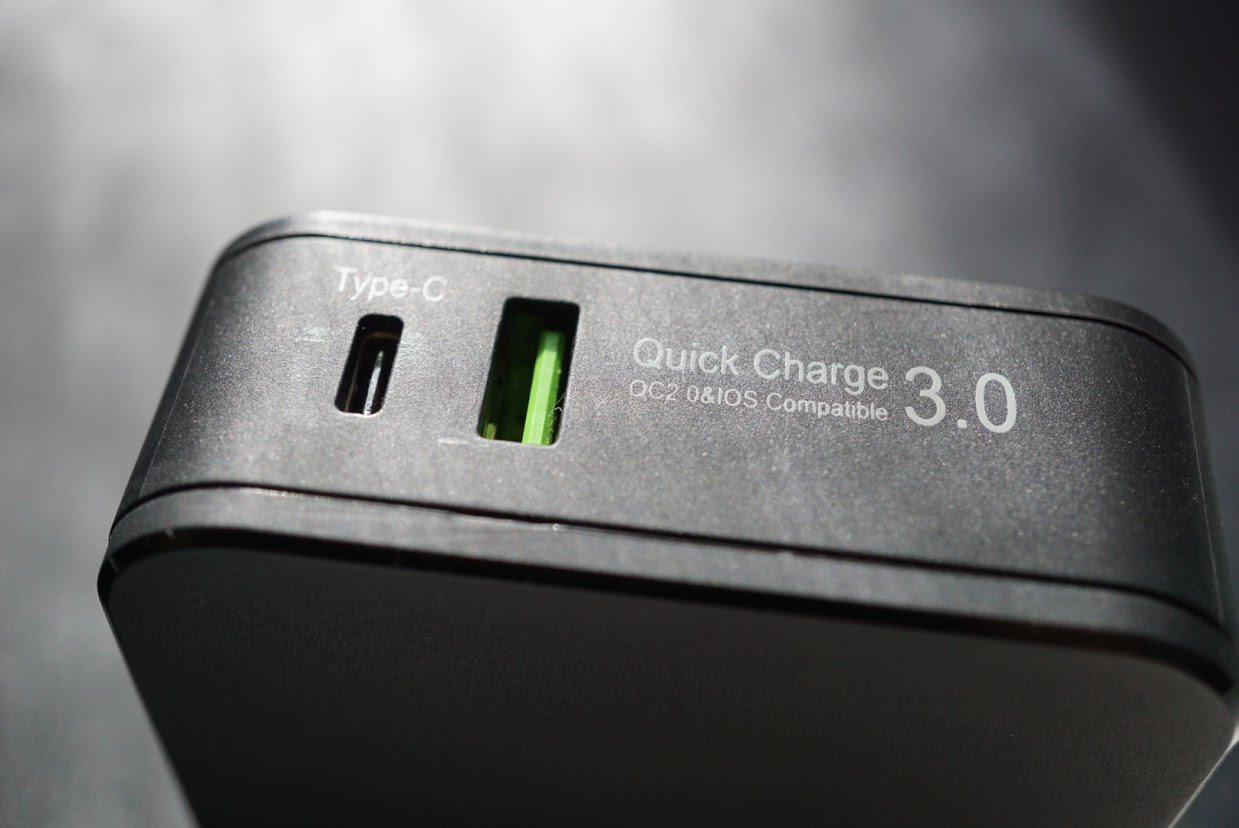
The USB C port is perfect for devices such as the Nexus 6P and 5X which have the Fast Charge standard.
Like I said before, the lack of unification standards amongst manufacturers is extremely annoying but Lumsing did its part by giving you everything with this dual port charger. Yet having the fastest charging speed available is necessary as batteries in smartphones and tablets get bigger. If you don’t have the fastest charge available, it can take extremely long to recharge a smartphone with an older charger since the batteries are much larger now.

It’s well built, reliable and it doesn’t generate excess heat like lesser chargers do.
All around the charger is just what I want in an accessory. Well-built, extremely functional, reliable and portable.
Summary
My only real gripe with the Lumsing dual port charger is the cost at $36.99 at Amazon. There are other capable chargers that have similar specs that cost less. While the Lumsing dual port 48W charger is highly capable and I love using it, I have a hard time recommending at this price. I have no doubts that Lumsing will reevaluate the price when it fills its backorders and fills inventory at Amazon.
If you’re looking for a reliable charger this is a strong contender in a sea of accessories. Just wait for the price to drop by $10 before you make a purchase.
Check out the Lumsing dual port 48W charger at Amazon.com.
Moto Z Play Droid unboxing and first impressions

Motorola today announced its latest smartphone, the Moto Z Play Droid, which figures to be an exclusive smartphone for Verizon. With specifications that fall more in the middle of the pack for today’s handsets, it’s still quite the attractive package.
We received a review unit of the Moto Z Play Droid on Friday and have spent a couple of days getting to know the device. We’re not ready to compile a full-on review of the phone just yet, but we do have some first impressions we’d like to share.

Taking the phone out of the box you realize that this iteration of Motorola is unlike anything else in the company’s history. Like the Moto Z Droid and Moto Z Force Droid this phone is svelte and sexy. On the surface it exudes premium craftsmanship and begs to be looked at from all angles.
It’s almost as if Motorola took the old Cliq XT design from years back and gave it a 2016 reboot. By that we mean it has a modern design with black cues but is also trimmed in a silver finish. It’s familiar to us because we knew something similar from 2010, but it’s oh so fresh with more solid materials. Dare we say it also looks as if Lenovo/Motorola took more time with details.
The Moto Z Play Droid is a heavy device; it’s more dense than we expected it to be. Looking it over, there’s so much here that intimidates us. It has been a very long time since Motorola delivered a phone that we were afraid to leave the house with over fear of ruining it. One drop and we’re afraid it would be scuffed, scraped, or worse, shattered. We want to show it off so badly but, at the same time, we want to protect with some sort of case. As much as we like to insure ourselves with cases, we enjoy looking at the details on the rear.

It didn’t take us long to realize that there’s no Verizon branding on the phone. While it’s certainly prominent on the box and in the apps, it’s not on the surface of the handset. There is a “Droid” branding under the camera, but that’s it. Otherwise, it’s a simple stylized “M” on the rear and a Moto on the front above the display. We’re not sure if this was Motorola’s doing or if Verizon loosened its grip a bit, but we’ll take it.
Holding and using the Moto Z Play Droid with one hand is comfortable, even with our smaller hands. At 5.5-inches, the display does have a little thicker bezel than some of its competitors, but we’ve seen worse. The 1080p resolution is crisp and color is quite accurate in our first few days with the phone.
In addition to the phone itself, the box also comes with a wall charger (USB Type-C), a MotoMod protective shell for the rear, and a tool to remove the microSD and Nano-SIM cards. There’s also a small booklet but there are no headphones. Speaking of which, a quick glance at the bottom shows us that Motorola did leave the 3.5mm port in this model.

The protective rear shell snaps into place via magnets and fits snugly against the phone. In fact, you’d be forgiven if you thought that it was part of the handset itself. The wood grain design has the same realistic appearance that is found in other, previous Motorola phones built in the Moto Maker tool.
Apps
Powering on the phone and checking the app tray we find that there’s no mistaking this for anything but a Verizon model. There are nearly one half dozen apps with Verizon branding pre-loaded including VZ Navigator, VZ Protect, My Verizon, Message+, and Cloud. You’ll also find a couple of others here, too: Android Pay, Caller Name ID, Amazon Kindle, IMDb, NFL Mobile, and Slacker Radio.
Android
After spending time away from Motorola phones, it was refreshing to be return to the software experience. Specifically, we were happy to find a largely untouched version of Android (6.0.1 Marshmallow) with only minor additions. And when we say additions, it’s subtle stuff that really enhances things.

Who doesn’t love picking their phone up and seeing the screen wake up? Moreover, we appreciate being able to twist our wrist to launch the camera, double chop to kick on the flashlight, or simply wave their hand over the display to wake it? To us, it’s just the right amount of OEM customization.
A couple of days into using the phone and we’re totally in love with it. Sure, the Moto Z Play Droid isn’t going to best any benchmarks but that matters little to us. We’re not pushing our phones to their limits and wager to guess that most of you aren’t either. With that said, the Snapdragon 625 processor (2GHz octa-core) and 3GB RAM do the trick so far. We’ll keep adding more apps and games to it to see how it fares with more demanding titles; look for that in the full review.
Fingerprint reader
The fingerprint reader was easy to set up and has responded quickly in every situation we’ve employed it. Whether waking a phone up or authenticating a purchase, we found it to be accurate and fast. We’d love to see Motorola put some sort of reader on the rear where the logo is, but that’s a quibble. To us, if you’re not pulling double duty with the reader acting as a home button, we say move it around back.

Sound
As for speakers, there’s only one on the Moto Z Play Droid; it’s the same one for taking calls. Listening to music is decent as there’s plenty of sound. It could be more rich, but we don’t ever find ourselves breaking out a phone to take in a playlist.
Watching videos on YouTube or Netflix was pleasurable, but not overly robust. Again, we’re not the type to spend extended periods on our phone watching movies and expecting a theater experience. Throw in some headphones or pair to a speaker and now we’re talking.
Camera
The 16-megapixel camera features laser autofocus, phase detection autofocus, and an f/2.0 aperture. There’s also a dual-LED flash on the back to brighten up your shots. We’ve not tested the camera in all lighting conditions yet, but thus far we’re impressed with the shots. The software is no-frills so there’s something to be desired in some aspects. On the other hand, we like that we’re not bogged down with too many choices for scenarios. we’ve yet to kick the tires on the front-facing camera.

Hasselblad MotoMod
As part of our review kit, we also received one of the Hasselblad camera MotoMods to try out. Indeed, you can snap this guy on to the back of the phone as easily as the case and give your Motorola phone a 12-megapixel camera with a 10X optical zoom. Capable of taking RAW images, the camera also boasts a Xenon flash.
As you might expect, the camera can connect with both the Motorola Z Droid and Motorola Z Force Droid, too. Moreover, the other MotoMods launched in the last few weeks can be attached to the Moto Z Play Droid. We’ve already snapped a number of pictures with the Hasselblad MotoMod and will share those in our full review.
Battery
The phone comes with an internal, non-removable 3,510mAh battery. We’ve found that it lasts us well beyond two full days of use but we’re not using it as a daily driver just yet. Additionally, we’ve yet to load all of our apps and accounts to the handset so we do expect to see it drop. Charging is super fast, for what it’s worth, thanks to the TurboPower cable. According to Motorola, spending 15 minutes on the charger will result in 10 hours of power.
We’re really enjoying the Moto Z Play Droid so far and look forward to putting it through its paces. Look for a more thorough review in the coming days and weeks!
Google wants your help to improve its automatic translations
Google’s ability to interpret and translate handwriting isn’t perfect. Sometimes you’ll scribble a word or take a photo of a restaurant menu on holiday, only to have a garbled mess thrown back at you. To help its “smart” assistants and services, Google has released a new app on the Play Store called Crowdsource. It’s a bare-bones affair, asking you to transcribe digital squiggles and photographed road signs. There are no discernible rewards, only the occasional message (“you’re great!”) and meaningless ‘milestone’ when you’ve completed a certain number of tasks. In short, you’ll need to really love Google to open the app more than once.
The app, of course, is still hugely beneficial to Google. Any submissions — no matter how few — can be fed into its algorithms and used as a foundation for better, more accurate translations and analysis. The subsequent improvements should trickle down into Maps, Translate, Photos and conversational services such as Google Assistant. It’s just a shame the company hasn’t integrated some form of reward system — something similar to Google Opinion Rewards or the Google Maps Local Guides program would go a long way to incentivizing contributions.

Via: Android Police, TechCrunch
Blu Pure XR review: All the flagship you need and only $300
Miami-based Blu has released its latest smartphone, the Pure XR. Worthy of the title of flagship, it features just about every hardware detail you’d need or expect in some of today’s best Android phones. And, why not? It’s the first sibling to the Pure XL, a powerful device with a big screen and kick-ass hardware.
What makes this one different? For starters, it’s got a price tag that you’ll have a tough time beating. At $300 it’s much lower than what you might find in other flagship models. Even when compared to devices like the $400 ZTE Axon 7, it’s a wonderful value proposition.
We’ve spent the last few weeks using the Blu Pure XR as a daily driver, replacing our main phone. Rather than carrying around a secondary phone, we swapped this one in as the phone we lived with for all needs. Why? Because it’s the sort of package that appeals to us. The specs are right in line with just about anyone’s needs; it’s not just for first-time buyers, but for those with a more demanding mobile lifestyle.

General Impressions
From the second we picked up the box we knew that the Pure XR was a cut above other Blu models. Whereas you might find a thin and cheaply made cardboard box in the R1 HD, this one is solid. We’re talking a thick, white box that signals a more premium device inside.
Opening it up we see that Blu brought its A-game with the phone and its accessories. Inside are the phone, a charger, a pair of headphones, and semi-clear (frosted) plastic protective case. We can see that Blu put extra care in the accessories as they don’t look or feel generic. Sadly, it’s not everyday that you get the headphones with a smartphone at this price.
Picking up the Pure XR, we noticed it was really thin but with just the right amount of heft. The metal unibody design looks gorgeous; there’s nary an antenna line to break up the look. The model we reviewed features a white front and gold rear, but there’s also a grey version to choose from, too.

We liked the chamfered edges on both the front and back, though they aren’t quite as pronounced as what the HTC 10 offers. Nevertheless, the bevel cut certainly catches the light and your eye in the process.
Hardware
On paper, the Blu Pure XR lines up very nicely with phones that fetch $400-$500. This means you’ll get more than enough to run today’s top games and apps, with breathing room for a good year or two as well. It largely depends on what kind of user you are, or end up being, as to how long it will last. We venture to guess you’ll have no problem holding on to this one as long as any other phone you’ve considered.
Power comes from a MediaTak (Helio P10) 64-bit 2.0GHz octa-core processor with a Mali-T860 GPU and 4GB RAM. Storage comes in at 64GB internally, with a microSD card slot good for another 64GB.
 Other key hardware includes a 16-megapixel rear camera with phase detection autofocus, laser autofocus, and F/1.8 aperture. Around front we find an 8-megapixel wide-angle camera.
As an unlocked phone, the Pure XR is compatible with AT&T, T-Mobile, and their respective GSM networks [4G LTE, (2/4/7), 4G HSPA+ (850/1700/1900/2100)]. Like other Blu models, this one comes with support for two SIM cards so feel free to mix and match, especially if you travel.
In terms of design, the Pure XR looks more expensive than it actually costs. The color palette works well together and we like the choice in material.
The right side of the phone houses the power button and volume rocker with the former sitting below the latter. Across to the left is where you’ll access the SIM cards and microSD expansion card slot. Down below is (from left to right) the speaker, USB Type-C port, microphone, and 3.5mm headphone jack.
The home button doubles as a fingerprint reader while there are two tiny buttons to the left and right. By tiny we mean there are small dots which light up to indicate location. But, in reality, there’s a rather decent amount of space around them which respond to presses. A software setting lets the user define which is the back button and which is the recent apps option.
Display
At 5.5-inches, the Super AMOLED display falls right on the border of super comfy and plus-sized. Its 1080×1920 pixel resolution (401 ppi) screen is protected by Corning Gorilla Glass 3 so it can withstand scuffs and scratches that come with life. Speaking of the glass, there’s a gently curved edge to the screen which not only looks great, but responds to touch well.
One area where lower priced smartphones tend to cut corners is the resolution; often they’ll dial down to 720p to keep price down. We’re glad to see that Blu went with a full HD image, especially as others are pushing into the 2K resolution.
 The Pure XR delivers a gorgeous and accurate picture in all lighting situations. Pictures pop off the screen and reading text was easy in an scenario. With software in the settings users can define particular options and configure to their liking. Want something more warm in tone? Need a larger font? There’s an easy way to toggle these.
One area where the Pure XR stands out from its competition comes in the 3D Touch technology. Indeed, it’s possible to press, long press, or push down on the screen to pull up different options.
There are a handful of places where we encountered the ability to leverage the 3D Touch. Icons for apps like phone, contact, file explorer, and camera yield quick-access shortcuts to functions within the respective titles. A hard press on the camera icon puts you one tap away from selfie, video, or snapshot modes. The file folder does the same for browsing music, documents, videos, or pictures.
 To say that the 3D Touch is invaluable would be a stretch. While we were pleasantly surprised at how it was implemented on the Pure XR, we didn’t find that use case where we simply had to use it. It might take some time, but we do see it being helpful and handy. It’s likely going to have to be an Android standard or supported at the platform level before we’re using it on a regular basis.
With all of that said, some of the default apps from Blu were fun to play with and figure out. It’s quite convenient once you figure out which apps take advantage and in what manner. It’s not unlike having one icon on your home screen that pulls triple duty (or more). We look forward to seeing this rolling out to Google apps down the road.
Camera
When it comes to cameras, the Blu Pure XR offers up one of the best experiences we’ve seen this year. And, when you factor in the $300 price tag, it gets even more appealing. We were consistently impressed with the handling of photos, in nearly all scenarios.
The depth of field was downright incredible, and even managed to trick a few of the others here into thinking the images came from some other source. Thanks to macro mode, we really enjoyed taking tightly focused shots and close ups.
Other modes included in the camera software include HDR, night, panoramic, time-lapse, HDR, and a text recognition. Yes, the last one can actually snap a photo of text in a magazine or book and it can be converted to something you can copy or share using Android’s built-in sharing options.
Camera Samples (Flickr)

Time and again we found ourselves tinkering with the options, creating gifs, and other fun stuff. When it came time to editing with apps or sharing on social media, the pictures looked just as good as anything else we’ve taken.
Can you get a better photo from a smartphone? Yes, of course. But, you’re going to spend at least $200 or more for that privilege. The Pure XR is not a perfect camera, but it far exceeds what you should expect from an unlocked $300 phone.
Software
As is to be expected with a Blu smartphone, there’s very little done to distract from the stock Android experience. There are some extra tweaks done here and there, and there are a couple of added apps, but it’s largely the same Android you might get from a Nexus phone.
Among the apps that Blu installs on the Pure XR are McAfee Security, Opera, NextRadio, a couple of Amazon titles, and its own clients for music, sound recorder, notes, and file explorer.

There are also a couple of apps for UI (Chameleon, Theme Park), which give the user control over the aesthetics for menus, wallpapers, icons, widgets, and more. They’re not necessary but they do make for a fun experience that can be refreshed in a matter of moments. If anything, we liked using Chameleon to pull real-world colors into our menus, giving us a palette that speaks directly to us.
Users will also find an option in the software for the 3D Touch which toggles a Force touch “Edge Bar”. When pressed on the edge of the screen it pulls up shortcuts to user-defined apps. It’s not unlike what you might get from a Galaxy S Edge model, but without the edge display. Just press harder on it than you would for a tap and there you go. Speaking of 3D Touch, you can adjust its sensitivity so you don’t feel like you’re going to smash it like the Incredible Hulk.
 Interestingly enough, Blu opted to put the shortcuts to system settings at the bottom of the screen. Instead of swiping down from the top as you might in any other setup, this one reveals itself from a bottom up swipe. Doing so reveals your shortcuts to sound, vibration, location, screen rotation, settings for Bluetooth and Wi-Fi, and more.
Expand the menu and you get deeper into things like alarm clock, camera, calculator, torch (flashlight), and airplane mode. Indeed, there’s even a “fake call” button that triggers a 15-second timer which rings and gives you a recorded message on the other end, prompting you to get out of your current situation.
For those who have ever wanted to take a long, full page screen shot, the Pure XR has you covered. Instead of piecing together multiple images in a row, or sending separately, the software gathers it all up in one neat picture.
 Whether or not the Blu Pure XR ends up with the recently introduced Android 7.0 Nougat release remains to be seen. We wouldn’t necessarily hold our breath on it, but thus far we don’t see many things you need to have. Sure, there are features which are definitely enjoyable, but it’s not like the major updates from years back.
At the very least, we hope to see Blu keeping pace with security updates and patches. Given there’s nothing major going on with the UI, this should not be a problem. But, this is the double edge sword that you end up with on unlocked smartphones.
Were we talking about a $100 phone we would say forget it and move on to a new phone a year or so down the road. But, when discussing a potential flagship model, you hope to see more than the minimum amount of support. Here’s hoping that Blu doesn’t “set it and forget it” with the Pure XR.
Performance
As a daily driver for someone who uses their Android for a little bit of everything, the Pure XR performed admirably. We’re always reluctant to install a bunch of apps and games until we’ve gotten a sense for the out of box stuff; a few weeks into using the Pure XR and we’re back to business with the games, apps, and other settings we’ve become accustomed to using.

One of the first things we tend to do with our phones is to swap out the launcher and software experience for Nova or something else. Why? Because it does away with the carrier or branded stuff and gets back to what we’ve defined over the years. Icon packs, wallpapers, widgets, and other settings are a breeze to import; it’s the UI we want.
Strangely enough, going the custom launcher route with the Pure XR was a mixed bag. On one hand we liked going back to the familiar software setup from our previous phones. On the other, doing so turned off the 3D Touch and Edge Bar. In just the two weeks we had with the phone we came to appreciate being able to access select apps and shortcuts from the sidebar.
If you’re not a custom launcher type, you won’t know or care much about this. Go with the stock Blu setup and enjoy yourself. The only real complaint we have with the standard setup is that it removes the app drawer in favor of placing icons on the home screen panels. In other words, you could have multiple pages of icons to swipe through. Yes, you can rearrange them and group into folders, but it can be a little off-putting to users who have come to expect a certain way of organizing things.
As we ramped up the number of apps and games we kept an eye on performance. We’re happy to say that the Pure XR works very well as a daily driver for a seasoned user. The hardware stands up to everything we tossed at it, be it a bunch of apps, GPS, camera, games, or a mixture of all of the above.

Battery life was great as well. The 3,000mAh power source gets us through far more than a day’s worth of usage without us breaking into a panic at dinner time. The included 9V/2A Quick Charger (USB Type-C) lets users juice up quickly so you’re not stuck to a wall for long at all.
Blu says a 10 minute charge is all you need for one hour of talk time and we’d tend to agree. It’s hard to rate talk time anymore since we use our phones for everything but the reason they were first invented. We tend to throw ours on a charger at lunch for an hour and we’re back in business with a full charge to get us home. Watching a variety of YouTube videos, playing a couple of games, and checking email on a regular basis seemed to have the same impact as what you’ll get in much more expensive flagship phones.
The fingerprint scanner home button was quick and very accurate. Whether you want to set this up for your lock screen or other security settings is up to you, but we totally recommend it. We’d like to have been able to simple touch our thumb to the home button to go back to the home screen, but it’s a trivial point. Instead, you have to press into it to activate the home shortcut.
Conclusion
We’ll cut right to the chase: there’s no reason for us to switch to another phone after using this. Sure, there may be some more exotic looking models out there, but they come at a price. Yes, there those with 6GB RAM or heavier specs, but those, too, don’t come cheaply. You’ll have to do your best to convince us to part with more money after having used the Pure XR for a few weeks.
As the second model in the Pure line from Blu, we really like where it’s headed. It’s considerably more of a flagship series than the Energy, Dash, Studio, Life, or Vivo line yet it doesn’t stray from the company’s roots. In other words, there’s tremendous bang-for-buck in the Pure XR.

We would recommend that anyone getting into the first Android consider going the Blu route. If for no other reason that carrier flexibility and price, it’s hard to beat ’em. More savvy or experience smartphone users should definitely consider the Pure XR as a replacement to anything from the last few years.
On paper, the phone lines up quite nicely with the Samsung Galaxy S7 or Motorola Moto G 4 Plus. But, only one of these is going to leave you with money left over for accessories, games, or a nice dinner.
- Shop for the Blu Pure XR at Amazon
- Shop for the Blu Pure XR at Best Buy
Ocho welojes: The 8 latest smart watches on the market

Asus
Zenwatch 2
The Asus ZenWatch turned some heads when it was released in 2014, but with more of the market moving towards round faces, nobody knew what to expect for its successor. The Asus ZenWatch 2 was announced at IFA in 2015 and released in September of 2015. The ZenWatch 2 was different from its predecessor due to the fact that it was offered in two different sizes; 49mm and 45mm with strap sizes of 22mm and 18mm, respectively.
Watch Face Type: Square
Key Features
- Built in Speaker
- Fast charging
- Curved Glass


Pricing
- Amazon: $159
- B & H Photo: $14
- Google: $149
Casio
Smart Outdoor Watch
Casio is a name familiar to the watch industry. The Smart Outdoor Watch marks the legendary company’s first foray into smartwatches. The watch was announced at CES 2016 and marketed to fans looking to live an active lifestyle.
While it isn’t the cheapest watch out there, you do get many features not included in most Android Wear smartwatches. A rugged design, water resistance, and many connected apps, just to name a few.
Watch Face Type: Round
Key Features
- 50-meter water resistance
- Dual LCD’s full color and monochrome
- Military-grade


Pricing
- Casio: $500
- Google: $499
- REI: $500
Huawei
Huawei Watch
The Huawei Watch isn’t Huawei’s first foray into the smartwatch world, but, it was its first smartwatch to feature Android Wear. The Huawei Watch was announced at Mobile World Congress in February of 2015 and officially released in September of 2015.
Huawei has impressed so many with its first smartwatch that some say its the best on the market. The Huawei Watch is a beautiful Android Wear device and is definitely worth checking out.
Watch Face Type: Round
Key Features
- Built in speaker
- Cold-forged stainless steel build
- Altitude sensor


Pricing
- Amazon: $249
- B & H Photo: $349
- Best Buy: $249
- Google: $399
- Target: $349


Huawei Jewel and Elegant
- B & H Photo: $399
- Google: $499
SEE ALSO: Infrequent but important: little used apps I can’t live without
Fossil
Q Founder
2015 brought several new traditional watchmakers to the Android Wear community, one of the most notable being Fossil. The legendary watchmaker released a few watches, most notably the Q Founder.
The Q Founder sits in the same price range as watches like the Moto 360 while offering stunning looks and great reliability. In a crowded market, Fossil is looking to give customers a reason to choose them over the rest of the field.
Watch Face Type: Round
Key Features
- Iconic Brand
- 1 GB ram
- 24-hour battery life


Pricing
- Amazon:$275
- Google: $275
LG
Watch Urbane – 2nd Edition LTE
This is the only watch that can get data on its own without needing a smartphone to connect to it. Using AT&T’s Number Sync feature the watch and get calls that are redirected from your cell phone using your current number.
The Watch Urbane – 2nd Edition LTE also has a huge (considering it’s a watch) 570 mAh battery that should last you all day if not into the night before having to charge it.
Watch Face Type: Round
Key Features
- LTE built in
- P-OLED 1.38″ display
- Sporty Design


Pricing
- AT&T: $199
- Verizon Wireless: $449
Motorola
Moto 360 Second Gen
Arguably the most beautiful Android Wear device was released in late 2014, the Moto 360. Folks everywhere were wondering how Motorola was going to follow up the great first run with an Android Wear smartwatch, and whether that annoying flat-tire would still be around. When the new Moto 360 started getting leaked, people were disappointed, until they saw it in person.
The 2015 Moto 360 still has that flat tire that houses the various sensors, but Motorola was quick to let everyone know that the display to bezel ratio was better than any smartwatch available today. It comes in 42mm and 46mm sizes as well as Rose Gold, Chrome, and Black.
SEE ALSO: Sprint to Announce LG Optimus S for October 31
Watch Face Type: Round
Key Features
- WiFi built in
- 24 Hour battery life
- edge-to-edge Gorilla Glass


Pricing
- Amazon: $224
- B & H Photo: $289
- Best Buy: $299
- Google: $299
- Walmart: $349


Moto 360 For Women (Rose Gold)
- Amazon: $316
- B & H Photo: $322
- Best Buy: $329
- Google: $329
 AIVAnet