


Breakout, Centipede and Asteroids, now in your Denny’s app

Denny’s — or as Denny’s and no one else calls it, “America’s Diner” — has partnered with Atari to create…interesting versions of classic games Breakout, Centipede and Asteroids. The games are free, and available now in both iOS and Android app stores via the Denny’s app. Whether you can stomach what they’ve become in the transition — from classic games to a “retro, remixed promotion” for a trio of new dishes at a chain of diners — is the question you’ll have to ask yourself. Breakout becomes “Take-out”; Asteroids becomes “Hashteroids”; and Centipede becomes “Centipup.” There’s a trailer too that’s only slightly soul-crushing.
We couldn’t help but share these game descriptions as well, straight from whoever at Denny’s was hired to write madness.
- Hashteroids – You’re aboard the SS Denny’s Condiment Transport ship and the mission is clear: deliver 40 tons of condiments to the 4th planet in sector 7d.
- Centipup – Once upon a time, a young boy named Danny came across a bottle of syrup and with just a slight squeeze the bottle’s sticky contents had the power to turn anyone or anything into a fried egg.
- Take-out – A wall made entirely of delicious Denny’s breakfast items appears blocking all the take-out orders from their rightful owners. The only way to feed customers is to break down that wall!
Filed under: Cellphones, Gaming, Handhelds, Tablets, Software, HD
Source: iOS App Store, Google Play Store, Atari

OUYA’s new subscription model gives you ‘everything’ for $60 a year

When the developer of your platform’s most popular game says “being the best game on OUYA isn’t a huge deal,” it might be time to innovate. OUYA is trying. Earlier this year it announced plans to bring its gaming platform to smart-TVs and set-top boxes — now it’s testing out a subscription model. The deal seems pretty straightforward: $59.99 buys a year’s worth of access to every game on OUYA. Read the fine print, however, and it’s clear this isn’t quite the Netflix of Android gaming.
OUYA’s all-access pass doesn’t instantly make every titles in the console’s library available to you, but it does drop all of the game’s prices down to $0.00 — users still have to rummage through the store and “buy” titles if they want to play. There are some restrictions, too: purchases made with the OUYA All-Access pass must fall under $30 a piece, and the zeroed-out prices don’t carry over to in-game purchases. It isn’t clear if these free “purchases” will stay on the user’s account after their 12-month subscription expires.
According to an email sent to developers, the All-Access pass is a limited time offer, and purchases made by subscribers will still contribute to their regular earnings. The message asserts that this is a test to see if a subscription model makes sense for OUYA in the long term. Is Ouya’s entire library worth $5 a month? Time will tell — but you can let us know your own opinion in the comments below.
Filed under: Gaming
Via: Ars Technica
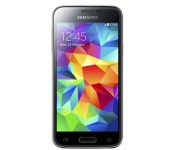
Samsung’s Galaxy S5 mini keeps the sensors but not the specs

Samsung has revealed the latest mini update to its flagship smartphone: the Galaxy S5 mini. While it’s often expected that the company will scrimp on sensors to save on price, the S5 mini includes many of the same features as it’s full-sized sibling, including waterproof certification, power-saving modes, a heart rate monitor, fingerprint scanner, and support for the latest Samsung wearables. As expected, there’s also a 1.4GHz quad-core processor, Android 4.4, 16GB internal memory (expandable up to 64), and 1.5GB of RAM, which match what we’ve seen in years past. The display is a 4.5-inch Super AMOLED affair, which powered by a 2,100mAh battery, with the cameras enjoying in 8- and 2.1-megapixel resolutions. The company expects the S5 mini to go on sale in Russia from “early July,” but there’s no word on when it’ll spread to other countries. Samsung plans to expand sales globally, though, offering the device in Charcoal Black, Shimmery White, Electric Blue and Copper Gold.
Filed under: Cellphones, Software, Mobile, Samsung
Source: Samsung Mobile Press

T-Mobile brings the LG G3 to the US on July 16th for $599 up front

Americans, your wait for LG’s G3 is (nearly) over. T-Mobile has become the first big US carrier to take pre-orders for the 2K-capable Android smartphone, and now expects the device to hit retail shops on July 16th. Be prepared to fork over a lot of cash if you want that pixel-packed display as soon as possible, though. The G3 will cost $599 if you buy it outright, and it doesn’t currently qualify for an easier-to-swallow installment plan. Other stateside carriers haven’t revealed their plans to carry LG’s brawny handset, but we’d expect matching announcements from at least the larger networks before long.
Filed under: Cellphones, Mobile, LG, T-Mobile
Source: T-Mobile (1), (2)

Samsung unveils a quartet of Android smartphones for the budget crowd

Not everyone can justify splurging on a powerhouse phone like the Galaxy S5, and Samsung clearly knows it — the tech firm just unveiled four Android KitKat handsets for frugal types. The Galaxy Core II (shown here) is the standout of the bunch, although it’s a curious case of taking two steps forward and one step back. While it has a larger 4.5-inch (if still WVGA) screen and a much faster quad-core 1.2GHz processor, it also drops from 1GB to 768MB of RAM and cuts the built-in storage in half, to 4GB. Thank goodness there’s a microSD card slot, or that storage could get cramped very quickly.
As for the rest? They’re much more focused on first-time owners and developing regions, like China or India. The Galaxy Ace 4 is mostly a software-focused refresh of the Ace 3 that still has a 4-inch WVGA screen and either a dual-core 1GHz or 1.2GHz processor, depending on whether or not you’re getting 3G or LTE data. The Galaxy Young 2 and Star 2, meanwhile, are strictly for those with basic needs — both have 3.5-inch half-VGA screens, single-core 1GHz processors and fixed-focus cameras, while the Star 2 omits even 3G data. You probably won’t be rushing to line up for any of these devices, but they should be big deals for anyone who has just enough cash to dip their toes into the smartphone waters.
Filed under: Cellphones, Mobile, Samsung
Source: Samsung Tomorrow

Google drops Quickoffice now that its own apps can handle your work

Google bought Quickoffice to boost the productivity of its Apps suite, and it clearly accomplished that mission when it released a slew of mobile editing tools that merge Quickoffice’s file tech with Google Drive. Accordingly, the search firm is pulling the plug on the earlier software; it’s going to remove Quickoffice from both Apple’s App Store and Google Play “in the coming weeks.” You can still download it after that if you’re an existing fan, but newcomers will have no choice but to use either Google’s apps or their rough equivalents.
The move isn’t surprising, since there’s no need for Google to keep a redundant app hanging around. However, it marks the end to a long, long chapter in cellphone history. Quickoffice was a mainstay of mobile workers before smartphones took off, and it has run on most major (and not-so-major) platforms over the span of roughly 12 years — it’s sad to see the name go, even if the technology will live on.
Filed under: Cellphones, Mobile, Google
Source: Google Apps
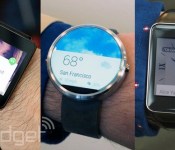
Google will have sole control over the interfaces of Android Auto, Wear and TV

You’d better get used to the interfaces you saw for Android Auto, Wear and TV at the Google I/O conference this past week — you’re going to be seeing them a lot. Google tells Ars Technica that it will maintain sole (official) control over the interface for all three new platforms, rather than give that power to manufacturers. While companies will be allowed branding and extra services, they won’t get to modify the core experience. You won’t see a Gear Live sequel with the Gear 2′s front end, for example, or find your way around town with a Honda-exclusive take on Android Auto.
Engineering director David Burke says this requirement is meant to provide a “very consistent” experience; you won’t have to grapple with different controls just because you’re watching TV in your bedroom instead of the living room. The shift in policy also lets Google manage the update process, which should be as “automatic and seamless” as the company’s Chrome browser. Theoretically, you won’t see the haphazard upgrade process common to non-Nexus Android devices, where updates sometimes arrive months after their official launches, if they arrive at all.
The move is likely to please fans of Google’s approach to interface design, or those who simply want to try new features as soon as possible. However, it’s a sharp break from Google’s mostly laissez-faire attitude to Android on phones and tablets — car, TV and wearable makers will primarily have to distinguish themselves through hardware if they want to use the bulk of Google’s services. If they insist on their own control layouts, they’ll have to take an Amazon-like approach and build (or find) replacement technology. The strategy likely won’t preclude you from loading custom software after the sale, but the Android you see in stores won’t be quite as diverse as it once was.
Filed under: Home Entertainment, Transportation, Wearables, HD, Mobile, Google
Source: Ars Technica
Google and MediaTek to work together on Android One project

During the Google I/O 2014, Google introduced the Android One series. The devices under it will be released in developing nations, and this is actually Google’s move to take a huge chunk out of the low-end smartphone market. There was a time when Nokia conquered it, now as Google Android powered smartphones are on top when we talk about high-end smartphones, they are also joining hands with different companies to manufacture low-cost phones under the Android One banner.
According to DigiTimes, MediaTek is now Google’s strategic solution partner for the development of the Android One initiative, which will enable smartphone makers to build low-cost smartphones that will target at least 1 billion customers.
At the I/O, Google showcased the first ever Android One smartphone, it was made by an Indian company Micromax and it was running on MediaTek MT6575 SoC as well.
Android One should be under the price tag of $150-100 if Google wants it to be a success in the developing smartphone markets. Do you think Android one will be a success for Google?
Source: DiGiTImes
The post Google and MediaTek to work together on Android One project appeared first on AndroidGuys.
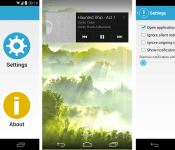
Download and install Android L’s “Heads up!” notifications on any Android 4.3+ device

It’s quite obvious Google I/O is Google’s biggest event of the year and one of the biggest tech events in general. This year Google had lots to say, they announced a bunch of stuff, but Andorid “L” preview was one of the biggest, definitely. Developers are apparently working 24/7 in order to bring some of that “L” preview to users which don’t own a Nexus 5 or 7, in other words those who can’t install Android “L” developers preview or don’t want to bother doing that.
Android “L” keyboard landed in the Google Play Store yesterday and now we get “Heads up!” notifications the same way. This app is brought to you by a developer called “Woodblock without Co.” and was first announced on XDA, where you can still preview it and download it for free. If you don’t want that hastle, you can get it directly via Google Play Store, though it will cost you $1 to get it from there. This is a small price to pay, plus you’d be supporting the developer.
There are lots of options within the app, you can whitelist/blacklist apps and even set the app to show you heads up notification while you’re in fullscreen mode within a certain app. This application is really packed as we said, but don’t take our word for it, if you want some of that Android L goodness, follow the links and see for yourself!
Source & download 1: XDA
Download 2: Google Play Store
The post Download and install Android L’s “Heads up!” notifications on any Android 4.3+ device appeared first on AndroidGuys.
Android L Keyboard now available in the Play Store

Earlier today, Kristijan showed those of you who don’t have a rooted device how to get the new Android L Keyboard. However, the issue is that this wouldn’t work on every device. In fact, there’s a lot of devices it wouldn’t work on such as my old, original Nexus 7 and my current daily driver, the Moto X.
But have no fear, there’s a guaranteed way for it to work now. That’s comes via Shen Ye on Twitter who now has a working APK and has uploaded it to the Google Play Store for everyone to grab…FOR FREE!
There are a couple of steps you need to follow once it’s installed to get it to display, but this is just a matter of going into the settings and activating the “Material” theme. You can find the steps below once you’ve installed the new Android L Keyboard from the widget below as well.
- Go To Settings
- Click on Keyboard (sometimes called Language & Input)
- Turn on the Android L Keyboard
- Scroll down to advanced settings
- Change Color Scheme to “Material”
- To use, go into somewhere you can type, drag down your notification bar and switch the keyboard there.
It’s literally as simple as that boys and girls. And the good thing is, this should work on any device running Android 4.2 and above. That’s going to cover a lot of devices actually now days. That’s a good thing and I know a lot more people will be happy installing it from the Play Store.
Also note that Shen Ye has stated that he’s working to get a version where the “Material” theme is set by default, to avoid the few simple steps above.
The post Android L Keyboard now available in the Play Store appeared first on AndroidGuys.

