


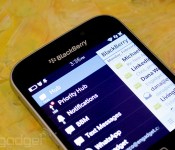
BlackBerry wants to bring some of its best features to every device

BlackBerry has only been willing to give out tiny pieces of its smartphone experience so far, like BBM and its enterprise servers, but it’s going to be much more liberal in the near future. It’s launching BlackBerry Experience Suite, a collection of apps and services that bring some of its biggest features to Android, iOS and Windows gear in hopes of making them mainstays of the working world. Some of them are more behind-the-scenes features that keep your corporate info both secure and separate from your personal affairs. However, others are very conspicuously borrowed from BlackBerry 10 smartphones. The company is promising the BlackBerry Hub (which unifies BB10’s messaging), universal search and even its own input method — yes, you may get a BlackBerry keyboard on your phone without resorting to a Typo case. The suite won’t be available until later in the year, but it may be just the ticket if you (or your office) wants to try BlackBerry features while keeping the hardware and apps you already use.
Filed under: Cellphones, Mobile, Blackberry
Source: BlackBerry (1), (2)

Google releases new Android video for the young at heart

With all kinds of new Android powered devices being announced at MWC 2015, like the Samsung Galaxy S6 and Galaxy S6 edge and the HTC One M9, Google has released a new video in their line of be together.not the same. commercials. The new video is titled Android: Young Together and shows how ordinary people of all ages use their devices to stay young at heart.
You can check out the video after the break. Be sure to stick with us at TalkAndroid for more coverage from MWC 2015 to see all the new Android powered devices ready to hit the market.
Click here to view the embedded video.
Come comment on this article: Google releases new Android video for the young at heart
Speck releases lineup of cases for Samsung Galaxy S6 and S6 Edge
With the big news about Samsungs new flagship phones you will need a case to protect all that glass. Speck is one of leaders in case making and is often praised for there functional attractive cases while providing the best protection. Today they have released a large portfolio of cases for the soon to be relesed galaxy S6 and S6 edge. These cases will be avalible at launch with seven of their most popular designs.
The launch lineup includes the popular CandyShell, CandyShell + Faceplate, CandyShell Grip, CandyShell Inked, CandyShell Card, MightyShell, and MightyShell + Faceplate all in various colors and designs. Speck has been a leader in case design for years offering some of the most fuctional yet protective cases for the most popular phones on the market. These cases will be availible day one when both the S6 and S6 edge releases. The Samsung Galaxy S6 and S6 edge are expected to be the hottest phones for Samsung and android this year. More information about these cases and reveiws will be avalible as soon as AndroidGuys has them.
The post Speck releases lineup of cases for Samsung Galaxy S6 and S6 Edge appeared first on AndroidGuys.
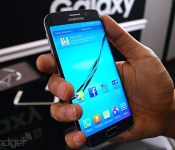
Samsung Galaxy S6 comes with Microsoft apps out of the box

Those rumors that Samsung would reduce the glut of in-house software on the Galaxy S6, and include some of Microsoft’s apps? They’re at least partly true. Both the S6 and S6 edge will ship with a “Microsoft Apps” folder that currently includes OneDrive, OneNote and Skype. There’s no hint of Office (at least not yet), but you will get 115GB of free OneDrive cloud storage for two years. You certainly won’t be hurting for photo backup space, then. It’s hard to say if the bundle is the direct result of Microsoft and Samsung calling a truce in their Android royalty dispute. Either way, the move is going to give Microsoft’s services a lot more exposure. While they’ve been available on Android for some time, their absence in phone bundles has typically made it easier to lean on equivalents from the likes of Google and Dropbox.
Filed under: Cellphones, Mobile, Samsung, Microsoft
Via: The Verge
Source: Samsung Mobile Press
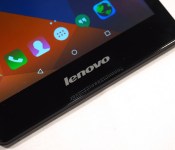
Lenovo rolls out new sub-$200 tablets, two with Dolby Atmos
 Lenovo might still be a little sore from the Superfish scandal that recently rocked its PC division, but thankfully the company’s mobile arm has remained unharmed. And that’s a good thing, because it’s kicking off Mobile World Congress with the announcement of not one, not two, but three new tablets, in both Android and Windows flavors. The Lenovo Tab 2 A10 and the Lenovo Tab 2 A8 are from the budget-friendly Android A series, while the affordable Lenovo MIIX 300 is for those who prefer the operating system from Redmond. The overarching theme of all three of these is simple: Value.

But just because they’re affordable doesn’t mean these tablets are shy on features. The highest end of the lot is the Lenovo Tab 2 A10, which is also the one that’s most focused on entertainment. Not only does it has a nice 10.1-inch full HD IPS display for watching movies, but it’s also equipped with Dolby Atmos technology and a multi-speaker soundbar to really give you that theatre experience. In a brief demo of the tablet, I thought the surround sound was remarkably good considering its compact size — it’s not too hefty at 509 grams and it’s about 8.9mm thin. The speaker soundbar sounded far richer than most tablet speakers, though using headphones would still result in better audio quality. It ships with Android 4.4 KitKat (it’ll be upgradeable to Lollipop later this year), runs on a quad-core MediaTek processor, has dual-band WiFi and a 8-megapixel camera. Markets outside the US will get a LTE version of the tablet as well. As for the battery life, Lenovo is promising up to ten hours of charge thanks to the 7,200 mAh battery.

Next on the list is the Tab 2 A8, which is very similar to the A10 except it’s, well, smaller. It has an 8-inch HD IPS display instead of 10 and is of course lighter at 360 grams. The Tab 2 A8 also comes with Dolby Atmos, but it would be better to experience it through headphones since the A8 lacks the A10’s powerful speakers. Other features of the A8 include a MediaTek quad-core processor, a microSD card slot that accepts up to 32GB cards, a 5-megapixel rear camera and dual-band WiFi. Interestingly, the international variant of the Tab 2 A8 comes with a dual SIM card slot for those who like to hop between carriers and it supports both voice and LTE. Yes, that means you could potentially use the 8-inch A8 as a phone. Holding it in my hand, I don’t think I could imagine hoisting this next to the side of my face, but I imagine you’d only make calls with this thing with a headset. It has quite a bit of bezel surrounding the display which I’m not a huge fan of, but the sharp and colorful high-def screen makes up for it. Another great feature of the A8 is that it ships with a pure version of Android 5.0 Lollipop, which could be why performance was relatively zippy when I played around with it.

Last but not least is the MIIX 300, which almost seems like the last kid picked for teamsports in this particular grouping — it’s not just quite as cool as the other two. Then again, the MIIX 300 is intended to be the most budget-friendly Windows tablet (a lower end version of the MIIX 2) from Lenovo yet and its humdrum design reflects that. Still, it has a decent 300-nit 8-inch HD IPS display, an Intel Atom quad core processor, a 5-megapixel rear camera, 64 GB of internal storage, a microSD card slot and, of course, WiFi. You also get a free one-year subscription to Microsoft Office 365 as part of the package. It ships with Windows 8.1, and a Lenovo spokesperson tells us that it should be upgradeable to Windows 10 when that rolls around later in the year.
The Tab 2 A10 will be available in Pearl White and Midnight Blue and will ship for $199 starting in April. As for the Tab 2 A8, that comes in Pearl White, Ebony, Midnight Blue and Neon Pink and will be available in June for a starting price of $129. International models with the dual SIM card slots will cost roughly $179. Finally, the MIIX 300 lives up to its affordability promise with a low low price of $149, which makes it the cheapest Windows tablet in Lenovo’s lineup. The MIIX 300 will be available in July.
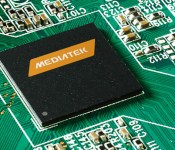
MediaTek’s standard lets your devices share their hardware

There are plenty of standards for sharing your media collection between devices, but what if you want to borrow a device’s camera or display? MediaTek thinks it has an answer. Its new CrossMount standard lets devices share their hardware and software when they’re on the same WiFi network, letting you use whichever components make sense in a given situation. You can use your phone’s mic to dictate voice commands to your TV, for example, or use your phone’s webcam for a video chat on your tablet.
CrossMount is an open standard based on the Universal Plug and Play (UPnP) standard you probably have in some of your existing gear, so it might be easy to implement when it’s available in the third quarter of the year. A few big East Asian TV and mobile device makers have already hopped on the bandwagon, including Changhong, Hisense, Lenovo and TCL. With that said, it’s hard to know if anyone else will bite. There are still a lot of other companies that haven’t signed on, and big names like Samsung or LG may prefer to use in-house tech for any device sharing.
Not that MediaTek is putting all its eggs in one basket — it has a few chips in store as well. The darling is the MT8173, a 64-bit processor that’s supposedly the “highest performing” CPU you can get in a tablet. It mates two high-end Cortex-A72 cores with two low-power Cortex-A53 cores to deliver about six times (!) the performance of last year’s MT8125, or enough to handle 4K video with ease. And fans of mid-range phones might like the MT6753, an eight-core 64-bit Cortex-A53 processor. Neither is available just yet, though. The MT6753 won’t reach devices you can buy until the second quarter of the year, while the range-topping MT8173 isn’t poised to show up until the second half.
Filed under: Cellphones, Home Entertainment, Tablets, HD, Mobile
Source: MediaTek

All racing sim fans should buy this Android game right now!
The quality of Android games is steadily increasing, as is the appeal of Android itself, which has in-turn lured some lucrative iOS developers to release their games on the Google Play Store.
One such game is Motorsport Madness by Christian West who has brought his hit game over from iOS, and boy is it good!
FEATURES
• This is your racing team. Hire drivers, develop your car and invest in technology.
• Work with your drivers to achieve the perfect qualifying lap.
• Formulate the ideal pitstop strategy to win races.
• Watch the race in real-time or jump into the strategy screens to take control of the action.
• React to weather changes, crashes and safety car periods.
• Win championships across the world to reach the pinnacle of motorsport.
If you’re an F1 fan, or even just share an appreciation for motorsport racing and simulation games then you need this game on your Android device.
Download it now from the link below.
The post All racing sim fans should buy this Android game right now! appeared first on AndroidGuys.
Android for Work is ready to make your phone office-friendly

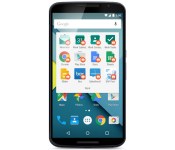
Remember Android for Work, Google’s big effort to make your smartphone safe for business? It’s finally ready for prime time. The officially launched initiative lets you keep work-related accounts and app info separate from personal affairs while maintaining security — you don’t have to worry that higher-ups will peek at (or worse, delete) your vacation photos. You’ll only get full flexibility if you’re using Android 5.0 Lollipop, which lets you create work profiles, but an app will grant you access to corporate-approved tools if you’re running Android 4.0 or later.
The launch is getting help from a mix of app and hardware providers, including Box, Citrix, VMware, HTC, LG and Sony. Even BlackBerry is helping out with Android for Work support in its latest management tools. Developers of paid apps can even get in the mix, by opting-in to make their apps available for bulk purchase. However, Samsung isn’t pitching in to the same degree that was promised last year. While Samsung is still a partner, Google tells Recode that it didn’t end up using the Korean tech firm’s Knox technology to lock things down. Whatever’s under the hood, you now have a better chance of using your personal phone for office duties without enduring the hassles and security risks of the past.
Filed under: Cellphones, Internet, Mobile, Samsung, Google, Blackberry
Source: Android Official Blog, BlackBerry

Android snags 81% of the market in 2014 with over 1 billion units shipped
 With 2014 in the books, we’re finally getting the numbers to see how each manufacturer and OS did over the past year. The good news for Google and Apple (and bad news for the likes of Microsoft and BlackBerry) Android and iOS accounted for a whopping 96.3% of all smartphones shipped. That leaves a very small 3.7% for Windows Phone and everything else that’s competing for scraps.
When you break the numbers down between Android and iOS, though, Android came out a clear victor in the market share battle. Android devices accounted for 81.5% of all phones shipped, finally breaking the 1 billion mark for smartphones. Compared to those 1 billion Android smartphones, Apple shipped 192 million phones for 14.8% of the market.
In the Android camp, Samsung still pulled in the most market share among Android OEMs. Samsung actually shipped more than the next five vendors combined, which is a phenomenal amount of devices. However, growth year-over-year was nearly non-existent, while smaller manufacturers saw quite a bit of growth.
It’s nearly set in stone that Android is going to stay the top dog, at least when it comes to global market share. The next big battle will be between Samsung and everyone else in 2015.
source: IDC
Come comment on this article: Android snags 81% of the market in 2014 with over 1 billion units shipped

T-Mobile details the progress of your Android phone’s updates

Many US carriers don’t tell you how close you are to an Android update — in some cases, you’ll be thankful if you get a forum post after the new software hits. T-Mobile, however, just became more accommodating. It just launched a tracking site that shows you whether or not an Android device upgrade is still in development, at the carrier for testing, or ready for action. If you’re curious, you can also dive into a discussion. This isn’t the most elaborate page (you won’t get time estimates), but it will at least let you know whether or not you should be patient.

Filed under: Cellphones, Wireless, Mobile, T-Mobile
Via: PCWorld
Source: T-Mobile
 AIVAnet