


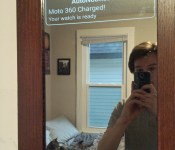
Redditor builds smart mirror that displays Android Wear watch notifications
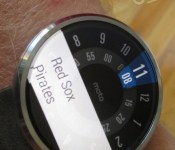
 Chalk this up for the craziest DIY project of the week. A Redditor has built a mirror that mirrors notifications from his Android phone and tablet, no pun intended. Using Auto Wear, that mirror now shows Android Wear notifications, too, like when the battery is fully charged and ready to go, as seen above. Yep, instead of actually picking up his watch to see if the battery is charged, he just gets to glance at his mirror.
Anyone want to make a bet on how long it takes for a major tech company to offer him a job?
source: Reddit
Come comment on this article: Redditor builds smart mirror that displays Android Wear watch notifications
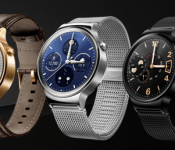
Huawei Watch won’t be cheap, but it won’t be super expensive either

The rumors of the Huawei Watch going for $1,000 was obviously insane. Now that everyone is back to earth, we are starting to get an idea of how much this thing of beauty will cost.
It has already shown up with a price of €349 ($370) for the silver and black versions on a German site called Billinger. They are offering the gold version for €399 ($424).
Mobile Fun in the UK has also chimed in with £300 ($448) for the silver and black versions and £350 ($522) for the gold.
Now we translated prices to the U.S., but it never works that way. We can expect that the U.S. price to be closer to the Euros or Pounds pricing since there won’t be any extra taxes built in. I am hopeful the U.S. price will be $299 and $349, but I suspect it will come in at $349 and $399.
The Huawei Watch looks awesome, but I am still concerned with that smaller battery. I sense another Moto 360 in that we won’t be able to leave that display on all the time like you can on the LG G Watch R and the upcoming LG Watch Urbane.
source: TechnoBuffalo
Come comment on this article: Huawei Watch won’t be cheap, but it won’t be super expensive either
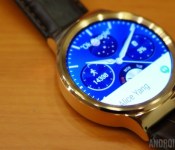
Huawei Watch price unveiled by several different online retailers

Huawei’s new Android Wear-powered smartwatch may be one of the best looking wearables ever made, though we still don’t have an official price directly from the company. When the Watch was announced, the only detail we heard regarding its availability was that it would launch in more than 20 different countries, whenever that may be. It seems as though we’re getting closer to finding out the official price point, as a number of different online retailers have outed the price for three different color variants of the Huawei Watch.

German online retailer Billiger first unveiled the price for the silver and black variants at €349 (~$370 US), and €399 (~$425 US) for the gold version. If those prices are indeed accurate, we could expect to see the Watch launch for somewhere around the $349-$399 price point. Not only that, but UK retailer Mobile Fun reached out to the folks at TechnoBuffalo and confirmed its pricing is set at £300 for the silver and black models, and £350 for the gold variant.
While these prices seem accurate so far, we still have yet to receive any official word from Huawei. Prices are outed early all of the time, so we need to make sure to remember that anything can change from now until launch date.
If you’d like some more information on the Huawei Watch, you can check out our hands-on and first impressions here. Would you buy the Watch if it cost somewhere between $349-$399? If not, which Android Wear device would you buy instead?
Street Art, Google’s first Android Wear watch face, is now live in the Play Store

Google has just released its first Android Wear watch face to the Play Store. It’s called Street Art, and features a very pretty design, though it comes with barely any customization options.
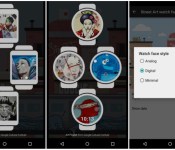
Every few minutes, the watch face rotates through a giant list of street art pieces, powered by Google’s Street Art Project. Dozens of different artists’ paintings are featured, including Cheko, Erik Otto, Gemeniano Cruz, Mariana Dias Coutinho, Mercedes deBellard and many more. As for customization, there are three different watch face choices: Minimal, Analog and Digital. Minimal features a circle that surrounds the screen with small dots to represent the minute and hour hands. Analog shows you numbers around the display with traditional watch hands, just like any other analog watch face. Digital shows the time towards the bottom, highlighting the featured art piece.
Other than that, there aren’t too many additional options to make it your own. You can choose to add or remove the date to your watch face, though you can’t choose the highlight color or how often paintings rotate through. Oh, and for those wondering, the Street Art watch face has small notification cards. We’ve attached some screenshots below for a closer look:
#gallery-1
margin: auto;
#gallery-1 .gallery-item
float: left;
margin-top: 10px;
text-align: center;
width: 33%;
#gallery-1 img
border: 2px solid #cfcfcf;
#gallery-1 .gallery-caption
margin-left: 0;
/* see gallery_shortcode() in wp-includes/media.php */
-

- Minimal

-

- Analog

-

- Digital

-

- Art information

-

- Small card view

Every time the watch face changes images, you’ll get a card letting you know the artist’s name and information on the painting. Swiping the card to the left will allow you to open the page on your phone, if you’d like to check out more information on the featured piece.
This watch face isn’t the most customizable, but it does do a really nice job at making sure you don’t get tired of the same old watch face. If you’d like to check this one out for yourself, head to the Google Play Store link below.

Moto 360 goes live on Moto Maker with various cases, bands and watch faces
Motorola announced this morning that the Moto 360 can now be ordered and customized through Moto Maker. The addition of the Android Wear powered watch gives you the ability to choose from the three cases, dark metal, light metal or champagne gold. After you choose your case you have nine watch bands to choose from […]
The post Moto 360 goes live on Moto Maker with various cases, bands and watch faces appeared first on AndroidSPIN.
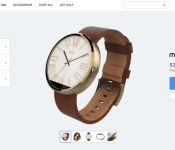
You can now customize your Moto 360 using Moto Maker

Months after leaks, Motorola has finally enabled Moto Maker support for the Moto 360 smartwatch. Customers can pick any combination of bands and body when purchasing the wearable, offering a unique customization experience like no other.
Available body variants include Light Finish and Dark Finish which are both offered for the base price of $249.99. The Champagne Gold unit will cost an additional $30 at $279.99. As far as the bands are concerned, you can get the 23, 24 and 18mm metal bands for an extra $50. The 22mm Stone Leather, Black Leather and Cognac Leather bands are offered for free. So you can get a Champagne Gold body and combine it with Cognac Leather band for just $279.99.
The 24mm metal mono link band will reportedly have delayed shipping, but all the other bands appear to be in stock. The options here are not as versatile as the Moto X, but it’s a welcome addition to allow customers to pick their own materials and design. Hit the links below for more details.
Source: Motorola Blog, Moto Maker
Come comment on this article: You can now customize your Moto 360 using Moto Maker
Moto 360 gets Moto Maker tool
Motorola on Tuesday introduced its Moto Maker tool for its Android Wear-powered smartwatch, the Moto 360. Head to the Motorola website today and you’ll find you can pick and choose the exact design you want for your wearable. Pricing shakes out to be the same as before with the predesigned models; there are no new… Read more »
The post Moto 360 gets Moto Maker tool appeared first on SmarterWatching.
Source: SmarterWatching
The post Moto 360 gets Moto Maker tool appeared first on AndroidGuys.
Android Wear getting ready to put on WiFi support, gesture control

As the smartwatch battlefield heats up with the entry of a new player in Apple’s Watch product, sources inside Google shared a little bit about the roadmap for Android Wear and its next version. According to these sources, Google is ready to enable WiFi support on Android Wear devices. This could make the devices marginally more useful for users. Currently, a Bluetooth connection to another Android device is required for users to get notifications or user Google Now. With the WiFi support, users could roam a little further from their other connected devices. Most Android Wear smartwatches already include WiFi hardware so they should benefit from this change.
In addition to the WiFi support, sources say Google will be adding gesture control to the devices. The present version of Android Wear requires users to got through notifications or find other information using their free hand or voice controls. The new gesture control means they will be able to do something like flick their wrist to move from one notification to the next.
Google reportedly is also making it easier to navigate apps and contacts on an Android Wear device. Some of that is probably driven by support for gesture control and some of it is probably due to Google needing to make the devices even more user-friendly now that the competition is heating up.
source: The Verge
Come comment on this article: Android Wear getting ready to put on WiFi support, gesture control
Apple Watch details: what you need to know about Android Wear’s biggest competitor

Apple revealed its first smartwatch back in September, but the Apple Watch models shown to the world back then were nowhere near final products. Six months later, Tim Cook’s company is finally revealing more concrete details on its wearables. Here’s what an Android fan should know about today’s Apple Watch announcement.

A little background
Google had a six months head start in the smartwatch race, having announced Android Wear in the spring of 2014. The first Android Wear devices were basic “reference” models from Samsung and LG, that haven’t really made a lasting impression through their hardware or features. Motorola’s Moto 360 sparked more excitement thanks to its sleek design, while more recent models from LG, Asus, Sony, and Huawei have added refinement, style, and new features to the basic Android Wear recipe.
While the Android Wear ecosystem is developing steadily, there’s still something missing. Just over 700,000 Android Wear smartwatches shipped last year, according to market research, and it’s increasingly clear that people aren’t yet convinced they want a smartwatch, let alone need one.
Will Apple, with its unparalleled marketing acumen, be able to kick-start the smartwatch category in a way Google and its partners haven’t?
Here comes the Apple Watch

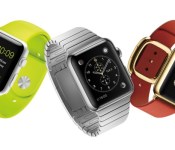
The Apple Watch will be available in three variants, and a variety of band configurations. Furthermore, all three models will be available in two sizes, 38mm and 42mm, in an apparent effort to appeal to women (and/or just those with smaller wrists) and to offer more customization options. That’s something we wish we would see from Android Wear manufacturers as well, as their current smartwatches are largely geared towards men.
At the bottom of the price range is the Watch Sport, made of aluminum and covered with ion-strengthened glass, which is identical to the iPhone cover glass. This model will be available from $349 for the 38mm version or $399 for 42mm, meaning it will compete directly with current Android Wear and smartwatches running other OS, like the Pebble Time and LG’s experimental webOS-powered Urbane LTE.
The Apple Watch Regular Edition is next up, swapping aluminum for stainless steel, and glass for sapphire. As you can imagine, pricing only gets higher from here, with the 38mm variant ranging from $549 to $1,049 and the 42mm variant from $599 to $1,099 — depending on your choice of bands.
With Watch Edition, Apple is really shooting for the luxury segment, offering 18K gold models. True to Apple’s premium demanding nature, the Watch Edition will be priced from $10,000. Yes, that’s the starting price. This particular model will only be available in limited quantities and from select retailers. We have to imagine “select retailers” could mean less of your Best Buy type stores and more of the type of establishments you’d buy high-end watches and jewelry from.

As far as functionality is concerned? The Apple Watch doesn’t feature just the interaction model based on swipes and taps that we all know from mobile operating systems and Android Wear. The mechanical crown on the side of the phone can be rotated to navigate through the installed apps, while the watch is able to differentiate between a simple tap and a hard press. There’s also some voice command integration, obviously thanks to Siri, which can be accessed by simply pressing on the crown.
In many ways, the Apple Watch experience remains largely the same as Android Wear, in that the device is meant to augment the smartphone experience, not replace it. You get all the messages you’d get on an iPhone with the Apple Watch and you get voice assistance, just like with Android Wear. However, one of the big differences in functionality is that you can receive calls on the Apple Watch, thanks to the built-in mic and speaker. For those keeping score, yes, that’s very similar to what we’ve seen with devices like Samsung’s Gear series and really nothing new.
Battery
During their initial announcement of the Apple Watch last year, battery life was an area where Apple remained rather quiet, leading folks to believe that this wasn’t going to be a strength for the Watch. As it turns out, Apple’s Watch is pretty average, coming in at about 18 hours based on “typical use”. That’s certainly nowhere as good as the Pebble or Pebble 2, and even many Android Wear watches can easily get up to two days on a single charge. Still, Apple’s Watch doesn’t appear to be much worse in this area than most of the competition.
Apps

Since it has been on market for a while, Android Wear is at an advantage when it comes to app support, but that doesn’t mean Apple doesn’t have a number of useful apps packed in and supported from day one. As you’d expect, several Apple staples will be coming to the watch including Siri, which can be accessed by pressing the crown, and even Apple Pay and Passbook. There’s also the ability to draw an animation on your screen and send it to other Apple Watch users, and plenty of other fun software tricks.
For those that need a nudge every now and then, the Apple Watch will also tell you when you’ve been sitting around too long
For exercise buffs, or those hoping to get a bit more active, the Apple Watch monitors your activity, measuring your pulse as you exercise. We imagine there are also a number of health-related apps and services on their way. For those that need a nudge every now and then, the Apple Watch will also tell you when you’ve been sitting around too long, and will remind you to get up and start moving. (My wife already nags me about that, so I don’t see this as a feature).
As for 3rd party apps, on stage Apple announced several including Twitter, MLB at Bat, American Airlines, Salesforce Wave, WeChat, Instragram, Uber and Alarm.com. Bottom-line, pretty much all the biggest hitters should be here pretty close to launch day.
Wrap up
The Apple Watch will begin pre-orders on April 10th, with the watch set to arrive in 9 countries on April 24th, the United States included. While Apple doesn’t say specifically, this availability should apply to all three models. Of course, you’ll need an iPhone in order to use the watch, as Android compatibility isn’t offered.
As you can see, the Apple Watch doesn’t exactly break the mold, but it does offer a few changes like a digital crown, Apple services integration and plenty of premium options for those that want a smartwatch but still want to brag about how they paid nearly the price of an economy car for it. Is there anything for Android fans to really be jealous of here? The only thing I personally see is the addition of two watch sizes, for those hoping for a larger watch. Otherwise, same basic concept, higher price tag.
What do you think, impressed by the Apple Watch? Do you think it will take off?
// <![CDATA[
(function () document.getElementsByTagName('body')[0]).appendChild(opst); ());
// ]]>
Bodgan Petrovan contributed to the creation of this post.
Android Wear vs Apple Watch – Quick Look

Apple has just announced the final details of its first entry into the smartwatch market, so let’s take a look at how the Apple Watch stacks up against the best that Android Wear has to offer.
Both platforms work as a companion to their smartphone counterparts, with Apple Watch supporting iOS 8 smartphones and Android Wear covering Android 4.3 handsets and up.
Software
Starting with the software, both operating systems have been built around smartphone notifications and a selection of apps designed specifically for wearables. Android Wear arranges these into swappable cards while Apple’s OS arranges apps on a single home screen with full screen pop-up notification. However, rather than relying solely on touch to navigate your way around, Apple’s crown dial is also used to hop in and out of apps and alter some settings.
Apple made a big deal about personalization during the announcement, and both platforms offers up a wide selection of watch-faces to choose from. You can already find a huge range of watch faces made by third party developers for Android Wear.

Core functionality also shares a lot of similarities on both platforms. Notifications pinged from your mobile appear in real-time, allowing for quick responses to messages, emails, calls, etc. Both platforms support common applications such as calendars, navigation, music control, weather checking, upcoming flight information and voice commands.
Speaking of which, Google Now plays a big part in Android Wear, while Siri assumes the voice responsibilities for Apple Watch. Google Now works for search, accessing apps, settings alarms, etc, and Siri allows for much of the same functionality, and can also be activated by voice command.

Apple Pay is one big feature currently unmatched by Android Wear devices, which will allow you to make small payments in some stores directly from your wrist. Although you have to hold the face of the watch against the contactless reader, which might involve some odd wrist twisting, depending on the reader.
Health and Fitness
The other half of the wearables battle is being fought for the health and fitness market, with both platforms again offering up a lot of similar functionality. Most Android Wear smarwatches come with a heartrate monitor and can link up with your smartphone to track location and distances. The Apple Watch comes with a heartrate monitor and built in GPS, like some more of the recent-gen Android Wear devices such as the Sony Smartwatch 3, which means that you can leave your phone at home while going out for a run.
With Android Wear, there’s support from Google Fit and a selection of third party apps that can all tap into the fitness hardware, most of which offer features like distance/step tracking and health monitoring. Apple’s Activity app can also keep track of your day to day activities, or lack of, in much the same way, while there’s a Workout app for those who want a more dedicated cardio workout.
Hardware
Apple has opted for two different sizes for its smartwatch, either 38mm or 42mm. Just like Android Wear, changeable watch straps are available to suit your preferred style, and Apple even has a selection of metals available to enclose the watch face, either stainless steel, aluminium, or 18k gold, if you so desire.
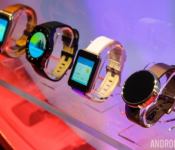
Of course, the wonderful thing about Android has always been its wider range of hardware. While Apple’s has a range of variations on the same design, Android Wear’s hardware has a selection of completely different looks available. The Moto 360 come with a choice of leather or metallic straps, while the G Watch R and Zenwatch offer a selection of leather options or Sony’s latest smartwatch can come encased in stainless steel.


Although there are plenty of different designs to pick from with Android Wear, most of the latest generation smartwatches feature surprisingly similar specifications to each other. The table below gives an example of some of the best Android Wear products and how they compare with the key hardware features offered by Apple’s Watch.
| Asus Zenwatch | LG G Watch R | Moto 360 | Apple Watch | |
|---|---|---|---|---|
| Display | 1.63″ 320×320 AMOLED | 1.3″ 320 x 320 P-OLED | 1.56″ 320×290 LCD | 340 x 272 or 390 x 312 |
| SoC | 1.2 GHz Snapdragon 400 | 1.2 GHz Snapdragon 400 | TI OMAP 3 | Apple S1 |
| RAM | 512 MB | 512 MB | 512 MB | unknown |
| Storage | 4 GB | 4 GB | 4GB | unknown |
| Battery | 360 mAh (2 days) | 410 mAh (2+ days) | 320 mAh (12 hours) | unknown (18 hours) |
| Size | 51 x 39.9 x 7.9 ~ 9.4 mm | 46.4 x 53.6 x 9.7 mm | 46mm diameter x 11.5mm | 42mm or 38mm (height) |
| Weight | 50g | 62g | 49g | unknown |
| Resistance | IP55 | IP67 | IP67 | no |
| Extras | pedometer, heart rate monitor | pedometer, heart rate monitor | pedometer, heart rate monitor | pedometer, heart rate monitor, GPS |
| Charging | Dock | Dock | Wireless | MagSafe Wireless |
| Price | $199.99 | $299 | $250 | $349 or $399 |
The 38mm Apple Watch is the smallest of the watches on our list, while the 42nm wide version is much closer to what we have come to expect from rectangular Android Wear watches. Of course, circular designs, like the Moto 360 and G Watch R, are going to be a little wider, but fortunately don’t add much in terms of weight. However, the scanner on the bottom of the Apple Watch seems to make the smartwatch stick out of the wrist a bit further than most Android watches, although we don’t have the exact dimensions to verify its size.
One of the most important metrics for a wearable is battery life. Typically, our testing of Android Wear devices results in a maximum battery life of around two days, with the exception of the Moto 360 which seems substantially worse. During Apple’s announcement, the device was stated to last 18 hours during “typical” usage, meaning that daily charging will be required and the watch may not last long at all under heavy usage.
The Apple Watch also supports wireless charging via a MagSafe induction connection. The Moto 360 uses Qi wireless charging, while most Android Wear products are charged through a physical connection to a docking station.
On its début into the smartwatch market, Apple has also launched sport and collector’s edition variants. Neither of these two add anything in terms of internal hardware, but the sport version’s aluminium, rather than stainless steel, cover should reduce its weight somewhat. Prices for the Watch Edition range between $549 and $1049, depending on the strap and build materials. If you have money to burn, there’s also a 18-karat or rose gold option available starting from $10,000.
There you have it, a quick look at some of the hardware and software features available with Android Wear and Apple Watch. There are a lot of similarities between the two, which likes leaves aesthetic design and smartphone support as the major deciding factors between the two.
 AIVAnet