


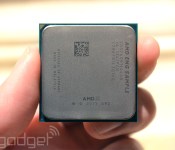
AMD says its next PC chip trumps Intel with 12 ‘compute cores’ and smoother gaming

A decade ago, AMD brought us the first dual-core x86 processor. Then, starting in 2008, the company came out with tri-core and quad-core designs in quick succession, leading up to octa-core chips in 2011′s FX range as well as in the latest AMD-powered game consoles. Today, we’re looking at a fresh leap forward, albeit one that will take a bit of explaining: a desktop and laptop chip called Kaveri, which brings together up to four CPU cores and eight GPU cores and gives them unheard-of levels of computing independence, such that AMD feels justified in describing them collectively as a dozen “compute cores.”
Marketing nonsense? Not necessarily. AMD is at least being transparent in its thinking, and besides, if you’ve been following our coverage of the company’s HSA project, and of GPU compute in general, then you’ll know that there’s some genuine technology underpinning the idea of GPU cores being used for more than just 3D rendering. Nevertheless, even if you don’t go for the whole 12-core thing, AMD still makes some down-to-earth promises about Kaveri’s price and performance — for example, that it matches up to Intel chips that cost a lot more (the top Kaveri desktop variant costs just $173, compared to $242 for a Haswell Core i5), and that it can play the latest games at 30fps without the need for a discrete graphics card. These are claims that can — and will — be put to the test.
“Compute cores”

Let’s start with the theoretical stuff, even though it’s largely academic until more software comes along that can make use of it. The reason AMD calls the GPU cores inside Kaveri “compute cores” is that they’re said to be fundamentally different to the GPU cores in other PC processors. This difference lies in the fact that they’re able to function as equal citizens: instead of relying on the CPU to orchestrate their workload, they can access system memory directly and take on tasks independently — almost like a CPU core does. The only difference is that they can’t take on the same types of tasks as a CPU, as they’re better suited to simple parallel chores rather than complicated serial processing.
As things stand, software developers are already able to exploit the GPU for general computing using tools like OpenCL, which can be used to accelerate anything from Photoshop to big spreadsheets. But OpenCL requires reams of code and a lot of inefficient to-ing and fro’-ing between the GPU and CPU — all of which, AMD says, will be drastically reduced if developers latch onto HSA. That’s a big “if,” of course, but now that AMD has recruited a bunch of partners into its HSA Foundation, and now that it has managed push its silicon into millions of households via next-gen games consoles, developer interest looks more likely, and Kaveri’s compute cores at least bring it some future-proofing as a result.
Gaming

Bearing in mind that we’re mostly reliant on AMD’s in-house test results for now, until independent reviewers put their graphs online, let’s look at that basic claim about Kaveri undercutting Intel as a gaming processor. The chart above shows a top-end Kaveri A10-7850K pitted against Intel’s Core i5-4670K for games being played at 1080p with max settings (or at least close to max settings — there’s a bit of ambiguity there, but it doesn’t affect the comparison). In each case, the processor is paired with a discrete graphics card, AMD’s mid-range Radeon R9 270X, presumably because most enthusiasts would still avoid relying solely on integrated graphics. As you can see, Intel is slightly ahead in a number of games, but never by a significant margin, suggesting that spending $70 more on Intel’s chip doesn’t add much to the experience.
Power efficiency and onboard graphics

In addition to Kaveri’s suitability for gaming when paired with a separate graphics card, the slide above suggests the chip also has an advantage over a Haswell Core i5 on certain synthetic benchmarks, likely due the fact that it has a bigger GPU than you’d find on an Intel processor. Kaveri’s built-in GPU accounts for 47 percent of all transistors in the chip (over a billion in total), and is potentially meaty enough for it to run games without the need for a discrete graphics card, thereby saving energy and money while also allowing for much smaller PCs. In practice, we played through a level of Bioshock: Infinite at 1080p with low settings, with Kaveri running beneath a little third-party cooler, and we experienced a steady frame rate of 30fps. This is something AMD claims is also possible in other big titles like Battlefield 4, which it’s bundling free with high-end boxed Kaveri chips, but again, you have to be prepared to accept low detail settings.
For the sake of balance, it’s important to point out that an Intel’s chip is likely to be more power-efficient in its own right. Haswell has fewer transistors (1.4 billion instead of Kaveri’s 2.3 billion) and its transistors are also significantly smaller (22nm instead of 28nm), which should equate to reduced power draw — something that’s especially when you think about notebook or hybrid/tablet versions of these chips, particularly ones that don’t need to focus on 3D graphics (or, equally, which delegate all such tasks to a separate GPU).
Mantle and TrueAudio

Speaking of Battlefield 4, we arrive neatly at Kaveri’s other big claim to fame — and it’s a claim that requires a much smaller leap of faith than HSA does. You see, Battlefield 4 is one of a growing number of games that will take advantage of an AMD-tailored programming tool called Mantle, which promises big boosts in performance even on lower-power (e.g., HTPC and laptop) versions of the chip. Mantle runs on any AMD graphics card that contains the newer Graphics Core Next (GCN) architecture, and since Kaveri’s graphics processor is based on GCN, it can run Mantle-optimized games and applications too, resulting in claimed performance increases of up to 45 percent in BF4 (once it gets its Mantle update later this month) and as much as 300 percent in real-time strategy games running on the new Star Swarm game engine. (For more on Mantle, read this.)
Finally, in addition to Mantle, Kaveri also brings another feature across from AMD’s latest graphics cards: TrueAudio. This is a dedicated, programmable audio processor that sits on the chip and helps to improve the audio in games by decoding data about location (giving sounds a feeling of directionality and distance) and also increasing the total number of voices and effects that can be heard at one time.
Wrap-up

Kaveri apparently took four years to develop, due to all the extra gubbins AMD has squeezed onto it, including HSA, Mantle and TrueAudio. This also explains why Kaveri chips are priced significantly higher than their predecessor, Richland: the lower-specced A8-7600 will start at $119, rising to $152 for the A10-7700K and, as we’ve mention, $173 for the flagship A10. Will they be worth the money? We’ll wait to round-up independent reviews from specialist sites before we make any final judgement, but it certainly looks like AMD has brought some clever additions to this generation that could boost its value. It looks good as a traditional gaming processor right now, especially if you intend to pair it with a Radeon graphics card in order to enable Dual Graphics (with the GCN cores in Kaveri’s GPU and in the discrete GPU effectively being added together), but we’ll need to see more Mantle- and HSA-enabled software before we’re ready to believe it can tackle Intel on general computing.
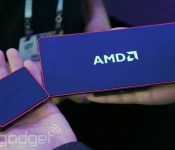
AMD’s impossibly thin nano PC prototype sits on your TV, but don’t call it a set-top box

Let’s take a moment to forget the technical nonsense. Seriously. Besides, we only really know the broad strokes about Mullins, AMD’s next-gen ultra-low voltage APU. Instead, let’s just gaze upon the tiny wonder that is the Nano PC for a bit and soak it all in. This reference design from the Sunnyvale company packs enough power to run Windows 8.1 pretty seamlessly and even get in a quick game of FIFA 14 at 1080p. Inside, in addition to a Mullins chip, is a 256GB SSD, a camera, Bluetooth, WiFI and a DockPort connector. And, it’s really not much larger or thicker than a Note 3 — it’s pretty much a marvel of engineering. It’s the last of those specs that’s pretty important, since it allows you to connect to a tiny breakout box with HDMI and USB ports. Obviously you’ll need one of those to connect it to a TV, which the Nano PC is designed to sit atop. Here’s hoping that a company or two picks up on the design and starts making absurdly thin machines of their own.
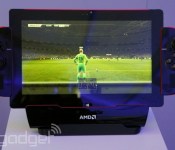
AMD’s Project Discovery tablet for work or play… but mostly play

Part of the goal with the energy-sipping Mullins APU and the DockPort connector is to create small devices that have the power and versatility to perform a myriad of tasks. The Project Discovery tablet is an experimental reference device designed to work all day and play all night (it’s the Vegas way, after all). The whole concept of DockPort, is that it’s can expand to a host of connections. So slot it into a productivity dock, and you can power Excel across two screens while using a traditional keyboard and mouse. But, when you head home to unwind, you can slap it into a gaming cradle like the one you see above and play some FIFA 14 or Dirt 3. It’s not all that dissimilar to the Razer Edge… in concept at least. As with most of the really interesting things at CES this is not a shipping product, nor do we expect it to be. Instead it’s a concept that AMD is using to promote its vision of the future. Now it just needs an OEM or two (or twelve) to take up the torch and start getting these things out the door.
Filed under: Peripherals, Tablets, AMD
Live from the Engadget CES Stage: AMD’s Kevin Lensing

And what about the chips that power all of those shiny new devices we’re seeing on the show floor here at CES? Kevin Lensing, the director of AMD’s mobility product line will discuss the hardware that makes our mobile devices tick.
Follow all the latest CES 2014 news at our event hub, and check out our full stage schedule here.
Filed under: Cellphones, Tablets, Mobile, AMD
AMD brings full-on Android to Windows through BlueStacks

BlueStacks has helped Windows users run Android apps on their PCs for a few years, but now the AMD-backed company is going a step further. The graphics titan has just announced that a new version of BlueStacks will be able to run full-on Android, right on your desktop, tablet or notebook loaded with Microsoft’s operating system. Rather than leaning on the BlueStacks App Player for virtualization, the coming version of the software will run the entire OS, giving folks access to a veritable Android interface, settings, configuration and more. What’s more, apps running through Google’s OS will have access to files that reside on the host desktop. Still, BlueStacks retains the ability to run applications in windows or in full screen. The firm says optimizations courtesy of its 4th-gen APUs help make this possible, but it’s not clear if the software will only work on machines using their silicon. There’s no word on when this refreshed software will drop or what version of Android it supports, but expect more news to trickle out as CES continues.
Filed under: AMD
Source: AMD
Maingear’s Spark is a tiny Steam Machine with laptop internals

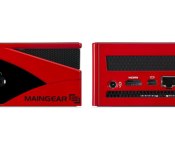
Traditionally, gaming PCs aren’t built with size in mind, but Valve’s Steam Machine initiative has changed the game — now these rigs are taking up residence in the living room. In fact, that’s exactly what Maingear’s Spark was built for. This diminutive PC is built from notebook components: a 3.1GHz AMD A8-5575M processor with Radeon R9 M275X graphics, up to 16GB of DDR3L RAM and support for a 256GB SSD with a spare 2.5-inch HDD tray. All together, the Spark measures in at just over two inches tall and 4.5 inches wide in either direction. Tiny? You bet. Weighing less than a pound, Maingear says it’s the smallest gaming PC they’ve ever offered. Despite its size, the company still had room to squeeze in four USB 3.0 ports, Ethernet and audio jacks and both HDMI and Mini DisplayPort output. Unfortunately, the Spark’s final price point is up in the air, but the company promises it will be “an affordable PC solution.” Spark is set to launch in the first quarter in Windows 7, Windows 8 and Steam OS configurations.
Our 2014 CES stage schedule is here and it’s awesome!

Sure, there’s a certain amount of creeping dread in the lead up to CES each year. It’s a sleep-deprived week spent elbowing our way through the packed halls of the Las Vegas Convention Center. The food is bad, the facilities few and far between and the hygiene practices of the tech-blogging community questionable, at best. But there are also plenty of things that make it one of the most exciting weeks of the year, not the least of which is our stage. As with the last couple of years, we’ve got a prime spot in the convention center lobby, where we’ll be speaking to some of the biggest and most innovative companies in the world of consumer electronics.
The list includes Sony, Ford, Pebble, Nokia, Leap Motion, Oculus, MakerBot, Lenovo, Samsung, AT&T and the Electronic Frontier Foundation, to name a few. You can check out the full schedule here and stay glued to our CES event hub for updates. See you on stage!
Filed under: Announcements, Cellphones, Desktops, Cameras, Displays, Misc, Gaming, GPS, Home Entertainment, Household, Laptops, Meta, Peripherals, Robots, Tablets, Transportation, Wearables, Wireless, Internet, Software, HD, Mobile, Samsung, Sony, Nokia, AT&T, AMD, Lenovo, NVIDIA
Source: CES 2014

Battlefield 4 won’t get AMD-powered frame rate boost until later in January

The company known affectionately as Advanced Micro Delays has just confirmed something we already knew: the intriguing Mantle update for Battlefield 4, which promises a “significant” frame rate bonus for PC gamers running AMD hardware, has been postponed. It didn’t arrive in December like it was supposed to, but is now officially meant to be on track for release sometime in January. The gossip is that the source of the delay isn’t actually on AMD’s side, but rather on EA DICE’s, since the game developer has been swamped with bug-fixing chores and hasn’t had time to focus on luxuries. Meanwhile, other developers tell us that they’re getting on well with Mantle, thanks to its ability to circumvent DirectX and make better use of AMD’s Graphics Core Next and octa-core CPU designs — and that’s something that we expect to be able to prove, one way or another, in the next few days.
Filed under: Desktops, Gaming, Laptops, AMD
Via: Anandtech

Alienware’s X51 now ships with AMD’s 4K-capable flagship graphics card
If Haswell innards weren’t enough to incite a purchase of Alienware’s X51 gaming PC, perhaps a 4K-capable GPU could push you over the edge: Dell’s little gaming-machine-that-can is now available with AMD’s Radeon R9 270X. This card brings the chip…
 AIVAnet