


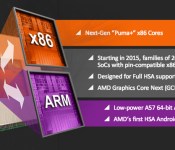
AMD plays both sides of the CPU wars with chips that use the same socket

Typically, you can’t reuse many parts when you switch processor technologies; if you change chips, you change the entire motherboard at the same time. That won’t be true for AMD in the future, though. It’s working on a common chip framework, Project Skybridge, that will let 2015-era ARM and x86 system-on-chip processors share the same pin layout. In other words, a basic motherboard design could handle both CPU types.
This doesn’t mean that you’d get to walk into a computer store, buy a motherboard and use your choice of ARM or x86 hardware in your new desktop. Rather, Project Skybridge would be for mobile and embedded gadgets — neither AMD nor device makers will have to reinvent the wheel just because they’re thinking of building x86-based Android tablets or ARM-based industrial gear. It’s also a hedge against obsolescence. AMD sees the computing world shifting toward ARM, and it doesn’t want to be stuck supporting only Intel’s x86 technology in the long run.
That’s just the start of the semiconductor firm’s expanded ARM plans, too. A 2016 core, K12, will be AMD’s first 64-bit ARM design. Most of its details are a mystery, but AMD says that the new processor focuses on high frequencies (clock speeds) and expanding ARM’s sphere of influence. That suggests that K12 will target heavy-duty tasks. It may not wind up in your pocket, then, but it could handle more duties that were previously reserved for desktops.
Via: AnandTech (1), (2)
Source: AMD

AMD wages benchmark war on Intel’s tablet chips

For all the success AMD has been having in the console and PC graphics spheres, none of it has really translated into the world of Windows-based tablets and ultraportables. The chip maker insists that’s going to change in 2014, however, and it has released a number benchmarks showing that its latest processors have a lead not only over AMD’s previous generation, but also over the Intel chips that currently reign supreme in these form factors.
We won’t bore you with a gabble of numbers when you can check out charts for yourself in the gallery below, but the main curiosity here is probably the 4.5-watt tablet platform, known as “Mullins.” This replaces last year’s Temash processor, which had impressive gaming skills but failed to catch on in the market. AMD’s in-house scores suggest Mullins offers much better performance per watt, with the new A4 Micro-6400T achieving a 15 percent lead over Intel’s Bay Trail T (the Atom Z3370) in PCMark 8 — a lead that could potentially be significant enough to bring the chip into more slim-line (and passively cooled) Windows 8 machines. What AMD doesn’t reveal, however, is whether devices equipped with this A4 chip will have comparable battery life to Bay Trail, so it’s all academic until actual, commercial devices come around.
Microsoft teases DirectX 12 reveal for GDC, rumors pit it against AMD’s Mantle

That death knell AMD has been ringing for DirectX? Microsoft’s having none of it. The software giant is now teasing the next version of the Windows graphics API, inviting developers to join it at GDC for the official reveal of DirectX 12. The splash page reveals little besides the version’s numeric and announcement time, but it does feature partner logos for Intel, Qualcomm, Nvidia and, of course, AMD. AMD’s disdain for the platform helped birth Project Mantle — a competing API that gives developers lower-level access (and as a result, more leverage over) PC graphics hardware. One of Microsoft’s GDC sessions suggest that something similar is in the works for its own development platform: “You asked us to bring you even closer to the metal… …so that you can squeeze every last drop of performance out of your PC, tablet, phone and console,” reads the description for one of the firms DirectX presentations. “Come learn our plans to deliver.”
It sure sounds similar, and indeed, it meshes well with recent rumors. Sources close to ExtremeTech say that while the two APIs will have different implementations, both should offer the same benefits. They also say that Microsoft’s “close to the metal” lower-level access API is a relatively new project in Redmond, meaning it probably won’t muscle in on Mantle’s territory until sometime next year. Between that, and the fact that Microsoft has recently taken to limiting Direct X upgrades to Windows upgrades, it’s possible that we might not see DirectX 12 in access until we’re installing Windows 9.
Filed under: Gaming, Microsoft
Source: Microsoft, ExtremeTech
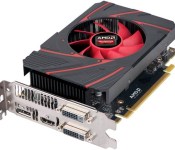
This new, low-end AMD graphics card’s meant for budget-conscious PC gamers, and maybe Steam Machines, too

Not every gamer has the desire means to get the latest and greatest graphics hardware. Fret not budget-minded PC aficionados, for AMD’s rolling out a new, more powerful low-end GPU that should suit your financial constraints. Called the Radeon R7 265, it brings twice the memory bandwidth of its predecessor, the R7 260x, which AMD claims translates into a 25 percent performance boost. It’ll cost $149 when it goes on sale in late February, and with its debut, AMD’s also dropping the cost of the aforementioned 260x to a scant $119.
Naturally, those meager price points will appeal to cost conscious consumers, but AMD’s announcement could have an effect on Steam Machine OEMs, too. We saw AMD’s higher-end R9 graphics in several of the Steam Machines at CES, and we’ve been playing with a working iBuyPower prototype packing an R7 260x for awhile now. So, it stands to reason that the 260x and 265 will prove awfully attractive options to manufacturers trying to hit the all-important sub-$500 price point needed to compete with other gaming consoles. And, who knows, maybe these new (relatively) inexpensive options will help drive down the prices of both more powerful cards and the GPUs being offered by AMD’s competition.
Source: AMD

Battlefield 4 gets even prettier with new AMD drivers

If you caught our recent coverage of the huge Star Swarm demo, you’ll know that AMD’s Mantle programming tool has already proven itself capable of radically transforming a real-time strategy game. But the console-inspired API has been claimed to deliver performance benefits in FPS games too, starting with Battlefield 4, and the first independent evidence of this is now starting to trickle out. AnandTech and HotHardware have used almost-final Mantle drivers to achieve frame-rate gains of at least 7-10 percent in BF4, rising to 30 percent with some configurations, by doing away with the need for Microsoft’s relatively inefficient DirectX drivers.
In general, it looks like systems with weaker CPUs stand to benefit the most, because Mantle uses the graphics processor in such a way as to reduce CPU bottlenecks. We’ll get a better idea of the size of the improvement once Mantle is released to the public and tested on a wider variety of systems, including laptops and desktops with low-end or integrated AMD GPUs, but nevertheless, these early results bode well for those who are trying to eke better frame rates out of older, cheaper or smaller gaming rigs.
Source: AnandTech, HotHardware
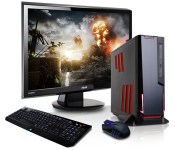
CyberpowerPC stuffs full-size graphics into a tiny gaming desktop

Not interested in buying a Steam Machine this year, but still want a tiny gaming PC? Never fear — CyberPowerPC has just released the Zeus Mini, its latest take on a conventional small computer with full-sized performance. The system is just 4.4 inches thick and 18 inches deep, but it has room for fast video cards like AMD’s R9 290 or NVIDIA’s GeForce GTX 780. You’ll also find a high-end AMD Kaveri or Intel Haswell processor inside, and there’s space for a large liquid cooling system if you insist on a silent rig. Zeus Mini prices start at $599 for a basic variant with a 3.7GHz AMD A10 chip and integrated graphics, but demanding players can shell out $1,479 for a flagship model with a 3.5GHz Core i7 and GTX 780 video.
Filed under: Desktops, Gaming, AMD, Intel, NVIDIA
Source: CyberpowerPC
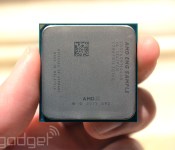
AMD Kaveri review roundup: a solid gaming chip that’s ahead of its time

It’s been a busy week for AMD news, what with the launch of the Kaveri APU and then our first real evidence of how the new Mantle drivers can impact on PC gaming. But now’s the time to kick back and check out some full reviews of Kaveri over at the specialist sites. We’ve rounded up some of the best articles after the break, and if you’re looking for brutally short executive summaries, we’ve got some of those for you too.

AnandTech — Based on a suite of traditional, real-world application benchmarks such as WinRAR, Kaveri usually struggled to match a Core i3 — except in those few applications that made good use of GPU compute via OpenCL. With games, on the other hand, Kaveri was usually better than a Core i7 in the more challenging scenarios, and you really should check out the site’s full frame-rate charts. The A10-7850K is actually able to play F1 2013 at max detail and 1080p resolution with a frame rate of 31fps, for example, versus 14fps from a much more expensive Core i7-4770K. Overall, Anandtech concluded that Kaveri could be an “ideal fit” for many people who aren’t power users but who like to indulge in a bit of gaming, but its reviewers also highlighted the fact that AMD has been tepid about supporting dual graphics for those who want to pair Kaveri with an Radeon R7-series graphics card (Kaveri also uses R7 graphics, so theoretically it should be possible to add the two GPUs together).

HotHardware — This site focused on the A8-7600, which can be customized to burn at 45W or 65W and is therefore aimed at small form factors (like HTPCs and Steambox-like gaming builds). In a number of synthetic graphics-focused benchmarks, such as 3DMark, this scaled-down processor was actually very close to (and sometimes better than) AMD’s flagship 95W from the previous generation (Richland), and also often better than any full-powered Haswell chip. Overall, despite it lagging behind Intel in single-threaded tests, HotHardware gave the A8-7600 its “Approved” badge.

ExtremeTech — This site spent a bit more time taking account of AMD’s new HSA technology. In its most practical sense, HSA is a fresh approach to GPU compute, but there is no mainstream software that makes use of it just yet. Instead, ExtremeTech ran a few niche HSA-enabled benchmarks to explore HSA’s potential, and they were pleasantly surprised: a JPEG decoding test showed that the A10-7850K was almost twice as fast as a Core i5-4670S, and even the A8-7600 was quicker than any Intel chips. A second test based on number-crunching within LibreOffice’s Calc spreadsheet application showed that the A10-7850K was about five times faster than the Core i5. Overall, this review concluded that, aside from its obvious gaming prowess, “Kaveri will only be competitive if developers implement the necessary optimizations for HSA,” and that pretty accurately sums up where AMD’s newest APU stands right now.


The Engadget Show 49: CES 2014 wrapup

Grab a wearable, switch on the ‘ole curved TV and fire up your favorite 3D printer. We came, we saw, we conquered and now we’re ready to distill it all for you in the form of some high-quality video content. We’re not going to suggest that it’ll replace the seemingly endless stream of posts we’ve churned out over the past week or so, but if you’ve got a cocktail party full of guests you need to impress tonight, it’ll help you drop some serious CES 2014 tech news knowledge on their collective heads.
We’ve pulled together some top editors to offer up an abbreviated view of tech’s biggest show of the year, charting trends in old standby categories like HDTV, mobile, tablets and cars, to emerging spaces set to define the changing face of the show for years to come. Oh, and we’ve also tossed in some fun video of the show’s gadgets, because, well, it wouldn’t be much of an Engadget Show without that sort of thing, now would it? Toss in a bit of video of your long-time host getting a bit welled up the end, and you’ve got yourself a little thing we like to call The Engadget Show 49.
‘Til we meet again, Engadgeteers.
Filed under: Announcements, Cellphones, Desktops, Cameras, Displays, Misc, Gaming, GPS, Handhelds, Home Entertainment, Household, Laptops, Meta, Peripherals, Podcasts, Portable Audio/Video, Robots, Tablets, Transportation, Wearables, Wireless, Storage, Networking, Science, Internet, Software, HD, Mobile, Alt, Apple, Samsung, Sony, Microsoft, HTC, Nokia, ASUS, Google, Amazon, Verizon, Sprint, AT&T, LG, AMD, Intel, Blackberry, T-Mobile, HP, Dell, Acer, NVIDIA, Nikon, Canon, Facebook, Nintendo

Daily Roundup: Sony Xperia T2 Ultra and E1, court blocks parts of FCC net neutrality rules and more!

You might say the day is never really done in consumer technology news. Your workday, however, hopefully draws to a close at some point. This is the Daily Roundup on Engadget, a quick peek back at the top headlines for the past 24 hours — all handpicked by the editors here at the site. Click on through the break, and enjoy.

Moto G Google Play edition
A Google Play edition of the Moto G popped up in the Play Store earlier today and is available for $180 (8GB) or $200 (16GB). Click through for details.

Court blocks parts of net neutrality rules
A Washington, DC appeals court voided anti-blocking and anti-discrimination requirements in the FCC’s Open Internet Order. Follow the link for more information.

Sony Xperia T2 Ultra and E1
Sony only recently released the Xperia Z1 Compact and Z1S at CES, but it’s adding yet another two additions to the Xperia line: the T2 Ultra and E1. Click the link for specs and launch information.

Next-gen game with 5K-unit population cap
Whether it’s Age of Empires or StarCraft, there comes a point where every gamer struggles with maximum population caps. However, that might not be much of an issue for the new demo game Star Swarm. By utilizing AMD’s Mantle programming tool, the title manages a whopping 5,000 AI objects. Click on through for more details.

Next-gen strategy game engine lets you control an army of 5,000 units at one time

Every real-time strategy game has some kind of population cap, limiting the number of units that can be placed simultaneously on a player’s terrain. This limit can stem from the designers’ need to balance competition between armies, but ultimately it’ll also have something to do with the underlying hardware in a PC or console, because a processor will slow down if it’s asked to simulate too many independent, physical 3D objects at once. Some RTS games set the limit at 50-70 units, while others can cope with as many as 500, but a new demo game called Star Swarm takes things to a new level: it uses AMD’s Mantle programming tool to speed up communication between the CPU and GPU, allowing up to 5,000 AI- or physics-driven objects (i.e., not mindless clones or animations) to be displayed onscreen at one time. Coming up, we’ve got a 1080p video of what this looks like, plus an explanation of how Oxides Games, the company behind Star Swarm, made this possible.
As you’ll hear from the video’s narration, Star Swarm is a demo game that is built to show off Oxide’s new engine, Nitrous, which is being licensed to other developers. At least three Nitrous-based RTS games are currently in production and Oxide believes that these games will represent a major leap forward for real-time strategy genre thanks to the “epic scale” permitted by the high population limit.
“It’s a difference of at least an order of magnitude,” says Oxide founder Dan Baker (who was previously Graphics Lead for Civilization V). “Take the most complex scene you’ve ever seen in StarCraft II and multiply it by ten.”
There are a couple of ingredients that are essential for delivering these huge 5,000-unit spectacles. Firstly, you need a robust CPU, since processing this quantity of AI and physics relies on general computing power just as much as on graphics. Unlike many games on the market, Star Swarm is designed to use many CPU cores at the same time. The configuration in the video includes a aging but powerful six-core Intel Core i7 980.
“Take the most complex scene you’ve ever seen in StarCraft II and multiply it by ten.”
Secondly, to allow for both scale and enhanced visual effects such as motion blur, the graphics-side of the system must contain a recent AMD GPU that supports the Mantle programming tool. As we’ve reported before, Mantle brings hardware-specific (read: brand-specific) programming to PC games, because it allows developers to code directly for AMD’s Graphics Core Next architecture rather than going through fluffy, hardware-agnostic middlemen like Microsoft’s DirectX drivers. In this instance, Mantle speeds up the communication between the CPU and GPU, allowing multiple CPU cores to talk to the GPU at the same time without causing a jam. (For deeper technical detail on this, check out Oxide’s presentation at APU13.)

Star Swarm is actually the first hard evidence we’ve seen of what Mantle can do, and the numbers speak for themselves: with everything else being equal, enabling Mantle increased the demo’s frame rate by nearly 300 percent, from an unplayable 13 fps to a buttery 44 fps. AMD promised as much when it launched its Kaveri APU earlier today, adding that Star Swarm will run at playable frame rates even on low-power 65-watt versions of the APU (versus 95-watts for a regular desktop chip).
More Info
Separately, AMD claims that a forthcoming Mantle update for Battlefield 4 will boost performance in that title by as much as 45 percent. We’ve also heard some gossip that the PC version of Sniper Elite 3 will support Mantle, likely reflecting the fact that its developer, Rebellion, is making PS4 and Xbox One versions of the first-person shooter and is therefore already accustomed to optimizing its code for AMD’s architecture. All in all, if these games leave up to the precedent set by Star Swarm, it could well be worth having some Mantle juice in your gaming rig in 2014.
 AIVAnet