


LG’s 4K monitor is first with AMD’s game-enhancing FreeSync

LG will be the first to sell a 4K monitor with AMD FreeSync technology, beating models from rival Samsung by a nose. The technology in its 27-inch 27MU67 is similar to NVIDIA’s G-Sync, matching monitor and GPU refresh rates to eliminate tearing, stutter and other gaming issues — as long as you have a compatible AMD graphics card or chip. Like Samsung, LG makes its own panels and it shows in the specs. The IPS screen can run at 40 to 60fps with 9.7 milliseconds of input lag, while being decent for color pros with a 99 percent Adobe gamut and 10-bit interpolated color. It’ll come calibrated out of the box later this month at select retailers for $599 — quite a drop in price from last year.
Source: LG
AMD’s latest chips bring gaming and video chops to mainstream laptops

With AMD’s new sixth-generation A-series processors, laptops in the $400 to $700 range could soon become far more capable. Formerly code-named “Carizzo,” the new chips offer twice the gaming performance of Intel’s Core i7, thanks to discrete Radeon graphics. They’re the first mainstream processors with hardware decoding for H.265/HEVC video, the successor to the current H.264 standard which includes far better compression and support for 4K resolutions. And they’ll also pack in up to 12 compute cores (four CPU and eight GPU), which basically means they’ll be able to handle whatever you throw at them. Why focus on mainstream laptops? AMD notes that it’s the largest segment of the PC market by revenue and volume sold, so it makes sense for a company that’s traditionally focused on value to show it some love.
AMD’s basically gunning hard for the gaming and media crowd with its sixth-generation chips. Naturally, they include its dual graphics technology, which can summon the power of Radeon R7 graphics along their built-in graphics for a 42 percent jump in frame rates. They also combine game performance with hardware video encoding, which should make for much smoother game streams on Twitch. Battery-wise, AMD says the new chips will last twice as long as their predecessors, even when watching video or gaming.
While it all sounds good on paper, AMD will face some stiff competition from Intel’s new Broadwell-H chips, which were announced yesterday. Those chips also double graphics performance and boost overall media performance. Intel’s chips seem pretty expensive though, ranging from $244 to $623, and while we don’t know the pricing of AMD’s new wares yet, they’re usually cheaper than Intel. So there’s a good chance AMD can keep up the value fight. We’ll find out for sure once the new chips hit the market. AMD says computers featuring the sixth-gen A-series will start shipping in June, while Intel expects its chips to hit computers within two months.
AMD’s next laptop processor is mostly about battery life

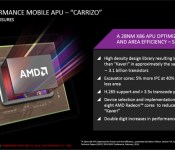
Intel isn’t the only chip giant championing battery life over performance this year. AMD has revealed Carrizo, a processor range that’s focused heavily on extending the running time of performance-oriented laptops. While there will be double-digit boosts to speed, there’s no doubt that efficiency is the bigger deal here. The new core architecture (Excavator) is just 5 percent faster than its Kaveri ancestor, but it chews up 40 percent less energy at the same clock rate — even the graphics cores use 20 percent less juice.
Not that this is the only real trick up AMD’s sleeve. Carrizo is the first processor to meet the completed Heterogeneous System Architecture spec, which lets both the CPU and its integrated graphics share memory. That lets some tasks finish faster than they would otherwise (since you don’t need as many instructions), and it could provide a swift kick to both performance and battery life in the right conditions. You’ll also find dedicated H.265 video decoding, so this should be a good match for all the low-bandwidth 4K videos you’ll stream in the future.
The new chip is pretty promising as a result. With that said, its creator will undoubtedly be racing against time. Carrizo is expected to reach shipping PCs in the second quarter of the year, or close to Intel’s mid-year target for its quad-core Broadwell processors. You may find shiny new AMD and Intel chips in PCs at around the same time — that’s good news if you’re a speed junkie, but it’s not much help to AMD’s bottom line.
Filed under: Desktops, Laptops, AMD
Via: PCWorld
Source: AMD

The Xbox One will get more affordable thanks to a new processor

Microsoft may have already cut the Xbox One’s price to $349 for the holidays, but there are hints that the game console may get a permanent price drop before too long. An AMD chip design manager recently updated his LinkedIn resume (since made private) with word that he worked on a more efficient, “cost-reduced” version of the Xbox One’s processor. There aren’t any clues as to when this spruced-up silicon will arrive, but recent AMD roadmap leaks suggest that its first CPU architecture based on the technology will ship in 2015. In other words, you could be buying a cheaper Xbox by this time next year.
Processor upgrades are nothing new in the console world. They’re crucial for both price cuts and smaller, cooler-running systems that aren’t so noisy. However, there’s added urgency this time around — the PlayStation 4 has been outselling the Xbox One due in part to its initial price advantage, and lower prices should both help Microsoft stay competitive and leave more money in your wallet.
Filed under: Gaming, Microsoft, AMD
Source: Mosen (Beyond3D Forums)

AMD’s new CEO has a background in mobile technology

It feels like just yesterday that AMD brought in Rory Read to turn around its ailing fortunes, but today there’s another changing of the guard. The chip designer has announced that chief operating officer Lisa Su is its new CEO, effective immediately; Read will stick around as an advisor until the end of the year. The company isn’t going into detail about the reasons behind the shift, but it does say that Read has been planning a succession with the board of directors. It’s an “ideal time” for Su to take the reins, the board’s Bruce Clafin says.
Su hasn’t said much about what she’ll do so far, but she hints that she’s likely to continue a strategy of crafting chips for “diverse” categories (think game consoles and mobile devices) that Read used to great success. Whatever the new CEO does, she likely has the right background for it. Su spent five years heading up technology development at mobile giant Freescale before she joined AMD in 2012, and she spent 13 years in semiconductor- and business-related positions at IBM before that. It’s safe to presume that she knows a thing or two about the importance of super-efficient silicon.
Filed under: Cellphones, Desktops, Laptops, Tablets, Mobile, AMD
Via: New York Times
.CPlase_panel display:none;
HP is building a $199 Windows laptop

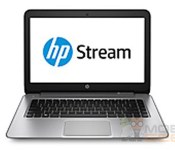
Microsoft has been pushing hard for extra-cheap Windows computers that can take on Chromebooks, and it appears that HP is more than willing to hop on that bandwagon. Mobile Geeks has posted a leaked data sheet for the HP Stream 14, an upcoming $199 laptop that’s clearly meant to fight Google-powered PCs. The base 14-inch system should cut corners by using a low-powered AMD A4 Micro processor, 2GB of RAM, a 1,366 x 768 screen and 32GB of flash storage; apart from the capacity, it’d be a step down from the company’s $299 Chromebook 14. You’d have to pay more for brawnier parts like an A10 Micro chip, 64GB of space and a 1080p touchscreen. Not satisfied with the limited drive options? HP would try to make up for the shortfall by giving buyers 100GB of OneDrive cloud storage for two years, matching what you get with many Chrome OS devices. There’s no word on when the Stream 14 would make its debut, although the deluge of information hints that we could see this budget portable fairly soon.
Via: GigaOM
Source: Mobile Geeks (translated)
.CPlase_panel display:none;

AMD is preparing to enter the SSD business

With all the computing components AMD makes already, it’s still hard to believe the company has yet to explore the solid-state drive space. But that’s about to chance soon — it looks like AMD’s finally ready to get into the business of making SSDs. Not surprisingly, the chip maker is bringing its new SSD line to market under the renowned Radeon R7 brand, perhaps hoping that becomes an incentive for potential customers. These solid-state drives, which AMD says are geared toward PC gamers, will be available in 120GB, 240GB and 480GB flavors, while the advertised read and write speeds appear to be on par with similar offerings from competitors like Samsung. Unfortunately, it’s not easy to compare any further, since AMD won’t be announcing the price of its Radeon R7 SSDs until they launch “later this year.”
[Image credit: Associated Press]
Filed under: Desktops, Misc, Laptops
.CPlase_panel display:none;

Russian government dumps Intel and AMD in favor of homemade processors

Russia’s policy on Western technology is clear: It can live without it, especially if key issues like economic sanctions, NSA spying and GPS cooperation aren’t resolved to its satisfaction. It looks like this tough stance extends to US-designed computer chips too, as a Russian business newspaper is reporting that state departments and state-run companies will no longer purchase PCs built around Intel or AMD processors. Instead, starting in 2015, the government will order up to one million devices annually based on the “Baikal” processor, which is manufactured by a domestic company called T-Platforms. An interesting twist, however, is that the Baikal processor is actually based on an ARM (Cortex-A57) design, which means the East / West divorce isn’t quite as complete as it might sound. It could also mean that many Russian bureucrats won’t get the chance to be a Mac or a PC: they’ll have to use some sort of ARM-compatible, presumably Linux-based operating system instead.
Filed under: Desktops, Misc, AMD, Intel
Via: TechEye
Source: ITAR-TASS News Agency
Intel forced to pay record $1.4 billion fine for unfair sales tactics

The European Union’s second-highest court has upheld a $1.4 billion fine levied against Intel for anti-competitive practices against chip foe AMD. In the original decision, way back in 2009, the European Commission found that Intel harmed its rival and consumers by giving unlawful rebates to retailers and PC makers like HP, Dell and Lenovo. Intel then appealed, saying the commission “ignore(d) the reality of a highly competitive microprocessor marketplace.” But the Luxembourg General Court found that Intel had a long-term game plan to shut out AMD and “attempted to conceal the anti-competitive nature of (those) practices.” It therefore ruled that the record fine representing 4.15 percent of Intel’s 2008 revenues was fair, saying the EU could have levied a penalty as high as 10 percent. Intel expressed disappointment with the decision, but it does have one more shot at an appeal: the EU’s Court of Justice. So far, however, it hasn’t said whether it’s willing to drag out the six-year-old case any further.
Filed under: Misc, Peripherals, Intel
Via: Reuters
Source: European Commission
Computex 2014 wrap-up: Intel and co. usher in the future of computing

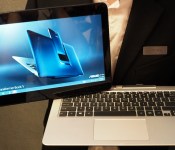
For the last few years, we’ve travelled to Computex in Taiwan to see the latest flock of Ultrabooks, with the latest and greatest models providing the biggest news of the show. This year, though, the highlight of the show wasn’t one particularly great notebook or even one company — though ASUS did steal the show with its mile-long list of new products. Rather, it was a prototype from Intel that teased the next generation of ridiculously thin and light PCs.
You think your Ultrabook or iPad Air is thin, but you have to see Intel’s reference design to grasp the skinniness of 2-in-1 devices powered by the Core M-series of processors. We’ll start to see products integrating Intel’s new line of chips later this year, but just imagine how much slimmer high-powered laptops will be a few Computexes down the line. At a certain point, devices will reach peak thinness, and then the focus will shift to improving battery life and performance in such a compact package — and that’s when everybody wins.

Intel’s look at the future of mobile computing is probably the most significant announcement at a show that’s traditionally all about PCs, but this year’s Computex also shined the light on wearables. True, we didn’t see any hardware that rivals Google Glass or Pebble in features or sophistication, but several prototypes from smaller companies boast clever designs for gadgets that live on your head or wrist. A flexible-battery manufacturer demonstrated a strap design that doubles the life of your smartwatch, offering a solution to one of the biggest complaints about the most popular models. E Ink’s wraparoud-display prototype is also an interesting approach to the next generation of wearables, giving you a ton of space to display info on your wrist.
Computex may not be the “CES of Asia” in terms of high-profile product announcements, and much of the new tech we saw here in Taipei was evolutionary rather than revolutionary. Still, that doesn’t mean there isn’t plenty of cool stuff to see. We’ve made it easy for you by breaking down our coverage just below — enjoy!

ACER
- Hands-on with the Liquid Leap: Acer’s first wearable tries to be everything to everyone
- Acer claims the Liquid Jade is the world’s ‘most compact’ 5-inch smartphone
- Acer shows off ‘Extend’ app allowing you to control your phone from your PC
- Acer claims its €79 Liquid Z200 is the cheapest branded Android phone
- With three SIM slots, Acer’s Liquid E700 is a phone for frequent travelers
ASUS
- ASUS’ PadFone X goes global: still a 5-inch to 8.9-inch transformer
- ASUS’ Zenbook NX500 is a thin and light laptop with a 4K screen
- The ASUS MeMO Pad 8 is ‘the world’s lightest 8-inch LTE tablet’
- New Fonepads from ASUS offer 3G, extra processing power
- ASUS intros the Transformer Book T300 Chi, a super-thin hybrid laptop
- ASUS Transformer Book V is a Windows hybrid with a detachable Android phone
- Here’s a semi-professional 32-inch 4K monitor from ASUS
- ASUS Transformer Pad refreshed with front speakers, lighter keyboard
- Hands-on with ASUS’ Zenbook NX500: The MacBook Pro meets its match
- ASUS’ 20-inch ‘portable’ all-in-one PC has gesture controls and a carrying handle
- There’s no such thing as too many antennas for ASUS’ high-end router
- ASUS’ new Fonepads are solid tablets, but still awkward for making calls
- Up close with ASUS’ quirky Windows laptop/Android phone hybrid
- ASUS has two Steam Machines and one is incredibly compact
- ASUS’ Chromebook C300 is yet another well-made budget laptop
- ASUS crams 4K gaming into sleek and distinctive laptop
- ASUS introduces us to the ‘world’s largest’ curved LED monitor
- ASUS’ new external Blu-ray drive does 7.1 audio at a fair price
- ASUS shows off a 14-inch USB touchscreen monitor
- Asia’s biggest tech show is ASUS’ show
- Angry owl is angry: ASUS does a badass gaming headset
DELL
- Dell adds two budget Android tablets to Venue lineup, prices start at $160
- Dell’s new Inspiron 20 is a giant tablet for work and play
- Dell aims for the mainstream with its two new Windows convertibles
HP
- HP’s back-to-school lineup includes lots of convertibles (and Beats products, too)
- HP hedges its bets, unveils a 14-inch laptop running Android (updated)
- HP’s Pro x2 612 laptop-tablet hybrid brings pen support, a sturdy keyboard
INTEL
- Intel doubles down on tablets, says it will power 130 models this year
- Intel launches Core M processors for even thinner 2-in-1 PCs
- Intel’s Windows 8.1 Pro Broadwell tablet is thinner than the iPad Air
- Intel’s super-thin ‘Core M’ tablets will be cheaper than you think
- Intel: Where we’re going, we don’t need cables
TOSHIBA
- With seven different use modes, Toshiba’s Kirabook is a Lenovo Yoga on steroids
- Toshiba stuffs Windows into a 7-inch tablet, whether you want it or not
OTHER HANDS-ONS
- Watch strap batteries could double the life of your wearable
- An up close look at the giant gaming PC that’s also a desk
- This $295 battery-powered unicycle could replace your Segway
- E Ink’s working on a smartwatch with a full wraparound display
- The PhoneStation uses your smartphone as a head-mounted display
Filed under: Laptops, Tablets, ASUS, AMD, Intel, HP, Dell, Acer
 AIVAnet