


Amazon Prime gives you Audible streams for free
Amazon Prime members get a pretty decent bunch of benefits for their $99 a year subscription, and the list of goodies just got a bit longer. The online retail giant now offers its subscribers free access to Audible Channels, a collection of talk show-type streams and audiobooks that would normally cost $5 a month.
Prime members can download the Audible app for iOS, Android and Windows 10 to access Channels, which will include ad-free programming and content from The Wall Street Journal, The New York Times, Charlie Rose, Harvard Business Review and The Onion, among others. It’ll also include 20 curated playlists around comedy, meditation and news, as well as a rotating selection of more than 50 audiobooks.
In addition to free two-day shipping and now, free Audible content, a Prime subscription also gets you free access to Amazon’s video streaming service, a ton of ebooks, photo storage, early entry to certain deals and a somewhat limited selection of music. But the company could be boosting its library of songs, and that, together with the Audible offering, could really enhance the amount and quality of its content.
Source: BusinessWire
Amazon accidentally outs new, cheaper Echo Dot on Twitter
Amazon Echo’s official Twitter account made a blunder that may have given hope to followers waiting for new Echo Dot stocks with bated breath. It sent out a tweet introducing an all-new and cheaper Echo Dot, according to Recode, but it deleted the post as quickly as it went out. If the company’s social media team didn’t tweet on purpose to drum up interest — post-then-delete is a common tactic used by celebs — then someone may have fired it out a bit too early. If you’ll recall, the tech titan also accidentally posted an iPhone 7 accessories landing page before Apple announced the product on stage.
Either way, the post caught by @Indypodcaster says the new Echo Dot will set you back $50 — $40 less than the original one’s price. Clicking the link on what he quoted just takes you to the first Echo Dot’s listing, though, which has been sold out since July. You’ll just have to wait for the e-retailer to officially announce its new Alexa-powered speaker if you want to buy one.
Apparently not? @amazonecho: Introducing the all-new Echo Dot. Add Alexa to any room – now for just $49.99. https://t.co/AQkwY5xbHh/s/Z-sj
— Darrin (@Indypodcaster) September 12, 2016
Source: Recode
Jeff Bezos’ next rocket is a massive, reusable booster
Jeff Bezos isn’t about to let SpaceX have the private heavy-duty rocket field to itself. Blue Origin has introduced New Glenn (named after astronaut John Glenn), a massive reusable booster rocket that makes SpaceX’s Falcon Heavy look modest. The two-stage model already dwarfs the Falcon at 270 feet tall, while the three-stage version is nearly as tall as the legendary Saturn V at 313 feet. Yes, it’s more than a little Freudian, but it’ll be helpful getting both satellites and people into space.
There is a good reason for that oddly suggestive size, though. New Glenn will lift off with 3.85 million pounds of thrust. That’s not as powerful as Falcon Heavy’s 5.1 million, but it’s contained within a single structure (SpaceX uses three Falcon 9 rockets at its core). Blue Origin probably won’t be first to the launchpad, though. While SpaceX has had to push back Falcon Heavy more than once, Bezos and crew are only promising that New Glenn will blast off from Cape Canaveral before the decade is out. At least there’s more coming: the company is teasing a New Armstrong rocket sometime in the future.
Source: Blue Origin, Jeff Bezos (Twitter)
Morrisons to open ‘hundreds’ of in-store Amazon Lockers
In the UK, Morrisons and Amazon have become unlikely allies. After partnering up on Amazon Pantry, the supermarket chain has revealed new plans to open “hundreds” of Amazon Lockers inside its stores. The complete roll-out will be “the UK’s largest collection” of pick-up points, it claims, giving Amazon customers another useful place to retrieve their online orders. Morrisons will be hoping to lure these fly-by shoppers into making additional purchases in-store, thereby boosting its own revenue. It’s a bold, but sensibly strategy — if you’re in the supermarket already, doesn’t it make sense to pick up some supplies before heading home?
Amazon is pushing a few different delivery services in the UK at the moment. Prime Now is a one-hour delivery service, spanning London, Leeds, Manchester, Liverpool and a bevy of smaller municipals. Amazon Fresh covers your everyday fridge requirements, including meat, seafood, fruit and veg, while Amazon Pantry is meant as a larder and cupboard-under-the-stairs filler. Together, these three represent a major assault on traditional supermarkets. You can’t push a trolley around an Amazon store, but the company’s argument is that you should never have to — its delivery services are more than sufficient. (That’s the argument, anyway.)
The Morrisons partnership is, in the short-term, beneficial to both parties. Amazon has an established, reliable supermarket partner, which can help to sell its vision of an online-only food delivery service. More Amazon Lockers will buoy the rest of its business, while minimising the costs that would be required with owning its own stores. For Morrisons, the deal is a chance to piggy-back on a highly aggressive, tech-savvy company. Amazon could one day threaten its own business, but for now it’s a useful ally, one that could help driver customers away from its brick-and-mortar rivals.
Source: Morrisons
Amazon might open more pop-up stores to showcase the Echo
You might see more pop-up Amazon stores in malls over the next year. According to Business Insider, the tech titan is planning to open more of them, particularly to showcase its Echo speakers and other devices. While the company mostly operates online, it’s been running 16 pop-up stores in the country. That number could reach over 30 by the end of the year, the report says, and could even go over a hundred by next year, as the e-retailer is reportedly putting up one almost every week across the US.
Amazon’s pop-up stores are under the company’s Devices team rather than its retail team, which is in charge of its bookstore in Seattle. That’s the reason it focuses on showcasing the company’s hardware products, like the Echo speakers, Kindles and Fire TV. Just because Amazon is expanding its physical presence doesn’t mean it’s focusing more on brick-and-mortar shops, though. Apparently, these pop-ups’ goal is to show the company’s devices to people, giving potential customers a chance to play with them for a bit, in order to drive up their sales online.
Earlier this year, there were rumors swirling around that the tech titan will open not just new bookstores, but also other types of retail shops. Amazon CEO Jeff Bezos eventually confirmed that the company will build additional stores, though it’s unclear at the moment if this pop-up expansion is part of those plans.
Source: Business Insider
The best places to buy and sell a used iPhone
By Jackie Dove
With a new iPhone arriving soon, many people will look to sell their old iPhone for some quick cash. But which places offer the best return and the smoothest process? To find out, Tom’s Guide tested seven services that buy and sell used iPhones.
To find out where you can expect the best return on your dollar, we bought an iPhone from each reseller service and then turned around and re-sold that phone to same service where it came from. We also rated each service on their convenience, ease of use and responsiveness to come up with our rankings.
The key takeaways from our testing:
- Glyde and Swappa top our rankings of the best places to buy and sell a used phone.
- Walmart and Best Buy finished at the bottom.
- We resold our iPhones for an average of 52 percent of what we had paid for them.
- We got the highest rate of return from marketplace services that connect smartphone buyers with sellers; the worst return came from big-box retailers.
How we tested
To best measure how much return you can expect from iPhone resellers, we selected services that both buy and sell used iPhones, evaluating seven. In addition to Glyde and Swappa, we also looked at Amazon, Best Buy, GameStop, Gazelle and Walmart. We bought a used iPhone from each service, and then — without activating or using our newly purchased phone — sold the same model back to the seller where we purchased it.
From most resellers, we bought a 16GB iPhone 6. We purchased a 16GB iPhone 6 Plus from Amazon and GameStop due to availability issues, though we stuck with iPhones released in 2014 to get comparable quotes from resellers. Also, due to availability, some of the iPhones we purchased were tied to specific carriers, which we’ve noted below. In our experience, unlocked phones not tied to any one carrier generally fetch higher prices (though AT&T and Verizon phones have a high resale value, too).
MORE: The Best iOS Apps You’re Not Using
As you might expect, there’s a gap between what resellers will charge you for an iPhone and what they’re willing to pay out when you try selling that same phone back. Just like with cars that depreciate the moment you drive them off the lot, that iPhone you’re hoping to unload will never recoup its value. In our testing, resellers make their money by buying low and selling high.
When ranking these seven services, in addition to measuring how much we got back when reselling an iPhone, we also took the entire process into account. Were the instructions easy to follow? How quickly did it take to get a quote on our iPhone? Did the reseller offer cash or store credit? And how promptly did we receive that cash or credit after completing the sale?
Glyde: Our top pick
What we bought: Space Gray iPhone 6 (AT&T)
What we paid: $359.50
What we got back: $265.60
Rate of return: 74 percent
Cash or credit: Cash and bitcoin
Pros: Best rate of return; Clear explanation of policies with explicit breakdown of fees; Option to wait for a better price; Can verify your identity via PayPal; Flexible payment options
Cons: You’re not required to post a verification photo, a step that can help weed out scammers.

Glyde offers a straightforward, colorful and easy-to-navigate website where you can find an assortment of second-hand iPhones as well as Android models from Samsung, HTC, LG and others. To sell my iPhone 6, all I needed to do was select the website’s Sell tab and type in the phone’s model number, carrier, color and condition. Several questions from Glyde covered details about physical appearance and scratches, personalization, and whether I had included accessories like a power adapter and cable.
Note that prices can change, often from day to day. After trying a dry run, I went back to Glyde to re-enter information about the phone I was trying to sell, and the market price had dropped to $316 from $326.
The market price is what the buyer is going to pay, not the amount I would pocket. Glyde charges a 15-percent transaction fee, while a kit with packaging to ship off your phone will cost you $3. Glyde was the most transparent service when it came to spelling out fees. I wound up collecting $265.60. (That amount would have been $274.10 if I had stuck with the quote from my dry run.) That’s still the highest percentage of return from any vendor we tested, as we got back 74 percent of what we paid for the iPhone.
MORE: Upgrading to the iPhone 7? Read This Before You Do
While I was disappointed with the price drop over two days, I decided to take my profit immediately and hit the List for Sale button. From there, you type in information about the phone, enter your email and Glyde account password, and verify your identity with your credit card or PayPal account. Click the button, and your item is listed. You can post your listing on Facebook, Twitter and Google + right from Glyde’s page.
Two days after I listed my phone for sale, a buyer bit and then reneged within an hour; Glyde notified me via email about both events. The next day, another person offered to buy, which I quickly confirmed. A packing box arrived in the mail, with a prepaid label; all I had to do was drop the package into the nearest mailbox. Three days after the buyer receives and accepts the phone, Glyde posts the money into your account. From there, you can transfer the cash to your bank account, opt for Bitcoin payment or have a check mailed to you for a $2 fee.
Swappa: Runner-Up
What we bought: Space Gray iPhone 6 (Verizon)
What we paid: $465
What we got back: $325
Rate of return: 70 percent
Cash or credit: Cash
Pros: Posted items are approved quickly by Swappa; Ability to adjust listing; Solid rate of return; Added protection via PayPal purchases
Cons: Time-consuming process required for shooting photos of your phone; Agreeing to an immediate trade will lower your rate of return; Mandatory $10 PayPal transaction fee.

Swappa — as in “you wanna swappa?” — is an electronics website that features a fun interface for selling several dozen brands of phones, including Android devices as well as the iPhone. Just type in the specific search term to find the model you want to sell, and if it appears, you get an immediate idea of how much cash you’ll get.
My Verizon-tied iPhone cost $465, and from the site’s initial offer, I would have pocketed up to $307 in cash, which came to 66 percent of the total I paid for the device. Swappa also gave me the choice of selling my phone for from $340 to $559 if I wanted to wait for a better deal. I opted for a better return — and to take the deal, I had to register, either through Facebook or Google+ or via email and password.
It took longer to get my listing up on Swappa than it did with other sites. The process requires you to shoot a verification photo of the phone and its accessories using a specific, rather low-tech approach. You have to set up your shots with the site’s verification number handwritten on a piece of paper next to the phone, and then powerup the phone you’re reselling, so the screen is lit when you take your picture. You repeat the process with any included accessories. The idea is to prevent scams, and Swappa at least offers ample instruction on how to take your picture.
MORE: The Best iPhone 7 Carrier Deals
After I took the photos, Swappa took 15 minutes to verify and approve my entry. From there, it’s a matter of waiting for someone to buy your phone. If you’ve tried to get a higher price, you can revise your listing to Swappa’s lower price, which I did after waiting three days. The phone sold only after I settled on a new price: $335, which netted me $325 once I took into account a mandatory PayPal transaction fee.
That PayPal fee is the only cost — there’s no fee to sell on Swappa — and using PayPal to handle transactions felt safer than having to punch in credit card information. Swappa reviews and approves all listings before buyers can see them. Swappy promptly answered my questions about my listing when I sent queries via email and posted them to Swappa’s Facebook page. When my phone sold, I was notified that money had been deposited in my PayPal account, after which I had two days to mail out the phone.
As an extra added layer of protection, anyone who sells a stolen phone, or one with a damaged screen or water damage violates Swappa’s terms of use, giving buyers recourse through PayPal.
Gazelle
What we bought: Space Gray iPhone 6 (Verizon)
What we paid: $406
What we got back: $210
Rate of return: 52 percent
Cash or credit: Both
Pros: Quick and easy resale process; Multiple options for getting paid for your device; Inspection processensures quality selection of phones on sale.
Cons: Middle-of-the-road payment for trade-ins, compared to other resellers.

Gazelle has an attractive site that makes it easy to get started with your sale: The company trades in iPhones and Samsung Galaxy models as well as Android devices from HTC, Nokia, LG and others that cover the four major carriers.
If you take Gazelle’s offer on your phone, you have a choice of payment via Amazon gift card (which adds an extra 5 percent to your total), PayPal, charitable donation or standard check delivered within 10 days of Gazelle verifying the phone’s condition. Customers buy your phone from Gazelle, not you directly, and the company inspects the device before selling it as certified pre-owned to guarantee the condition. To ensure buyers are satisfied, there is a 30-day return policy.
After you enter your email address and a minimum amount of information about the phone’s brand, capacity and physical condition, you do not have to wait for a buyer — just accept the Gazelle offer, box up the phone and choose how you want to be paid.
As a reseller, Gazelle will appeal most if you want to unload your phone quickly and would like some options for how you’ll be reimbursed. We got back only half of the value of the iPhone we had bought, though.
Amazon
What we bought: Space Gray iPhone 6 Plus (unlocked)
What we paid: $549.99
What we got back: $265
Rate of return: 48 percent
Cash or credit: Amazon gift card
Pros: Process is clearly explained; Trade-in offer is immediate; Amazon offers free mailing label for sending in your phone.
Cons: Prices paid are fairly low; You’re restricted to store credit; Trade-in links can be hard to find.

To sell your old smartphone on Amazon’s massive website — which appears to sell a huge variety of almost every brand imaginable — requires an eagle eye and some clicking around to find the right path. In the end, typing the exact item into Amazon’s search box, clicking on a result and finding the trade-in link on the page was the quickest way to get an estimate.
For an iPhone 6 Plus that we bought for $549.99 from the e-commerce giant, Amazon offered $265 in trade — less than half of what we paid. While your phone’s appearance and condition may be acceptable to you, Amazon reserves the right to inspect the device and asks straightaway if you will accept a lower price or if you want the phone sent back if your price and Amazon’s don’t match. After my phone passed inspection, Amazon deposited the proceeds of my gift card directly into my account.
The company’s trade-in program offers an Amazon gift card in exchange for your used phone. If you don’t mind registering as an Amazon seller — which involves entering credit card and tax info — you can sell your phone on Amazon’s individual seller marketplace. But that’s a lot of hoops to jump through for a one-time sale, especially when the gift card can be used to buy any of the hundreds of thousands of things Amazon sells on its site.
GameStop
What we bought: Space Gray iPhone 6 Plus (AT&T)
What we paid: $459.99
What we got back: $240
Rate of return: 52 percent
Cash or credit: Both
Pros: Choice between cash or store credit; Simple process; In-store staff were helpful and professional during our testing.
Cons: Middling return on the value of our phone; Requires a visit to a brick-and-mortar store to complete your sale.
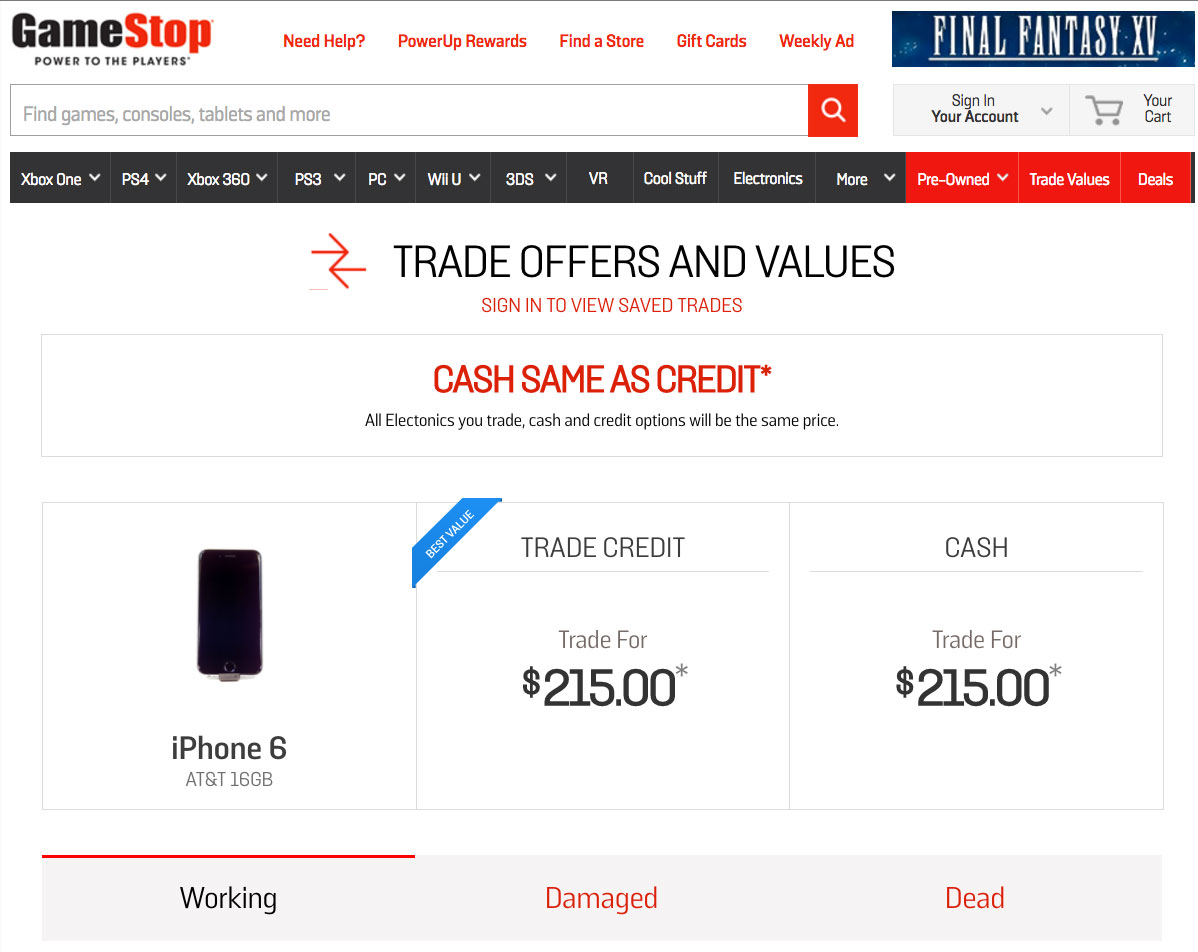
GameStop takes a different approach than other resellers because of its focus on games. While some resellers offer a mix of cash and credit, GameStop customers may be more inclined to trade in their phones for store credit in games, VR headsets and gaming systems, in addition to the refurbished iPhones and Samsung Galaxy models available on the GameStop site. The transaction is straightforward except for one thing: The final turnover of your phone for cash or gift cards must be done in person.
The website offers a list of the phone types GameStop accepts for trade. A working iPhone 6 Plus that has no missing parts, cracks or dents will trade or get cash totaling $240. That’s a little more than 52 percent of the $459.99 we had paid GameStop for the same phone the previous month. A damaged phone will trade for $95, while a dead phone gets $25.
My trade-in experience took just 15 minutes, as the pleasant and efficient clerk behind the counter tested the phone and looked up records. I walked out with a $240 gift card.
GameStop lets you search for stores within a 15-mile radius of your zip code. If there’s no retail outlet near you, you’ll want to turn to a different reseller.
Walmart
What we bought: Space Gray iPhone 6 (Straight Talk)
What we paid: $369
What we got back: $125
Rate of return: 34 percent
Cash or credit: Credit
Pros: Simple transaction requiring little information; Free shipping label supplied.
Cons: Very low return on resales; Limited to in-store credit.

You’ll find plenty of phones available for sale at Walmart, including contract, unlocked and refurbished phones available for the major carriers as well as the retailer’s in-house Straight Talk network. What you won’t find is the option to get cash back for your phone. It’s store credit and no negotiating.
It’s easy enough to go through the process, using the Gadgets for Gift Cards link. The used iPhone 6 we bought from Walmart netted a $125 offer, 34 percent of what we paid, which was the lowest return from any reseller. Interestingly, the phone was tied to Straight Talk. Had we tried selling back an unlocked phone or one tied to AT&T or Verizon, Walmart would have given us $160 in credit.
Once you approve Walmart’s appraisal, just log in to your account or create a new account with your email and mailing address. Walmart offers a printed label that you can use to pack up your phone and send it in. After that, just wait for your gift card to arrive via email, which it did within three days of receiving my phone.
Best Buy
What we bought: Space Gray iPhone 6 (AT&T)
What we paid: $599.99
What we got back: $208
Rate of return: 35 percent
Cash or credit: Gift Card
Pros: Trade-in process is simple, if you have no questions; Trade-ins at the store are handled efficiently by friendly staff.
Cons: Long wait times for answering questions on Best Buy’s 800-number; Low rate of return.

Best Buy has a busy website that features a vast variety of iPhones and flavors of Android phones for sale. But it’s still fairly easy to find the place to trade in your older iPhone. If you do, be prepared to accept payment in credit. Like Walmart and Amazon, Best Buy doesn’t deal in cash for phone trade-ins.
We paid $599.99 for an iPhone 6 that arrived in a sealed box (for an iPhone 6s oddly) but with no earbuds included, the only used phone we bought that was missing an item. That didn’t affect my trade-in price; when I turned in my iPhone for resale, the Best Buy clerk said I didn’t need to include accessories. But Best Buy’s offer was the second-lowest return from any reseller: just a $208 gift card, or 35 percent of what we paid for the iPhone.
MORE: Best Cellphone Plans for Your Money
Getting a quote from Best Buy’s website is simple enough. All I had to do was list the phone’s color, carrier and condition to get a trade-in value that I could redeem in person or by mail. Getting answers to questions proved more difficult. I called Best Buy’s toll-free number to ask about the missing earbuds and an issue with the phone’s IMEI number, and waited 20 minutes and through three transfers before I was told it would be a better idea to do my trade-in at a store. That took a much more efficient 15 minutes.
Other options
You don’t necessarily need to go through a reseller or e-commerce marketplace to unload your aging iPhone. Certainly, Craigslist offers the opportunity to find a willing buyer, and depending on your negotiating skills, you may be able to get a bigger return than you would from a reseller who’s going to offer you a set price.

That said, handling a sale on your own can be a hassle, and there’s always the risk of running into scammers. A reseller or reputable marketplace removes a lot of the headaches and potential risks.
If you’re planning on using the money you get from trading in your phone to finance the purchase of a new phone and you’re committed to a specific wireless carrier, you may want to see what that carrier will offer you for your old phone. Verizon offered us the best quote on an iPhone 6, with a $265 trade-in value. AT&T quoted us a price of $200 for a 16GB iPhone 6, while T-Mobile and Sprint offered $191 and $159, respectively. Those quotes assume a phone is in excellent condition, and the amounts can vary based on which carrier your old phone is tied to. You receive the trade-in value in the form of credit or a gift card.
Where to buy a used phone
Our testing of reseller services focused primarily on selling a used iPhone, because that’s where you’re likely to experience the greatest amount of variance, from the money you get back for your phone to the simplicity of the resale process. In contrast, shopping for a used iPhone from these sites is a pretty similar experience, though there are a few differences worth noting.

In terms of selection, you’ll generally find each service offers a wide degree of smartphone models and capacities. In our search for a used iPhone 6, we found that models tied to AT&T and Verizon were plentiful while T-Mobile and Sprint devices were in shorter supply. Amazon, Glyde and Swappa offered the widest range of phones in terms of carriers and capacities.
Used iPhone shoppers will find the best range of prices at Swappa, though lower-priced phones are likely to have been well-used. Glyde, Gazelle, GameStop and Amazon also offer attractive pricing on used phones depending on what model you’re looking for.
We found it easiest to shop for a used iPhone at Glyde and Swappa, which conveniently group iPhone models together, allowing you to drill down to the version you want. Despite its wide selection, Amazon offers very cluttered search results; type in iPhone 6, and you’re just as likely to get entries for the 6s, 6s Plus and 6 Plus as you are for the model you want. Walmart and Best Buy feature helpful filters for removing superfluous search results.
We should note that we ran into one quirk when buying our phones from Glyde and GameStop, though that’s likely a result of how we ordered our iPhones. Because we bought our phones through our corporate office and shipped them to an editor at another location, both Glyde and GameStop flagged our initial purchases, requiring us to set up a PayPal account to complete the deals. Most shoppers won’t run into that problem, though it could flare up if you’re buying a used phone as a gift for someone who has a different address than yours.
More from Tom’s Guide:
- Walmart, Best Buy Offer Worst iPhone Trade-in Deals
- The Best and Worst iPhone Trade-In Deals
- iPhone 7 vs iPhone 7 Plus: What Should You Buy?
- Why You Shouldn’t Get the iPhone 7
- iPhone 7 Camera Tech: Can Apple Be the Best Again?
Amazon’s Alexa can tell you what’s trending on Twitter
Twitter has announced a new “skill” for Echo devices called Twitter Reader. The company tweeted that you can now “use the Twitter Reader to hear trends, top Tweets, notifications & more!” A report yesterday revealed that Amazon might open up its Alexa ecosystem to allow push notifications, so that it could interrupt to warn you about a traffic jam, for instance.
However, Twitter also added “Just #AskAlexa” hashtag, so the new feature apparently doesn’t support push notifications just yet. It does give you a lot of options — you can ask Alexa to read back recent tweets, trending topics and even your own tweets. The device is surprisingly prudish and censors profanity, as PC Mag discovered, so if your feed is like mine, that could be a lot of beeping. However, it should be handy for Twitter addicts who want to stay on top of current events while cooking or doing other tasks.
New on Amazon Alexa! Use the Twitter Reader skill to hear trends, top Tweets, notifications & more! Just #AskAlexa. pic.twitter.com/BvXRS4NiQu
— Twitter (@twitter) September 9, 2016
Source: Twitter
Amazon Prime Now delivers supplies to tailgaters at 49ers games
Amazon’s one-hour Prime Now deliveries were already available to customers in the San Francisco area, but the company is going a step further for football season. The online retailer is teaming up with the San Francisco 49ers to deliver supplies to tailgaters at Levi’s Stadium during this year’s slate of NFL games. This will certainly come in handy when fans run out of game-day essentials and can’t easily drive out of the lot to go on a grocery run.
Ordering is pretty straightforward, you just have to enter the venue’s zip code to access a list of available items. At checkout, enter the address for Levi’s Stadium and be sure to include which parking lot you’re in and the nearest parking flag number. Prime Now is only available in three parking lots — Red Lot 1, Green Lot 1, and Blue Lot 1 — but the 49ers say that’s where most of the tailgaters set up. Amazon’s quick delivery service is available in the Bay Area from 8 AM until midnight and two-hour delivery is free. If you need something in an hour, you’ll have to pay an extra $8.
Source: San Francisco 49ers
Bloomberg: Amazon wants live sports streaming rights
Bloomberg believes that Amazon is considering buying the rights to a variety of live sporting events as a way of bringing more people into Prime. According to the site’s anonymous sources, the firm has made discreet enquiries about picking up licenses for global sports including tennis, golf, soccer and car racing. The company is believed to have a beady eye on domestic sports like baseball and basketball, although knows that traditional broadcasters have that sewn up for the next few years.
The report explains that Amazon hired a former Sports Illustrated executive, James DeLorenzo, to head up a sports division earlier this year. In addition, the company poached a former YouTube executive, Charlie Neiman, to look into partnering with sports companies and build new business opportunities. Amazon has refused to make a public comment, but these preliminary negotiations could be the start of a whole new broadcasting platform.
One of the existential problems that both Amazon and Netflix suffer from is that their audience has to make an effort to reach them. If you’re not that interested in highbrow dramas about the modern family, classical music or the political machinery in a bizarro-world White House, you won’t bother signing up. Netflix and Amazon have taken two very different routes to broaden their appeal beyond a hardcore audience — since both are believed to have around 50 million subscribers.
Netflix, for instance, is going for pure populism, and has broadened its outreach beyond blue-chip consumers who enjoy shows like Orange is the New Black. Shows like Fuller House and the deal it signed with Adam Sandler demonstrate how Netflix is attempting to move beyond its traditional customer base. Amazon, meanwhile, is hoping that bundling its own platform with Prime means that its retail customers are, invariably, going to want to check out its more populist original shows.
The rights to live sports broadcasts are likely to be the most lucrative, and expensive, things that broadcasters can buy. For instance, each of the big three networks spends around a billion dollars each year for the right to air NFL Games. In return for that outlay, they can expect audiences of between 18 and 21 million, which would be eye-gougingly high for a company like Amazon.
It’s not just Amazon or Netflix which are looking to sports to help break its apparent ceiling in subscriber numbers, either. Twitter signed a deal with the National Football League to stream 10 Thursday night games that are currently broadcast on NBC and CBS. Facebook, meanwhile, has considered joining the fray for sports rights, and has experimented with showing live soccer games on its own video platform.
Admittedly, every hurdle between audience and channel reduces that figure — so ESPN, which requires a cable subscription to access, only gets audiences of 13 million. Given the current extra layer of complexity required for consumers to get Instant Video on their TVs, it’s likely that the potential audience would be less that than ESPN can expect.
Of course, the big three networks can afford to spend billions on sports because they make that money back with ads. Amazon doesn’t air commercials, and would probably have to charge a pretty penny for an ad-free sports tier on Prime. Then again, if it did air commercials, it’d suffer a similar backlash to the one Netflix suffered at the mere rumor that it would bring ads into its shows.
Millennials, unfortunately, hate ads, and this has even affected NBC, a show that relies entirely upon promotional spots for revenue. Earlier this year, it conceded that such breaks are hostile to users and will reduce the amount of marketing clips in Saturday Night Live to win back younger audiences.
Source: Bloomberg
Amazon’s Alexa may soon butt into your conversations
Amazon’s Alexa may soon be interrupting your conversations with traffic notifications and other important announcements, if you want her to.
Amazon is eyeing spoken push notifications for the Amazon Echo, and it could either be a really great or a really terrible thing depending on how the service is set up. For instance, if Alexa could offer notifications customized by time, place and type, it could perhaps let you know if the email you’ve been waiting for about that event coming up has arrived. It could alert you to terrible traffic conditions in relation to appointments you need to make.
That’s looking on the bright side, however, as Alexa’s spoken notifications could quickly bug users, even though it’s an interesting suggestion for a feature. It would need a large set of customizational tools and permissions to work as flawlessly as it should in theory, but perhaps Amazon could figure it out.
Amazon hasn’t yet offered any comment on the situation, but on a personal front it wouldn’t be too obnoxious to have Alexa cutting in if her interjections are important. There’s always an “off” button, after all.
 AIVAnet