


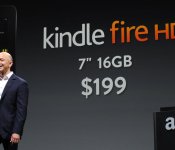
What you need to know about Amazon’s fight with e-book publishers

Unless you’ve been living in a book-free cave, you may have heard that retail giant Amazon and book publisher Hachette are having a little tiff. It’s all about digital versions of books — so-called e-books — and it boils down to this: Amazon wants to sell most of them for $10, and Hachette wants to set its own prices depending on the title and author. In the latest volley, Amazon tightened the screws by listing Hachette’s printed titles as unavailable on its site, halting pre-orders and pulling some product pages completely. In a blog post, Amazon claimed it was trying to do well by consumers and (confusingly) invoked George Orwell. Meanwhile, 900-plus authors — including household names like Stephen King and J.K. Rowling — said they were innocent victims and took out a $104,000 ad decrying Amazon’s hardball tactics. The dispute shows no sign of abating.
So, who’s right and, more importantly, who will win?
WHAT’S IT ABOUT?

Amazon and Hachette’s fight erupted when negotiations broke down, but how did it go so wrong? Amazon is far and away the largest e-book retailer, with Kindle e-reader sales of around $4 billion last year, and e-book earnings estimated between $265 million and $530 million. While that might not sound like a lot for a $74 billion company, Amazon has nurtured e-books over time and makes large margins on them (unlike other goods it sells, often at a loss). Hachette, meanwhile, isn’t exactly David to Amazon’s Goliath: French parent company, Lagardère, raked in 7.2 billion euros ($9.5 billion) last year.
Once Amazon got big enough to dictate terms, it declared $9.99 to be the de facto price for e-books. Simon & Schuster, Penguin, Hachette and other publishers wanted to set their own prices, but had no leverage against Amazon’s dominance. To change that, they struck a deal with Apple to create the “agency” model, which let them set retail prices while giving Apple and other retailers a fixed, 30 percent cut. Amazon was forced to take those terms, but it promptly complained to the US Department of Justice (DoJ). A judge eventually ruled that Cupertino and the publishers conspired to raise prices — a cardinal sin in the US. The court forced publishers to tear up all the agency e-book agreements and renegotiate terms with Amazon.

Once those negotiations started, Hachette and Amazon quickly found themselves at loggerheads. Hachette wants to set wholesale prices at about 70 percent of retail and pay authors whatever cut they can negotiate — usually about 10 percent. That leaves 30 percent or less to Amazon, depending on discounts. It’d be a pretty rich deal for the publisher, which takes less profit on printed volumes. Amazon, on the other hand, is willing to keep its e-book margins at 30 percent but is adamant that the price for most titles be the pre-agency rate of $9.99, 30 to 50 percent lower than what they are now (depending on the title). It also proposed that publishers split the 70 percent balance with authors, rather than taking so much of it.
When Hachette wouldn’t budge, Amazon curtailed supply of its 5,000 titles by halting pre-orders, delaying shipments (despite plentiful supply), eliminating discounts and removing titles entirely. Hachette said it wouldn’t back down either, adding that “Amazon … considers books to be like any other consumer good. They are not.” Without taking sides, the 900 members of Authors United (many not published by Hachette) decried Amazon’s order-stalling tactics, saying they’re being used as pawns. Amazon — which also has a publishing arm — trotted out its own scribes, along with the “me-too” Readers United group.
WHAT’S THE ARGUMENT?

Amazon grinds suppliers to keep its competitive edge, and publishers are no exception. It claims that reduced e-book prices actually result in higher sales and more money for all the players, not less. The online giant further argues that high e-book prices are unjustified since publishers have no printing, returns, resales and warehousing to deal with. It believes high prices are hurting the book industry, which must compete against video games, movies, television and other rival forms of entertainment. That was where it quoted Orwell, who said in the 1930s that publishers should “suppress” the new menace of paperbacks (he was joking).
Meanwhile, Hachette thinks a one-size-fits-all pricing model is unworkable; it wants the ability to set pricing for its own books, both higher and lower than the $10 standard. It said that it would only settle on an agreement that valued the publisher’s role in “editing, marketing and distributing” books. As a final dig, it accused Amazon of harming authors with its current actions, and believes it — not publishers — should compensate them for losses once the dispute is settled.
Amazon has received a lot of bad press of late. Not necessarily because of its negotiating position, but due to its tactics: slowing Hachette sales (see Stephen Colbert’s rant, above) is a prime example. Publications like the New Yorker have argued that, despite Amazon’s high-road arguments, it only cares about profits, not consumers. Some authors have also sided with Hachette: they say that publishers often lose money developing talented writers until they’re finally successful. But one WSJ pundit believes that the publishing industry is dying and that higher prices are the last thing it needs. And Forbes argued that the free market will ultimately decide who wins anyway.
But is it a free market? Some antitrust experts think that Amazon is now a monopoly, since it controls about 65 percent of the e-book trade (and 30 percent of printed titles). For instance, author Douglas Preston told the New York Times that his e-book and paperback sales were down around 60 percent since Amazon began slowing Hachette orders. Pundits say such consequences prove that Amazon has an iron grip on retail book sales — something they believe the DoJ may look into, just as it did with “agency” price-fixing.
WHY SHOULD I CARE?

Assuming you do believe that books are just boilerplate consumer goods, lower prices win every time. Amazon says you’ll pay less for books and more money will go into author’s pockets if it prevails. And while publishers contribute plenty toward the production of books, it’s hard to see why they deserve 60-70 percent profits on e-books, which are virtually free to distribute. Amazon, on the other hand, does offer clear consumer benefits like bulletproof customer service, “look inside” previews, millions of titles and deep discounts (in most countries). Amazon arguably deserves its large share of the e-book market too, since it was largely responsible for creating it in the first place with the Kindle.
However, let’s be clear: lower prices will make Amazon even more dominant in the e-book market. It could then put more more competitors out of business, and we know what happens to companies with few rivals — take Comcast (please). If you hold the position that books are culturally and socially important, unlike t-shirts and banana slicers, you may feel even more strongly. If publishers lose influence, literature could be ruled primarily by the forces of the economy, reducing the number of interesting or cutting-edge books. Finally, Amazon and Hachette can afford a long fight, but imagine the plight of a newly-published Hachette author right now. That’s why I’ll still use Amazon, but if I need a Hachette title, I’m heading to another retailer — I hear that Barnes & Noble has a new Nook.
WANT EVEN MORE?

Amazon and Hachette’s dispute has dominated the tech news, but the New York Times has a nice take on how it’s hurting authors. The WSJ has an in-depth argument as to why it supports Amazon, while Forbes thinks the free market will sort things out. The Guardian is neutral, but believes that the battle was overdue and that publishers need to change their business model anyway. Hachette has presented its side of the story here and Amazon has a mini-essay on its Reader’s United site. If you’re looking for alternatives to Amazon’s Kindle ecosystem, Barnes & Noble has the Galaxy Tab 4 Nook, now made by Samsung — and plenty of Hachette titles. And don’t forget Apple, which arguably started the whole thing. It took a dig at Amazon by discounting Hachette pre-orders.
[Image credits: Joe Klamar/AFP/GettyImages (Lede/Jeff Bezos at Amazon 2012 event); AP Photo/Mark Lennihan, File (Hachette trade show); Matt Cardy/Getty Images (Amazon Warehouse); Alamy (woman browsing books)]
Filed under: Handhelds, Tablets, Software, Amazon
.CPlase_panel display:none;
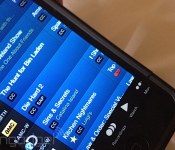
U-Verse app gets more live TV channels, launches on Amazon devices

AT&T is making U-Verse more appealing with each passing day. After the carrier revealed it would beat Google to the punch on bringing gigabit internet to Silicon Valley, now U-Verse is getting a great deal of fresh content and making its way to additional mobile devices. Aside from launching on Amazon’s Kindle Fire HD and Fire HDX, as well as the Fire phone, the U-Verse app today also welcomed over 50 new channels to its catalog of live TV streaming channels. This includes Cartoon Network, CNN, EPIX, ESPN, GolTV, HBO, HGTV, TBS, TNT and Travel Channel, plus many others — most of which you can watch even if you’re away from your home network. All in all, definitely a boost for U-Verse subscribers, and if you aren’t, it’s at least good to know that U-Verse looks to be a solid choice, especially now that DirecTV is joining AT&T’s ranks.
Filed under: Home Entertainment, Internet, Software, HD, Mobile, Amazon, AT&T
Source: AT&T
.CPlase_panel display:none;
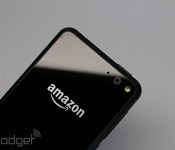
Amazon’s first Fire phone update tackles its big interface problems

Generally speaking, Amazon’s Fire phone hasn’t had the warmest of receptions, and the online retailer is looking to improve things with its first major update for the device. To start with, the flagship smartphone from Amazon is finally capable of multitasking, a feature that’s hard to believe could be missing to begin with — double-pressing on the home button now lets you quickly switch between apps and tasks. In this new version of the handset’s Fire OS, Amazon has also introduced App Grid Collections, aka application folders; Carousel Pinning, which lets users pin their favorite apps to the main home screen; and the ability to take Lenticular photos with 11 images rather than only 3, something that should make the optical illusion better on those type of images. Perhaps most importantly, however, this update is said to bring “dozens” of system tweaks which improve the Fire phone’s battery life, and we all know how important that is.
We should mention that, strangely enough, these features have been there for people with review units, including ours, but this is the first time Amazon is making them available to formal customers — the company said it was waiting for AT&T to approve the update. So, knowing this, give the refreshed software a try and let us know in the comments what you think of the handset now.
Filed under: Cellphones, Software, Mobile, Amazon
Via: Android Police
Source: Amazon
.CPlase_panel display:none;
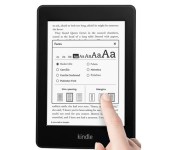
Amazon’s quietly doubled the storage on its Paperwhite e-reader

Head on over to the Amazon product page for the Kindle Paperwhite and you may spot the message telling you that there’s a newer version of the glow-in-the-dark e-reader available. That’s because the retailer has quietly doubled the internal storage of the device from 2GB on the 2013 model to 4GB on this year’s edition. In a statement to our friends over at The Digital Reader, the bookseller admitted that the storage had increased, but that it doesn’t consider this new Paperwhite to be a new product. So, if you were finding that 2GB simply wasn’t enough to hold your enormous e-book collection, you know where to go.
Filed under: Amazon
Via: The Digital Reader
Source: Amazon (Kindle Paperwhite 2013), Amazon (Kindle Paperwhite 2014)
.CPlase_panel display:none;

Limited time sale sees Amazon Fire TV on sale for $84 (15% OFF)

On the fence about whether to pick up the Amazon Fire TV? How about if we gave you a gentle nudge over that proverbial fence? Amazon is, for a limited time, offering the new gadget for $84, a savings of $15 (15%) off the normal price. What’s more, Amazon will toss in free shipping for… Read more »
The post Limited time sale sees Amazon Fire TV on sale for $84 (15% OFF) appeared first on AndroidGuys.
.CPlase_panel display:none;

Amazon undercuts Square and PayPal with its own mobile card reader

Square’s grand plan to democratize credit card payments has inspired a clutch of imitators, the latest of which is Amazon. The company has just announced Amazon Local Register, a credit card reader and app combination that’ll enable small businesses to take payments they wouldn’t otherwise get, as long as they have a smartphone or tablet lying around. The retailer is savagely undercutting both Square and PayPal Here, offering a flat charge of 1.75 percent per payment until the start of 2016, a full percent lower than the 2.75 and 2.7 percent asked by the other two. On January 2nd, however, the fee rises to 2.5 percent, a smaller yet still significant cut compared to Amazon’s rivals in the space. The gear’s available for Android, iOS and the company’s own Fire devices, priced at $10, and there’s even a business bundle for $380 that’ll include a Kindle Fire HDX 8.9 — which we figure is a whole lot cheaper than trying to install a cash register in your taco truck.
Filed under: Cellphones, Tablets, Internet, Amazon
Source: Amazon Local Register, (2), (3)
.CPlase_panel display:none;

LG’s $3,500 OLED TV is the first one you might be able to afford

Now that plasma TVs are really on their way out, it’s the perfect time for a true alternative to LCD, and LG is ready with its cheapest OLED TV yet. The 55EC9300 is the third generation of curved 1080p OLED TVs to roll out and with a price tag of $3,500, the price has dropped 75 percent since the first one debuted a year ago for $15,000. It’s still pricey for its size, but you won’t have to choose between tuition and a TV this time around. Inside is the webOS Smart TV platform we loved at CES, and of course, the new display technology that is supposed to bring better colors and deeper blacks than have ever been possible before.
The question now, is if the improved colors of OLED are a better option than the high-res 4K screens currently flooding shelves. If the rumors are right, we’ll see a 65-inch 4K version soon that cuts out the compromises, but costs twice as much. You’ll be able to get your own eyes on the screens soon — pre-orders are available through Best Buy and Amazon, and Best Buy will sell the set starting on the 24th.
Filed under: Displays, Home Entertainment, HD
.CPlase_panel display:none;

Vote for which new shows Amazon should give the green light

Amazon may be fighting with Hachette and Disney, but it’s still got enough energy to try and beat Netflix at its own game. The bookseller has announced its third pilot season, asking members of the public to determine which of five new original TV series will be given a full series by Bezos and his chums. This time around, three comedies and two hefty dramas will be screened on the retailer’s website on August 28th in the US and the UK, of which the most praised and watched will arrive on Prime Instant Video in due course. If you’re excited at the prospect of playing armchair TV executive, we’ve prepared a print-out-and-keep guide for what to expect.
First up, there’s The Cosmopolitans, in which a group of mostly white, privileged Americans wander around Paris looking for “love and friendship in a foreign city.” Adam Brody and Chloë Sevigny star, and we imagine it’ll be great, if you like obscure music, going to Paris and whining about how no-one “gets” you, you know?
Second in the batting order is Hand of God, a meaty hour-long drama in which Ron Perlman plays a hard-drinking judge who suffers a mental breakdown after his family his destroyed. He decides to take his revenge, and is aided in his quest by messages and visions that he believes have been sent to him by God. It all sounds tremendously exciting, but it’s directed by Marc Forster, who ruined Quantum of Solace, and therefore we won’t get excited lest he breaks our hearts once again.
Thirdly, there’s Hysteria, in which Mena Suvari plays a neurologist in Austin, Texas, who has to stop a weird psychological disease that’s spread through friendship. Let’s just hope that no-one in the show has ever heard of Facebook, or we’re all doomed. Weird premise aside, it’s been created by Shaun Cassidy, who created American Gothic, so this one is likely to be first on our watch list.
The second half-hour comedy on the list is Really, in which a group of hard-charging suburban Chicago couples try to grasp onto their dwindling youth. It sounds a little like the premise of thirtysomething, in which a group of people in their late-thirties try to grasp onto their dwindling youth — although that show was set in Philadelphia, so they’re probably completely different.
Finally, there’s Red Oaks, a coming-of-age comedy set in the “go-go” 80s that’s “equal parts hijinks and heartfelt.” We’re not sure what that means, but presumably every time someone makes a joke about Molly Ringwald, or leg warmers, or mobile phones, they have to hug someone and cry.
Filed under: Home Entertainment, Internet, HD, Amazon
Source: Amazon
.CPlase_panel display:none;
Amazon wants you to ask Hachette’s CEO for lower e-book prices

Amazon’s fight with Hachette over e-book pricing just got extra-personal. Hot on the heels of writers attacking Jeff Bezos’ “retaliation,” the Amazon Books Team has posted a Readers United site that calls on you to email Hachette CEO Michael Pietsch and ask him to lower the costs of e-books. The online retailer doesn’t want you to mince words, either — it wants you to bring up his “illegal collusion” and claim that he’s using authors as “leverage.” Some writers aren’t on his side, Amazon says.
Whether or not you think flooding someone’s inbox is an effective advocacy tactic, Amazon may not have used the best evidence to criticize writers that back Hachette’s position. It cites 1984 creator George Orwell as saying that publishers should conspire together to keep costs artificially high. Well, that’s not really true. As the New York Times notes, Amazon is quoting Orwell out of context — he was in favor of cheaper books (like paperbacks), but contended that they would still hurt the industry’s income. He also disputed the notion that lower prices will lead to people buying more books, as Amazon argues. Orwell believed that customers would simply roll the savings into other forms of entertainment, like movies; that’s good for both readers and multi-talented media giants like Amazon, but not authors and publishers. While he wasn’t completely right about pricing — paperbacks did spark a literary renaissance, after all — the issue isn’t necessarily as clear-cut as Amazon makes it out to be.
[Image credit: David McNew/Getty Images]
Via: New York Times
Source: Readers United
.CPlase_panel display:none;

Amazon and Disney are fighting, so you can’t pre-order ‘Guardians of the Galaxy’ on Blu-ray

Neither side has confirmed it, but it looks like Amazon’s latest pricing battle (after Warner Bros. and its ongoing battle with book publisher Hachette) is with Disney. That’s why you can’t pre-order a copy of Guardians of the Galaxy on DVD or Blu-ray from Amazon right now, even though you can at other retailers like Best Buy. Home Media Magazine points out that the same goes for other upcoming Disney releases like Maleficent, Captain America: The Winter Soldier and Muppets Most Wanted. In some cases, like GotG, you can sign up for a notification for when they’re available, others are just missing from the virtual shelf entirely, but what Amazon will offer is a pre-order for the digital copy on its Instant Video service. Amazon and Warner squabbled for a few weeks before a truce ironed things out, hopefully they can resolve things with Disney in time to cook up a boxed set bonus for the baby version of a certain Guardians character we absolutely must have (and aren’t willing to pay $360 for).
Filed under: Home Entertainment, HD, Amazon
Source: Home Media Magazine, Amazon
.CPlase_panel display:none;
 AIVAnet