


Baby steps toward better wearables at Computex 2014

Google’s latched on to Diane Von Furstenberg as the solution for making Glass fashion-forward, unveiling a collection of frames made by the famed Belgian designer last week. While it remains to be seen whether trendy colored-frames can make a $1,500 wearable more appealing, a few smaller companies here at Computex in Taiwan have some novel ideas that could make you more willing to strap a mini-computer on your face… or your wrist.
To be clear, there are plenty of cheap smartwatches and Google Glass rip-offs hogging booth space at Computex. It’s just another sign that wearables are taking off in a big way — everyone wants in on the game, even if it means producing an also-ran product at a much lower price point. Innovative fitness trackers, for one, didn’t make a big splash at the show, with devices like Acer’s Liquid Leap mimicking features we’ve already seen in countless other products.

But even if their tech isn’t cutting-edge, many manufacturers showcasing here in Taiwan are paving the way to more innovative design with one-off prototypes. In some cases, that means sleeker and more diverse hardware, and in others it means clunky but interesting use cases. We’ve seen examples of both, and it made trudging through the copy-cats worthwhile.
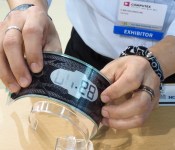
Take E Ink, for instance. The company has teased the concept of a full wraparound display smartwatch several times, but a rep at the show said the design has been prototyped, and he wasn’t shy about providing details about how such a watch would work. For one thing, having more screen real estate would let you view more information than on your typical smartwatch, and color E Ink would allow for some neat watch-face designs. And, as one Engadget reader pointed out, the sleek design’s footprint isn’t a far cry from some bracelets, so it could be a more stylish option than the Galaxy Gear, for example.
While getting rid of the watch strap altogether could make for a sleek design with more room for displaying information, one company wants to put the band to good use by adding a lithium-ceramic battery. Prologium’s watchband battery could double the runtime of your wearable, which is definitely good news for anyone who’s been disappointed with the Galaxy Gear or Pebble’s stamina.

One of Epson’s E Ink watches on display, designed in partnership with wOw Tokyo, is also worth mentioning. It’s like the girly equivalent of the Pebble Steel — there’s a delicate, feminine pattern on the band — with a longer battery life but no smart functionality, that is. The E Ink screen displays a variety of cute animations and watch faces, including images of London’s Big Ben, street lamps and circus tents. Another version, not on display, offers the same concept with a soccer theme. Nothing revolutionary here; just an E Ink watch that serves as an alternative to the standard monochrome aesthetic we’re used to seeing.
An attractive design is one thing, but on the other end of the spectrum is an unwieldy yet novel take on the head-mounted display trend. It’s no Oculus Rift, but the PhoneStation literally puts your handset’s screen before your pupils, channeling a side-by-side picture so you can watch 3D YouTube hands-free. In its current incarnation, the design is almost ridiculously heavy on your head — especially when you have a larger phone like the Galaxy Note 3 — but the convenience factor is pretty obvious.

With a little refinement, such as a lighter design or one that distributes weight more efficiently, the PhoneStation could become a compelling option for virtual-reality gaming (just add a Bluetooth controller and you’re set). And since nearly all of the tech comes from your handset, the price point would likely be quite low.
As Computex becomes less of a show about Ultrabooks, there’s room for smaller vendors from Asia and beyond to showcase quirkier products and proofs-of-concept. And, frankly, that’s made for a very interesting few days roaming the convention-center halls. Even if you never own a wraparound-display watch or strap a Galaxy Note to your head, get ready to think beyond Pebble and Google Glass — the wearable game is just heating up.
Acer CEO: Better to make an imperfect smartwatch than none at all

Acer is in trouble, but that’s not Jason Chen’s fault. The CEO, who’s only been on the job five months, inherited an organization besieged by a shrinking PC market and record losses. So how is he doing? Too soon to say, really, but there are signs Acer might be turning over a new leaf: The company this week unveiled a tablet, a bunch of smartphones and its first smartwatch, the Liquid Leap. No PCs, though. If nothing else, it’s clear the firm is eager to branch out beyond cheap laptops.
Here at Computex (ostensibly a computer show), we asked Chen what he thinks consumers want in a smartwatch, and how the Leap will stand apart from other wearables entering the market. Chen’s surprising answer: He doesn’t know yet. “We believe over time the market will prove itself,” he said in an interview. “What we have to do is get the product [out] and see how it goes.” In the meantime, Acer’s strategy is to hedge its bets. The Leap attempts to be both a smartwatch and a fitness device, with features that include SMS/call notifications, step counting and sleep tracking. At launch, it will only work on Android (just an Acer phone to start), but an accompanying iOS app is already in the works. Whatever it is that people want to do with a smartwatch, Acer is trying to cover its bases.
Reading in between the lines, though, it seems Chen is aware the Leap is probably imperfect. “This is the first product we’ve introduced in the wearable market, and it won’t be the last,” he said. “We understand the market is going up, and we have to make sure we don’t miss it. What we are learning, the industry is also learning.” In other words, better to enter the market as soon as possible, and get your mistakes over with early.

Just ask Samsung. Or Sony, for that matter. Both companies are on their second generation of smartwatches, and both have yet to master things like user experience and app selection. It’s not surprising, then, that Jason Chen doesn’t seem to know what consumers want in a smartwatch; companies that have been at it for years still don’t have the answer. That doesn’t bode well for Acer, which perhaps isn’t as early to the market as Chen would have you believe — and which faces competition from other newcomers such as Motorola, LG and Razer. Then again, plenty of other companies (Apple, Dell, HP, ASUS, Toshiba) have yet to announce anything at all.
Acer certainly faces serious challenges trying to figure out the wearable equation, but Chen insists his company has a leg up. His own experience in semiconductors — he comes from TSMC — helps, he says. “How long can you expect to recharge your device?” he asked, referring to some of the unsolved challenges of building a smartwatch. “Those power consumption questions need to be fixed.” More importantly, Chen says, Acer is a big brand that people trust. And even if they don’t, the company can still reach a large population of people, all while keeping the price down. “We have established a foothold in the industry so when the market starts to ramp up, we participate,” he added. “Rather than being too late, at the tail of the market.”

Acer shows off the first 4K monitor with NVIDIA’s stutter-reducing G-Sync tech

It’s been nearly eight months since NVIDIA unveiled G-Sync, a new technology for game monitors that reduces lag, stuttering and screen tearing. In that time, none of these displays has been widely available, though we have been treated to an in-person demo or two. Finally, though, Acer is on the verge of releasing a G-Sync monitor, and it appears to be the first with 4K resolution, to boot. The XB280HK (pictured above) is a 28-inch display with a 3,840 x 2,160 TN panel — a big improvement over the Philips 1080p model we saw back at CES. Separately, ASUS just announced the ROG Swift PG278Q, here at Computex; that’s a 27-inch G-Sync monitor with 2,560 x 1,440 resolution. See? They don’t all have to be capped at 1,920 x 1,080.
Like other G-Sync displays, both of these match your GPU’s refresh rate with the monitor’s as a way of eliminating the sort of bumpiness you’d normally get if you extended your gameplay onto a bigger screen. The in-person demo we got today reminded us how effective the technology is, especially in side-by-side comparisons with older monitors. But don’t take our word for it — the demo video embedded below does a better job capturing the benefits than any hands-on walk-through we could put together. Even if you’re already aware of how the technology works, you might want to check it out; it’s the clearest demonstration of the technology we’ve seen yet. As for the question of “when can I buy these?”, well, we’re not actually sure yet. No word on when either of these will arrive or how much they’ll cost, but the Acer model, at least, is slated to ship in Q2, which means it should go on sale very soon.
With three SIM slots, Acer’s Liquid E700 is a phone for frequent travelers

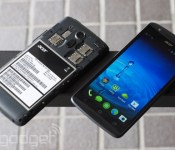
Not that you’d know from its formulaic product name (seriously, Acer, you’ve gotta switch things up), but the 5-inch Liquid E700 Android smartphone has an interesting feature geared toward travelers: three SIM slots. Dual-SIM phones are one thing, but why would anyone need space for three? Acer envisions you having separate work and personal cards, with trips abroad requiring one more. And though it’s mostly a matter of convenience – you can keep your home SIM in the phone while also popping in one at your international destination – the setup has the side benefit of preventing you from losing any cards as well.
Still, it’s not like you’ll be able to use multiple SIMs at once; if you receive a call on the AT&T card you use at home, for example, the other two will be left in standby mode. It’s a little like KnowRoaming’s sticker, which sits on top of your SIM to offer global data; when it’s in use, your regular SIM won’t be active. And while we’re at it, it’s worth mentioning that several other companies, including LG and Motorola, have announced triple-SIM phones of their own, but many of these have been confined to a specific region or country. The Liquid E700, on the other hand, will be available in Africa, Europe and the Middle East.
To take advantage of all those SIMs, the Liquid E700 is a quad-band phone, which means you’ll be able to use it virtually anywhere in the world (or anywhere there’s GSM, at least). And beyond the handset’s travel-friendly features, there’s a hefty battery rated for up to 60 days of standby and a full day of talk time. The E700 is light and thin, too, though you definitely wouldn’t buy this device for its design alone. Look for it in August, with a price tag of €199 attached.
Zach Honig contributed to this report.
Filed under: Cellphones, Mobile, Acer
Acer shows off ‘Extend’ app allowing you to control your phone from your PC

For every promising concept we see, there’s one that gets scrapped before ever making it to market. That’s what happened with Acer’s “Extend” dock, an accessory that would have allowed you to connect your smartphone to a clamshell-style dock with a display, keyboard and a spare battery to recharge your handset. Turns out, lots of people already carry laptops, and don’t necessarily need to transform their phones into a de facto tablet or netbook. What they do need, though, is to move stuff on and off their phone, or pick up on their PC where they left off on their handset.
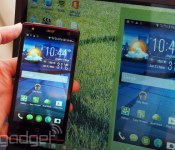
Enter Acer — again. The company has totally re-thought its Extend concept, so that rather than use a dock, you just have to install an app on your Windows PC, allowing you to control the phone. To connect your phone, you can either use a standard USB cable, or connect wirelessly, assuming your PC and phone are on the same network. Once your phone’s homescreen appears in a phone-shaped emulator box, you can do things like drag and drop files on and off the devices. You can also, say, share a YouTube video on your phone to Acer Extend, and have it open in whatever your default browser is. Ditto for other kinds of content, like PDF files and Microsoft Office documents. If you were desperate, you could also potentially use this to bypass your company’s VPN, and access blocked sites over 3G.
In the demo we saw here at Computex, the emulator ran consistently smoothly. Acer says this isn’t an accident: It’s aiming for frame rates of at least 24 fps for each device. The catch, though, is that the performance here depends partly on the phone, and apparently not every device is up to snuff. To meet that 24-fps minimum, then, Acer is only releasing the app for some of its phones — namely, flagships and some mid-range devices. So if you happen to be the lucky (?) owner of a Liquid E2, you’re going to be left out on this one.
Zach Honig contributed to this report.
Filed under: Cellphones, Software, Mobile, Acer
Acer claims its €79 Liquid Z200 is the cheapest branded Android phone

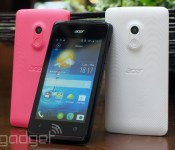
The Acer Liquid Z200, an Android phone with a 4-inch WVGA display and a plastic design, is nothing if not budget-friendly. What makes it special is that it’s the cheapest Android phone — at least excluding any off-brand devices you might come across in electronics markets, Acer says. It costs just €79, and while its specs are at the low end of the spectrum, it does what it says on the tin.
Of course, this assumes that you’re content with a 1GHz dual-core MediaTek SoC and 512MB of RAM. You also only get 4GB of internal storage, though Acer includes a micro-SD card slot to bring more media on board. There’s only one camera on board, and it’s a 2-megapixel module with fixed focus. Clearly, no bells and whistles here, but Acer makes no bones about this phone’s cheap pedigree.
Fitting its budget price, the Z200 comes in five “fun” (read: unsophisticated) colors including neon pink and black with red accents. The look isn’t sleek or sexy, but the stippled, patterned texture on the plastic backing feels good and helps your hands get a good grip. A dual-SIM version will be available, though Acer hasn’t shared pricing for that model. The Z200 will hit Africa, Europe and the Middle East in early August.
Zach Honig contributed to this report.
Filed under: Cellphones, Mobile, Acer
Hands-on with the Liquid Leap: Acer’s first wearable tries to be everything to everyone
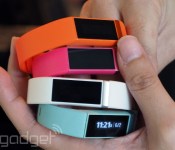
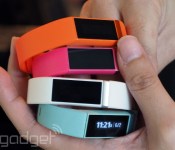
Thanks to a quick tease a few weeks back, we already knew Acer was on the verge of revealing its first smartwatch. Until today, though, we had all talk — it’s a smartwatch! It’s a fitness tracker! — but virtually no details. Now, at Computex, we’re getting our first look at the Liquid Leap, due out later this year. The best way to think of this (other than as a “me too” device) is that it’s a wristband trying really hard to be a jack of all trades. In addition to doing typical smartwatch things (call and SMS notifications), it tracks your sleep, steps, distance traveled and calories burned. It can also pause, play and skip music tracks. Like other fitness trackers, it’s waterproof, though it’s far more discrete than your average sports watch. For now, Acer is being coy about the price, except to say it’ll cost less than €99 in Europe. Without a price, then, it’s hard to say how good a value this will be when it goes on sale in Q3. That doesn’t mean we can’t tell you more about how it works, though. So join us, won’t you?
At first glance, the Liquid Leap reminds me a little bit of the Jawbone Up: both are thin (this one is just 17mm wide) and both come in an array of bright colors (white, black, aqua, pink and orange in this case). The main difference, of course, is that the Jawbone Up doesn’t claim to be a smartwatch, so it can get away with having no screen, thus passing for a piece of jewelry. With the Leap, there is indeed a display, though it’s at least slim — as slim as it can be while still being useful. All told, it’s a little like the Samsung Galaxy Gear Fit in that respect, except the screen here basically sits flush with the band, making it less conspicuous. What I’m trying to say is, this looks more like a watch than a bracelet, but it’s at least lightweight and delicate enough that it doesn’t call much attention to itself.
The Leap has an adjustable design, with fasteners that fit into cut-out holes on the wristband. Particularly because of that rectangular display, the watch stays put — that long watch face is designed so that it lies flat on the wrist and can’t go anywhere else, especially if the fit is already snug. Also, you thankfully can’t tell at first glance that this is made of rubber, so while it feels soft and pleasant against the skin, it’s not immediately obvious how sporty it is (because let’s face it, sporty watches don’t usually look good with everyday outfits).
Another reason the design here is so sleek: There aren’t any physical buttons. Rather, to wake up the watch, you do a long-press on the touchscreen. From there, the UI is idiotproof, if a bit tedious. Whatever you want to do — check notifications, control music playback — you need to swipe from left to right. Right now, at least, there’s no way to customize the order of those home screens, so if the feature you want most happens to be four screens in, you’re out of luck; just brace yourself for a lot of repetitive swiping. Eventually, as you’re swiping through, you’ll get to the so-called apps menu — tap that and you’ll find the sleep-tracking feature (Acer will eventually release an SDK allowing for third-party apps, but hasn’t done so yet). What’s odd — and slightly annoying — is that once you’re ready to exit the apps menu, there’s no way to navigate backward, into the main set of home screens. All you can do is wait a few seconds for the apps menu to go away. There has to be a better way.
As a fitness tracker, the Leap does all the basics: it counts steps, calories burned and distance covered. Similarly, too, it uses an energy-efficient Bluetooth 4.0 radio to ensure battery life — five to seven days, to be precise. Unlike, say, the Up, it has no altimeter, so you can’t count flights climbed; just steps taken. There’s also no workout mode, per se, so steps really are the only measure of how active you’ve been. As for sleep tracking, you can monitor your sleep habits, though you will have to manually enter sleep mode, and there isn’t yet any sort of sleep estimate feature, as there is on the Up.
In the beginning, at least, Acer is making some compromises in terms of device compatibility as well. At launch, the Leap will only work with Acer’s new Liquid Jade phone, with other Android devices to be added in due course. Even then, of course, your phone might not make the cut. Acer says an iOS app will follow later on, though who knows? Maybe that unicorn iWatch will be out by then.
Zach Honig contributed to this report.
Acer Liquid Jade is the world’s ‘most compact’ 5-inch smartphone

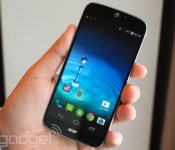
As an American site, we tend to ignore devices that have zero chance of making it to the states. That said, we’re making an exception for Acer’s new Liquid Jade phone. For one thing, it’s going to come bundled with Acer’s new Liquid Leap smartwatch in select markets (Asia, mostly), and will initially be the only phone that’s compatible with it. In addition, though, Acer claims this is the world’s “most compact” 5-inch smartphone. And you know we love us a good superlative.
Whether or not that claim is actually true (and we believe it is), the Jade is indeed very thin and light. All told, the phone measures between 6.8mm and .75mm (0.27-0.03 inch) thick, depending where you hold the tape. Because this hasn’t been released yet, Acer isn’t committing to a final weight spec, but it says the phone will come in under 120g (4.23 ounces). In fact, the device would be even thinner if not for the bulge on the upper back, where the 13-megapixel, f/1.8 camera lives. That module does create sort of an awkward nipple on the back, but with that kind of aperture, it could be worth it, especially for people who are serious about smartphone photography. And hey, even as is, the phone feels surprisingly insubstantial in the hand.
That thin design and high-res camera aside, this is, at its heart, more of a mid-range device. As sleek as the actual build is, the backside is clothed in glossy plastic that picks up fingerprints easily. That was especially true on the black unit I handled, though you might have better luck with the white and aquamarine models, which have been designed to color-coordinate with the Leap smartwatch. Spec-wise, it has a 720p, not 1080p, display, though the IPS panel and “Zero Gap” bonding technique mean viewing angles are quite good. The processor, meanwhile, is a generic quad-core MediaTek chip. (In fairness, the processor was more than capable of handling Android 4.4.2 in my brief hands-on time.) Storage is also fairly limited, with either 8GB or 16GB on board, though you’ll thankfully find a microSD reader in the same slot where the SIM tray lives.
The Jade will arrive in Europe and Asia sometime in the third quarter of this year, with the price expected to be under €300. If you are indeed one of our American readers, you won’t want to hold your breath, then, but feel free to partake of our hands-on photos anyway.
Zach Honig contributed to this report.
Filed under: Cellphones, Mobile, Acer

Google aims for the mainstream with 20 new, more powerful Chromebooks

If you haven’t picked up a Chromebook just yet, you might want to wait a little longer. Intel has just announced that it plans to roll out as many as 20 new Chromebooks by the latter half of this year. This new set will be thinner, lighter, more powerful and generally more diverse in terms of design. It’s clear that Google is making a play for the mainstream.
Most of these will be based on Intel’s more powerful and efficient Bay Trail-M system on a chip.
“Bay Trail is optimized for power, performance and cost,” Intel’s VP and general manager, Navin Shenoy, said. “The first Chromebooks are also now available with over 11 hours of battery life, which is up from about 10 hours on Haswell.”
They’re also the first ever Chrome devices to be fanless, he said, and will be 15% lighter. Also expect a lot more different Chromebook designs and form factors. There’ll be some models with touchscreens, and some, like the Yoga, will have a folding display. In addition to just Chromebooks, Intel also introduced a tiny HP Chromebox that you’ll be able to hook up to any display and announced the availability of LG’s all-in-one Chromebase. Last but not least, Shenoy also announced that all of the Chrome devices released today will be made with the world’s first “conflict-free” microprocessors, that were not mined by slave regimes in the Republic of Congo.
At least a couple of them will be based on the company’s Core i3 processor, including an Acer version that’ll be available for $349 this summer and an updated version of Dell’s 11-inch model that should ship later in 2014. In addition, Intel is partnering with at least four major manufacturers — Acer, ASUS, Lenovo and Toshiba — to produce Bay Trail-powered devices. Lenovo has announced two of these last night: the N20 and N20p. Not to be left out, ASUS also rolled out a couple of new offerings. They include an 11.6-inch C200 and a 13.3-inch C300, both of which will begin shipping this summer.
Caesar Sengupta, VP of product management at Google, took to the stage to say that sales numbers for the Chrome devices have been great. “Chromebox is the number one selling desktop,” he said, “And the top six rated laptops on Amazon are all Chromebooks. They’re both the highest rated and the most affordable.” He also pointed out that eight of the top computer manufacturers offer Chromebooks, and that Chrome devices are available in over 20 countries and nearly 10,000 schools, with more coming in the future. Shenoy also showed off an education Chromebook reference design that he hopes will inform the next generation of Chromebooks for schools. In addition, Sengupta told us that not only are Google Now and voice commands coming to Chromebooks, but also Play movies will be available to view offline as well. “The momentum is solid and gathering pace,” he said.
Filed under: Google

Chairman tries to boost confidence in Acer as he slips out the back

Six months ago, the co-founder of Acer stepped out of retirement to take up the positions of Chairman and CEO, with the intention of turning the embattled PC maker’s fortunes around. Stan Shih now claims that he’s succeeded in this mission, and that people’s confidence in the company should be restored by the end of 2014, with a full-fledged “return to glory” to be expected within three years. He won’t be sticking around to see if any of that happens, however: The 69-year-old has already handed over the chief exec’s reins (twice), and now he’s decided to give up the chairmanship too. As of June, he’ll retreat to the relative obscurity of Acer’s cloud department. He’ll oversee the company’s effort to make money from its “Build Your Own Cloud” service, based on the idea that customers may want to store their data centrally but privately, rather than on someone else’s servers. Ultimately, though, Acer’s future still rests on its hardware, and its most recent products — the Switch 10 and Iconia Tab 7 — look a lot like business as usual.
[Image credit: CEIBS]
Filed under: Laptops, Tablets, Acer
Via: PC Advisor (IDG)
Source: PC Advisor (IDG)
 AIVAnet