


Spotify’s ridiculous offline limits are finally getting raised!

Come for the easy setup, stay for the algorithm-based recommendations
One of the most popular names in the music world today isn’t a band or a record label: it’s an app called Spotify. Spotify was one of the earliest and most popular music streaming services on the market today. The service is available on almost every platform, from cars to home assistants to high-end speakers to phones, tablets, and computers. Spotify’s prowess with data analysis and algorithmic music suggestions have made the service addictive for music-hungry users, and as the first major service to offer student pricing, it’s spread like wildfire on college campuses across the country.
Here’s what you need to know before and after you dive in with it.
The latest Spotify news
September 14, 2018 — Spotify is raising its offline limits!!

Spotify’s offline limits have been one of the bigger sticking points for Premium users. While Spotify’s 10,000 song library limit takes a while to reach, the 3-device, 3,333 song limit for Spotify’s offline content has been quite easy for users to hit, especially if they subscribe to any huge community playlists. Well, after years of persistent user complaints, Spotify is upgrading its offline limits to 10,000 songs on up to 5 devices. A Spotify spokesperson confirmed to Rolling Stone:
At Spotify, we’re always working on improving the experience for our users. We can now confirm that we have increased the number of offline tracks per device — from 3,333 on three devices to 10,000 tracks per device for up to five devices.
Being able to use more devices with Spotify’s offline content is great news, but the fact that you’ll be able to download your entire library on a single device is even better, since most users only use one phone at a time, and want to be able to access all of their music offline rather than just a third of it.
All the big details
Getting Started

Spotify is built to be as easy a listening experience as possible, and for most users, making an account is as easy as pressing one button. From setting up an account to getting your library established, we’re here to help you avoid as much pain as possible while you make the switch.
Getting started with Spotify
Pick your subscription

There are a lot of subscription styles out there for Spotify, but which one will fit you — and your family members — best? We break down the difference in Spotify subscriptions beyond the price points and show their prices and pitfalls, especially the very tight strings wrapped around Spotify Premium for Family subscriptions.
How to pick a Spotify account
Play your music everywhere

One of Spotify’s perks is that users can play back their music just about everywhere: their watch, their phone, their TV, their car, their smart speakers, high-end speakers, their computer, and just about everything in between. Best of all, connecting to all of these diverse devices uses the same simple UI: Spotify Connect. Here’s how this musical magic works and what it works with.
Spotify Connect: What it is and why it’s awesome
Settling in with Spotify

Once you’ve gotten your account up and running, it’s time to start mastering Spotify and making it work for you. From library management to offline playback and beyond, there are some simple things you can do to turn your Spotify experience up to 11.
Top 5 tips to make the most of your Spotify subscription
Playlist problems persist…

Playlists are a big part of any music service, but they’re doubly important on Android because playlists curated by everyday users can be highlighted by Spotify’s search and shared with your friends, family, and followers. There’s just one little problem: you can’t really edit playlists properly on Android. Or Chromebooks, for that matter.
Spotify has a playlist problem on Android
… but Spotify’s playlists have a secret ally

Even if you can’t tweak your playlist order, description, and image on Android, it’s still possible to build a big, beautiful playlist on Spotify. If you start running out of ideas for additions to your playlists, don’t worry. You can leverage the work you’ve already done and Spotify’s algorithms to expand your playlist with Playlist Radio.
Use Spotify’s radio to build bigger, better playlists
Queues, subqueues, and frustration

Managing and mixing up your queue on Spotify is a bit of a minefield for two reasons. The first is that rather than showing your listening history by letting you scroll up in your playlist, whatever you’re playing is at the top of the queue and what you last listened to is at the bottom if it’s visible at all.
The second is that Add to Queue doesn’t do what it’s called, which can turn an already confusing queue into a vanishing, inconsistent tur-queue-ken.
Spotify’s Add to Queue is a lie
Offline mode could use some work
We take our music out for a run, we bring music into the shower, and we always bring music when we travel, be it by plane, train, or automobile. And since we bring our music where our internet sometimes cannot follow, that means that offline modes for our music apps are important. Offline for Spotify is lackluster at best, and that’s disappointing for a whole host of reasons.
Offline mode on Spotify sucks out loud
Made For You is made in heaven

Finding something to listen to can be a tricky proposition for any music lover, but Spotify is known far and wide for their algorithmic prowess. And the best example of it isn’t the Discover Weekly or the year-end statistics. No, siree, the best use of Spotify’s number-crunching genius is a little section in Your Library called Just For You.
Spotify’s ‘Made For You’ is a love letter to music addicts
Spotify vs. Google Play Music

Spotify has a lot of competition, but perhaps the biggest competition they face on Android is convincing people that they’re better than the music player that came pre-installed on your phone: Google Play Music. To be sure, both services have their ups and downs, but here is a critical comparison of the two services to help you decide if you want to give Spotify your time, attention, and money.
Spotify vs. Google Play Music: The battle of the bigs
What’s your take?
What do you love or hate about Spotify? Let us know in the comments!
Whitestone Dome Glass Galaxy Note 9 case review: Corner save
Protecting the aesthetic and design simultaneously.

The Galaxy Note 9 is beastly: at nearly 6.4 inches tall and just over 7 ounces, when it falls it goes down hard. Anyone with a shattered glass back or front can attest to that. Whitestone’s Dome Glass clear case is just $10 but it does everything a good case should do: maintains the phone’s beauty while protecting as much of the device as possible.
A clear winner
Whitestone Dome Glass for Galaxy Note 9

$9.99 at Amazon
A clear case with no compromises
Whitestone’s Dome Glass is a clear case that adds much-needed grip and protects the Note 9’s four corners from impact.
The Good
- Doesn’t add much bulk
- Inexpensive
- High-quality plastic
The Bad
- Attracts dust and fingerprints

Whitestone Dome Glass for Galaxy Note 9 What’s good
Reviewing cases for big phones is a difficult proposition because as slippery or fingerprinty as a phone gets, the last thing you want to do is add weight or bulk to what may already be a pocket-protruding product. That’s the good news with Whitestone’s Dome Glass case, which is about as thin, light, and unobtrusive as it comes.
This is about as good a clear case as you’re going to get for $10.
Made with high-quality, flexible plastic (also known as TPU), the case’s best feature its grippy texture and reinforced corners, which make it easier to grip the slippery Note 9, and protect it from falls when those moments inevitably come. But while there is some give to the plastic, making it easy to install the phone, it’s thick and strong enough to give me confidence in its longevity — this case isn’t going to fall apart in a few months, and in the weeks I’ve had it on the phone, it’s yet to show the telltale discoloration that comes with cheaply-made clear plastic.
The Note 9’s side buttons are all easily accessed through the plastic perimeter, and the phone’s S Pen, a hallmark of Samsung’s series since its introduction in 2011, is quickly removed. Similarly, the bottom cutouts for the headphone jack, USB-C port, microphone, speaker, and S Pen, are all perfectly positioned.

Whitestone Dome Glass for Galaxy Note 9 What’s not good
As with all clear cases, it’s imperative you clean the phone, and the inside plastic, prior to inserting the phone every time, lest you end up with dust, lint, and obvious fingerprints. With this case and the oversized Note 9, there’s plenty of surface area for those tiny particles to get trapped, and that makes for a not-so-fun experience if you’re the fastidious type like me. I had to remove the Note 9 more than a few times, and then finally install the case in a steamy bathroom, to prevent said visual aberrations.
And while this is true of all cases, the Whitestone Dome Glass case, despite its transparency, still somewhat mars the Note 9’s visual appeal. Not by a lot mind you, but you miss the carefully-designed chamfers and other subtleties of the phone when it’s presented in a case.

Should you buy it? For a clear case, this is a great choice
There’s no question that, when buying a case, you want something that effects the right compromise between protection and protecting the visual appeal of the phone in your pocket. While the Note 9 is one of the tallest phones on the market, the Dome Glass case adds only a little weight and length to every dimension, and that it keeps my expensive phone from harm is more than enough reason to keep it on there in the long-term.
4
out of 5
At just $10, the Whitestone Dome Glass case for the Note 9 is a great deal.
See at Amazon
Samsung Galaxy Note 9
- Samsung Galaxy Note 9 review
- Galaxy Note 9 vs. Note 8
- Where to buy the Galaxy Note 9
- Galaxy Note 9 specifications
- Is the Note 8 still a good buy?
- Join our Galaxy Note 9 forums
AT&T
Verizon
T-Mobile
Samsung
Amazon
Skagen Falster 2 smartwatch now available for $275 and up
If you can live without the Wear 3100 processor, the Falster 2’s worth a look.

Back at IFA this August, Skagen announced its Falster 2 Wear OS smartwatch. The original Falster was a good-looking wearable that lacked a few key features, and with the Falster 2, we have an even better design and many of the features the original model was lacking.
There are now two buttons above and below the turntable dial on the right side of the frame, and these can be used for opening up your most-used apps. The bezel surrounding the circular display is also considerably slimmer.
Along with these good looks, you’ll find a pretty solid fitness focus, too. There’s now a heart-rate sensor so you can keep tabs on your ticker, built-in GPS for mapping runs without needing to carry your phone with you, and waterproofing.
And, if you like making payments with your watch, the Falster 2 has an NFC chip for Google Pay support. The Falster 2 is powered by the older Wear 2100 processor instead of the all-new Wear 3100, so if you want Qualcomm’s latest and greatest silicon, this may not be the watch for you.
The Falster 2 is available for purchase starting today and costs $275 for the watch with a leather or silicone band. If you step up to the new steel mesh band, you’ll spend $295.
See at Skagen
Google Wear OS
- The best Wear OS smartwatches
- Discuss Android Wear in the forums!
Would a plastic backing on a phone be a big deal to you in 2018?

A plastic body isn’t enough reason on its own to completely write off a phone.
Remember when Russian site Mobile-Review dropped an entire Pixel 3 XL early impressions review a few weeks ago, complete with unboxing photos and camera samples? There was a ton of information to unpack in the article, but in the hardware section specifically, the writer mentioned a rough plastic backing on the phone, to accommodate for the newly added wireless charging.
Plastic isn’t necessarily ideal in an expensive flagship, but it wouldn’t be the end of the world, either.
I’m doubtful that the Pixel 3 XL will actually ship with a plastic backing. Beyond the phone obviously being a pre-production unit that may or may not use the same materials as the final shipped product, let’s not forget that the Pixel 2 felt a lot like plastic, despite having an all-aluminum body, thanks to the paint on top. The Pixel 3 XL is in all likelihood glass around the back.
Even still, would it be that bad if the Pixel 3 and 3 XL were made of plastic? It would certainly reduce manufacturing costs, and plastic is significantly more durable than glass. Let’s not forget that plastic doesn’t immediately have to mean a cheap, flimsy shell reminiscent of the Galaxy S3; the Nokia Lumia 920 was terrifically durable, and it was made entirely of polycarbonate — yep, that’s plastic.
I get it, though. For the $850 or so we can expect the Pixel 3 XL to cost, a plastic back would be far from ideal given the premium materials used in similarly priced alternatives. So let’s talk about a different phone.

The POCO F1 has gotten a lot of attention lately for being a mind-bogglingly affordable vessel for the Snapdragon 845 and other top-end specs. The upgraded Armored Edition model offers a kevlar backing, but the $300 variant utilizes polycarbonate to keep costs low and durability high. While I’m sure some people will opt for the kevlar version, which also includes better specs, the F1’s driving selling point is its low price, and the plastic body won’t stop the vast majority of customers from buying the $300 model.
I’m not trying to make the argument that plastic would be a better choice than metal or glass in a flagship phone — though I’m sure some would, given the rather vocal anti-glass crowd who don’t appreciate the material’s fragility. I just don’t think a plastic body is enough reason on its own to completely write off a phone, especially since most people throw their phone into a case as soon as they get it anyway.
What about you? Would you buy a plastic phone in this day and age of curved glass and chamfered aluminum, even if the phone came at the same price? Would you actually prefer it? Let us know in the comments below!
Google Pixel 2 and Pixel 2 XL
- Pixel 2 FAQ: Everything you need to know!
- Google Pixel 2 and 2 XL review: The new standard
- Google Pixel 2 specs
- Google Pixel 2 vs. Pixel 2 XL: What’s the difference?
- Join our Pixel 2 forums
Best Buy
Verizon
Google Store
Project Fi
MacRumors Giveaway: Win an iPhone XS Max and Case Bundle From Casetify
To celebrate the launch of Apple’s new 2018 iPhones, we’re hosting a few special giveaways this week, and we’ve saved the best for last.
We’ve teamed up with Casetify to offer MacRumors readers a chance to win a brand new 64GB Space Gray iPhone XS Max along with a Casetify Impact iPhone case bundle.
Apple’s 6.5-inch iPhone XS Max is its newest, biggest flagship device, and Casetify has an attractive, slim case ready to go for the new device and its sibling, the 5.8-inch iPhone XS.
Casetify’s Impact Cases for iPhone XS and iPhone XS Max are some of the slimmest cases available that also offer Military Grade drop protection. They measure in at 1.8mm thick, but offer protection from drops of up to 6.6 feet.

Priced at $49, the Impact Case features a dual-layer construction with a “Qitech” shockproof material that offers both impact resistance and shock absorption for protection from drops. iPhone XS and iPhone XS Max are made from glass to allow for wireless charging, so a case like the Impact is essential.

If you’re not familiar with Casetify, you should know that all of Casetify’s cases are ultra customizable. You can choose from millions of artist designs or upload your own designs.

The Impact Case features a high gloss finish that can be customized with any design and there’s a raised bezel to protect the screen when it’s face down. A flash absorbent camera ring is located at the back and the Qitech material at the sides adds style and protection. All Casetify cases work with wireless charging.
Casetify is giving an iPhone XS Max and case bundle to one lucky MacRumors reader, but those who don’t win can get a 20 percent discount on an Impact Case from the Casetify website, dropping the price from $49 to $39. Just use code MACRUMORS when checking out.

To enter to win the iPhone XS Max, use the Rafflecopter widget below and enter an email address. Email addresses will be used solely for contact purposes to reach the winners and send the prizes. You can earn additional entries by subscribing to our weekly newsletter, subscribing to our YouTube channel, following us on Twitter, or visiting the MacRumors Facebook page.
Due to the complexities of international laws regarding giveaways, only U.S. residents who are 18 years or older and Canadian residents (excluding Quebec) who have reached the age of majority in their province or territory are eligible to enter. To offer feedback or get more information on the giveaway restrictions, please refer to our Site Feedback section, as that is where discussion of the rules will be redirected.
a Rafflecopter giveawayThe contest will run from today (September 14) at 9:00 a.m. Pacific Time through 9:00 a.m. Pacific Time on September 21. The winners will be chosen randomly on September 21 and will be contacted by email. The winners will have 48 hours to respond and provide a shipping address before new winners are chosen.
Tag: Casetify
Discuss this article in our forums
Apple’s unsafe Mac App Store is simply inexcusable
(in)Secure is a weekly column that dives into the rapidly escalating topic of cybersecurity.
Mac fans haven’t felt the love from Apple lately, but the problems go beyond a lack of new products. It’s become a matter of security.
A string of recent reports has shown certain apps in the Mac App Store were stealing data without user knowledge. These apps were supposedly vetted by Apple, and were popular, frequently-downloaded apps on the Mac App Store. Users had no reason to suspect the apps were malicious.
People’s trust in Apple has left them vulnerable, and it’s time Apple addressed it.
An app store legacy
The success of the iPhone has a lot to do with the app store’s curation. Each app available on iOS has an implied seal of approval from Apple. If you can download an app on your iPhone, it can be trusted. It’s safe. It’s a stark contrast from the Google Play store, which isn’t nearly as rigorous.
Adware Doctor app
Much of the iOS App Store’s credibility has carried over to the Mac App Store, but apparently, it’s not deserved. As reported by ThreatPost, an app called Adware Doctor has been copying people’s browsing history from Chrome, Firefox, and Safari, and sending it off to a China-based domain, for currently unknown purposes. The app requests access to several questionable functions, though because of the trust people have put in the highly-rated app, they often approve the access.
Adware Doctor was in the number four spot in the “Top Paid” app list, right behind first-party software like Final Cut Pro.
The app was able to pass through the security controls of MacOS undetected, pull sensitive browsing history data, and download it as a zip archive. That flies in the face of Apple’s own data privacy policies. Of course, security breaches happen. That’s something every software company in the world deals with. The real problem is Apple’s failure to quickly remove the app.
The data theft was noted first by Patrick Wardle, founder of Mac security company Objective-See. According to him, Apple had been alerted about the suspicious app a month ago, and at the time of going public with his findings, had failed to take action.
Adware Doctor wasn’t just a small app that snuck through the fence. As ThreatPost points out, the app was listed in the number four spot in the “Top Paid” app list, right behind first-party software like Final Cut Pro. It was listed with endless five-star reviews, which were no doubt fake. It’s not hard to imagine why people would trust an app with such a high profile.
While Adware Doctor has since been removed, it took widespread media coverage for Apple to protect Mac owners who were actively having their data stolen. Apple’s failure to act quickly breaches the trust owners have put in Apple’s store.
It’s not just a few oddballs. It’s a trend
Adware Doctor isn’t the only app that’s been caught. In fact, an entire suite of apps from Trend Micro has been flagged for capturing the same data. That includes Dr. Antivirus, Dr. Cleaner, Dr. Unarchiver, and App Uninstall. Trend Micro initially denied the findings, but has since removed all such functions from the apps in attempts to get back into Apple’s good graces.
How could an app like this pass muster to begin with?
Malwarebytes said it has “taken as long as six months for a reported app to be removed.”
As it turns out, Adware Doctor was first accepted by Apple under the name of Adware Medic, which just happened to share its name with AdwareMedic app, a legitimate piece of software run by Malwarebytes. Trend Micro’s app was then removed, only to be re-accepted as Adware Doctor.
Not only did Apple approve an unsafe app, it approved it masquerading under the name of a proper app. That’s hardly top-tier espionage. If Apple could fall for that, what else might’ve pass by undiscovered?
Malwarebytes has been looking into that issue for years and reporting the appearance of junk software in Mac App Store. According to Malwarebytes, it’s sometimes “taken as long as six months for a reported app to be removed.”
With Apple’s renewed focus on the App Store in MacOS Mojave, we can only hope it takes back responsibility for cleaning up its mess. Yet with Apple’s attention squarely on iOS, we’re not getting our hopes up. If security isn’t a good enough reason to remember the Mac, then what is?
Editors’ Recommendations
- Apple allowed spyware posing as anti-malware tool into its Mac App Store
- Appy birthday: A brief history of the App Store’s first 10 years
- Google is adding DRM to Play Store apps for offline verification
- The best music apps for iOS and Android
- Opinion: Apple needs to modernize its antiquated annual app update routine
Samsung’s going to up its (Galaxy) A game on October 11
What’s going on at Samsung? The company isn’t satisfied with launching the Galaxy Note 9, the Galaxy Tab S4, and the Galaxy Watch during the second half of the year, and has something else planned for October 11. Samsung tweeted a mysterious invitation to an online event, saying it will reveal something with “4x fun,” on the day. It comes from Samsung’s mobile division account, so we know it’ll be phone related.
Let the fun times begin, this October 11, 2018. pic.twitter.com/8zzWYAgiWB
— Samsung Mobile (@SamsungMobile) September 14, 2018
Visit Samsung’s website and a little more information is revealed. The October 11 event will introduce at least one new Galaxy A smartphone. The Galaxy A range currently consists of multiple models, all occupying the mid-range, with a focus on style, affordability, and decent features.
What about the 4x tagline? It’s possible Samsung will introduce an A series phone with four camera lenses, most likely two on the front and two on the back. Phone leaker Ice Universe recently tweeted a cryptic message saying, “Samsung Camera Camera Camera Camera,” which may or may not be related to the device it has planned for October 11. The 2018 Galaxy A8+ currently has a single lens on the rear and two on the front, making a dual-lens rear camera to join the Live Focus-equipped front camera setup a logical step forward for the most desirable Galaxy A model.
There is another camera feature where 4x would be an interesting addition — the zoom. Samsung, along with other manufacturers, already has a 2x hybrid zoom on some dual-lens camera phones. It has in the past introduced phones with far greater degrees of optical zoom such as the Galaxy S4 Zoom and the Galaxy K Zoom. However, this is only speculation and a degree of wishful thinking on our part.
Some online commenters have also hoped the October 11 announcement will be regarding Samsung’s folding phone — which we know as the Galaxy X — but this will not be the case. Recently, Samsung has hinted we may get a first look at the phone during the company’s developer conference in November, so we have to be patient for that one.
The Galaxy A 4x Fun event will take place on October 11 at 10 a.m. U.K. time. It will be livestreamed on the samsung.com website, and we will update here with any additional rumors and news, over the coming weeks.
Editors’ Recommendations
- Here’s everything announced at Samsung Galaxy Unpacked
- Samsung Galaxy Note 9: Everything you need to know
- Samsung Galaxy S9 and S9 Plus: Here’s everything you need to know
- The Galaxy Tab A 10.5 is cheaper than the Tab S4, with the same screen size
- Everything you need to know about the 2018 Samsung Galaxy J7 and Galaxy J3
How does the Galaxy Watch compare to Wear OS watches?
Checking in with the AC forums.
If you own an Android phone and want a new smartwatch, one of your best options is easily the Samsung Galaxy Watch.

The Galaxy Watch brings a lot to the table, with some of the highlights being a great design, rotating bezel for UI navigation, Samsung Pay, multi-day battery life, and more. All of that’s fine and dandy, but if you’re coming from a Wear OS / Android Wear device, how does it compare?
Here’s what some of our AC forum members have to say.
worldsoutro
09-07-2018 05:40 PM“
I have been strictly a wearos user ever since it came out but decided to give the galaxy watch a try because wearos has been stagnant with updates, performance issues with 2.0 and battery life hasn’t been good.
I had the watch for about 2 weeks and my feeling are mixed. I miss assistant and being able to send text or play an album while I am driving. I also miss being able to just swipe…
Reply
Nacho1545
09-07-2018 08:38 PM“
I tried Wear OS for two days after returning my Galaxy Watch (which I promptly returned and bought another galaxy watch). Bixby sucks. That goes without saying. You can clear notifications as they come, just swipe up in the main notification area (one click counterclockwise from the main watch face). The health aspect is leaps and bounds over WearOS and as you said, battery is crazy. I get 2.5 to…
Reply
09-08-2018 05:24 AM“
I am in a similar position, coming from owning android wear devices since day one, and have switch to give Tizen a try purely based on the hardware.
My initial reactions is that Tizen is a better OS for more involved/productivity type things (e.g. the fitness tracking), and the hardware is leaps and bounds over any AW device…but for me personally a smartwatch is primarily about quick access…
Reply
What say you? How do you think the Galaxy Watch stacks up against Wear OS watches?
Join the conversation in the forums!
TaoTronics Neckband with ANC review: Good and inexpensive
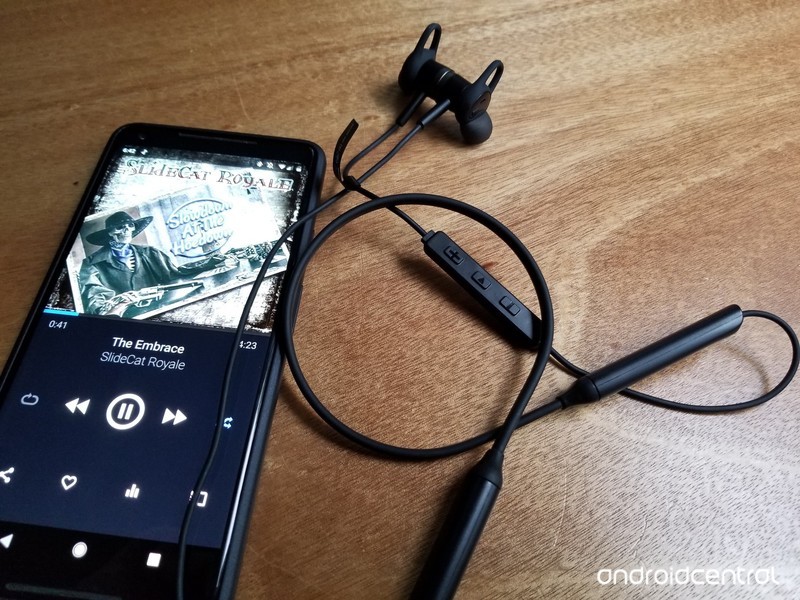
The company known for making inexpensive but quality products does it again.
I — Tom Westrick — have been using these headphones as my daily use headphones for the past week, including in the gym and for hours in a crowded coffee shop. TaoTronics provided these headphones for review.
Active Noise Cancellation (ANC) is one area where headphones continue to get better year after year. While traditionally found on big, over-ear headphones, ANC is starting to make its way into smaller headphones.
TaoTronics is well known for making inexpensive but great products, and these headphones are no different. If you’re a fan of earbuds, definitely consider these.
Good ANC, better audio
TaoTronics Neckband Headphones with ANC
Price: $46
Bottom Line: These are one of the cheapest ways to get noise cancellation, so if you like earbuds, check these out.

See at Amazon
The Good
- Lightweight
- 16-hour battery life with ANC disabled
- Magnets keep the earbuds together
- ANC works stupendously
The Bad
- Micro-USB charging
- Only eight hours of battery life with ANC enabled
TaoTronics Neckband Headphones with ANC What I like
I gravitate towards good earbuds for their compact size, so believe me when I say these are good earbuds. They come with three pairs of earbud tips and three pairs of ear hooks to help you find the perfect fit for your ear canals, but I found the default options were perfect for me. The earbuds stay in place well, even when I’m running. They’re comfortable too — I’m happy to wear these for hours on end.
The controls are located along the right cord, in the form of volume up, play-pause, and volume down buttons. Holding the volume buttons is how you cycle through tracks, and holding the power button is how you turn the headphones on and off. Unlike the OnePlus Bullets Wireless, the magnet isn’t used to turn the headphones on and off. And truth be told, I actually prefer it this way. I don’t want the headphones turning on in my pocket or bag just because the magnets came apart.
These last for 16 hours with ANC disabled, more than long enough for a day’s use.
Battery life with ANC off is also great. TaoTronics quotes 16 hours of use without ANC, which matches up to my experience. Unless you’re using these headphones on a super long international flight, you should have no problem getting a day’s use out of them. The wireless signal was strong too; I had no problems with cutouts as I walked across the gym with my phone laying in a safe spot.

TaoTronics Neckband Headphones with ANC What’s just okay
Audio quality is okay for the price. There’s no aptX or even AAC support, just the basic Bluetooth audio codec. It sounds fine, but not outstanding. The sound quality doesn’t degrade any — at least, not to my ears — with ANC enabled, which is nice.
Tastes will vary on this, but I personally hate how far down my chest these headphones dangle when they aren’t in my ears. I understand these need to be designed for users of all heights, but as an average-sized dude, I’m left with a lot of extra cable just hanging there and getting in the way.
TaoTronics Neckband Headphones with ANC What I don’t like
It’s 2018, and it’s time for products to stop charging with Micro-USB. The only two products I regularly use that don’t charge with USB-C at this point are my Xbox controller and whatever headphones I’ve used. Everything else — including my mechanical keyboard — uses USB-C, and it’d be really great to only need to bring one kind of cable with me when I go out.
Battery life with noise cancellation enabled is officially rated for eight hours, though I was getting closer to seven in my use. That’s not bad given the size constraints, but it means if you use these at the office, you’ll need a charge partway through the day. Not the end of the world, but there’s room for improvement.
TaoTronics Neckband Headphones with ANC Should you buy them?
Maybe. If you really want active noise cancellation, these are one of the cheapest ways to get that. But if you just want earbuds period, there are less expensive options with comparable sound quality, or similarly priced earbuds with aptX support for better sound. It’s not that these headphones are outright bad, it’s just that headphones are a competitive field.
4
out of 5
If you prioritize active noise cancellation in your headphones, these earbuds are for you.
See at Amazon
Pixel 3 mint color teased in new promos from Google
Everything we know about what’ll likely be one of the year’s best phones.
Google first introduced its Pixel series in 2016, and since then, has been hard at work to establish itself as a serious player in the smartphone market. Google may be one of the most powerful and iconic companies in the world, but when it comes to hardware, is still very much a newcomer.
We saw vast improvements with the Pixel 2 compared to the original Pixel line, and we’re expecting to get that again with the Pixel 3. Google’s quickly learning what it takes to compete with the likes of Samsung and Apple, and seeing as how the Pixel 2 was one of 2017’s best phones, there’s a lot riding on this year’s entry.
Ladies and gentlemen, here’s everything we know so far about the Google Pixel 3.
The latest Pixel 3 news
September 14, 2018 — Pixel 3 mint color teased in new promos from Google

With a little over three weeks to go before the big October 9 event, Google’s shared two new teasers to get people excited for the Pixel 3 and 3 XL.
The first of these appears to be live on all versions of the Google Store and is pretty basic. There’s a large 3 and some text next to it that reads “Stay tuned! Looks like you’ve already enrolled for updates from the Google Store. Be on the lookout for some news from us on Oct. 9.”


In addition to that, a Google page in Japan has a much fancier promo page that also potentially reveals a new color that we’ve yet to see in any of the leaks.
If you visit the page on your smartphone or tablet, you’ll see large text at the top that says “Coming Soon.” Below that is an outline of a phone with Google’s “G” logo at the bottom.
You can rotate your device side-to-side to move the outline of the phone on the page, and tapping on your screen cycles between a white, black, and mint background. These background colors also fill in the phone outlines, suggesting that these are all colors that’ll be available for the Pixel 3/3 XL. We’re already expecting white and black, but this is the first time we’ve ever seen a reference of a mint option.
September 6, 2018 — Google officially announces October 9 event for Pixel 3

Google has just sent out invites to the press for a hardware event in New York City, and just as rumored it will take place on October 9. The invite came in with a delightfully designed (and very swiftly swoopy) animated gif that honestly doesn’t give us any hints as to what we’ll be seeing. But there’s no reason why this wouldn’t be the launch event for the Google Pixel 3 and 3 XL.
The only question is whether we see more than the two phones. Last time around, Google had a blockbuster event that was ostensibly for the Pixel 2 and 2 XL, but also included the launch of the Google Home Max, Google Home Mini, Pixel Buds and Pixelbook. If Google pulls out all the stops once again, we could be in for a huge hardware launch event.
Last year’s event was in San Francisco (and on October 4), but it’s hard to read too much into a venue switch to NYC — it’s an easy place for press from all around the world to get to, and Google maintains a large presence in the city. Google will be streaming the event live, as well.
August 31, 2018 — Google Pixel 3 and 3 XL swing by the FCC
Before we head out for the week, let’s end our Friday on another Pixel 3 tidbit.
Today, FCC listings A4RG013A and A4RG013C from Google appeared — likely relating to the Pixel 3 and 3 XL, respectively. These numbers line up to last year’s phones where the Pixel 2 was G011A and the 2 XL was G011C.
Although no new information is revealed in these listings, it’s once again confirmed that Foxconn is the manufacturer rather than HTC or LG like we saw with the Pixel 2 series.
August 30, 2018 — Regular Pixel 3 appears in first hands-on photos, might not be a Verizon exclusive


Although the Pixel 3 XL has been leaked to death at this point, we still haven’t seen much on the regular Pixel 3 outside of device renders. However, thanks to a user over on Reddit, that’s now changing.
The photos confirm that the Pixel 3 will not have a notch and instead have slightly thicker bezels on the top and bottom compared to its XL sibling. The screen measures in at 5.5-inches, the resolution is 2160 x 1080, and there’s an aspect ratio of 18:9. The smaller battery also appears to be a 2,915 mAh unit.


Other specs from the 3 XL are carried over to the Pixel 3, including the Snapdragon 845 processor, 4GB RAM, dual 8MP front cameras, etc.
Also, in an update to the Reddit post, it’s said that the Pixel 3 in the above photos is part of a carrier testing program that isn’t Verizon. Contrary to reports we heard earlier this year, this suggests that Verizon’s exclusivity of the Pixel line may finally be over.
August 27, 2018 — Unboxing video shows off the Pixel 3 XL and its packaging, October 9 announcement date revealed
It’s pretty difficult to be surprised by a Pixel 3 leak anymore, but that certainly hasn’t stopped them from flowing in.
Most recently, a YouTube channel by the name of In DIGI uploaded a high-res 1080p Full HD unboxing video that shows the Pixel 3 XL being taken out of its packaging in one of the crispiest clips we’ve seen yet.
In addition to the Pixel 3 XL itself, the box is also home to the Pixel Bud-like wired earbuds that definitely appear to be included with the phone, #teampixel stickers, USB-C charging cable, USB-C to USB-A adapter, a USB-C to 3.5mm adapter, and AC wall adapter. The video gives us an up-close look at the front and back of the phone, as well as a few camera samples.
Lastly, we also got another hint as to when the Pixel 3 will officially be unveiled. In a Bloomberg article published by Mark Gurman this morning, it’s noted that:
Alphabet Inc.’s Google also plans to debut new Pixel phones on Oct. 9 at a media event in New York City, other people familiar with the plans said.
Google declined to comment on this news, but that lines up with earlier rumors and the press events for the company’s previous Pixel announcements for the past two years.
August 23, 2018 — Pixel 3 XL reported to have new Pixel Visual Core and a wide-angle selfie camera
We’ve known for quite some time that the Pixel 3 and 3 XL will have dual front-facing cameras, but up until now, it’s been a mystery as to what the second sensor will actually do. Thanks to a report from 9to5Google, we now have some more info as to what these sensors will be used for.
According to one source the site spoke with, the two cameras will allow for a new “Super Selfie” mode with another mention of there being an “improved Portrait Mode.” A leak from earlier today revealed new Portrait settings in the camera app, so that all lines up quite nicely.
As for the second sensor specifically, another source claims that this will act as a wide-angle lens so that users can fit more people in the frame in a single shot.
Details on the single rear camera are still pretty scarce, but 9to5 also mentions that one of their sources mentioned a “new Visual Core chip” and that Google is “doubling down on making a single camera powerful enough to not need a second camera.
August 23, 2018 — Another Pixel 3 XL leak highlights an updated camera app, included earbuds, and more
Kicking things off with a bang this morning, Russian website Mobile-Review recently published a “first look” at the Pixel 3 XL using a prototype model that was sent to it by “an anonymous well-wisher.” This hands-on is very similar to other ones we’ve seen already, but there are a couple new tidbits worth mentioning — specifically with the Pixel 3 XL’s camera app.
The UI shown here is a bit different from what we currently have on the Pixel 2. Rather than swiping open a hamburger menu to change shooting modes, the app now has them listed above the shutter button. Users can cycle through Panorama, Portrait, Camera, and Video. Tapping the More icon gives options for Google Lens, Slow Motion video, and Photo Sphere.


Portrait mode now allows you to choose between Natural and Soft face-retouching in addition to toggling it off altogether, a new “Google Lens suggestions” mode is featured, and the rear camera is confirmed to be 12.2MP while the front-facing camera is 8MP. For whatever reason, only one front-facing camera is mentioned in the app despite the Pixel 3 XL clearly having two.
As for the included earbuds, the instruction manual that comes with them indicates you’ll be able to use the in-line controls for controlling music, answering calls, and prompting the Google Assistant.
August 22, 2018 — Stolen Pixel 3 XL handsets are apparently being sold on the Ukranian black market
It’s not an uncommon practice for smartphones to be leaked ahead of their official release, but with the Pixel 3 XL, the quantity and quality of leaks we’ve been getting lately has been somewhat staggering. The first hands-on photos of the Pixel 3 XL were shared all the way back in June, and since then, it’s been a nonstop flood of leak after leak.
According to a new report from 9to5Google, a large portion of the leaks have been appearing thanks to a black market dealer over in Ukraine.
Essentially, this dealer somehow acquired multiple models of the phone and is shipping them from London at a price of $2,000 USD per phone. They’re said to be pre-release versions of the Pixel 3 XL, with it noted that “everything looks and works exactly the same” compared to the final versions that’ll be released in October.
We aren’t sure how many units this seller has or how they obtained them in the first place, but it’s further reported that people are still buying the phones and that more leaks are coming soon.
August 22, 2018 — Pixel 3 XL poses for more hands-on photos, Active Edge appears to be making a return

The Pixel 3 XL has reared its head in a number of hands-on photos at this point, but for the most part, they’ve been pretty low-quality and not the prettiest to look at. Thanks to user @wylsacom on Twitter and Rozetked, that’s no longer the case.
These photos don’t reveal a whole lot that we haven’t seen before, but they show off the Pixel 3 XL in a much more professional manner and, more importantly, a higher resolution.
The notch is as big as ever, the back is definitely all glass, and thanks to a shot of the settings page, it appears that Active Edge is returning so you can squeeze the sides to prompt Google Assistant.
August 22, 2018 — Leaked video confirms wireless charging on Pixel 3 XL; Camera samples shared on Instagram
Thanks to various hands-on photos, we’ve known for a while that the Pixel 3 and 3 XL will come with all-glass backs. However, up until now, it’s been a mystery as to whether or not wireless charging will make its way to the phones.
At least for the larger Pixel 3 XL, a video that was shared by user @khoroshev on Twitter confirms that this feature is, in fact, present.
pic.twitter.com/XtAtAeWreH
— Максим Хорошев (@khoroshev) August 22, 2018
The video above shows the Pixel 3 XL being placed onto a wireless charging pad, and when it makes a contact, a small animation appears on the screen to show the current battery percentage and to indicate that charging has begun. Google’s obviously yet to confirm the legitimacy of this video, but it sure does seem like wireless charging is a go for the Pixel 3 lineup.
Along with the video, that same person also took to Instagram to share a heap of photos that he supposedly captured with the Pixel 3 XL. Just like the Pixel 2 before it, the pictures showcase great dynamic range, excellent colors, and more. We don’t have access to the full-resolution files seeing as how these were uploaded to Instagram, but even so, it’s a great early look at what’s to come.
You can check out all of the photos here and here.
August 17, 2018 — Pixel 3 XL and its unforgiving notch pop up in Toronto

Surprise, surprise — another Pixel 3 XL leak!
A reader of the Canadian tech site MobileSyrup recently snapped the above photo while riding a streetcar in Toronto. As you can see, the phone shown in the picture appears to be none other than the Google Pixel 3 XL.
While Google’s yet to formally unveil the phone, the device lines up with everything else we’ve seen so far. It’s running Android P, has a chin below the display, and its large notch is impossible to miss.
This photo doesn’t reveal anything we didn’t already know about the phone, but the fact that Google’s got people using these out in the wild confirms that we’re not too far off from an official launch.
August 10, 2018 — Another hands-on video shows the Pixel 3 XL in use while also confirming some specs
The same person that shared those Pixel 3 XL photos and unboxing video from a couple days ago has returned with yet another video that reveals even more about the phone.
In this video, we can see the Pixel 3 XL actually being used. It’s running Android 9 Pie (no surprise there) and appears to have the same UI of the Pixel and Pixel 2 running the new software.
A couple benchmarks results are also shown during the video, and as such, a handful of specs have been confirmed. They include:
- 1440 x 2960 screen resolution
- Qualcomm Snapdragon 845 processor w/ Adreno 630 GPU
- 3,430 mAh battery
- 12.2MP rear camera
- 8.1MP front-facing camera (x3)
The most interesting of those specs are the front-facing cameras. Antutu lists three 8.1MP sensors up front, although in the video we can only see two. This could be nothing more than a glitch in the app, or Google could have implemented some sort of mystery camera up there. We really aren’t sure about that one.
August 8, 2018 — Pixel 3 XL appears in more hands-on photos and unboxing video


Previous renders and real-world pictures have already given us a clear look at the Pixel 3 XL’s design, and to help make that image as clear as humanly possible, SlashLeaks recently shared three additional hands-on photos and an unboxing video of the phone.
One of the photos shows the back of the white Pixel 3 XL while the other two showcase the front. We once again see that Google will be sticking with just one rear camera and a rear-mounted fingerprint sensor, and unfortunately, that notch hasn’t shrunk at all since the last time we saw it.
Moving over to the unboxing video, it’s apparent that Google’s using very similar packaging compared to the Pixel 2 and 2 XL. The box does contain a pair of wired USB-C earbuds in addition to the Pixel 3 XL, but seeing as how Google experimented with this idea for last year’s release, we aren’t entirely sure if the free buds will stick around for the final retail packaging.
August 6, 2018 — October 4 launch date leaked for the Pixel 3
While we’ve seen plenty of leaked renders and specs for the Pixel 3, talk about its release date has been fairly quiet. That is, up until now. As spotted by Brandon Lee from the YouTube channel This is Tech Today, the Pixel 3 is shown to be released on October 4 according to the website Famebit.
Famebit is a website that allows companies to connect with content creators and work out deals to create sponsored content for YouTube videos, Instagram posts, etc. An ad on the site was recently created by Google and asks for Canadian creators to switch to the Pixel 3 and then making a video talking about their experience.
In this listing, it’s stated that “The Pixel 3 phone is launching October 4, 2018.”
While there’s no way to confirm if this ad really was created by Google, that October 4 date is what we were previously expecting anyways. That’s the same day Google used to announce the Pixel and Pixel 2 before, so it makes sense that it’d keep the trend going this year.
July 30, 2018 — Clearly White Google Pixel 3 XL shows up in new leak

We just got our best look at the Google Pixel 3 XL courtesy of XDA. The images in question show off the Clearly White color option, and the live photos confirm a cutout at the front and a single rear camera. We can also make out a single speaker located below the display.
The XDA leak once again reaffirms the presence of a glass back on the Pixel 3 XL, with the finish alternating between glossy and matte. A glass back opens up the possibility for wireless charging, but for now there’s no further information as to whether the feature will make its way to the device.
July 28, 2018 — ‘Pixel Stand’ could be a wireless charger for the upcoming Pixels
A teardown of the Google app by the folks at XDA has served up interesting information. The code references something called a Pixel Stand, leading to suggestions that it will be a wireless charging dock for the upcoming Pixels.
According to XDA, the Pixel Stand will feature Assistant integration, and will be able to offer personalized suggestions and answer queries when the phone is docked.
June 27, 2018 — Pixel 3 and 3 XL renders show the phones from every possible angle

As if previous leaks of the Pixel 3 and 3 XL haven’t been revealing enough, MySmartPrice teamed up with OnLeaks to share a boatload of both photo and video renders of the two phones.
These renders confirm a lot of what we’ve previously seen, including things like an all-glass back for both phones, single rear cameras, and a notch on the larger Pixel 3 XL.


However, while earlier rumors suggested that only the 3 XL would have two front-facing cameras, these renders show that the regular Pixel 3 will have them, too.
The Pixel 3’s display is said to measure in at 5.4-inches with an 18:9 aspect ratio, whereas the Pixel 3 XL will have a 6.2-inch screen and 19:9 setup. As for the dimensions, we’re looking at 145.6 x 68.2 x 7.9mm for the Pixel 3 and 158 x 76.6 x 7.9mm for the 3 XL.
June 18, 2018 — Case render confirms Pixel 3 XL design

Ice Universe on Twitter has built up a reputation for being pretty accurate about leaks/rumors in the mobile space, and on June 18, they shared a case render that further confirms the Pixel 3 XL’s design.
Like we saw with the hands-on photos on June 7 and 8, the Pixel 3 XL will have a notch in its screen, dual front-facing cameras, stereo speakers, rear-mounted fingerprint sensor, and a single rear camera.
It’s peculiar that Google’s choosing to use two cameras on the front while keeping just one on the back, but based on how excellent the Pixel 2’s single rear camera is, I don’t expect this will be a downside at all.
June 8, 2018 — Pixel 3 XL shown off in six more hands-on pictures
Less than a day after those first two hands-on photos of the Pixel 3 XL surfaced, six more have appeared.


These additional photos showcase the Pixel 3 XL from every possible angle, and when XDA Developers reached out to their forum member that shared them, they were able to confirm that the phone has a full glass back. In other words, it’s possible this year’s Pixel line may finally adopt wireless charging.


The front and back photos are pretty similar compared to what we saw yesterday, but the other images showcase a reflective glass frame around the phone, volume rocker and power/lock button on the right side, and a USB-C port and SIM slot on the bottom.
Also, as 9to5Google pointed out, that mysterious logo on the back of the Pixel 3 XL was used previously with old Pixel 2 prototypes.
June 7, 2018 — Hands-on photos apparently showcase a Pixel 3 XL prototype


Out of the blue, XDA Senior Member meraz9000 shared two photos on the XDA Forums showing what’s supposed to be a prototype of the Pixel 3 XL. There’s obviously no way we can confirm whether or not this is the real deal, but it sure does line up with the display panels that were leaked last month.
The photos show the Pixel 3 XL from both the front and back, with the front reiterating the point that the 3 XL will more than likely have a notch in its screen. For what it’s worth, it does look like we’ll be getting two front-facing cameras and a chin at the bottom to retain stereo front-facing speakers.
Around back, this Pixel 3 XL prototype looks nearly identical to that of the Pixel 2 XL. The glass panel seems to be ever-so-slightly smaller, but that could just be the way the photo was taken.
In any case, what do you think about how the Pixel 3 XL is shaping up?
June 4, 2018 — Google’s apparently working on a mid-range Pixel phone
According to one tipster, Google’s in the process of developing a mid-range Pixel phone that’s codenamed “Bonito” and is powered by the Snapdragon 710 processor.
Rumors of a mid-range Pixel first popped up in April, but the old claim of it launching this July has since been replaced with a release scheduled for the first half of 2019.
That would suggest that Google may launch this new Pixel phone during I/O next year, but with so much discrepancy surrounding the release date, it’s entirely possible it’ll be announced alongside the Pixel 3 in October.
May 30, 2018 (part 2) — Verizon is said to be the exclusive carrier for the Pixel 3, again 😕
A report from Bloomberg recently surfaced confirming a few details about Google’s upcoming phones per a source that’s familiar with their production. According to the report:
- The Pixel 3 series will once again be exclusive to Verizon Wireless in the U.S.
- A notch will be present on the larger Pixel 3 XL
- Google will announce/launch the phones in October
- Foxconn will manufacture the Pixel 3/3 XL
- Stereo speakers will be present on both phones
- The Pixel 3 XL will have dual front-facing cameras
- “Both models will include upgraded, single-lens cameras on the back”
May 30, 2018 — LG will reportedly manufacture the Pixel 3 XL’s OLED display

Just a couple days after the Pixel 3 XL’s notched panel leaked, a report’s come out of Korea claiming that Google will once again use LG to manufacture and supply an OLED screen for the phone.
Furthermore, an official from LG Display that remains anonymous said, “We have maintained close ties with Google and the volume will not be much different from the previous one (the Pixel 2 XL).”
If this turns out to be true, one can only hope that LG’s improved the quality of its mobile panels since last year. The LG-made Pixel 2 XL display was the center of a lot of controversy for the phone’s first few weeks out in the wild, and Google really can’t afford to go through that again with gen-three.
What do you think about LG making the Pixel 3 XL’s display?
May 28, 2018 — The Pixel 3 goes 2:1 and the Pixel 3 XL gets a notch

Here’s an interesting leak that, while not necessarily all-telling, gives us an indication of where Google is taking the series in 2018. Specifically, the larger Pixel 3 XL looks to have a notch while the smaller Pixel 3, though moving to a 2:1 aspect ratio, will lack one. At the same time, we see some sensors that may indicate Google is adding either a second front camera to the phones or, more likely, some sort of dedicated biometric sensor for faster/more reliable face unlock.
The leak comes from Weibo (by way of Slashleaks) and reportedly shows two front glass panels for the new phones. Given that we’re almost in June, this would be the time for accessory makers to begin testing products for the final phone design. It’s also good to see Google maintaining dual front-facing speakers for the lineup.
What do you think of this latest leak?
May 10, 2018 — The Pixel 3 could be joined by second-gen Pixel Buds and a Pixel Watch
Google’s hardware events surround the Pixel phones with a heap of other product announcements, and this year, it’s reported that we’ll see a second-gen version of Pixel Buds and Google’s first Pixel-branded smartwatch.
Specifics on these gadgets are still up in the air, and as excited as I am to see how Google improves its wireless earbud game, I’m beyond ecstatic to see how the company’s first smartwatch turns out.
Wear OS is in an awkward stage right now, but a proper Pixel Watch and new silicon from Qualcomm could bring it back into the limelight. Assuming Google handles this right, the Apple Watch may soon be faced with some of its stiffest competition yet.
When will the Pixel 3 be released?
In 2016 and 2017, Google held its hardware event on October 4. We don’t have a concrete date for this year’s event quite yet, but there’s no reason to believe Google will deter from this pattern.
A Bloomberg article reports that the event will be held on October 9, and while that’s a few days later than the past two announcements, is still within the general ballpark we were expecting.
Pre-orders for the Pixel 3 will likely open shortly after it’s announced that same day with shipments going out at least a couple of weeks later.
How much will the Pixel 3 cost?
Over the past couple years, pricing for Google’s Pixel phones has remained mostly the same. The MSRP for the Pixel and Pixel 2 series is as follows:
- Pixel w/ 32GB — $649
- Pixel w/ 128GB — $749
- Pixel 2 w/ 64GB — $649
- Pixel 2 w/ 128GB — $749
- Pixel XL w/ 32GB — $769
- Pixel XL w/ 128GB — $869
- Pixel 2 XL w/ 64GB —$849
- Pixel 2 XL w/ 128GB — $949
I imagine we’ll see similar numbers with the Pixel 3, but don’t be too surprised if we get a Pixel 3 XL variant that crosses the $1000 threshold.
Google Pixel 2 and Pixel 2 XL
- Pixel 2 FAQ: Everything you need to know!
- Google Pixel 2 and 2 XL review: The new standard
- Google Pixel 2 specs
- Google Pixel 2 vs. Pixel 2 XL: What’s the difference?
- Join our Pixel 2 forums
Best Buy
Verizon
Google Store
Project Fi

