


Pick up Anker’s ultra-slim Bluetooth keyboard for just $13 at Amazon
Grab one before the discount ends.

Anker is offering its black ultra-slim Bluetooth keyboard for $12.99 with coupon ANKER761, a savings of $7. If you prefer the white version, you can pick it up for the same price with coupon code ANKER762. The keyboard works with Windows and Mac computers, as well as Android and iOS devices, and has shortcut keys that work with all four operating systems.
It’s 30% smaller than other keyboards and weighs in at just 6.7-ounces. The keys are quiet and comfortable to type on, and the battery lasts for over three months on a single set of AAA batteries. It doesn’t come with any batteries, so you’ll want to make sure to have some on hand.
Anker backs the keyboard with an 18-month warranty.
See at Amazon
Take your Amazon Echo (2nd gen) wherever you go with the SKY battery base
Pre-orders are live right now for just $49.95.
Amazon’s 2nd-generation Echo is one of the best values in the smart speaker market, and if you’ve been longing to free it of its power cord and use it as a portable speaker, a new product from Ninety7 now has you covered.
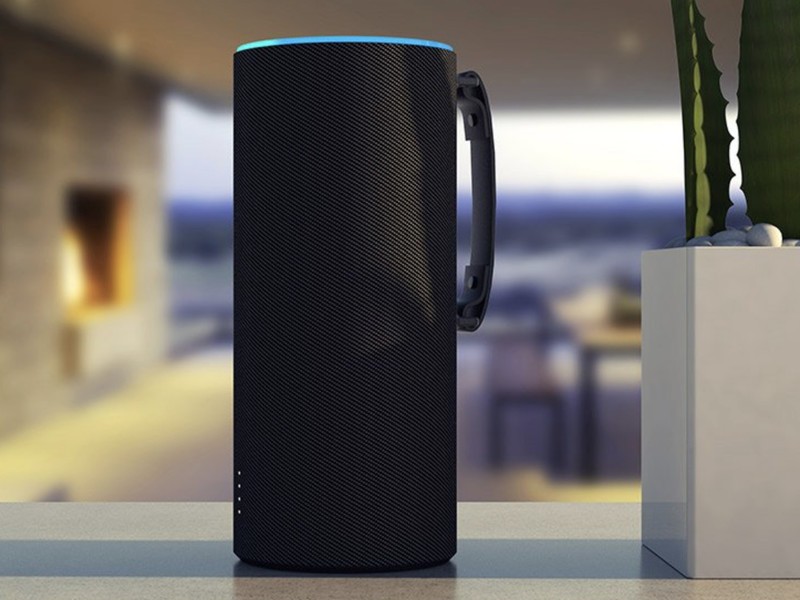
Ninety7 just announced the SKY battery base for the 2nd gen Echo, and it allows you to take the speaker anywhere with you for up to 8-hours of regular use – similar what we saw last year with the LOFT base for Google Home.
There are four LED lights on the front of SKY indicating how much battery life you have left, and a convenient handle on the back allows you to quickly pick it up for whatever adventure lies ahead. The SKY does add a bit of height to the Echo, but it’s nothing that hinders its portability.
Pre-orders for the SKY battery base are live right now, and you can currently reserve one for yourself for just $49.95. Shipments are expected to go out in early June, and once the pre-order phase is over, the price will go up to its regular $59.95 MSRP.
See at Ninety7
Amazon Echo
- Tap, Echo or Dot: The ultimate Alexa question
- All about Alexa Skills
- Amazon Echo review
- Echo Dot review
- Echo Spot review
- Top Echo Tips & Tricks
- Amazon Echo vs. Google Home
- Get the latest Alexa news
See at Amazon
Lumos bike helmet adds Apple Watch gestures to control turn signals
It’s been almost three years since we first came across the Lumos smart cycling helmet, which got our attention with its cunning automatic brake lights and wirelessly-controlled turn signal indicators. The helmet has since been shipping as of late 2016, but the Hong Kong startup didn’t stop there. Today — which happens to be the first day of Bike Month — Lumos is releasing an update that adds gesture control for the helmet’s blinkers via Apple Watch, along with Apple HealthKit integration for automatic cycling tracking.
To enable gesture control, the user simply has to install the iOS and watchOS apps, pair the iPhone with the helmet over Bluetooth, calibrate the watch with your left- and right-turn gestures using your watch-wielding hand, then you’re good to go. The turn indicators will continue to blink until you shake your hand. All of these actions should be much more intuitive — or at least easier to access — than the original wireless remote control.

As part of the update, the Lumos helmet can also be integrated with Strava and Apple Health apps, which enables automatic cycling tracking in iOS. For those who want to check out this $180 helmet in person, you’ll soon be able to see it at one of the 300 Apple Stores across the US and Europe, or you can simply order online.
Source: Apple
Science takes a step toward coding virus-resistant human cells
In 2016, scientists unveiled one of the most ambitious genetic engineering efforts yet: Genome Project-write wanted to do nothing less than create (not just edit) human cells immune to all known viruses. There was a rough start that included dramatic funding shortfalls, but it now looks like the initiative is getting underway in earnest. Harvard’s Wyss Institute and French immunotherapy company Cellectis have formed a partnership that will see Cellectis supply genome engineering tools to a Wyss team led by George Church. They’ll use custom enzymes to remove redundant codons (nucleotide “triplets” that produce amino acids for specific proteins) and prevent viruses with those codons from hijacking cells to produce copies of themselves.
It’s an important deal, but you won’t want to pop open the champagne just yet. STAT noted that the project needs to make a whopping 400,000 changes to the 20,000 genes in the human genome (for context, Church’s team made 321 changes to E. coli bacteria). And this won’t be affordable in the near term — it would currently cost about $30 million to recode a human genome, and even the plans to reduce that cost by a thousand fold would still make it a non-trivial exercise. There’s a good reason why Genome Project-write gave itself 10 years to reach its goal, and there’s no certainty the group will accomplish its goal in time.
Still, it’s easy to see why they want to try. Virus-proof cells could be used for stem cell therapies that could fend off dangerous viruses like HIV. There are broader applications, too. Scientists could replace codons that are more likely to produce cancerous tumors, and the approach could be used in non-human cells (such as virus-resistant crops). It wouldn’t mark an end to illnesses, but you might be far less likely to contract an illness or to deal with its effects.
Source: BusinessWire, STAT
Ford’s smart windows can help blind passengers take in the view
Ford has created a device that could help visually impaired travelers get a sense of what the scenery around them looks like. It’s called “Feel the View” and it turns a window into a vibrating depiction of what’s outside. First, with the push of a button, the device snaps a picture of the window’s view. It then turns that picture into a grayscale image and each shade of gray corresponds to a vibration of different intensity. Feel the View can generate up to 255 different levels of vibrations. The blind or visually impaired rider can then touch the window and feel what the outside looks like.
Along with the vibrations, an AI-powered vocal assistant connected to the car’s audio system can give a short description of what’s being felt. In the video below, you can see the vocal assistant tell a rider that she’s touching a snowy mountain as she traces it on the window. “We seek to make people’s lives better and this was a fantastic opportunity to help blind passengers experience a great aspect of driving,” Ford Italy spokesperson Alù Saffi said in a statement. “The technology is advanced, but the concept is simple – and could turn mundane journeys into truly memorable ones.”
Ford says Feel the View — which was conceived and developed by Ford’s Italian team, GTB Roma and Aedo, a start-up interested in devices for the visually impaired — is a prototype. We’ve reached out to Ford to see if there are plans to further develop and manufacture the device and we’ll update this post when we hear more.
Source: Ford
Two ‘Mega Man’ classics will be re-released on cartridge
Fans of Mega Man are being spoilt rotten at the moment. The game’s 30th anniversary has seen a slew of announcements, including the forthcoming arrival of Mega Man 11 and two new Mega Man Legacy Collection compilations. Now Capcom and iam8bit are upping the ante with the release of limited edition cartridges for Mega Man 2 and Mega Man X.

Each cartridge costs $100 is available in one of two colours, opaque light blue or translucent glow-in-the-dark blue (although which you’ll get is a surprise). They’re not just collector’s items either, as both are fully playable. Pre-order on iam8bit.com now for shipping in September, but be quick, each game is restricted to a run of just 8,500 units.
Lumos Smart Bike Helmet With Smart Gesture Turn Signal Support Now Available From Apple Retail Stores
The Lumos Smart Bike Helmet, which got its start as a Kickstarter project back in 2015, is the first bike helmet to make its way to Apple retail stores.
Available from the online Apple Store and in retail locations in the United States and Europe as of today, the $180 Lumos Helmet has integrated LEDs to keep you safe when riding at night and built-in gesture controlled turn signals.
There are 10 white LEDs on the front, 38 red LEDs on the back, and 11 amber LEDs that serve as the aforementioned turn signals. You control the turn signals built into the helmet with a connected Apple Watch, with the helmet able to interpret your hand gestures to activate the lights on the helmet.

Previously, the helmet’s built-in turn signals were controlled via a remote attached to the handlebars of a bike, but the new Apple Watch integration makes it simpler than ever to signal your intentions to drivers on the road.

The Lumos Helmet also has a beta feature that’s able to detect when you’re using the hand brake on your bike, flashing the lights on the helmet to a bright red.
Through a Bluetooth connection to the iPhone, the Lumos Helmet records your bike riding activity and uploads it to the Apple Health or Strava app.

Design wise, the helmet is safety certified and meets gold standard safety certifications in the United States and Europe, and it has been created to be durable and weatherproof so it can be used in rain, snow, and fog. There’s just a single size available, which can fit most adult head sizes in the range of 21.3 to 24.4 inches.
The Lumos Helmet can be purchased from the online Apple Store or through an Apple retail store for $179.95.
Tag: Apple retail
Discuss this article in our forums
Apple Expected to Report Record-Breaking Second Quarter Today With Clues About iPhone X Sales
Apple is set to report its earnings results for the second quarter of its 2018 fiscal year at 1:30 p.m. Pacific Time today.
The quarter began December 31, 2017 and ended March 31, 2018, according to Apple’s fiscal year accounting calendar.
Apple provided the following guidance for the quarter back on February 1:
- revenue between $60 billion and $62 billion
- gross margin between 38 and 38.5 percent
- operating expenses between $7.6 billion and $7.7 billion
- other income/expense of $300 million
- tax rate of approximately 15 percent
Apple’s guidance suggests the company will report its best second quarter results ever, topping its previous record of $58 billion:
- 2014: $45.6 billion
- 2015: $58.0 billion
- 2016: $50.6 billion
- 2017: $52.9 billion
- 2018: $60+ billion
Wall Street analysts forecast that Apple will report $60.9 billion revenue, meeting roughly the midpoint of its guidance, and earnings per share of $2.69, according to over 30 estimates averaged by Yahoo Finance.
MacRumors has compiled second quarter revenue and EPS estimates from a handful of Apple-focused analysts:

Key Takeaways and What to Look For
- Apple is expected to report iPhone unit sales of 51.9 million, a roughly two percent increase over 50.8 million in the year-ago quarter, according to average analyst estimates compiled by Bloomberg.
- Apple doesn’t break out iPhone sales on a model-by-model basis, but the iPhone’s average selling price should reveal whether there’s any truth to reports that iPhone X sales have slowed significantly. iPhone ASP was $796 last quarter, up from $695 a year earlier.
- Of increasing importance is continued growth of Apple’s services category, including the App Store, Apple Music, iCloud, iTunes, Apple Pay, and AppleCare. The average analyst estimate is around $8.3 billion, according to Gene Munster, up from $7.04 billion in the year-ago quarter.
- With increasing competition from Huawei, Vivo, and Oppo, Apple’s performance in Greater China will be a focus. Apple reported revenue of $10.4 billion in the region in the year-ago quarter.
- Apple said it would provide an update on its capital return program during today’s conference call, and many analysts expect significant increases, given the company’s plans to repatriate an estimated $250+ billion in overseas cash under new tax laws in the United States.
- Apple’s third quarter guidance will set expectations for April-June, which has historically been the slowest period of the company’s fiscal year. The average revenue estimate is currently $52.04 billion, according to Yahoo Finance, which would top $45.4 billion in the year-ago quarter.
Apple’s CEO Tim Cook and CFO Luca Maestri will discuss the company’s earnings results on a conference call at 2:00 p.m. Pacific Time today. MacRumors will loosely transcribe the one-hour call as it happens.
Tags: earnings, AAPL
Discuss this article in our forums
Qualcomm Hopes to Defuse Tensions With Apple Through Broadened Use of Lower-Cost Licensing Model
Following a legal battle that’s been ongoing between Apple and LTE chipmaker Qualcomm since early 2017, the latter company today announced an initiative aimed at defusing tensions with Apple. Specifically, Qualcomm says it will “broaden” its use of a lower-cost licensing model moving forward (via Reuters).
The move is a response to the FTC’s original complaint that Qualcomm was engaging in anticompetitive patent licensing practices in order to remain the dominant supplier of LTE chips for smartphones. Soon after the FTC targeted Qualcomm, Apple sued the supplier, stating that Qualcomm “reinforces its dominance” through exclusionary tactics and high patent licensing fees.
Now, Qualcomm will receive a lower licensing rate when it does business with customers like Apple, Samsung, and Huawei. Qualcomm licensing division head Alex Rogers hopes that this move will eventually resolve its disputes with Apple and one other unnamed company, thought to be Huawei.
“It’s a good context for dealing with the two licensee issues we have now,” Alex Rogers, the head of Qualcomm’s licensing division, told Reuters in an interview, naming Apple but leaving Huawei unnamed as is the company’s policy when a dispute hasn’t become public through a court proceeding.
Rogers did not comment directly on the likelihood of resolving either customer dispute.
Rogers explains that Qualcomm is doing this by “including more technology” in its licensable patents without raising prices. Before, smartphone makers had the chance to buy two sets of Qualcomm patents, representing a “full suite” or a “standard essential” set. While most customers license both bundles to avoid lawsuits, Qualcomm is aiming to ease tensions by both making it easier for companies to license only the low-cost patent set, and by adding 5G wireless network patents to the sets at no additional cost.
“We have not lowered the rate. What we’re doing is including more technology, more (intellectual property) in the offering without increasing the price,” Rogers added
While Qualcomm has made its move at finally ending the long legal dispute with Apple, the Cupertino company has not yet responded to the announcement. Rogers says that both the Apple dispute and reportedly Huawei “are essentially now being handled within the framework of the current programme.”
Given the legal dispute between the two companies, a rumor in late 2017 suggested Apple is considering eliminating Qualcomm chips from its future devices, instead relying on Intel and MediaTek. More recently, unnamed sources speaking with Fast Company stated that while Intel will supply Apple with a 70 percent majority of LTE chips for the 2018 iPhones, Qualcomm will still be sourced for the remaining supply.
Tags: Qualcomm, Patent lawsuits
Discuss this article in our forums
DNC launches a marketplace for digital election tools
The Democratic National Committee (DNC) wants to reposition the Democrats as politics’ most pioneering party. Today, it announces I Will Run, a marketplace for software, services and training designed to make Democratic campaigns more engaging and effective in a world that’s come to rely on the internet for everything, including politics.
According to the DNC’s tech program manager, Sally Marx, candidates and campaign staff feel overwhelmed by the number of tools that have emerged in recent times, while software innovators aren’t reaching campaigns effectively. The I Will Run platform aims to address these issues, helping to connect campaigns with the best-in-class tools that are already being used with demonstrable results.
The platform is broken down into six categories — digital, finance, research, security, training and voter outreach — and is currently bring piloted in states such as Nevada, Arizona, Washington, Texas, Florida, Massachusetts and Iowa. It’s not the ‘campaign in a box’ proposal the DNC touted back in November, but it’s a significant step in getting Democrats into a more tech-savvy mindset — this is important given the role digital and social media played in the 2016 election. Plus the DNC has got some significant names onside now, including ex-Twitter VP Raffi Krikorian and former Yahoo security chief Bob Lord, which should help the DNC — and the I Will Run platform — avoid the kind of embarrassing tech whoopsies that besieged the Democrats’ 2016 efforts.
Via: Medium
Source: I Will Run

