


Portal Home Wi-Fi System review – CNET
The Good The Portal has fast speed and far-reaching Wi-Fi coverage. The system has both a web interface and a mobile app and doesn’t require an account to work.
The Bad The web interface lacks some fairly typical Wi-Fi features and the mobile app is buggy. You can only use the app on a single mobile device. It requires you to change your settings in order for it to be compatible with all 5GHz devices. The system has terrible signal handoff.
The Bottom Line Though fast, the Portal has too many niggling issues that prevent it from being a seamless experience. Go with the Google Wifi or the Netgear Orbi instead.
When I first learned about the Portal a few months ago, it was intended to be a single Wi-Fi router. Now Ignition Design Labs has reintroduced it as a mesh system, meaning you can use a second unit to extend its Wi-Fi network.
While it works fine as a single router, it’s not a well thought-out or well tested mesh Wi-Fi system. And it certainly isn’t worthy of its current price of around $180 for a single unit or $319 for a set of two.
Why should I care about yet another Wi-Fi system?
Good question. What makes the Portal different from the most Wi-Fi routers is a dynamic frequency selection (DFS) mechanism Ignition Design Labs calls FastLanes. The router can use Wi-Fi channels that were previously only available to radar systems to boost speed at peak times (around 6-8 p.m. wherever you live). This means that FastLanes will only benefit those who’ve had speed or connection problems during peak times in the past. I personally didn’t see any improvement at home, but your mileage will vary depending your internet speed and how congested the air space in your neighborhood is.
The real problem with Fastlanes, however, is that not every product is compatible with it. Here’s a short list of those that aren’t and therefore will only connect to the 2.4GHz frequency band of the Portal (FastLanes is only available on the 5GHz band.) Since the the 2.4GHz’s airspace is almost always congested, which is why we need the 5GHz band in the first place, FastLanes will mean extremely slow Wi-Fi for certain devices.
FastLanes is turned on by default. When turned off, the Portal will support all existing devices.
 View full gallery
The Portal system includes two identical units.
Dong Ngo/CNET
OK, here’s what’s (mostly) good
Simple setup
Setting up the Portal is similar to that of the Google Wifi or the Eero. But you don’t need to create an account with Ignition Design Labs. As with most home routers, the system does not require you to connect to the vendor in order to work.
The Portal mobile app (available for Android and iOS) was buggy, however. I used it on a Pixel XL and the interface would freeze while applying changes or switching from one section to another. Still, it took me just 10 minutes to set up the first router. Basically, all I had to do was pick a name and a password for the Wi-Fi network.
Adding a second unit to create a mesh system took me much longer but most of the time was spent on waiting for the system to be ready. The process itself was still simple and relatively straightforward.
Good performance
Supporting AC2400 Wi-Fi, the Portal performed well both as a single router and a mesh Wi-Fi system. As a single router, it has a top sustained real-world Wi-Fi speed of more than 540 megabits per second. As a Wi-Fi system, when connected to the second unit, the top speed fell to just 244Mbps, due to signal loss. Signal loss is a common phenomenon of Wi-Fi systems, when the “satellite” unit needs to both receive and rebroadcast the Wi-Fi signal from the first router unit at any given time, resulting in some 50 percent efficiency reduction. Dynamic frequency selection (FastLanes) is supposed to mitigate this phenomenal but it doesn’t seem help in the Portal’s case.
The Portal has good range. As a single unit, it could cover about 2,800 square feet of a residential setting with strong a Wi-Fi signal, with two units combined into a mesh network, you now can cover easily around 5,000 square feet or even more.
Denon AH-D7200 Release Date, Price and Specs – CNET

Denon’s new reference headphone ships in January for $999.
Denon
Denon has a new high-end headphone coming this January — the AH-D7200 — and from its design and specs it seems worth keeping an eye on, if you’re in the market for a $999 headphone. (There’s no word on international pricing but we’ll add it when we get it. It converts to £800 or AU$1,400.)
Designed for “discerning audiophiles,” it’s got a classic reference headphone look with real walnut housings and Denon’s FreeEdge nano-fiber drive units. The earpads use Japanese-developed soft synthetic leather covers that have been designed for maximum comfort, according to Denon.
We’ll let you know how the AH-D7200 sounds and feels and soon as we get our hands on a review sample.
The AH-D7200 at a glance:
- 50mm FreeEdge Driver Technology made from nano-fiber material
- Real wood earcups
- 385 grams (13.6 ounces) excluding cable
- Ultra high-quality connection with 7N oxygen-free copper cable
- Earcups are suspended on ergonomically curved, diecast aluminium hangers
- Headband is finished in real sheepskin leather
- Memory-foam ear-cushions are trimmed with artificial leather chosen for its softness and durability
- Fit and side pressure optimized for the widest possible range of head sizes and shapes
- Price: $999
- Shipping in January 2017
2016 Jeep Cherokee Trailhawk review – Roadshow
The Good On paper it’s got the most off-road capability in its class. The Cherokee comes with the excellent Uconnect system.
The Bad No Apple CarPlay or Android Auto. The Cherokee has much less cargo space than competitors and the Trailhawk trim line suffers a bit on the pavement.
The Bottom Line If you expect to go off-road, the Trailhawk is a great choice. However, if you plan to stay in civilization, the top-of-the-line Overland trim line may be the better choice.
Many folks shopping for a midsize crossover just want a vehicle with all-wheel drive that performs well in any kind of weather, like the Mazda CX-5 or Toyota RAV4. If, however, you want a vehicle that can cross a creek and drive through a rainstorm on an unmaintained dirt road to your secluded cabin in the woods, let me tell you about the 2016 Jeep Cherokee Trailhawk. Just be prepared for a few on-pavement concessions.
The Cherokee, around in some form or another since 1974, debuted as a full-sized SUV. Over five generations it morphed into its current midsize crossover platform, and it currently keeps pace in sales with both the popular Wrangler and Grand Cherokee.

The Cherokee is available with a four-cylinder engine, but at 4,000 pounds I was glad for the extra grunt of the 3.2-liter V6 power plant. It’s an extra $1,745 but produces 271 horsepower and 239 pound-feet of torque. It’s definitely the better choice and well worth the extra coin.
Power goes to the pavement through a nine-speed automatic transmission. Yes, nine speeds. I was surprised at the well-behaved gearbox. It never searches for a gear and it willingly steps down two gears, and often three or four, during passing.
I took the Trailhawk on a road trip from Roadshow HQ in San Francisco to Los Angeles and averaged a dismal 22.8 miles per gallon, all while driving 70 to 80 mph for six hours at a time, a bit less than the EPA highway rating of 24 mpg. However, that’s much less than the EPA highway rating of the Subaru Crosstrek, at 33 mpg, and the Toyota RAV4 at 28 mpg.
Take a gander at the 2016 Jeep Cherokee…
See full gallery


1 – 6 of 10
Next
Prev
The Cherokee is available in nine different trims, but only the Trailhawk goes through Jeep’s rigorous off-road testing and wears the Trail Rated badge. I was hoping to get the thing on the dirt, but alas our busy schedule worked against us. We hope to revisit the Trailhawk, as it’s got all kinds of off-road goodies that the adventurous will appreciate. At minimum you need two things to make a vehicle off-road-worthy: a locking rear differential and a low range. The Trailhawk has both, plus more features that make it the most dirt-worthy option in its class.
The Cherokee has 8.7 inches of ground clearance and is outfitted with skid plates on the underbody, fuel tank and front suspension. The Selec-Terrain system lets you pick from auto, snow, sport, sand/mud or rock driving modes. High approach, breakover and departure angles help get the Cherokee Trailhawk up and over obstacles and it can ford up to 20 inches of water. The cherry on top is the 56:1 low gear ratio, perfect for high-torque, slow-speed rock crawling. It’s not a Wrangler, but it certainly is approaching one and on paper it kicks butt over other soft-roaders like the Subaru Forester or Crosstrek.
A grown-up Cherokee
The interior of the Cherokee Trailhawk belies its go-anywhere capabilities. The seats are comfortable and there is plenty of leather, with the added bonus of the excellent
Uconnect
navigation head unit. The optional 8.4-inch screen may seem crammed with information, but it’s all thoughtfully laid out and easy to navigate. Included with Uconnect are Siri Eyes Free compatibility, a new drag-and-drop menu bar and a Do Not Disturb function that sends phone calls straight to voicemail and can generate an automatic reply to text messages. It’s not as good as having Apple CarPlay and Android Auto, but it’s a good start.
Divoom Voombox Travel 3 review – CNET
The Good The Divoom Voombox 3 is an inexpensive mini Blueototh speaker that’s splash- and shock-resistant and sounds decent enough for its low price and small size. It also has speakerphone capabilities and a built-in carabiner for clipping onto a backpack or belt loop.
The Bad You get what you pay for: It distorts at higher volumes, and the bass is limited.
The Bottom Line For its ultralow price, the Divoom Voombox Travel 3 delivers more than you’d expect.
Divoom’s Voombox Travel 3, a Bluetooth speaker that’s about the size of a creme-filled doughnut, can be found online for a mere $20 (this exact model doesn’t appear to be available in the UK or Australia, but versions of the Travel are available in the UK for around £20).
No, this little guy didn’t blow me away with its sound, but I don’t expect that much for 20 bucks, and the Voombox Travel 3 slightly exceeded my low expectations. I noticed an uptick in sound quality from the original Voombox Travel I reviewed a few years back, but it’s not a big leap.

What you get in the box.
Sarah Tew/CNET
Like all these micro speakers, it’s strongest in the midrange, so it sounds best with your favorite soft rock and acoustic material (it did well enough with several tracks from Sting’s “The Last Ship” album, for example). Its 5 watts of power allows it to play reasonably loud — enough to fill a small hotel room — but once you start throwing more complicated songs at it, your music will fray around the edges and distort a bit. There’s some bass but not a lot. It certainly sounds better than your phone’s or tablet’s speakers.
You can lay the speaker flat, but I found it sounded better standing vertically and pointed directly at me (I used its built-in carabiner to hang it from a hook). It’s splash-resistant and rated to deliver six hours of battery life, which is decent enough for a speaker this size. A microphone is on board for speakerphone calls.
This competes with such speakers as the now-discontinued Logitech X100, which also retails for less than $20 and is similar in shape. The Divoom speaker feels more durable, and — unlike the old Logitech — it’s splashproof. But I can’t say the Divoom sounds better than the X100 or is a definitely better choice than that speaker. It’s just a little different — and both are recommendable at their low price points if a a tiny portable speaker is what you’re looking for.
Nomu S10 review

In an world where every company tries to come up with an ever thinner device than last year’s, sacrificing battery life for looks, leaving out plasic and using metal and glass instead, it’s nice to see a manufacturer like Nomu. Its whole lineup of devices is aimed at people that are normally in harsh environments.
With IP68 water resistance rating, utilitarian design and a mind-boggling 5000mAh battery, the Nomu S10 is not aimed at someone working a run-of-the-mill office job.
Specs
The specs for the Nomu S10 are very respectable for 2016 standards. And look at that battery.
- Android 6.0 Marshmallow
- 5.0-inch display at 1280 x 720 pixel resolution; Gorilla Glass 3
- Quad-core Mediatek 1.5GHz processor
- 2GB RAM
- 16GB internal storage; microSD expansion card slot for 32GB
- 8-megapixel (interpolated to 13-megapixel) rear camera
- 5-megapixel front-facing camera
- Dual-SIM
- 5000mAh battery
- 2G GSM: 850/900/1800/1900(B5/B8/B3/B2)
- 3G WCDMA: 900/2100(B8/B1)
- 4G FDD-LTE: 800/900/1800/2100/2600(B20/B8/B3/B1/B7)
- TDD-LTE: 2300(B40)
- WiFi: IEEE 802.11 a/b/g/n 2.4GHz
- Bluetooth: 4.0 BLE
MicroSD support is also nice in an era where more and more phones leave this feature behind in favor of internal storage. You’ll have to make a compromise though: it’s either a microSD or two SIM cards, but not both.
Initial Impressions and Setup
 Pretty straightforward packaging.
The packaging is pretty straightforward. It’s just a brown box with the Nomu logo on it, devoid of any other branding or indication of the phone itself. Curiously, the Nomu S30 comes in exactly the same box, even though it is much bigger.
Inside you will find the phone, a pair of headphones and a charger. This review unit came with a charger compatible with European plugs, something which wasn’t a problem for me but could be a minor inconvenience for those who live in the US.
Something peculiar about this phone is that, upon powering on, it doesn’t take you to the normal setup screen that you’re used to when booting an Android device for the first time. Instead, you’re greeted with the phone’s main screen. You can effectively use the phone without configuring. As a person who dislikes long setup processes, I like this approach.
If you actually want to use your Google account with your phone, accessing any Google-made app will take you to the configuration you’re used to. From then on, everything will work exactly as expected. As a side note, some Google apps you’re used to don’t come installed by default, including YouTube and Google Drive; you’ll have to do that by yourself.
Hardware and Build Quality
First, let me address the elephant in the room: this is the thickest phone I’ve used since my Nokia 3590 back in 2003. Probably the massive 5000mAh battery has something to do with it. But let me get something straight: this is actually not a bad thing.
Sure, Apple, Motorola, Samsung and company have us think that a thinner phone is better (which, to an extent, you can say it is), but there’s also a market for people looking to, you know, actually use their phones. What’s more, they don’t want to turn off every shiny new feature to make it through the day. Sure, there’s a trade-off, and that’s something Nomu has obviously accepted, but kudos to them for favoring function over form.
Upon holding the device, you will immediately notice its ruggedness. This is a heavy-duty phone, aimed at people who work in harsh environments, where a power outlet is not available for hours and/or water is a serious concern.
1 of 9


Corners are not rounded, but very angular and sharp instead. It tries to alleviate the thickness factor by reducing it around the edges, something which works to some extent.
Except for the Gorilla Glass 4 screen, the whole device is made of some kind of rubberized plastic. While many phones these days opt for metal and glass casings that can make the phone slippery, the Nomu S10 is almost impossible to drop by accident under normal conditions.
The device itself is black with orange accents, which, combined with its rugged elements, makes it look futuristic and it has certainly garnered attention when using it throughout my review process.
 The orange accents makes it a pretty looking device.
Its IP68 water resistance rating means that it can be submerged for 30 minutes under a maximum of 1.5 meters of water. That’s A LOT of time, so feel safe knowing that this phone will survive that drop into the toilet.
All of these characteristics and focus on ruggedness makes the phone feel incredibly sturdy. Your immediate reaction would be to think that this phone is more expensive, because it sure feels like it is.
For those wondering, the volume keys and the power key (in that order, from top to bottom) are all located on the upper right side of the device, while the speaker is at the back.
The 3.5mm headphone jack is present (thanks Nomu for not being “courageous” enough to remove it) and located at the top, while the microUSB port is located at the bottom. Both of them are covered by rubber flaps in order to achieve its water resistance rating. I actually didn’t try submerging the phone with the flaps open, but I’m pretty sure that is one of those “don’t try this at home” situations.
Screen
Being a $100 phone in this era means that some corners have to be cut. The first place where you notice this is by looking at the screen. The 1280×720 5.0″ Sharp IGZO screen does a decent job under normal conditions and you can perform your tasks without your eyeballs bleeding. However, sometimes you can see some icons and colors being displayed in a weird way. Picture an image compressed 5 times: this is how the S10’s screen displays stuff sometimes.
This was really noticeable for me while taking a closer look at the default wallpaper. At first I thought “Wow, that’s a really crappy picture,” but then I changed it to a different one and saw the same kind of artifacts. It’s a shame, because otherwise this panel would be decent enough for a $100 device.
It gets really bright (there’s almost no direct sunlight in Estonia at the moment, but trust me, the screen can get very bright) and the 720p resolution is good news for battery life. Unfortunately, in its current state, the screen leaves something to be desired.
Speakers and Audio
 Speaker is located at the back of the device.
As previously mentioned, the speaker is located at the back side of the phone. The last phone I owned that had this configuration was the LG G3, and I sure hated that speaker. I just can’t stand speakers there because you have to lie your phone on its screen for the speaker to be useful. That simply doesn’t make sense.
Anyways, the good news is that it gets extremely loud. If loudness was the only factor, then actually I would use this phone over my Bluetooth speaker. However, as we know, quality is the other side of the story, and unfortunately some distortion and loss of quality can be heard when the speaker is at its maximum. It’s not a deal-breaker, but something to note anyways.
Nevertheless, keep in mind that this may be noticeable to us who actually care about this kind of stuff. I tried the speaker with a couple of friends and both noticed the loudness first, and made no mention about the loss in quality.
When actually connecting the phone to a pair of headphones, output was good enough. Note that I’m not able to detect any significant improvements in quality since my only pair of headphones are Apple Earbuds, but I can definitely notice a reduction in said quality, something that didn’t happen while listening Epica’s latest masterpiece, The Holographic Principle, or a really nice 80’s music playlist I found the other day.
Connectivity
If you didn’t get the message when talking about the charger that ships with the S10, then you will definitely notice it here. Clearly, Nomu is not focused on the US market for now. Why? In short, it’s because its phones doesn’t have the required bands for 4G to work there. That is really a shame for our US readers; the phone will get 3G speeds at best. However, here in Estonia, Telia uses bands 3, 7, and 20 to deliver its 4G service, so I could test it.
 Be careful about the bands your carrier uses, since there’s limited support for bands in some regions.
Overall, I got good signal everywhere I went. Call quality was exactly as you might expect, so, if you have the required bands, the phone behaves exactly as you expect it to. Be sure to check this beforehand, though.
Regarding WiFi, I could achieve the same download speeds as on my other devices, so there are no surprises here either. A thing to note, though: there’s no support for 5.2GHz WiFi networks as only 2.4GHz is supported.
Software
 The launcher is not Google Now or Pixel.
Do you like stock Android? I have good news for you. Nomu has decided that Google’s implementation of Android Marshmallow is good enough for its purposes and decided to leave it partially unchanged. That is normally good news regarding updates, since it means less things to test and update for new versions, but I wouldn’t hold my breath for a Nougat update.
However, let me tell you that this Android 6.0 implementation works pretty well. Since you already know the main features of Android 6.0, I will tell you the deviations from Google’s original software.
First, there is the launcher. I know what you might be thinking: “First, he says that Android is largely unchanged and then he says that the launcher is different?” I know, let me explain. This is neither Google Now Launcher nor the shiny new Pixel Launcher introduced in Android 7.0. This is a generic launcher that has home screens, an app drawer and nothing more. It is pretty bare-bones and, frankly, not that good of an experience. Fortunately, the Play Store has a plethora of options from which you can choose, so that shouldn’t be a problem.
Also, a weird thing about this Android build is that, even though it is Marshmallow, the icons for some apps look like their Jelly Bean era counterparts. I can’t for the life of me understand the reason behind this.
Regarding other aspects, you’ll see that the quick settings has two new members: Audio Profiles and Supershot. The former lets you change your sound profile from four predefined options: General, Silent, Meeting and Outdoor. The latter lets you take a screenshot without having the Volume Down + Power Button combination.
 Many useful options have been added.
When taking a screenshot, you will get the option of editing it too. You can crop it in a rectangular shape, with a lasso tool, or with a graffiti function (the image becomes your canvas and you select parts of it by making lines over it). You can also create longer screenshots by using the scroll function.
The problem with this is that the phone doesn’t generate screenshots correctly. It compresses its height a little bit, making the image look distorted. It seems like it is a problem with the implementation of the navigation bar, since making it hide and then opening an app results in screenshots being captured correctly. I’m sure this can easily be corrected with an update, but it’s inadmissible that this kind of faults have made it through QA and into production software.
There are some really useful options in the settings screen. Stuff like tap to wake, hiding the navigation bar and turbo download (download big files using both data and WiFi) are present there for your pleasure.
Also, there’s this neat feature in which you can draw a letter on the screen while it is off, and, upon detection, the phone will open the related app. For example, I configured the C to open the camera. It works exactly as advertised, although it could benefit from opening the app faster. The current implementation wastes time making an animation based on the detected letter.
Performance
I know that benchmarks tell us nothing about the performance under daily use, but here is the AnTuTu benchmark score in case you were wondering.
 With its score of 37396 points, the Nomu S10 is ranked among devices like the Samsung Galaxy A3 (2016), Huawei Honor 5X, Blu Vivo XL and OnePlus One. For reference, the Google Nexus 5 scores 23225 and the Samsung Galaxy S6 scores 76912.
Using it for a couple of weeks, though, I can say that I could easily use this phone as my daily driver. It is really snappy when doing normal activities, like checking Facebook and Twitter, watching YouTube videos and streaming Spotify. It struggles when there’s a lot of things going on (for example, when downloading apps), but then again, a lot of phones do.
Games is a different matter, though. Stuff like Star Knight performs superbly, since it is not a graphic-intensive game. However, things change a bit when launching N.O.V.A 3. It’s likely my fault for trying to run such a game on a $100 phone, but results are decent at best. The game gets laggy in a lot of instances and skips a lot of frames. If you’re the kind of person that plays heavy-load games, then you won’t be interested in this mid-range phone.
Camera
Continuing with the list of components that were hindered in order to reduce costs, we arrive at the camera. I don’t want to blame the camera only, since the screen actually makes pictures look worse than they are, but the results are not stellar either. The 13 MP shooter with a single flash does a modest job in daylight conditions, but it is especially bad in low light.
 The camera is decent at best under conditions with lots of light, but struggles in dark environments.
Unfortunately, I didn’t have a single clear day to take pictures in which the sky was blue, but you can clearly see that colors are not bright enough on any of the samples anyways. Also, you have to move the phone as little as possible when taking pictures, because if not, the photo will turn out blurry.
Low-light images look like they were printed on sandpaper and the camera does an awful job with colors too. Also, focusing sometimes takes a really long time, something that, in my opinion, is as annoying as the quality itself. This is specially true on low-light conditions, when focusing is sometimes downright impossible.
1 of 10


The camera app is not Google Camera but a different implementation which actually has some nice options. There’s a mode in which you can capture a picture with both cameras at the same time, and the software will superimpose one on top of the other. There are also different filters like mono, sepia, negative, whiteboard and similar.
Stuff like scene modes, timers, ISO and video quality can be changed at the touch of a button. Unfortunately, it can’t aleviate the camera’s inefficiencies, which is a hardware problem that no software might be able to resolve.
Battery
 Battery life is superb on this phone, thanks to its 5000mAh battery.
The phone can easily last three days on a charge with location, several social networks constantly pinging home for no reason, some light gaming, some YouTube videos, and Amaranthe’s Maximalism looping for hours on Spotify.
There’s one small thing though: standby time could be better. Sometimes, when leaving the phone at home with WiFi and Bluetooth on, the phone discharges just a bit slower as when actually carrying it with me and using it appropriately, something that makes no sense.
Actually, the phone has a function called “Standby Intelligent Power Saving,” which I tried to turn on and off for a few days but it made no noticeable difference. Another thing, the battery screen appears to be kind of broken, since it always displays “Phone idle” as the most expensive process, with a disproportionate amount of computed power use.
Charging the phone takes a lot of time, even with the included charger. We’re talking about 4 hours easily. Also, the phone tends to get warm when charging, especially when the battery is almost depleted. This is an increasingly common thing these days thanks to Quick Charge, so you probably shouldn’t worry about it.
Conclusion
The Nomu S10 is certainly a peculiar device. It has no middle ground: its ups are superb, but its downs are almost catastrophic. On one side you have a really sturdy, rugged, Bear Grylls-worthy build, but the screen then fails to display some patterns correctly. The battery is the best one I’ve used by far (at least since the dawn of the smartphone era), but its camera is not dependable at all. Even within the same category, there are some superb stuff and some unbearable aspects. Take as an example the speaker: really, really loud but on the back of the phone, and some quality is lost at high volumes.
Recommending this phone is as hard as it gets. Do you care about a phone that will last through use and abuse? Then buy it. This is the S10’s main market, and, it is really good at that. Do you want to buy a phone that will accompany you through your son’s first years in this world? Then don’t but it. You will probably want to take pictures of his first steps into this world, and this camera will produce pictures that will leave you as disappointed as the kid will be when he realizes he has to study for the next 20 years.
There are some situations in which this phone is almost perfect, and some in which it’s not up to the task. For $100 though, this phone is good to have as a backup (which actually has longer battery life than the phone it is backing up).
If you’re looking for one, you can get it from the following shops:
- iGoGo.es
- Coolicool
- Geekbuying
- GearBest
- EverBuying
Prices vary from shop to shop, but they won’t ever surpass $130 dollars (or euros, depending on where you are). If you want more information about the phone, then Nomu’s official site has more information.
Lenovo Vibe K5 Note review
Lenovo has been on a hot streak in India, with a slew of great smartphones on offer that cover everything from entry-level to high-end. The company has found particular success with its K Note series, while both the K3 Note and the Vibe K4 Note proving to be quite popular.
Also read:
Lenovo K4 Note review
July 25, 2016
Lenovo is hoping to find the same success with the latest addition to the series, the Vibe K5 Note, that was launched in India in August. With upgraded hardware and a premium design, does the latest affordable smartphone from Lenovo prove to be a worthy successor? We find out, in this comprehensive Lenovo Vibe K5 Note review!
Buy now from Flipkart
Design
The Lenovo Vibe K5 Note features a beautiful, all-metal unibody design
More and more manufacturers are starting to include all-metal designs in their mid-range and entry-level smartphones, so it’s not surprising that the Lenovo Vibe K5 Note features a full metal unibody construction. Admittedly, it doesn’t feel like the highest quality metal when compared to its more expensive and higher-end counterparts, but the construction is sturdy, and the device feels solid in the hand.
Taking a look around the device, the headphone jack sits on the top, while the microUSB port can be found on the bottom. The hybrid dual-SIM card and microSD card slot are on the left side, and on the right is the power button and volume buttons. The buttons are definitely an improvement when compared to its predecessor, with a good amount of travel and a nice click to them.
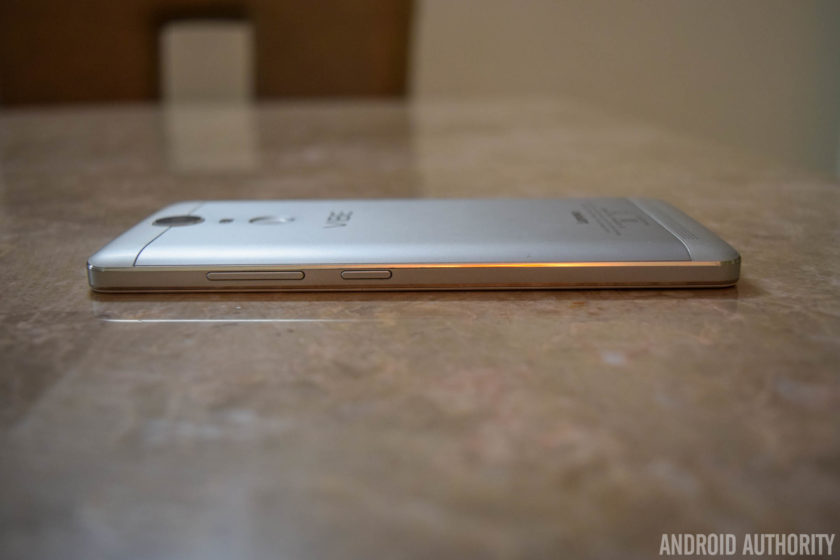
Below the display are capacitive navigation keys, and unlike its predecessors, the keys do light up, which is a nice upgrade. It’s not particularly bright though, and you won’t really notice it unless you are in a dark environment, but that is when having back-lit navigation buttons is the most useful anyway.
The fingerprint scanner is on the back, below the camera unit and the dual LED flash, and at the bottom is the single speaker unit. During the launch event, Lenovo made a big deal about how the camera, the flash, the fingerprint sensor, and the Vibe logo were perfectly aligned and symmetrical. It’s a nice design touch that you don’t really appreciate day to day, but has led me to taking a lot more notice of what other phones look like.
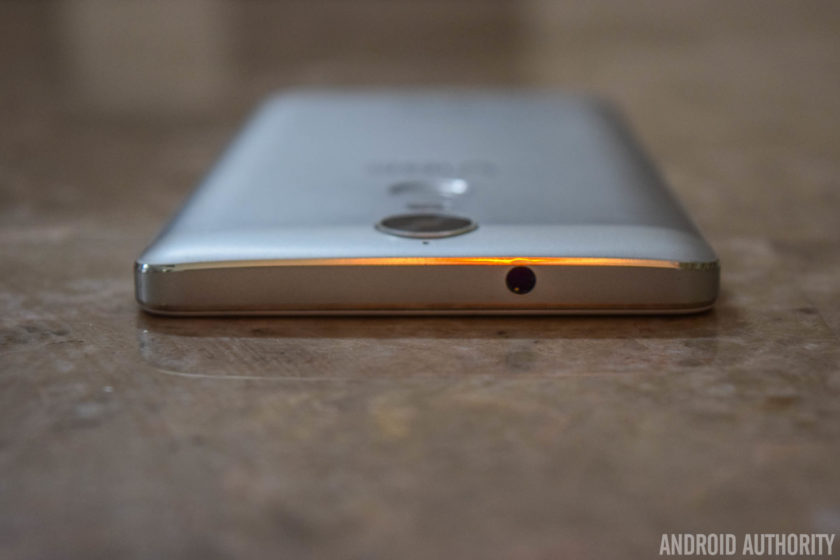
With a 5.5-inch display, the K5 Note is a large device, but Lenovo has done a good job with keeping the bezels along the sides of the display relatively thin. The subtle curves all around the back contribute positively to the handling experience as well. However, the metal body makes for a very slippery device, which can take some getting used to. If you have had issues with dropping your phone, you are definitely better off using a case that adds some grip.
Display

The Vibe K5 Note’s display is a huge improvement over its predecessor
The Vibe K5 Note comes with a 5.5-inch IPS LCD display with a Full HD resolution, resulting in a pixel density of 401ppi. This display is a huge improvement over its predecessor, particularly when it comes to the brightness. Color reproduction and viewing angles are better as well. 1080p allows for plenty of sharpness, and reading text, watching videos, and playing games are all enjoyable on this large display.
The default settings are good enough, but you do have the option to change the color balance and temperature to better suit your needs. There is a manual mode that gives you granular control over these aspects, and a few preset options, like Comfort Mode, that helps protect your eyes when browsing the phone for long periods of time.

One point to keep in mind here is that the glass panel protecting the display isn’t of the Corning Gorilla Glass variety, which is definitely a step back, considering it was available with the K4 Note. It’s difficult to judge how sturdy the panel is without actually scratching it or dropping the phone, but if that is a worry, a regular or tempered glass screen protector is certainly recommended. That said, I haven’t had any issues with scratches on this screen yet.
Performance

The Vibe K5 Note is powered by the octa-core MediaTek Helio P10 processor, clocked at 1.8GHz and backed by the Mali-T860MP2 GPU. This particular review unit comes with 4GB of RAM, but there is also a slightly cheaper version of the phone available with 3GB of RAM. The benchmark scores may not be very impressive, but the overall performance has actually been really good.


Opening, closing, and switching between apps has been a breeze, and the device handles everyday tasks very well. The gaming performance is excellent as well, and there have been no instances of lag or stutter when playing games like NBA Live Mobile, Stick Cricket 2, Modern Combat 5, and Riptide GP: Renegade. That is as heavy as my gaming requirements go, and the K5 Note did a wonderful job with all of them.
Hardware

32GB is the only option as far as on-board storage is concerned, regardless of whether you pick the 3GB or 43GB of RAM version. Expandable storage via microSD card is available, up to an additional 256GB. However, the second SIM slot doubles as a microSD card slot, so users will have to make the choice between expandable storage and dual-SIM capabilities.
Users will have to make the choice between expandable storage and dual-SIM capabilities
While the K4 Note featured dual front-facing speakers, the single speaker unit of the K5 Note has been relegated to the back. Lenovo mentions that the curve along the bottom near the speaker directs the sound better, and it does help to some extent, but front-facing is definitely the better way to go. The sound quality itself is pretty good, and the speaker gets decently loud without sounding tinny.

The Dolby ATMOS features do return however, where you can choose between preset options like Movie, Music, Game, or Voice, or set up custom settings depending on your liking. You also get additional features, including Surround Virtualizer, Dialogue Enhances, and Volume Leveler. As before, access to this feature in buried in the Settings menu, and can be found at the end of the “Ringtones and Volumes” section.
Speaking of ringtones and volumes, Lenovo’s software has a few interesting additions here. You have the ability to set up different ringtones and message tones for the two SIM cards, which is a nice and easy way to distinguish between the two. There is also a feature called “Pocket Enhancer,” that boosts the ringtone volume when the device is in your pocket. However, that only really works if your default volume setting is less than all the way up already.

The fingerprint scanner on the back is really fast, but not as accurate as before, with the sensor often requiring a second try to unlock the device. The speed more than makes up for the slight lack of accuracy however, and you don’t even have to lift your finger for the sensor to read it the second time and get it right. It’s fast enough that the only reason I know it took another try is because of the vibration when it gets it wrong.
The fingerprint scanner on the back is really fast, but unfortunately not as accurate as before
The sensitivity and speed of the scanner did prove to be a problem in some instances though. For example, when pulling the phone out of a pocket, accidentally touching the scanner with the wrong finger would result in the device attempting to read it multiple times. This would result in the fingerprint scanner failing, which means the phone would then resort to requiring a PIN or pattern to unlock the phone. This would happen so fast that by the time I’d hold the phone up to actually unlock it, I would see an error message that reads “Too many attempts.”

As we’ve seen with the devices from other Chinese OEMs, this fingerprint scanner is capable of more than just unlocking the phone. There are a few different functions that it can be set up to perform. For example, a single tap can be set to work as a back button, or to take you back to the home screen. A long press can open the Recent Apps page, and finally, you can use the scanner as a shutter button, which is very useful when taking selfies.
The Vibe K5 Note comes with a large, non-removable 3,500mAh battery, and the battery life it provides has been excellent. With average to heavy usage, the device has consistently managed at least 4.5 to 5 hours of screen-on time, and there have been a few days where I’ve managed to push the screen-on time to close 6 hours. With fantastic standby times, the K5 Note will comfortably allow for a full day of use, and can easily be pushed to a day and a half to two days with lighter usage. There is no fast charging or wireless charging capabilities to be had though.
See also:
Screen-on time: Why is it important, and how can I extend it?
2 weeks ago


If you are looking to get even more juice out of the battery, there is the standard Battery Saver mode that automatically activates at the 15% mark. There is also an Ultimate Battery Saver feature that makes the UI much more minimal, and allows for only calls and texts. Another useful battery feature is “Scheduled Power On and Off,” which lets you select a time period where the device automatically switches off and turns back on again.
Camera

The Vibe K5 Note comes with the same rear camera as its predecessor – a 13MP shooter with a f/2.2 aperture and a dual LED flash. The front-facing camera has been updated however, now sporting an 8MP sensor.
Taking a look at the camera app, it is quite simplistic and easy to use. Everything you need can be found on the viewfinder, including the toggles for HDR and flash, as well as the button to switch between the front and rear cameras. The menu houses just the Panorama mode and a slew of color filters, and diving deeper into the Settings is where you can play around with features like aspect ratio, photo resolution, snap mode, white balance, ISO, triaxial leveling, and guidelines.

There isn’t a whole lot of improvement in terms of image quality with the K5 Note when compared to its predecessor. The camera is still capable of taking some really nice shots outdoors and in good lighting conditions. The color reproduction isn’t very accurate though, and images lack saturation, making them appear quite dull. HDR mode just brightens the shot completely, which works well in certain situations, but is certainly not something you can use all the time.
Unsurprisingly, noise and grain starts to creep into the images when lighting conditions deteriorate. That said, the camera performs particularly poorly in low-light situations. The shutter speed is extremely slow, requiring a very steady hand to avoid blurry shots. Even then, highlights are blown out, and pictures lack detail.

The 8MP front-facing camera allows for more detail in the shot, but generally suffers from the same issues faced by the primary shooter. There is a nifty “Beauty” mode that you’ll be able to use with the front camera too, as well as an option called “fill light” that adds pink or chrome bars at the top and bottom of the viewfinder to provide some light for your selfies in darker environments.
Software

On the software side of things, the Vibe K5 Note is running Android 6.0 Marshmallow out of the box. The default launcher is very clean, minimalistic, and features a lot of stock Android elements – especially when it comes to the Settings menu, notification shade and app drawer. However, for those who have used Lenovo smartphones in the past and prefer the company’s different take on Android, you also have the option to easily switch to the company’s Vibe UI.
See also:
Android 6.0 Marshmallow updates roundup
7 days ago
This offers a completely different look and feel, and elements like the app drawer are no longer available, leaving users dependent on folders to keep things organized. My personal choice is the former, but people who are already used to it from the experience they enjoyed with their previous smartphones may prefer the latter. Overall, it’s great to see Lenovo leave the choice up to the user.

There are still a few pre-installed apps, but certainly not as many as what you’d get with its predecessor. All third-party apps can also be uninstalled easily, and the only ones that cannot be removed are Lenovo staples like ShareIt, SyncIt, the Lenovo Companion, and a Themes store that isn’t particularly robust. The Companion app is useful, and provides a quick and easy way to set up service requests, and a features a slew of guides and solutions to address common, everyday problems that you may come across.
A software feature that can be very useful for a lot of people is Secure Zone, which provides a simple way to create two virtual zones, which, as an example, can be used to keep your professional and personal lives separate. The feature can be toggled in the Quick Settings menu, and each zone can be set up to have their own accounts, passwords, and apps, with the setup of one not carrying over to the other.

If you get a notification from an app in the other zone, you will know via a red dot that appears in the status bar. You’ll then have to switch to the other zone to check it. App data and documents are also kept apart, but there is a way to share information between the two zones as well, via a common shared folder. However, call logs and messages can be accessed from either zone.
Finally, we come to a feature that is very unique to the Lenovo K series, and that is the VR Mode. This mode can be triggered by simply long pressing on the power button, and after the shutdown and restart options, there will be an option to launch VR Mode. On the phone, it looks like the screen has been duplicated, and once you put the phone into a VR headset, you can enjoy a virtual reality experience regardless of which app you are using.


Lenovo recommends the ANT VR headset that has been designed specifically for these phones. It can also be paired with a Umido Remote Controller for basic navigation around the user interface while in VR mode, or the Amkette Evo Gamepad Pro 2, which is what I used. It is a fun way to enjoy videos, movies, and games, so we’d definitely recommend trying one of these headsets out if you can.
However, a Quad HD display is definitely better to enjoy a VR experience, with the 1080p screen of the K5 Note not exactly up to the mark here. The headset isn’t the most comfortable either, and watching a movie or playing a game for a long time can become quite stressful on the eyes. I wasn’t able to use the VR mode for more than 20 minutes at a time, for instance. It definitely is a nice feature to have and proved to be quite the conversation starter, but is unfortunately nothing more than a novelty at this point.
Specifications
| Display | 5.5-inch IPS LCD display Full HD resolution, 401ppi |
| Processor | 1.8GHz octa-core MediaTek Helio P10 processor Mali-T860MP2 GPU |
| RAM | 3/4GB |
| Storage | 32GB expandable via microSD up to 256GB |
| Camera | 13MP rear camera, f/2.2 aperture, PDAF, dual LED flash 8MP front camera |
| Connectivity | Wi-Fi 802.11 b/g/n/ac Bluetooth 4.1 A-GPS FM Radio microUSB 2.0 |
| Battery | 3,500mAh Non-removable |
| Software | Android 6.0 Marshmallow |
| Dimensions and weight | 152 x 75.7 x 8.5mm 165g |
Gallery

Pricing and final thoughts
The Lenovo Vibe K5 Note is priced at Rs 11,999 (~$180) for the model with 3GB of RAM, while the higher-end model with 4GB of RAM will set you back Rs 13,499 (~$202). The ANT VR headset can be picked up for Rs 1,299 (~$19), and the Umido ESoul DH2 Remote Controller and Amkette Evo Gamepad Pro 2 are priced at Rs 999 (~$15) and Rs 2,599 (~$39) respectively.

So, there you have it for this in-depth review of the Lenovo Vibe K5 Note! This is yet another fantastic offering from Lenovo that provides an experience that goes far beyond what its price tag would suggest. Of course, this smartphone isn’t as powerful or packed with features as as the more expensive flagships out there. That said, the Vibe K5 Note handles day to day tasks very well, features an impressive gaming experience, provides impressive battery life, and comes with a clean and smooth software package.
And that is all that some users really need from their smartphone. The camera is a bit of a let down, but can take some nice shots in ideal lighting conditions, and that is the only negative in what has been a very positive experience overall. At this price point, the Lenovo Vibe K5 Note is definitely a phone that I would recommend.
Buy now from Flipkart
Huawei Mate 9 review – CNET
The Good The Huawei Mate 9 has more power than you’ll need, a camera that’s great for arty shots and a battery that won’t quit on you by dinner.
The Bad Its screen is only full HD and its design is utterly forgettable.
The Bottom Line It doesn’t have the flame-prone Note 7’s beautiful lines and curves, but if you’re after a high-performance big-screened phone that won’t set your pants on fire, the Mate 9 is a great option.
Visit manufacturer site for details.
So you’ve got to send back your Galaxy Note 7 before it explodes, but you still want a high-performance giant phone in your pocket. Come and check out the Huawei Mate 9.
It’s a beefy thing, with a 5.9-inch display that edges out the 5.7-inches of the now-dead Note 7. It’s wrapped in an all-metal body, packs two cameras on the back and is stuffed with powerful components.
Apart from the lack of a stylus, it’s got pretty much everything you’d expect from the Note, but without the risk of your pocket bursting into flames.
Do hold on before you draw money from your bank account though — while the phone was initially scheduled to be on sale globally by November, at the time of writing Huawei has yet to make it available to buy through official channels. The company still says it’s aiming for this side of the new year, but I’d be surprised to see that happen.
 Andrew Hoyle/CNET
It’s also worth bearing in mind that Huawei snuck out an even better-sounding version of the Mate 9, called the Mate 9 Pro. With a curved-screen design that looks identical to the Note 7, the Pro packs a meaty 6GB of RAM, up to 256GB of built-in storage and a fingerprint scanner set into a physical home button on the front. It’s really the phone that the Mate 9 should be.
Huawei told me that this supercharged variant is only for China, but the product does appear on the UK website, so I can’t say for certain that the UK, US and Australia won’t see this model at all.
There is also the Mate 9 Porsche Design, which has the same high-end internal specs as the Pro, but has a different aesthetic, thanks to the hands at the Porsche Design house. It’s available now in Europe, but it will set you back 1,395 euros (about £1,180, $1,485 or AU$1,980). I’d suggest simply waiting for the Pro, which I imagine will cost about half that.
I’ve asked Huawei for a full rundown on when the Mate 9 will be available to buy and whether the Pro version will hit shelves outside China and will of course update this review with information as we get it.
Full metal jacket
- 156.9×78.9×7.9 millimetres (6.17×3.1×0.3 inches)
- 190g (6.7 ounces)
- USB-C charging port
- 64GB storage
- MicroSD card slot
Squashing in such a big display has made the Mate 9 a big guy to hold. If you’ve got hands the size of moons then holding it in one hand won’t be an issue, but even then, it’s tough to stretch your thumb across to type. Bashing out a long email? Use both hands.
The metal body feels sturdy and has none of the flex in the back that you’d find on cheaper handsets. That said, it lacks the luxurious, slick design of the curved glass and metal Note 7. It may be an alternative in specs, but in looks, the Mate 9 is no match for Samsung’s phone.
 Andrew Hoyle/CNET
The back of the phone is home to a fingerprint sensor, which works quickly and rarely misreads your prints. It charges through a USB-C connector at the bottom of the phone and there’s a 3.5mm headphone jack on the top — ideal if you’re not willing to give up your headphone cable for the iPhone 7 Plus.
The phone comes with a generous 64GB of storage as standard, which you can expand further with a microSD card.
A vibrant display that needs more
- 5.9 inches
- 1,920×1,080-pixel resolution
- 373 pixels per iinch
The display’s large size helps it show off images and movies well, but I’m disappointed to only see a full HD resolution here. While full HD is sufficient for everyday tools like Twitter, Whatsapp and so on, it doesn’t have quite the same clarity as you’ll find on higher resolution panels, like the Note 7 with its 2,560×1,440-pixels.
Indeed, the Mate 9 has a pixel density of 373 pixels per inch. The Note 7 packed more pixels into a smaller space, resulting in a much more impressive 515ppi and Google’s Pixel XL beats them both with 535ppi. High resolutions are particularly important if you ever want to use your device with a VR headset like Google’s Daydream — when the screen is right in front of your eyes, you’ll really notice the extra pixels.
The Mate 9’s screen is at least bright enough to counter the worst of CNET’s overhead office lights, and its colours are rich and vibrant. Colourful games like Riptide GP look great. If you don’t care a bit about VR then a full HD display like this one will suit you just fine.
 Andrew Hoyle/CNET
A powerful beating heart
- Octa-core Kirin 960 processor
- 4GB RAM
- Android 7.0 Nougat with Huawei Emotion skin
The phone runs on Huawei’s latest octa-core Kirin 960 processor, which is backed up by 4GB of RAM. It’s a potent processor that blitzed through our benchmark tests (see results chart below) and it’s helped along by a handful of software tweaks. At the phone’s launch, Huawei explained that a whole host of behind-the-scenes software changes help the phone manage its memory and background tasks more efficiently.
How much work Huawei has really done is impossible to say, but regardless I’m happy to report that the phone is indeed buttery smooth to use. It has none of the lag and stuttering when swiping around the Android interface as I’ve seen on many of Huawei’s previous phones. Apps load quickly too, and rarely crash while in use — something I can’t say about the previous Mate 8.
Huawei Mate 9 benchmark scores
Huawei Mate 9
27,832
6,158
1,941
Samsung Galaxy Note 7
29,332
3,845
1,699
Google Pixel XL
28,256
4,201
1,556
Samsung Galaxy S7 Edge
28,896
4,062
1,724
Legend:
3DMark Ice Storm (Unlimited)
Geekbench 4 (Multi-core)
Geekbench 4 (Single-core)
Note:
Longer bars equal better performance
The powerful processor was able to tackle photo editing in Adobe Photoshop Express and Snapseed, Netflix streamed without any problem and demanding games like Riptide GP: Renegade and Asphalt Xtreme had consistently high frame rates for smooth gameplay.
I’ve not enjoyed Huawei’s software in the past as it changes so much of the stock Android interface that it ends up feeling bloated and clunky to use. The changes have been toned down a touch this time round, though. Most notably with the return of the Android app tray. While previous versions removed the app tray, forcing you to keep your apps scattered across the homescreens, the Mate 9 gives you the option of putting it back. It’ll help experienced Android users feel more at home.
The software still isn’t perfect though. The settings menu is needlessly complicated and while you can change the themes on the phone, I can’t figure out how to download others beyond the pitiful six “local themes” that come preloaded. Huawei’s custom skin has been tweaked just enough to make it that bit more pleasant to use overall.
Asus ZenPad 3 8.0 Release Date, Price and Specs – CNET
Unlike last year’s 8-inch ZenPad S, the Asus ZenPad 3 settles for a more plasticky build. But don’t be fooled, the tablet features specs as good as those on Apple’s iPad Mini 4. This gives you an option to sacrifice on build quality if your budget’s tight, while keeping decent performance.
It retails in Singapore for S$499, which converts to about $350 in the US, £280 in the UK and AU$470 in Australia respectively. It’s currently not available in the US, but there’s a cheaper 2GB RAM version being sold in Europe.
While I’m not a fan of the less than luxurious plastic rear, the textured surface does make for a very good grip. This tablet will not easily slip out of your hands, compared with say the smooth metal rear of the iPad Mini. The 7.9-inch, 2,048 x 1,536 pixel screen is bright and crisp, which makes watching videos on it a treat.
Powered by Android 6.0 Marshmallow, the tablet runs a heavily customized version of Google’s mobile operating system. Asus has loaded plenty of its own tweaks into the system, which can result in a very frustrating experience if you prefer the stock Google OS. Right from the get go, I was prompted to update a total of at least 18 Asus apps, which doesn’t sound very fun.
Asus ZenPad 3 8.0 is an affordable premium…
See full gallery


1 – 4 of 6
Next
Prev
The power button is located on the right side along with the volume controls, and is easy enough to reach. On the rear you’ll find an 8-megapixel camera, and if you like taking selfies, there’s a front 2-megapixel shooter just for this.
Key Specs
- Qualcomm Snapdragon 650, 1.8GHz
- 4GB RAM
- 4,680mAh embedded battery
- 4G support
- USB Type-C port
Meant as an entertainment device, the ZenPad’s dual speakers are located at the front towards you, so you’ll get a pretty good audio experience when playing games or watching videos. While I was initially worried about blocking the speakers with my fat palms, that wasn’t the case.
The ZenPad 3 8.0 is a pretty good tablet to grab if you want a value tablet, but bear in mind it’s currently only sold in select countries in Asia. If you’re traveling to this part of the world and want to buy gadgets, this could be something worth considering.

The front-facing speakers are located at the edge, but your hands aren’t likely to block them.
Aloysius Low/CNET
 AIVAnet