


New monitors from Philips are sleek, color-accurate, cost less than $200
Previous
Next
1 of 5


If you’re a creative who wants a solid, color-accurate monitor that won’t cost a fortune, Phillips’ new 2018 E-Series look like an intriguing option. The new line of monitors offers ultra-narrow bezels with IPS panels that features realistic color reproduction great for color sensitive work such as photography or videography. Offered in three different sizes — 22-inch, 24-inch, and 27-inch — the new lineup starts at only $110 and is available on NewEgg starting today, September 18.
Phillips new offerings prove that smartphones and laptops aren’t the only devices with shrinking bezels. Offering ultrathin bezels on a desktop monitor isn’t just a grab for style points either; thinner bezels are a great way to create a more seamless multi-monitor setup without large vertical borders getting in the way.
With what it calls “Ultra Wide-Color” IPS LED panels, Phillips’ new monitors claim to deliver crisp, bright, color accurate high-definition imagery with a color gamut that covers 129-percent of the sRGB color space. All three displays — 22-inch ($110), 24-inch ($140), and 27-inch ($180) — offer Full HD resolutions of 1920 x 1080 with the ability to display 16.7 million colors with 250 nits of brightness. That’s not the brightest monitor we’ve ever seen, but for this price, it’s not bad.
The displays themselves also feature an anti-glare coating to keep reflections from getting in between you and your work. The IPS display also mean that you’ll be able to view the monitor from angles of up to 178-degrees without anything distorting.
Gamers might also find something to love about Phillips’ new E-Series of monitors. Although the panels all cap out at a 60Hz refresh rate, the E-Series does have some features for gamers, including built-in AMD FreeSync technology to prevent screen tearing issues at high framerates. Additionally, due to Phillips’ proprietary FlickerFree technology, the company promises a viewing experience with reduced flicker and more comfortable viewing, which means a bit fewer headaches during your intense gaming sessions.
Other included features for the E-Series lineup of monitors from Phillips include LowBlue light modes for reduced eyestrain, an EnergyStar 7.0 rating for reduced power consumption, and a wide array of connectivity ports include VGA, DVI-D, and HDMI. Phillips is hoping you love black and silver, as the E-Series monitors are only available in the one color combo.
Editors’ Recommendations
- AOC makes curved gaming displays more affordable with G1 series
- Computer monitor buying guide
- Acer targets gamers with new color-rich 4K Predator and Nitro monitors
- Dell P2715Q review
- Dell’s new fast-refresh Freesync display could be your next great gaming screen
Swiss researcher offers blueprints for animal-friendly autonomous machines
In the words of Mahatma Gandhi, “The greatness of a nation and its moral progress can be judged by the way its animals are treated.” By that metric, America (and every other nation that gorges itself on factory-farmed livestock) has some ethical issues to address.
For Oliver Bendel, a researcher at FHNW University in Switzerland, the issue isn’t strictly with our industrial agricultural techniques. Bendel worries that the high-tech future we’re developing fails to consider the well-being of Earth’s other creatures. Specifically, he thinks we should be developing animal-friendly autonomous machines.
“Machine ethics is a young discipline, 10 to 20 years old,” Bendel told Digital Trends. “It deals with machine morality or with moral machines. Machine ethics has so far concentrated almost exclusively on automatic actions that affect people. The moral machines I design also take animals into account.”
In a paper published last month in Paladyn, Journal of Behavioral Robotics, Bendel lays out a few ideas for how autonomous machines might be developed to respect the animals around them. Bendel suggests using “annotated decision trees,” in which the machine’s actions are clearly described, along with annotations that provide moral guidelines. “With [annotated decision trees] one can make moral assumptions and justifications explicit and make them the framework of the machines,” he said.
Among Bendel’s animal-friendly autonomous machine ideas, he proposes wind turbines that exhibit themselves when birds approach, robotic vacuum cleaners that avoid ladybugs, and farm equipment that steers around baby deer hidden among crops. “Cars that brake for toads and hedgehogs would be important to me,” he added.
At the Massachusetts Institute of Technology’s Media Lab, researchers use a platform called Moral Machine to crowdsource moral judgements that could someday help self-driving cars make split-second decisions. But the scenarios in Moral Machine are almost exclusively concerned with human well-being. As autonomous machines become more commonplace, Bendel thinks it’s essential that we develop a framework that takes animals into account as well.
“In the future, more and more robots and devices will encounter animals, pets as well as farm animals and wild animals,” he said. “Robots like Nao, Pepper, Paro, iPal, and K5 appear everywhere in households, nursing homes, retirement homes, and shopping malls. They are primarily oriented towards people. That must change. Because in fact they also encounter animals, frighten them, disturb them, injure them. At the moment, we are anthropocentric in robot construction.”
Editors’ Recommendations
- CanguRo robot is part transport, part best friend
- Tannenbaum in a box? You can order a real, 7-foot-tall Christmas tree from Amazon
- Spirit animals: 9 revolutionary robots inspired by real-world creatures
- The best PlayStation 4 exclusives (September 2018)
- Look out, bartenders: This cocktail-making robot is coming for your job
The Flamethrower Diet is better than keto and I burned all this food to prove it
Like most people, I’ve tried (and failed) at a bunch of different diets. I’ve done everything from Weight Watchers to the Ketogenic diet, and while they’ve all helped me shed a few pounds in the short term, I’ve never managed to stick with any of them. More often than not, the diet du-jour ends up being a temporary change that only lasts a few months, rather than becoming a permanent part of my lifestyle. But when I completely made up heard about the new Flamethrower Diet that’s been taking the world by storm, I knew I had found something special.
For those of you who aren’t hip and in-the-know, the Flamethrower Diet is the hottest new nutrition trend from Silicon Valley. Rather than forcing you to cut carbs or count calories, this diet gives you the freedom and flexibility to eat whatever you want, whenever you want — as long as it can be cooked with The Boring Company’s new Not-A-Flamethrower.
Sounds crazy, right? I know — I was skeptical at first too, but after you read into it a bit, you’ll realize the logic behind this diet is bulletproof. Think about it: Our ancestors cooked all their food over open flames, right? And do you know how many obese cavemen there were? Do you know how many Paeleolithic-era hominids were diagnosed with Type 2 diabetes or non-celiac gluten intolerance? None! Not a single one!
Previous
Next
1 of 11

Dan Baker/Digital Trends

Dan Baker/Digital Trends

Dan Baker/Digital Trends

Dan Baker/Digital Trends

Dan Baker/Digital Trends

Dan Baker/Digital Trends

Dan Baker/Digital Trends

Dan Baker/Digital Trends

Dan Baker/Digital Trends

Dan Baker/Digital Trends

Dan Baker/Digital Trends
The only logical conclusion to draw from these facts is that the secret to a long, healthy life is cooking everything over an open flame. And what better way to mimic the culinary practices of our ancestors than with a gas-powered, shoulder-fired flamethrower from Elon Musk?!
What follows is an honest account of my first day on the Flamethrower Diet. My hope is that by sharing my journey with the world, it’ll encourage more people to try #TFD for themselves. You won’t regret it!
 Levy Moroshan for Digital Trends
Breakfast
Instead of my usual breakfast (a handful of Reese’s Pieces, a swig of Gatorade, and two Marlboro Reds), I decided to go the healthy route and make myself a cup of tea and a piece of whole-wheat toast — both of which would be prepared using my brand-spanking-new Boring Company Not-A-Flamethrower, naturally.
Almost immediately, the benefits of cooking via flamethrower became apparent to me. The time savings alone make this diet worth a try. My toast was finished in seconds, and instead of fiddling with a tea kettle like some sort of chump, my shoulder-fired searing machine allowed me to heat up my tea directly in the cup. Talk about efficiency!
 Dan Baker/Digital Trends
Nevermind the fact that my tea was only lukewarm, that the tea bag string was burned into oblivion, or that I could taste propane in every sip. I could care less if drinking trace amounts of natural gas every day might eventually give me cancer. The way I see it, that’s a small price to pay for not having to count calories or wait for a kettle to heat up. This flamethrower diet is perfect for folks like me who have a busy lifestyle.
Lunch
For my midday meal, I decided to mix things up with some German-style bratwurst and a side of elote — also known as Mexican street corn. This meal turned out better than I ever could’ve imagined. The flamethrower provided a nice charred flavor, similar to what you’d get from cooking over a campfire or a grill, which was absolutely fantastic. After the first bite, I was ready to rip my range out of the wall and set it aflame with my next meal. Seriously, who needs a bunch of bulky appliances when a $500 flamethrower can get the same job done?
 Dan Baker/Digital Trends
Unfortunately, right when I was really starting to feel good about this new diet and excitedly cooking up a second batch of bratwurst, my nosy neighbor started yelling “ARE YOU INSANE?! YOU CAN’T DO THAT!” from her porch. Normally I would’ve been discouraged by this, but past experience has taught me that you need to stay strong and can’t let the haters get you down. So instead of internalizing the discouragement, I let her know that she wasn’t getting to me by shouting: “YES I CAN! I BELIEVE IN MYSELF, KAREN! I WILL STICK TO THIS DIET AND YOU CAN’T STOP ME!!!”
Dinner
To round out the day, I decided to cook up a nice, lean sockeye salmon fillet with a side of roasted asparagus. I flame-blasted the salmon on a alder plank in an effort to impart the fish with some woody smoke flavors, and also to keep from scorching the pavement in my driveway too much. As for the asparagus, I tossed it in a bit of olive oil, seasoned it with some garlic, truffle salt, and a dash of lemon zest — and then lit that shit up like the Fourth of July.
 Dan Baker/Digital Trends
I don’t mean to toot my own horn, but this meal was easily the best of the bunch. It absolutely brought the house down. Not literally, but close! It must’ve smelled amazing because, within minutes, I had a whole squadron of hungry men in my driveway, asking all kinds of questions about the delicious meal I had just prepared.
I’ve never seen anything like it. There were cops and firemen shouting excitedly at me and causing a ruckus. “What are you doing?! they screamed. “Where’d you get that flamethrower!? Are you out of your goddamn mind!?” I could hardly get a word in edgewise!
After the shouting died down a bit, one of the police officers stepped forward and politely offered me a ride in his cruiser. How could I say no!? I’ve always wanted to be a cop, so this was like a dream come true. All I had to do was let him borrow my flamethrower until we got to the station.
Real nice guy, that cop. I think we really hit it off. Next week I get to meet his friend who’s a judge!
Editors’ Recommendations
- GE JES1097SMSS microwave review
- The Brava Oven uses light – and seemingly magic – to cook. It changes everything.
- Automated gardens and smart beds made my apartment every geek’s domestic dream
- 8K is the next big thing in TVs. Get over it
- Silverware handles up or down? Dishwasher experts settle it once and for all
Facebook appears set on crafting custom silicon for augmented reality devices
Facebook acquired Oculus in 2014 as a part of its development dive into the worlds of augmented reality and virtual reality.
Facebook is recruiting — and it’s seeking to hire engineers and designers to assist its Silicon team with the process of crafting custom chips for augmented reality (AR) devices and applications. With speculation that the company is looking to release a pair of AR glasses in the near future, the recent news isn’t surprising, but it does tell us that the company is serious about taking Facebook into the next phase of reality.
According to a report in The Information, Facebook has been looking for several different job positions over the past few days. The included description from the advertisement helps us to understand the direction in which the team is looking to take the project:
“Facebook Silicon team is driving the state of the art forward with breakthrough work in computer vision, machine learning, mixed reality, graphics, displays, sensors, and new ways to map the human body. Our chips will enable AR devices where our real and virtual world will mix and match throughout the day. We believe the only way to achieve our goals is to look at the entire stack, from transistor, through architecture, to firmware and algorithms.”
Recent job postings have made it evident that Facebook doesn’t just want to have its software run on other platforms; the company is looking to control the entire process, going beyond basic hardware to the silicon at the device’s heart. The first step to crafting an efficient pair of AR glasses may undoubtedly be to begin at the chip layer, and that is what we may be seeing with this newly discovered information.
The team members at Facebook are no strangers to the world of AR; they recently released a collection of AR games for the Messenger platform, in addition to opening up access to businesses, allowing third-party developers to build AR advertising solutions. Most notably, in 2014, the social giant acquired Oculus, a company specializing in virtual reality (VR) software and hardware.
With Facebook Messenger as a building block, it is an excellent opportunity, allowing Facebook to craft AR applications without first producing a complete AR headset. As Google learned back in 2013 when launching Google Glass, having an AR platform without a strong software foundation can be detrimental to success. However, Messenger may help to build up a software base for the company if it decides to release a pair of glasses soon.
Whether or not Facebook is planning to release a pair of AR glasses is still up in the air, but its hard to imagine what other uses the company could have for engineers who can develop custom hardware for augmented reality devices.
Editors’ Recommendations
- Apple AR glasses: News and rumors about ‘Project Mirrorshades’
- Augmented reality is coming to Facebook — in the form of advertisements
- Magic Leap One: Everything you need to know
- Adobe’s next big software secret? An augmented reality tool called Project Aero
- When sci-fi meets reality: Adobe re-imagines AR from ‘Terminator 2’
Facebook appears set on crafting custom silicon for augmented reality devices
Facebook acquired Oculus in 2014 as a part of its development dive into the worlds of augmented reality and virtual reality.
Facebook is recruiting — and it’s seeking to hire engineers and designers to assist its Silicon team with the process of crafting custom chips for augmented reality (AR) devices and applications. With speculation that the company is looking to release a pair of AR glasses in the near future, the recent news isn’t surprising, but it does tell us that the company is serious about taking Facebook into the next phase of reality.
According to a report in The Information, Facebook has been looking for several different job positions over the past few days. The included description from the advertisement helps us to understand the direction in which the team is looking to take the project:
“Facebook Silicon team is driving the state of the art forward with breakthrough work in computer vision, machine learning, mixed reality, graphics, displays, sensors, and new ways to map the human body. Our chips will enable AR devices where our real and virtual world will mix and match throughout the day. We believe the only way to achieve our goals is to look at the entire stack, from transistor, through architecture, to firmware and algorithms.”
Recent job postings have made it evident that Facebook doesn’t just want to have its software run on other platforms; the company is looking to control the entire process, going beyond basic hardware to the silicon at the device’s heart. The first step to crafting an efficient pair of AR glasses may undoubtedly be to begin at the chip layer, and that is what we may be seeing with this newly discovered information.
The team members at Facebook are no strangers to the world of AR; they recently released a collection of AR games for the Messenger platform, in addition to opening up access to businesses, allowing third-party developers to build AR advertising solutions. Most notably, in 2014, the social giant acquired Oculus, a company specializing in virtual reality (VR) software and hardware.
With Facebook Messenger as a building block, it is an excellent opportunity, allowing Facebook to craft AR applications without first producing a complete AR headset. As Google learned back in 2013 when launching Google Glass, having an AR platform without a strong software foundation can be detrimental to success. However, Messenger may help to build up a software base for the company if it decides to release a pair of glasses soon.
Whether or not Facebook is planning to release a pair of AR glasses is still up in the air, but its hard to imagine what other uses the company could have for engineers who can develop custom hardware for augmented reality devices.
Editors’ Recommendations
- Apple AR glasses: News and rumors about ‘Project Mirrorshades’
- Augmented reality is coming to Facebook — in the form of advertisements
- Magic Leap One: Everything you need to know
- Adobe’s next big software secret? An augmented reality tool called Project Aero
- When sci-fi meets reality: Adobe re-imagines AR from ‘Terminator 2’
The Kindle Paperwhite is down to $80 during this Prime exclusive sale
Chapters on chapters.

Amazon has its Kindle Paperwhite on sale for only $79.99 right now. This deal is valid only for Prime members, so click here if you need a free trial. Usually this would run you $120, and the reviews are stellar. As an alternative, you could get the Kindle for $50, but that model lacks a backlight and it doesn’t have as good of a battery life either.
The Kindle Paperwhite is available in both black and white. Its touchscreen display is easy on the eyes with no screen glare and feels akin to reading words on actual paper, as opposed to regular mobile device screens which can cause eye fatigue after staring for some time. A single battery charge can last for weeks which is pretty awesome too. As a bonus, it doesn’t have the built-in distractions that a smartphone does, so you will actually get some reading done and not end up crushing candies or running through temples.
As an aside, if you’re an eligible American Express Membership Rewards cardholder, you might be able to get your Paperwhite for just $40. Your mileage may vary.
This isn’t the only offer available to Prime members right now. You can also get great deals on the Fire 7 Tablet and the Fire TV 4K.
See at Amazon
YouTube Gaming app is shutting down in March, moving to a web portal

There’s a new place to watch all of your favorite gaming YouTubers.
Back in 2015, Google launched its YouTube Gaming app to give gamers their own platform for separate features like Game Pages, Super Chat, and Channel Memberships. Since then, many of those features made their way to YouTube as a whole, and it seems as though YouTube Gaming no longer needs its own standalone app.
The YouTube Gaming app will be shutting down as of March 2019, but that doesn’t mean the entire platform is going away. Instead, YouTube Gaming is moving to its own site starting today at youtube.com/gaming. Google says that while it has a strong audience on the YouTube Gaming app, it can reach an even larger audience directly on YouTube, with over 200 million gamers and 50 billion hours of gaming content in the last year.
At the new YouTube Gaming webpage, you can search and sort by particular games to find related videos, ongoing live streams, and other games from the developer. You can also subscribe to specific games, and YouTube Gaming highlights creators on the rise to help boost new and existing channels.
Of course, there’s the standard fare of discovery features we’re all used to, as well; trending videos, upcoming live streams, and recommended videos all populate the home feed, along with any gaming-related videos from channels you already subscribe to on YouTube.
Android Gaming

- Best Android games
- Best free Android games
- Best games with no in-app purchases
- Best action games for Android
- Best RPGs for Android
- All the Android gaming news!
Apple Highlights iPhone XS and iPhone XS Max Reviews
Reviews for the iPhone XS and the iPhone XS Max went live this morning ahead of Friday’s launch, and in a new press release, Apple has highlighted reviews from several members of the media who were able to spend some time with the new iPhones.
Apple shared key passages from sites that include Mashable, TechCrunch, Daring Fireball, The New York Times, Best Products, Hypebeast, Tom’s Guide, Dailymail, TechRadar, Hardwarezone, Sydney Morning Herald, and photographer Austin Mann.
Daring Fireball’s John Gruber, for example, praised the iPhone’s custom silicon and software and its always-in-your-pocket convenience for photography.
“iPhones can’t compete with big dedicated cameras in lens or sensor quality. It’s not even close. The laws of physics prevent it. But those traditional camera companies can’t compete with Apple in custom silicon or software, and their cameras can’t compete with iPhones in terms of always-in-your-pocket convenience and always-on internet connectivity for sharing. In the long run, the smart money is to bet on silicon and software.”
The New York Times praised the way Apple increased the iPhone XS Max’s screen size without adding bulk or compromising usability, while Tom’s Guide did some benchmarking on the A12 and declared the iPhone XS models the fastest iPhones available.
“[To transcode a 2-minute 4K video to 1080p,] iPhone XS and iPhone XS Max knocked it down further to 39 seconds. … The Galaxy S9+ took 2 minutes and 32 seconds to complete the task, and that’s the fastest we’ve seen from an Android phone. … Based on our testing, the A12 Bionic processor inside the iPhone XS and iPhone XS Max make these the fastest phones you can buy.”
Apple, of course, focused on the positive elements in these reviews and while reviewers did generally offer praise for the iPhone XS and iPhone XS Max, especially for the camera improvements and the larger screen size, most agreed that iPhone X users may not be tempted to upgrade just for a new processor and a better camera.
Apple’s full list of review selections can be seen in the article shared via Apple Newsroom. More reviews can also be found in our review roundup, shared this morning.
Customers who pre-ordered an iPhone XS or iPhone XS Max will be able to get their hands on the new devices starting on Friday, September 21, the official iPhone XS and XS Max launch date.
Related Roundup: iPhone XS
Discuss this article in our forums
Apple Stores in Canada Accepting iPhone XS and iPhone XS Max Reservations, Launch Day Pickup Still a Possibility
If you live in Canada and haven’t pre-ordered an iPhone XS or iPhone XS Max yet, you might still be able to score one on launch day.
Apple has activated its Reserve and Pickup system in Canada, allowing customers to place an in-store pickup reservation for an iPhone XS or iPhone XS Max at an Apple Store across the country, subject to availability.
The page often says Apple is “not taking reservations to buy an iPhone right now,” but limited supplies are added each day, at which point the page becomes functional. When live, the page allows you to reserve an iPhone XS or iPhone XS Max in whichever colors and storage capacities are available at the time.
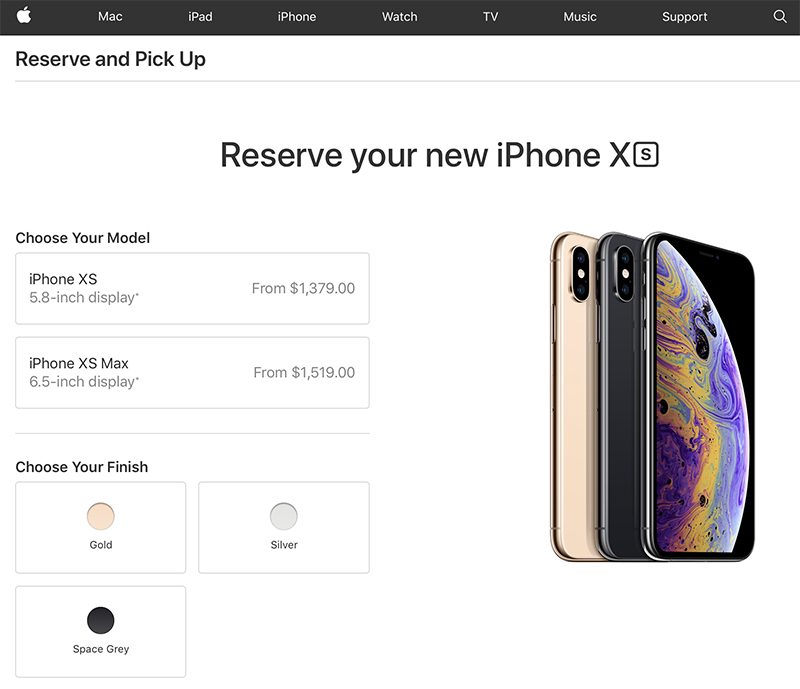
The best part is that the reservations are for Friday, September 21, the day the iPhone XS and iPhone XS Max launch in stores, so if you missed out on middle-of-the-night pre-orders, this is a good second chance.
Instead of constantly refreshing the page, we recommend following Robinhood Monitor on Twitter. The account parses the backend of Apple’s reservation system and automatically tweets when an iPhone XS or iPhone XS Max in any color or storage capacity becomes available to reserve at any Apple Store in Canada.
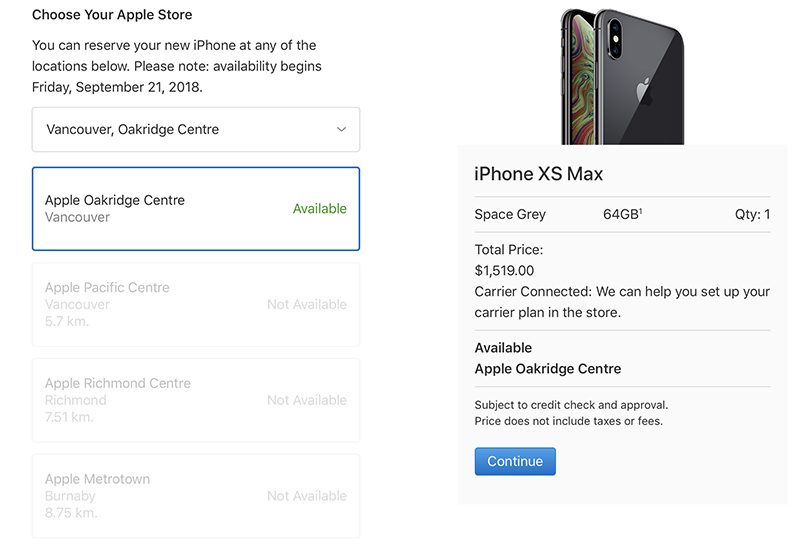
Since inventory runs out very quickly each time an iPhone XS or iPhone XS Max reservation becomes available, the key is to enable push notifications on the Robinhood Monitor account to receive real-time alerts. As soon as more stock is added, head to Apple’s reservation page as soon as possible.
Placing a reservation allows you to pick up an iPhone XS or iPhone XS Max at an Apple Store within a designated 30-minute window. Apple recommends bringing a government-issued photo ID with you for verification.
Note that payment for the iPhone is not collected online in advance, but rather upon arrival to the Apple Store for the in-store pickup.
I used the Reserve and Pickup system to buy an iPhone X at the Eaton Centre in Toronto last year, despite not placing a pre-order, so I can vouch that it works. Another option is to simply wait until Friday, line up at an Apple Store, and make a walk-in purchase, but lines are often long and stock runs out.
Another benefit to the Reserve and Pickup system is that, at some Apple Stores, there is a dedicated queue for customers with reservations.
Unfortunately, the Reserve and Pickup system is currently only working in Canada. The page eventually went live in Australia, Hong Kong, and the United Kingdom as well last year, so it may be worth keeping an eye on those links. In the United States, the page simply says that reservations are no longer required.
iPhone XS and iPhone XS Max launch in stores this Friday, September 21, with most locations in Canada opening early at 8:00 a.m. local time.
Related Roundups: Apple Stores, iPhone XSTag: Reserve and Pickup
Discuss this article in our forums
Spire’s Wearable Health Tags Now Available in Apple Retail Stores
Spire, a company that makes small Health Tags that are designed to clip on to your clothing, is now selling its products in Apple retail stores.
The Spire Health Tag, available as a single tag for $50, a 3-pack for $129, or an 8-pack for $299, tracks sleep, stress, and activity. It’s meant to be an activity tracker that you can forget about, clipping it onto a shirt or pajamas and then not worrying about it again.
It’s sold in multiple packs so you can keep one attached to each of the clothing items that you use most often. It’s small enough that it can clip into the waistband of a pair of pants or attach to the strap of a sports bra.

The Health Tags can be washed, so you can clip one to a piece of clothing and leave it there permanently if desired, for no-hassle tracking and no device to worry about. Health Tags feature a 1.5-year battery and don’t need to be recharged.

Spire Health Tags measure activity, heart rate and heart rate variability, sleep quality, breathing patterns, and stress levels to offer up an overall picture of a person’s health.
According to TechCrunch, Apple retail stores will be offering the Spire Health tags in one, three, and eight pack configurations, with stores set to get the new accessories soon. The Spire Health Tags will also be available on Apple’s website, but aren’t showing up just yet.
Apple also sells Spire’s Mindfulness and Activity Tracker, a $130 activity tracker that clips to your clothing and senses respiratory patterns to detect changes in your state of mind.
Related Roundup: Apple Stores
Discuss this article in our forums
 AIVAnet