


Facebook appears set on crafting custom silicon for augmented reality devices
Facebook acquired Oculus in 2014 as a part of its development dive into the worlds of augmented reality and virtual reality.
Facebook is recruiting — and it’s seeking to hire engineers and designers to assist its Silicon team with the process of crafting custom chips for augmented reality (AR) devices and applications. With speculation that the company is looking to release a pair of AR glasses in the near future, the recent news isn’t surprising, but it does tell us that the company is serious about taking Facebook into the next phase of reality.
According to a report in The Information, Facebook has been looking for several different job positions over the past few days. The included description from the advertisement helps us to understand the direction in which the team is looking to take the project:
“Facebook Silicon team is driving the state of the art forward with breakthrough work in computer vision, machine learning, mixed reality, graphics, displays, sensors, and new ways to map the human body. Our chips will enable AR devices where our real and virtual world will mix and match throughout the day. We believe the only way to achieve our goals is to look at the entire stack, from transistor, through architecture, to firmware and algorithms.”
Recent job postings have made it evident that Facebook doesn’t just want to have its software run on other platforms; the company is looking to control the entire process, going beyond basic hardware to the silicon at the device’s heart. The first step to crafting an efficient pair of AR glasses may undoubtedly be to begin at the chip layer, and that is what we may be seeing with this newly discovered information.
The team members at Facebook are no strangers to the world of AR; they recently released a collection of AR games for the Messenger platform, in addition to opening up access to businesses, allowing third-party developers to build AR advertising solutions. Most notably, in 2014, the social giant acquired Oculus, a company specializing in virtual reality (VR) software and hardware.
With Facebook Messenger as a building block, it is an excellent opportunity, allowing Facebook to craft AR applications without first producing a complete AR headset. As Google learned back in 2013 when launching Google Glass, having an AR platform without a strong software foundation can be detrimental to success. However, Messenger may help to build up a software base for the company if it decides to release a pair of glasses soon.
Whether or not Facebook is planning to release a pair of AR glasses is still up in the air, but its hard to imagine what other uses the company could have for engineers who can develop custom hardware for augmented reality devices.
Editors’ Recommendations
- Apple AR glasses: News and rumors about ‘Project Mirrorshades’
- Augmented reality is coming to Facebook — in the form of advertisements
- Magic Leap One: Everything you need to know
- Adobe’s next big software secret? An augmented reality tool called Project Aero
- When sci-fi meets reality: Adobe re-imagines AR from ‘Terminator 2’
Facebook appears set on crafting custom silicon for augmented reality devices
Facebook acquired Oculus in 2014 as a part of its development dive into the worlds of augmented reality and virtual reality.
Facebook is recruiting — and it’s seeking to hire engineers and designers to assist its Silicon team with the process of crafting custom chips for augmented reality (AR) devices and applications. With speculation that the company is looking to release a pair of AR glasses in the near future, the recent news isn’t surprising, but it does tell us that the company is serious about taking Facebook into the next phase of reality.
According to a report in The Information, Facebook has been looking for several different job positions over the past few days. The included description from the advertisement helps us to understand the direction in which the team is looking to take the project:
“Facebook Silicon team is driving the state of the art forward with breakthrough work in computer vision, machine learning, mixed reality, graphics, displays, sensors, and new ways to map the human body. Our chips will enable AR devices where our real and virtual world will mix and match throughout the day. We believe the only way to achieve our goals is to look at the entire stack, from transistor, through architecture, to firmware and algorithms.”
Recent job postings have made it evident that Facebook doesn’t just want to have its software run on other platforms; the company is looking to control the entire process, going beyond basic hardware to the silicon at the device’s heart. The first step to crafting an efficient pair of AR glasses may undoubtedly be to begin at the chip layer, and that is what we may be seeing with this newly discovered information.
The team members at Facebook are no strangers to the world of AR; they recently released a collection of AR games for the Messenger platform, in addition to opening up access to businesses, allowing third-party developers to build AR advertising solutions. Most notably, in 2014, the social giant acquired Oculus, a company specializing in virtual reality (VR) software and hardware.
With Facebook Messenger as a building block, it is an excellent opportunity, allowing Facebook to craft AR applications without first producing a complete AR headset. As Google learned back in 2013 when launching Google Glass, having an AR platform without a strong software foundation can be detrimental to success. However, Messenger may help to build up a software base for the company if it decides to release a pair of glasses soon.
Whether or not Facebook is planning to release a pair of AR glasses is still up in the air, but its hard to imagine what other uses the company could have for engineers who can develop custom hardware for augmented reality devices.
Editors’ Recommendations
- Apple AR glasses: News and rumors about ‘Project Mirrorshades’
- Augmented reality is coming to Facebook — in the form of advertisements
- Magic Leap One: Everything you need to know
- Adobe’s next big software secret? An augmented reality tool called Project Aero
- When sci-fi meets reality: Adobe re-imagines AR from ‘Terminator 2’
The Kindle Paperwhite is down to $80 during this Prime exclusive sale
Chapters on chapters.

Amazon has its Kindle Paperwhite on sale for only $79.99 right now. This deal is valid only for Prime members, so click here if you need a free trial. Usually this would run you $120, and the reviews are stellar. As an alternative, you could get the Kindle for $50, but that model lacks a backlight and it doesn’t have as good of a battery life either.
The Kindle Paperwhite is available in both black and white. Its touchscreen display is easy on the eyes with no screen glare and feels akin to reading words on actual paper, as opposed to regular mobile device screens which can cause eye fatigue after staring for some time. A single battery charge can last for weeks which is pretty awesome too. As a bonus, it doesn’t have the built-in distractions that a smartphone does, so you will actually get some reading done and not end up crushing candies or running through temples.
As an aside, if you’re an eligible American Express Membership Rewards cardholder, you might be able to get your Paperwhite for just $40. Your mileage may vary.
This isn’t the only offer available to Prime members right now. You can also get great deals on the Fire 7 Tablet and the Fire TV 4K.
See at Amazon
YouTube Gaming app is shutting down in March, moving to a web portal

There’s a new place to watch all of your favorite gaming YouTubers.
Back in 2015, Google launched its YouTube Gaming app to give gamers their own platform for separate features like Game Pages, Super Chat, and Channel Memberships. Since then, many of those features made their way to YouTube as a whole, and it seems as though YouTube Gaming no longer needs its own standalone app.
The YouTube Gaming app will be shutting down as of March 2019, but that doesn’t mean the entire platform is going away. Instead, YouTube Gaming is moving to its own site starting today at youtube.com/gaming. Google says that while it has a strong audience on the YouTube Gaming app, it can reach an even larger audience directly on YouTube, with over 200 million gamers and 50 billion hours of gaming content in the last year.
At the new YouTube Gaming webpage, you can search and sort by particular games to find related videos, ongoing live streams, and other games from the developer. You can also subscribe to specific games, and YouTube Gaming highlights creators on the rise to help boost new and existing channels.
Of course, there’s the standard fare of discovery features we’re all used to, as well; trending videos, upcoming live streams, and recommended videos all populate the home feed, along with any gaming-related videos from channels you already subscribe to on YouTube.
Android Gaming

- Best Android games
- Best free Android games
- Best games with no in-app purchases
- Best action games for Android
- Best RPGs for Android
- All the Android gaming news!
Apple Highlights iPhone XS and iPhone XS Max Reviews
Reviews for the iPhone XS and the iPhone XS Max went live this morning ahead of Friday’s launch, and in a new press release, Apple has highlighted reviews from several members of the media who were able to spend some time with the new iPhones.
Apple shared key passages from sites that include Mashable, TechCrunch, Daring Fireball, The New York Times, Best Products, Hypebeast, Tom’s Guide, Dailymail, TechRadar, Hardwarezone, Sydney Morning Herald, and photographer Austin Mann.
Daring Fireball’s John Gruber, for example, praised the iPhone’s custom silicon and software and its always-in-your-pocket convenience for photography.
“iPhones can’t compete with big dedicated cameras in lens or sensor quality. It’s not even close. The laws of physics prevent it. But those traditional camera companies can’t compete with Apple in custom silicon or software, and their cameras can’t compete with iPhones in terms of always-in-your-pocket convenience and always-on internet connectivity for sharing. In the long run, the smart money is to bet on silicon and software.”
The New York Times praised the way Apple increased the iPhone XS Max’s screen size without adding bulk or compromising usability, while Tom’s Guide did some benchmarking on the A12 and declared the iPhone XS models the fastest iPhones available.
“[To transcode a 2-minute 4K video to 1080p,] iPhone XS and iPhone XS Max knocked it down further to 39 seconds. … The Galaxy S9+ took 2 minutes and 32 seconds to complete the task, and that’s the fastest we’ve seen from an Android phone. … Based on our testing, the A12 Bionic processor inside the iPhone XS and iPhone XS Max make these the fastest phones you can buy.”
Apple, of course, focused on the positive elements in these reviews and while reviewers did generally offer praise for the iPhone XS and iPhone XS Max, especially for the camera improvements and the larger screen size, most agreed that iPhone X users may not be tempted to upgrade just for a new processor and a better camera.
Apple’s full list of review selections can be seen in the article shared via Apple Newsroom. More reviews can also be found in our review roundup, shared this morning.
Customers who pre-ordered an iPhone XS or iPhone XS Max will be able to get their hands on the new devices starting on Friday, September 21, the official iPhone XS and XS Max launch date.
Related Roundup: iPhone XS
Discuss this article in our forums
Apple Stores in Canada Accepting iPhone XS and iPhone XS Max Reservations, Launch Day Pickup Still a Possibility
If you live in Canada and haven’t pre-ordered an iPhone XS or iPhone XS Max yet, you might still be able to score one on launch day.
Apple has activated its Reserve and Pickup system in Canada, allowing customers to place an in-store pickup reservation for an iPhone XS or iPhone XS Max at an Apple Store across the country, subject to availability.
The page often says Apple is “not taking reservations to buy an iPhone right now,” but limited supplies are added each day, at which point the page becomes functional. When live, the page allows you to reserve an iPhone XS or iPhone XS Max in whichever colors and storage capacities are available at the time.
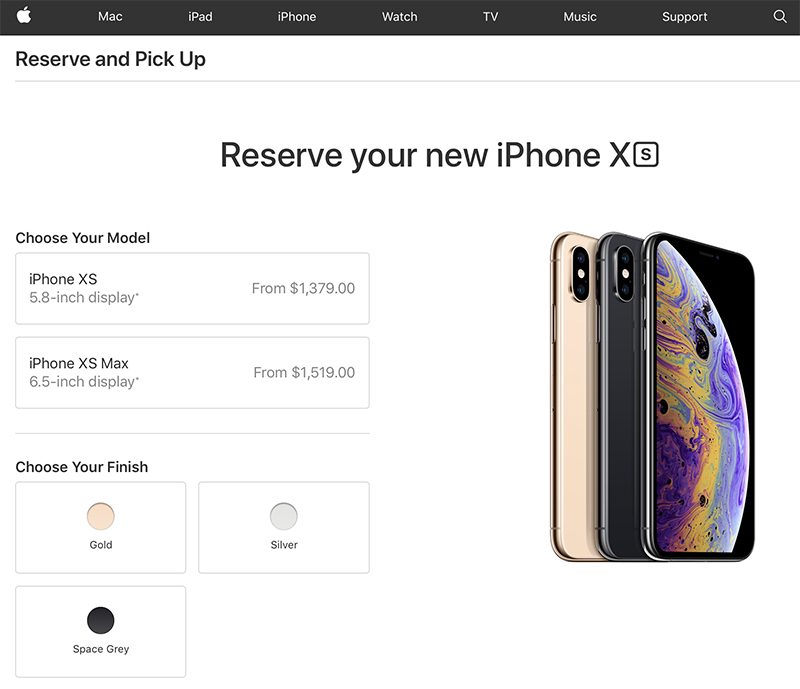
The best part is that the reservations are for Friday, September 21, the day the iPhone XS and iPhone XS Max launch in stores, so if you missed out on middle-of-the-night pre-orders, this is a good second chance.
Instead of constantly refreshing the page, we recommend following Robinhood Monitor on Twitter. The account parses the backend of Apple’s reservation system and automatically tweets when an iPhone XS or iPhone XS Max in any color or storage capacity becomes available to reserve at any Apple Store in Canada.
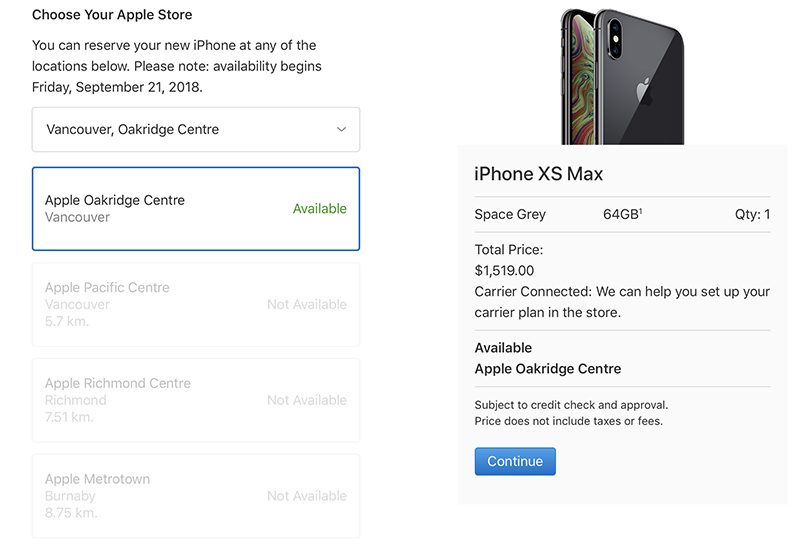
Since inventory runs out very quickly each time an iPhone XS or iPhone XS Max reservation becomes available, the key is to enable push notifications on the Robinhood Monitor account to receive real-time alerts. As soon as more stock is added, head to Apple’s reservation page as soon as possible.
Placing a reservation allows you to pick up an iPhone XS or iPhone XS Max at an Apple Store within a designated 30-minute window. Apple recommends bringing a government-issued photo ID with you for verification.
Note that payment for the iPhone is not collected online in advance, but rather upon arrival to the Apple Store for the in-store pickup.
I used the Reserve and Pickup system to buy an iPhone X at the Eaton Centre in Toronto last year, despite not placing a pre-order, so I can vouch that it works. Another option is to simply wait until Friday, line up at an Apple Store, and make a walk-in purchase, but lines are often long and stock runs out.
Another benefit to the Reserve and Pickup system is that, at some Apple Stores, there is a dedicated queue for customers with reservations.
Unfortunately, the Reserve and Pickup system is currently only working in Canada. The page eventually went live in Australia, Hong Kong, and the United Kingdom as well last year, so it may be worth keeping an eye on those links. In the United States, the page simply says that reservations are no longer required.
iPhone XS and iPhone XS Max launch in stores this Friday, September 21, with most locations in Canada opening early at 8:00 a.m. local time.
Related Roundups: Apple Stores, iPhone XSTag: Reserve and Pickup
Discuss this article in our forums
Spire’s Wearable Health Tags Now Available in Apple Retail Stores
Spire, a company that makes small Health Tags that are designed to clip on to your clothing, is now selling its products in Apple retail stores.
The Spire Health Tag, available as a single tag for $50, a 3-pack for $129, or an 8-pack for $299, tracks sleep, stress, and activity. It’s meant to be an activity tracker that you can forget about, clipping it onto a shirt or pajamas and then not worrying about it again.
It’s sold in multiple packs so you can keep one attached to each of the clothing items that you use most often. It’s small enough that it can clip into the waistband of a pair of pants or attach to the strap of a sports bra.

The Health Tags can be washed, so you can clip one to a piece of clothing and leave it there permanently if desired, for no-hassle tracking and no device to worry about. Health Tags feature a 1.5-year battery and don’t need to be recharged.

Spire Health Tags measure activity, heart rate and heart rate variability, sleep quality, breathing patterns, and stress levels to offer up an overall picture of a person’s health.
According to TechCrunch, Apple retail stores will be offering the Spire Health tags in one, three, and eight pack configurations, with stores set to get the new accessories soon. The Spire Health Tags will also be available on Apple’s website, but aren’t showing up just yet.
Apple also sells Spire’s Mindfulness and Activity Tracker, a $130 activity tracker that clips to your clothing and senses respiratory patterns to detect changes in your state of mind.
Related Roundup: Apple Stores
Discuss this article in our forums
Tired of getting screwed by airlines? Score great deals on tickets with Hopper (Review)

Let’s face it, buying a plane ticket is a terrible experience. The price that you get today in your searches is not the same as the one you will see tomorrow. You never know if you are getting a good deal or if waiting would be better for your wallet. What if waiting backfires and you end up paying more than you should?
While the absurd state of plane ticketing is a topic for another article, it is time to highlight Hopper, one of the most useful services in the Play Store. Search for a flight, mark it as watched, and let Hopper do its magic.
Developer: Hopper Inc.
Price: Free
Setup
 When launching the app, Hopper shows a small onboarding screen with information about what it does. The premise of Hopper is really simple: search for a flight, watch it, and Hopper will check for the best deals on the internet. The app claims to watch “billions of flight prices a day” in order to give you the best deals and to predict if prices are going to increase or go down.
Overview
The app consists of four different tabs: Watch, Notifications, Search, and Trips. The Watch tab is where all of your watched flights will appear. They will also have a label recommending you to either wait for a better price or to buy a ticket now. The Notifications tab shows all of the information that Hopper has gathered about your flights. The service relies heavily on push notifications, but you can also see here how your flights are doing in case you want to remember previous notifications you received.
Read more: Apps Sale review – the simple way to discover which paid apps have gone free & on sale
The Search tab is the most important in the application since this is where Hopper’s service truly shines. The application asks you for your origin and your destination. Fancy a romatic trip to Paris with your significant other? How about to a getaway to the always-warm Canary Islands? What about New York, home of the most convoluted subway service I have ever seen? The world is at your fingertips.
 Hopper then shows what is, in my opinion, the most useful screen in any flight-related service. A color-coded calendar will be shown to you, displaying shades of red for days that are in high demand (thus commanding higher prices) and greenish colors for days that are more wallet-friendly. This screen is incredibly useful in a plethora of situations, primarily if you have flexible dates for your flight and are looking for the lowest prices.
This screen also displays a couple of useful options. You can decide if you want to search for round trip tickets or one way only. Also, you can choose if you want tickets with basic fares (which normally strip you from benefits such as checked baggage, food, or seat selection), and the number of layovers.
Afterward, the app will show the current lowest price, along with a prediction about how the prices will vary in the following days. Since Hopper has been doing this for years, it has a sizeable amount of historic data, which allows it to do a decent prediction about the fluctuation of prices in the following weeks.
In case you decide to buy a ticket now, the application shows a trip summary along useful information, such as cancellation terms, changes fees, and baggage allowance. You can buy a ticket from the app, but you need to create an account in order to do that. This isn’t a problem at all right? Wrong.

To create an account, Hopper asks for your phone number. There is no way of creating an account with your email, for example. Since Hopper earns money by selling the tickets themselves, one would think that they would make it easier for you to spend money on the app. However, giving away your phone number is a huge turnoff that limits the number of people that is willing to create an account.
The final tab is called Trips. Here, you will be able to see the trips that you have bought from the application itself. I haven’t been able to see this screen in action. This is a combination of me refusing to create an account with my phone number, and me being too poor for plane tickets. Sad times.
Options
 Under the Trips tab, you will also find the Settings screen. It is pretty barebones but it has a few noteworthy options. You can see the Terms & Conditions and the Privacy Policy, which I highly recommend you to read in case you create an account. Also, you can sign up for an account or sign in in case you have one already. Finally, there is also an option to change the currency in which the prices all over the app are shown. There is A LOT of currencies available, so chances are you will find yours here.
Conclusion
Our phones are full of useful services that make us more productive and allow us to accomplish more. However, when the time comes to take a well-deserved rest, Hopper is there to alleviate the pains of looking for a plane ticket. Just mark a flight as watched and Hopper will shoot reliable and trustworthy notifications every once in a while.
I have used this service for years, and I can attest to the usefulness of it, having scored decent deals thanks to its constant scanning of ticket prices. Aside from the fact that creating an account inexplicably asks you for your phone number, with no other options, Hopper is one of the most reliable services in the Play Store. Let Hopper show you the world.
Download and install Hopper from the Google Play Store.
No more scraping? Anti-frosting advance could mark end of frozen windshields
Virginia Tech
With autonomous and flying cars on the horizon, there’s a whole lot that we’re excited about in the automotive world. But ask us on a frosty Monday morning in darkest winter as we’re scraping the ice off our windshield while muttering curse words under our breath, and you’ll find us to be a lot less enthused. In those moments, the car-related technology we want more than anything else in the world is a frost-resistant windshield.
Fortunately, researchers from Virginia Tech appear to have heard our agonized prayers. With this precise goal in mind, they have invented what they claim to be the world’s first passive anti-frosting surface, which is capable of staying 90 percent dry and frost free in frigid conditions. And all without the need for chemical or energy inputs to make it work.
“Everyone is familiar with the concept of laying salts down on the ground before a big snowstorm,” Jonathan Boreyko, assistant professor in the Department of Biomedical Engineering and Mechanics, told Digital Trends. “Salts are a hygroscopic chemical, which means that they are a very good humidity sink, capable of sucking up nearby moisture and water to keep the surrounding surface dry.
“However, there are two big problems with using salts to combat icing. First, as the salt crystals absorb water from the air and surrounding ice, they become diluted and quickly lose their hygroscopic properties. This is why we have to lay down salt over and over again, to the tune of about 10 million tons per year in the U.S. alone. Second, the practice of laying down salts has been well-established to contaminate the environment, especially the groundwater.”
What the Virginia Tech researchers have done is to take this concept of using a hygroscopic chemical to minimize frosting as a starting point. But instead of using salt, they machined patterns of micro-grooves into the surface of sample material they created. These microscopic grooves function as sacrificial areas, creating stripes of intentional ice when it is freezing. Because ice has the same low-pressure properties as salts, the intermediate areas between these stripes stay completely dry from condensation or frost, since the humid air is instead attracted to the ice stripes.
“We are currently in serious talks with both aerospace and heating, ventilation, and air conditioning (HVAC) companies to see if we can apply this technology to airplanes or the outdoor heat exchanger of heat pumps,” Boreyko said. “The heat pump idea, for example, would involve patterning the ice stripes on the array of micro-fins that are already on the outer portion of an outdoor heat exchanger, to keep the interior of the unit dry from frost.”
A paper describing this research was recently published in the journal ACS Applied Materials & Interfaces.
Editors’ Recommendations
- Solar-powered nanoscale coating could defrost frozen car windows
- Headed to a festival this summer? Here’s the best gear you can get for camping
- Get your Sagan on with 60 awe-inspiring photos of the final frontier
- Beat the heat this summer with an affordable air conditioner
- All of the high-tech materials that make modern outdoor gear great
Japanese billionaire faces tricky task of choosing 8 artists for his moon trip
He’s going to the moon (with eight artists): Yusaku Maezawa
So, who do you think Yusaku Maezawa should take with him on his five-day round trip to the moon when he travels there aboard SpaceX’s Big Falcon Rocket (BFR) in 2023?
SpaceX CEO Elon Musk on Monday named the wealthy Japanese entrepreneur as its very first paying passenger for the planned fly-by of the faraway rock.
Maezawa, who made his fortune in online fashion retail, surprised the gathered crowd at SpaceX’s headquarters when he revealed that he wants to invite as many as eight artists on the once-in-a-lifetime space trip.
He said each artist should be established in a field such as painting, photography, music, movies, fashion design, and architecture, adding that he hasn’t decided who to ask yet.
It sounds rather like the “fantasy dinner guest list” game for the billionaire club, though this is for real and will … perhaps … OK, maybe … actually happen. In that case, 42-year-old Maezawa will need to choose his travel companions with the utmost care. In space, no one can hear you scream, but things could get rather raucous inside the capsule if any of those titanic egos clash hundreds of thousands of miles from Earth. If they stick a few cameras on board, it could turn out like a space-based Celebrity Big Brother. How cool would that be?
There’ll be huge pressure, too, on the artists who accept the invitation, as Maezawa wants his fellow space travelers to use their experience as inspiration for a new piece of art. Presumably, the Japanese billionaire will gracefully accept whatever each person comes up with after the trip, even if it’s a papier-mâché model of the lunar surface, or a T-shirt with a picture of the moon printed on it (perfect for a collaboration between the fashion designer and the photographer), or even a catchy song with the lyrics: “The moon is great, We love the moon, Yeah, yeah, yeah.”
But the big question is, if Maezawa invites Elon Musk — the man behind SpaceX, Tesla, the Boring Company, and Hyperloop, and who many consider as an artist of sorts — will he accept it? It would certainly be hard for the man who owns the company that built the rocket to say no. Though if he did, he’d definitely need an excuse better than “Sorry, I need to get my hair cut that day” to convince Maezawa and his fellow passengers that BFR doesn’t actually stand for Big F—— Risk.
Editors’ Recommendations
- SpaceX to send Japanese billionaire on moon trip, but he won’t be going alone
- 5 reasons why you shouldn’t be surprised Elon Musk smoked weed
- Who will be the first private passenger to the moon? SpaceX will tell us today
- What kind of mini car does Tesla CEO Elon Musk have in mind?
- This 21-year-old’s 3D-printed aquatic jetpack makes scuba fins look prehistoric
 AIVAnet