


Grab a Choetech wireless charger for your car or nightstand on sale today
Stay powered up with no charging cables.
The Choetech wireless charging USB-C car phone mount is down to $15.99 with code MSBU35EC on Amazon. The charger normally sells for $30, and this price beats out previous deals by a couple bucks. It has never dropped this low directly.
Choetech’s Stand Fast wireless charging stand is also on sale today. Drop it to $12.99 from $18 with code NSYAANTF.

Choetech’s mount uses a suction cup to attach to your dashboard and holds just about any phone between 2.6 and 4 inches wide. It supports Fast Charge up to 10W with Android phones like the Samsung Galaxy S9, 7.5W charging for the iPhone, and 5W for whatever’s left that is also Qi enabled. The holder is designed not to scratch your phone while still keeping it securely held, and it has a 360-degree rotating ball joint so you can find the best viewing angles while driving. It comes with an 18-month warranty. Users give it 4.2 stars based on 37 reviews.
The stand also does 10W charging for Android and 7.5W charging for iPhone. It has 4.8 stars based on 20 reviews.
See on Amazon
The Oppo R17 offers a glimpse as to what the OnePlus 6T might look like
Look at that itty-bitty little notch!

While it can be fun to look at OnePlus as an underdog in the smartphone space, it’s important to remember that its parent company is Oppo — one of the largest phone manufacturers in the world. OnePlus phones often take a lot of inspiration from Oppo handsets that come out before them, and should that pattern continue this year, the recently announced Oppo R17 looks like an excellent foundation for the OnePlus 6T.
At first glance, the Oppo R17 impresses with its design. The back of the phone has a stunning multi-color paint job that appears to shift hues based on how the light hits it, and around front, we’ve got a large 6.4-inch 2280 x 1080 screen with one of the tiniest notches we’ve ever seen.
There’s still a chin at the bottom of the display, but it’s also so small that most people likely won’t be offended by it.

Under the hood, the R17 is packing a Snapdragon 670 processor, 8GB RAM, 128GB of internal storage, and a 3,500 mAh battery.
There’s still no word as to when the OnePlus 6T will be announced or how much it’ll cost, but should OnePlus use the R17 as inspiration for the handset, upgrade its internals with more powerful specs, and keep the price around the $530 marker of the OnePlus 6, we could be in for a real treat later this year.
See at Oppo
OnePlus 6
- OnePlus 6 review
- OnePlus 6 vs. OnePlus 5T: How much changes in six months?
- OnePlus 6 vs. OnePlus 5: Should you upgrade?
- These are the official OnePlus 6 cases
- The OnePlus 6 doesn’t work on Verizon or Sprint
- Join the discussion in the forums
HomePod Sales May Be Closer to 1-1.5 Million Than 3 Million Since the Speaker Launched
HomePod shipments totaled an estimated 700,000 units in the second quarter of 2018, giving Apple a roughly six percent share of the worldwide smart speaker market, according to research firm Strategy Analytics.
Strategy Analytics previously estimated HomePod shipments totaled 600,000 units in the first quarter of 2018, suggesting that worldwide shipments have reached 1.3 million units since the speaker became available to order in the United States, Australia, and the United Kingdom in late January.
That figure is much lower than one shared by research firm Consumer Intelligence Research Partners, which recently estimated Apple has sold three million HomePods in the United States alone since the speaker launched.
The significant variance in the datasets stems from the fact that Apple doesn’t disclose HomePod sales, instead grouping the speaker under its “Other Products” category in its earnings reports, alongside the Apple Watch, Apple TV, AirPods, Beats, iPod touch, and other Apple and third-party accessories.
Apple reported revenue of $3.74 billion from its “Other Products” category last quarter, up 37 percent from $2.73 billion in the year-ago quarter.
Shipments aren’t sales, either, so it’s impossible to know exactly how many HomePods ended up in the hands of customers.
If we had to guess, we’d say the Strategy Analytics numbers are probably more within the ballpark, as the HomePod is a niche product. The speaker is also available in just six countries, after launching in Canada, France, and Germany in June, with no indication when availability may expand to other regions.
Versus the Competition
HomePod was the world’s fourth most popular smart speaker in the second quarter, behind the Amazon Echo, Google Home, and Chinese company Alibaba’s Tmall Genie, according to Strategy Analytics.
Amazon remained the leader in the category last quarter, with the Echo commanding an estimated 41 percent market share, while the Google Home finished runner-up with an estimated 27 percent market share, according to Strategy Analytics. Alibaba took third place with an estimated seven percent market share.

While the HomePod has made somewhat of a dent, Apple still has significant ground to make up, which is to be expected given its smart speaker launched around two to three years after its biggest competitors.
It may be tough for Apple to gain further market share unless it releases a more competitively priced model, as the HomePod at $349 is considerably more expensive than the Amazon Echo, priced from $50, and the Google Home, $129.
To that end, rumors suggest Apple may have a lower-priced HomePod or a Siri-enabled Beats speaker in its pipeline.
Related Roundup: HomePodTag: Strategy AnalyticsBuyer’s Guide: HomePod (Buy Now)
Discuss this article in our forums
How to take a screenshot on the Galaxy Note 9

Learn it now, use it forever.
No matter what you use your Galaxy Note 9 for, you’re going to need to take a screenshot at some point. And because it’s a Note phone, you have more than one option for a simple screenshot — and plenty of features you can play with after you’ve taken it as well.
This is something you’ll learn now, and be able to use for the life of the phone. And even if you already know one of the methods you may not be as well versed in the others — the Note 9’s screenshot tools are incredibly powerful. Here’s how they work.
How to take a regular screenshot
Taking a single screenshot of your entire screen is simple enough. Samsung gives you two ways to do it.
Screenshot using a key combination
Open the content you wish to screenshot.
At the same time, press and hold both the power button and volume down button for two seconds.
You’ll see the screen flash, and the screenshot will briefly appear on the screen.
The screenshot will be instantly shareable, but also remain in your notifications and Gallery for sharing later.

Screenshot using a palm swipe
Open the content you wish to screenshot.
Place your hand vertically along the left or right edge of your Note 8, and swipe in from that edge with your hand touching the screen.
- If this method doesn’t work, check Settings > Advanced features to enable “Palm swipe to capture.”
You’ll see the screen flash, and the screenshot will briefly appear on the screen.
The screenshot will be instantly shareable, but also remain in your notifications and Gallery for sharing later.
Capture more
No matter how you initiate your screenshot, after capturing you’ll briefly see a set of options at the bottom of the screen, including “scroll capture.” This “scroll capture” button makes the phone scroll through the content shown on your screen and take multiple screenshots, which are automatically stitched together into one long screen showing everything together. This is particularly useful for capturing a full webpage, a set of directions or a long restaurant menu online.
Just tap “scroll capture” as many times as you want, and as soon as you’re done you can share, edit or save the screenshot just like any other.
Take a screenshot with the S Pen and Screen Write
If you’re inclined to take a screenshot and then get to work on it with your S Pen, you can do just that.
Open the content you wish to take a screenshot of.
Take out the S Pen to launch Air Command, tap on Screen Write.
The screen will flash and capture a single screenshot.
You’re now instantly taken to an editing pane, where you can write on the screen with the S Pen.
In the top toolbar, you’ll see options to change the color of your pen, enable an eraser and undo/redo your strokes.
When finished, tap Crop, Share or Save to complete your work.

Samsung Galaxy Note 9
- Samsung Galaxy Note 9 hands-on preview
- Galaxy Note 9 vs. Note 8
- Where to buy the Galaxy Note 9
- Galaxy Note 9 specifications
- Is the Note 8 still a good buy?
- Join our Galaxy Note 9 forums
AT&T
Verizon
T-Mobile
Samsung
2018 iPhones Could Start at $699, May Include Apple Pencil Support, 512GB Storage Option for OLED Models
Apple may introduce its upcoming 6.1-inch LCD iPhone with a starting price of around $699 to $749, according to industry analysis by TrendForce. The pricing strategy is said to be partly a response to lower than expected iPhone sales last year, and partly a result of competition from Chinese brands that have expanded their market shares with devices that offer high performance at affordable prices.
Three new iPhone models are expected to form Apple’s 2018 lineup: two OLED models measuring in at 5.8 and 6.5 inches, and a 6.1-inch lower-cost LCD model. All three models will feature Face ID in lieu of a Home button, but TrendForce predicts the “budget” LCD device will be Apple’s main device in terms of production share.
Image via TrendForce
The specs upgrades would make new iPhones more favorable in the competition with Android phones. On the other hand, the cost of this model has been approaching that of iPhone 8 Plus due to the upgrades. However, the 6.1-inch LCD model would be positioned by Apple’s main product this year, with a production share of around 50% in the new iPhone series. Apple is bound to adjust the prices of this model to meet the market expectation and to further expand its market share. Considering the cost reduction of components, TrendForce estimates the starting price of this LCD version at around $699-749.
As for the new OLED models, TrendForce expects the 5.8-inch device will have a lower starting price of $899 to $949, while the current-generation iPhone X, which starts at $999, will enter its “end of life” process due to the similarity in the specs of the two models. Meanwhile, the upcoming 6.5-inch device will target the “premium business segment” with a starting price of $999.
TrendForce believes Apple could introduce a 512GB storage option for the OLED models. In addition, Apple Pencil support may feature with the new iPhones, although it’s unclear whether this also relates to just the OLED models. Respected analyst Ming-Chi Kuo has previously suggested that Apple Pencil support for a future iPhone is a possibility, although he doesn’t believe iPhones will support Apple Pencil until 2019 at the earliest.
Apple is said to have been bargaining with its supply chain partners to reduce the cost of components, especially those which have been used in earlier generations of iPhone. That view tallies with earlier reports claiming Apple wants Samsung to reduce the price of its OLED display panels so it can cut the cost of current and future iPhone X models.
Price cuts to the display and other components would help Apple lower its bill of materials for the new models, with the savings potentially passed on to customers. For example, in line with TrendForce’s prediction, RBC Capital Markets analyst Amit Daryanani believes the second-generation iPhone X will start at $899, down from $999.
TrendForce expects the production volume of the three new iPhones to be around 83-88 million units, potentially taking a larger share of the company’s annual sales volume compared with the three models it released last year. Sales volume of iPhones in 2018 meanwhile is expected to remain flat or grow marginally by 2 to 3 percent, owing to the saturated smartphone market and the longer replacement cycle of phones globally.
TrendForce believes the two OLED models have been assembled by manufacturers since late July, while the assembly of the LCD models is scheduled for mid-September. Apple is expected to announce the trio of new iPhones sometime in September or October.
Related Roundup: 2018 iPhonesTag: TrendForce
Discuss this article in our forums
How to Use Secure Code AutoFill in iOS 12 and macOS Mojave
Most readers will have at some point received a two-factor authentication code delivered to them by SMS text message. Many apps and websites send the one-time codes to confirm that the person attempting to log in to an account is the legitimate account holder, and not just someone using a stolen password.
Depending on how notifications are set up on your iPhone, receiving a code via text message may mean that you have to switch out from the app or website to read the message and memorize or copy the code, and then switch back to paste it or type it into the login screen manually.
To make this process less of a hassle, Apple is introducing Security Code AutoFill for iOS 12. The new feature ensures that SMS one-time passcodes that you receive instantly appear as AutoFill suggestions in the QuickType bar above the virtual keyboard, letting you input them in the passcode field with a simple tap.
If you’ve enabled Text Message Forwarding on your iPhone, you can use the Secure Code AutoFill feature in macOS Mojave, too. The code should appear in Safari as an AutoFill option in the relevant field as soon as the SMS is delivered to Messages on your Mac.

iOS and macOS use local data detector heuristics to work out whether an incoming message carries a security code, and Apple says the Security Code AutoFill feature does not alter the security of this two-factor authentication method.
So as long as developers craft their secure code text messages correctly, Security Code AutoFill should work in all third-party apps updated for iOS 12 and macOS Mojave, which are due for official public release this fall.
Related Roundups: macOS Mojave, iOS 12Tag: security
Discuss this article in our forums
Omega Centauri hosts 10 million stars and probably not an ounce of life
The search for life in outer space is like the holy grail of astronomy. But with some 170 billion galaxies in the observable universe, where do we even begin?
How about with the bright, Christmas lights-like stars of the densely packed globular cluster Omega Centauri? Surely something so spectacular could harbor life.
Not so. According to a paper published this month in The Astrophysical Journal, scientists can safely cross it off their list.
Omega Centauri is a sight to behold. It contains some 10 million stars, making it the largest globular cluster in the Milky Way. And at about 16,000 light years away, the globular cluster is visible to the naked eye and a prime object of observation for professional astronomers. So it makes sense that scientists would home in on Omega Centauri in their hunt for extraterrestrial life.
“In the search for planets around other stars, we are investigating a wide range of stellar environments that are very different from our own system,” Stephen Kane, a professor of planetary astrophysics at the University of California, Riverside, and study lead, told Digital Trends. “In particular, we are looking for planets that lie in the habitable zone where water on the surface of the planet could be in a liquid state, something which is necessary for life on Earth. The results of our study show that it is highly unlikely that the stars in the largest globular cluster to the Milky Way, Omega Centauri, can host a planet in the habitable zone.”
Kane and his colleagues looked at roughly 500,000 stars whose age and temperature could potentially support planets with life. They measured the temperature and brightness using data from the Hubble Space Telescope and calculated how often these neighboring stars would pass directly within each other’s habitable zones.
“The results of our study show that, on average, the stars of the cluster will pass directly through the habitable zone of other stars around once every million years,” Kane said. “This means that for most of the stars, it will be impossible for a planet to remain in the habitable zone of its host star, thus removing the planet from a location where it could maintain a long period of energy and climate stability.”
Kane said it could be possible for Omega Centauri to contain a group of small planetary systems near its core (much like TRAPPIST-1, a promising solar system for harboring life) but that their calculations made the existence of such systems unlikely.
Moving forward, Kane and his colleagues will collect more Hubble data about our neighboring clusters to determine stars’ habitable zones and how often they cross each other’s paths.
Editors’ Recommendations
- Get your Sagan on with 60 awe-inspiring photos of the final frontier
- Astronomers make huge exoplanet discovery haul in record time
- Mars is as near to Earth as it’s been in 15 years, so Hubble took some photos
- Astronomers finally confirm general relativity around a supermassive black hole
- Scientists pinpoint exoplanets where life could bloom like here on Earth
Xiaomi Mi A2 vs. ASUS ZenFone Max Pro M1: Divergence
You can choose between a great camera or outstanding battery life, but not both.

Earlier this year, ASUS turned the tables on Xiaomi with the ZenFone Max Pro M1, a budget phone with a huge battery and enticing hardware that went toe-to-toe with the Redmi Note 5 Pro and came out ahead in a few areas. ASUS not only managed to undercut the Redmi Note 5 Pro but was also able to make enough units available to meet the deamnd for the M1, which Xiaomi still struggles with today.
We’ve already seen how the ZenFome Max Pro M1 fares next to the Redmi Note 5 Pro, but it makes sense to pit the device against Xiaomi’s latest phone as both devices are running pure Android. The Mi A2 falls under the purview of Android One, whereas ASUS is offering a “stock” Android ROM with a few ZenUI underpinnings.
For its part, the Mi A2 has plenty going for it. The device is powered by the Snapdragon 660, which is more powerful when compared to the Snapdragon 636 in the M1, and has class-leading front and rear cameras. With the Mi A2 set to go on sale later this week in India for ₹16,999 ($250) and the ZenFone Max Pro M1 available for ₹12,999 ($185), it’s time to see how the M1 holds up next to Xiaomi’s latest Android One phone.
Xiaomi Mi A2 vs. ZenFone Max Pro M1: Specs

| Operating System | Android 8.1 OreoAndroid One | Android 8.1 Oreo |
| Display | 5.99-inch 18:9 FHD+(2160×1080) IPS LCD panelGorilla Glass 5 | 5.99-inch 18:9 FHD+(2160×1080) IPS LCD panel |
| SoC | Octa-core Qualcomm Snapdragon 6604×2.2GHz Kryo 260 + 4×1.8GHz Kryo 26014nm | Octa-core Qualcomm Snapdragon 636Eight Kryo 260 cores up to 1.8GHz 14nm |
| GPU | Adreno 512 | Adreno 509 |
| RAM | 4GB/6GB | 3GB/4GB/6GB |
| Storage | 32GB/64GB/128GB | 32GB/64GB/64GB |
| Expandable | No | Yes, dedicated up to 2TB |
| Rear camera | 12MP (f/1.75, 1.25um) + 20MP (f/1.75, 1.0um)PDAF, LED flash, 4K video recording | 13MP Omnivision 16880 f/2.2 + 5MP f/2.4 PDAF, LED flash4K video recording |
| Front camera | 20MP (f/1.75, 1.0um)AI portrait modeLED Selfie lightBeautify 4.0 | 8MP f/2.01080p video recording |
| Connectivity | LTE with VoLTEWi-Fi 802.11 ac, Bluetooth 5.0GPS, GLONASS | LTE with dual VoLTEWi-Fi 802.11 b/g/n, Bluetooth 4.2 with AptXGPS, GLONASSMicro-USB, 3.5mm audio jack |
| Battery | 3000mAh batteryQuick Charge 4.0 (India)QC3.0 (ROW)USB-C | 5000mAh batteryFast charging (5V/2A) |
| Fingerprint | Rear fingerprint | Rear fingerprint |
| Dimensions | 158.7 x 75.4 x 7.3mm | 159 x 76 x 8.46mm |
| Weight | 166g | 180g |
| Colors | Black, Rose Gold, Gold, Blue | Meteor Silver, Deepsea Black |
Where they’re equal
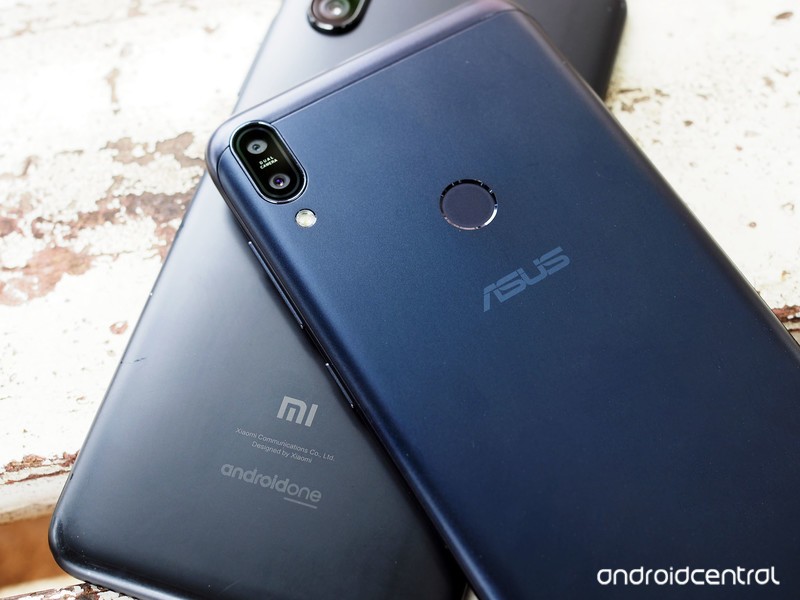
There’s a lot of similarities between the Mi A2 and the ZenFone Max Pro M1. Although ASUS didn’t team up with Google to launch the M1 with Android One, the user interface on the device is near-identical to what you get on the Mi A2.
The Mi A2 is rocking an aluminum unibody chassis, with the M1 offering a metal alloy back with plastic inserts for the antennae and an aluminum mid-frame. Going with a mix of materials has allowed ASUS to cram a monstrous 5000mAh battery in the M1 while still bringing the overall weight down to an easily manageable 180g.
Neither phone stands out from an aesthetic standpoint, and although the Mi A2 feels slightly better to hold in day-to-day usage, it isn’t going to win any design awards.
Both devices feature 5.99-inch 18:9 FHD+ panels, and you get little in the way of display color customization. On the software front, both phones are currently running Android 8.1 Oreo.
What the Mi A2 does better

The Mi A2 is Xiaomi’s most powerful phone in the $250 segment yet, with the device powered by the Snapdragon 660. The M1 meanwhile features a Snapdragon 636, which has similar cores that are clocked lower. You’re not going to see a huge difference between the two devices in real-world usage scenarios, but the Mi A2 has a slight edge when it comes to gaming thanks to higher clocks on the Adreno 512 GPU.
The highlight with the Mi A2 is the front and rear cameras. Xiaomi has mentioned that its main goal for 2018 is to improve the camera quality on its phones, and we’ve seen that over the course of the year with the Redmi Note 5 Pro, Mi Mix 2S, and now the Mi A2.
The 12MP + 20MP cameras at the back do a fantastic job both in daylight and low-light scenarios, and it’s clear that the phone has a considerable edge over the M1 when you look at just a few samples. The 20MP front camera is also a considerably upgrade from what the M1 has to offer, with Xiaomi touting AI-assisted portrait mode along with a front LED module that kicks in during low-light conditions.


Xiaomi Mi A2 on the left, ASUS ZenFone Max Pro M1 on the right.

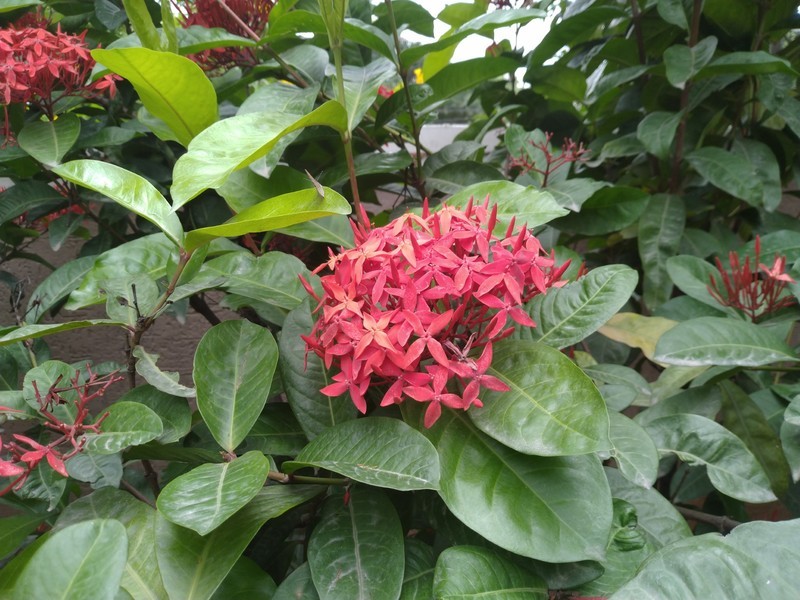


And while the M1 has an uncluttered user interface, as the device isn’t under the Android One program, there’s no telling when it will pick up the Android Pie update. As for the Mi A2, Xiaomi has stated during the launch that the device will be one of the first third-party devices to pick up the stable Android Pie build, and although we haven’t been told a timeline, it is reasonable to assume that the update will be delivered before the end of the year.
What the Max Pro M1 does better

The ZenFone Max Pro M1 doesn’t hold up to the Mi A2’s cameras, but it utterly destroys Xiaomi’s handset when it comes to battery life. With a 5000mAh battery under the hood, the M1 manages to easily deliver two days’ worth of usage with some charge left over.
Honestly, if you’re looking for a phone with the best battery life in this segment, then the M1 is an easy recommendation. ASUS has also managed to do a better job with the basics — the M1 has a 3.5mm jack as well as a dedicated MicroSD slot in addition to two SIM card slots. The MicroSD slot can fit in a 2TB SD card, and the phone has dual VoLTE.
All of the aforementioned features are integral to budget devices, and they’re missing from the Mi A2. The M1 does one better by including AptX support, which makes a lot of difference when streaming media over Bluetooth.
Finally, the M1 has an edge when it comes to actual sales. All signs point to Xiaomi sticking to a flash sales model for the Mi A2, which if history is anything to go by will make it difficult for customers to get a hold of the device. In contrast, ASUS is selling the ZenFone Max Pro M1 in an open sale on Flipkart. If you’re interested in picking up the device, all you need to do is hit up the link below and shell out ₹12,999 ($185).
See at Flipkart
What should you buy? Down to you

The camera on the Mi A2 is the one to beat in this segment, and if you’re one to take a lot of photos, then the Mi A2 is a no-brainer. The phone is missing the 3.5mm jack and a MicroSD slot, but it isn’t as big a deal when you factor in just how good that camera is in day-to-day usage conditions. Xiaomi includes a USB-C to 3.5mm dongle in the box, and the 64GB of internal storage should be more than enough for most users.
If you require more storage, then you’re better off waiting for the 6GB/128GB variant to launch in the country. There’s no specific timeline for a launch, but it should be in the coming months.
See at Amazon India
If you’re looking for a device with a two-day battery life, then you’ll love what the Max Pro M1 has to offer. ASUS has done a masterful job with the M1, and the device is one of the best budget phones you can buy in 2018.
Sure, the camera isn’t as good as what you get on the Mi A2, but the device has outstanding battery life and has features that target a more mainstream audience, like the 3.5mm jack and a MicroSD slot.
See at Flipkart
Galaxy Note 9’s screen receives record-setting rating from DisplayMate

The unsurprising news continues a fantastic trend for Samsung’s high-end phones.
That Samsung’s phones have the best displays in the business isn’t all that surprising at this point. What’s truly amazing, though, is that they keep getting better at a steady pace despite already being well ahead of the competition. The Galaxy Note 9 marks another leap in display quality for Samsung, with the stylus-packing phone’s display taking home DisplayMate’s highest rating yet.
Samsung is making the best mobile displays available today, and it’s not particularly close.
In DisplayMate’s testing, the Note 9 hit record marks in several areas. It has a record-high Absolute Color Accuracy, which it says is “visually indistinguishable from perfect.” It has record-high color accuracy and intensity, independent of the on-screen image. It has record-high small color shifts, brightness shifts and viewing angles, including when displaying white. And somehow Samsung managed to get the Note 9’s full-screen peak display brightness to 710 nits, which is 27% higher than the already-fantastic Galaxy Note 8; the screen is capable of 825 nits of brightness in situations where 50% of the display is active (aka not black), and 1050 nits for very small portions of the display (1%) are active. The list goes on … here’s a full breakdown of the plaudits:
- Highest Absolute Color Accuracy (0.5 JNCD) – Visually Indistinguishable From Perfect.
- Smallest Change in Peak Luminance with the Image Content APL (2%).
- Smallest Shift in Color Accuracy and Intensity Scale with the Image Content APL (0.7 JNCD).
- Highest Peak Display Brightness (1050 nits with 710 nits at 100% APL).
- Largest Native Color Gamut (113% DCI-P3 and 142% sRGB / Rec.709).
- Highest Contrast Ratio (Infinite).
- Lowest Screen Reflectance (4.4%).
- Highest Contrast Rating in Ambient Light (239).
- Smallest Brightness Variation with Viewing Angle (27% at 30 degrees).
- Smallest Color Variation of White with Viewing Angle (1.3 JNCD at 30 degrees).
DisplayMate’s ultimate rating of the Note 9’s display is “A+” and leaves little doubt as to how great this display is with its conclusion:
The Galaxy Note 9 is the most innovative and high performance Smartphone display that we have ever Lab tested, breaking and establishing many new Display Performance Records that are listed above. The Galaxy Note 9 delivers uniformly consistent all around Top Tier Display Performance and receives All Green (Very Good to Excellent) Ratings in All of the DisplayMate Lab Test and Measurement Categories – only the second display we have ever tested to get All Green in All Categories – the Galaxy S9 was the first. The level of display performance and excellence has been increasing each year, and the Galaxy Note 9 has now raised the bar significantly higher.
DisplayMate’s tests are very much focused on the scientific measurement of the characteristics of displays and how they compare to one another, but the results really do back up the eye test: the Note 9’s display is gorgeous to look at. The Note 9’s display seriously outperforms the competition in just about every respect, and even outperforms its own displays shipped as the latest and greatest just six months ago with the Galaxy S9 and S9+. If you’re a screen quality buff above all else, it’s clear that you shouldn’t look anywhere but the Galaxy Note 9.
See at Samsung
Samsung Galaxy Note 9
- Samsung Galaxy Note 9 hands-on preview
- Galaxy Note 9 vs. Note 8
- Where to buy the Galaxy Note 9
- Galaxy Note 9 specifications
- Is the Note 8 still a good buy?
- Join our Galaxy Note 9 forums
AT&T
Verizon
T-Mobile
Samsung
Apple Hosts Nobel Prize Laureate Malala Yousafzai for Talk at Apple Park
Apple today held an event at its Apple Park campus where Apple CEO Tim Cook and Lisa Jackson, Apple Vice President of Environment, Policy and Social Initiatives, interviewed and honored Nobel Peace Prize Laureate Malala Yousafzai, who spoke to hundreds of young people about her work with the Malala Fund.
“If you stand for truth, you cannot lose.” Honored to host @Malala at Apple Park today with @lisapjackson. We are proud of the work Apple is doing with @MalalaFund to advance girls’ education around the world. pic.twitter.com/weuPiKGCwW
— Tim Cook (@tim_cook) August 13, 2018
Apple in January announced a partnership with Yousafzai’s Malala Fund, which advocates for quality education and equal opportunity for girls around the world.
Through support with Apple, the Malala Fund has said it expects to double the number of grants awarded by its Gulmakai Network and extend funding programs to India and Latin America with the initial goal of providing secondary education opportunities to more than 100,000 girls.
The Malala Fund is also working with Apple’s Developer Academies in Brazil, providing Apple Developer Academy students and alumni in brazil with the opportunity to esign and develop apps aimed at furthering the Fund’s goals.
Apple is helping the Malala Fund scale its organization by assisting with technology, curriculum and research into policy changes needed to help girls everywhere attend school and complete their education.
At the time Apple announced the partnership, Apple CEO Tim Cook joined the Malala Fund leadership council.
Note: Due to the political nature of the discussion regarding this topic, the discussion thread is located in our Politics, Religion, Social Issues forum. All forum members and site visitors are welcome to read and follow the thread, but posting is limited to forum members with at least 100 posts.
Discuss this article in our forums
 AIVAnet